



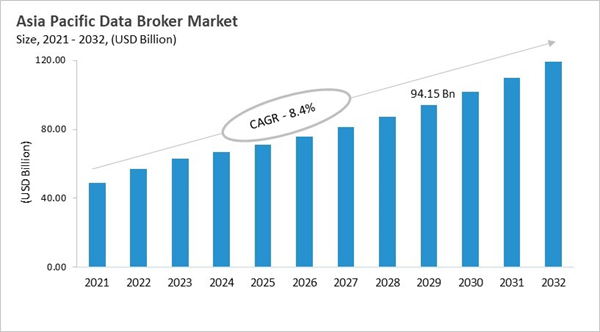
The Asia Pacific Data Broker Market is expected to reach $94.15 billion by 2029 and is expected to witness market growth of 7.7% CAGR during the forecast period (2025-2032).
The China market dominated the Asia Pacific Data Broker Market by country in 2024, and is expected to continue to be a dominant market till 2032; thereby, achieving a market value of $34.43 billion by 2032. The Japan market is registering a CAGR of 7% during 2025-2032. Additionally, the India market is expected to showcase a CAGR of 8.5% during 2025-2032. The China and Japan led the Asia Pacific Data Broker Market by Country with a market share of 32.8% and 17.9% in 2024.
The Asia Pacific Data Broker Market has changed in a fast-paced digital world where fintech, e-commerce, and mobile connectivity are growing quickly in countries like Singapore, Australia, Japan, India, and South Korea. Data brokers are middlemen who gather, analyze, and share organized information about people and businesses to help with things like credit risk assessment, fraud detection, identity verification, marketing analytics, and following the rules. The market started out as traditional credit bureau services that banks used to make lending decisions, but it has grown a lot since then because of digital banking and online platforms. Regulatory frameworks like Singapore's PDPA, Australia's Privacy Act, and Japan's APPI have made it clear how to get consent, be open about data sharing, and move data across borders. These rules have changed how data brokerage companies do business. Central banks and financial regulators have also made responsible data governance stronger to help keep digital financial ecosystems safe.
Some important trends that are affecting the market are stronger privacy laws, a greater need for risk and identity solutions based on analytics, and more regulatory focus on competition between digital platforms and data concentration. Businesses need real-time fraud detection, identity verification, and credit risk modeling that use artificial intelligence and machine learning technologies as more and more transactions happen online. In response, top companies are putting compliance with regulations first, putting money into cybersecurity and consent management systems, and growing their API-based analytics services that work directly with fintech and enterprise platforms. There are global credit bureaus, regional analytics firms, and domestic data service providers that compete in the area. A company's competitive edge is based on its knowledge of regulations, ability to keep data safe, advanced analytics infrastructure, and ability to work well in different regulatory jurisdictions.
The China market dominated the Asia Pacific Data Broker Market by country in 2024, and is expected to continue to be a dominant market till 2032; thereby, achieving a market value of $34.43 billion by 2032. The Japan market is registering a CAGR of 7% during 2025-2032. Additionally, the India market is expected to showcase a CAGR of 8.5% during 2025-2032. The China and Japan led the Asia Pacific Data Broker Market by Country with a market share of 32.8% and 17.9% in 2024.
The Asia Pacific Data Broker Market has changed in a fast-paced digital world where fintech, e-commerce, and mobile connectivity are growing quickly in countries like Singapore, Australia, Japan, India, and South Korea. Data brokers are middlemen who gather, analyze, and share organized information about people and businesses to help with things like credit risk assessment, fraud detection, identity verification, marketing analytics, and following the rules. The market started out as traditional credit bureau services that banks used to make lending decisions, but it has grown a lot since then because of digital banking and online platforms. Regulatory frameworks like Singapore's PDPA, Australia's Privacy Act, and Japan's APPI have made it clear how to get consent, be open about data sharing, and move data across borders. These rules have changed how data brokerage companies do business. Central banks and financial regulators have also made responsible data governance stronger to help keep digital financial ecosystems safe.
Some important trends that are affecting the market are stronger privacy laws, a greater need for risk and identity solutions based on analytics, and more regulatory focus on competition between digital platforms and data concentration. Businesses need real-time fraud detection, identity verification, and credit risk modeling that use artificial intelligence and machine learning technologies as more and more transactions happen online. In response, top companies are putting compliance with regulations first, putting money into cybersecurity and consent management systems, and growing their API-based analytics services that work directly with fintech and enterprise platforms. There are global credit bureaus, regional analytics firms, and domestic data service providers that compete in the area. A company's competitive edge is based on its knowledge of regulations, ability to keep data safe, advanced analytics infrastructure, and ability to work well in different regulatory jurisdictions.
Data Type Outlook
Based on Data Type, the market is segmented into Structured Data, Unstructured Data, and Custom Structure Data. With a compound annual growth rate (CAGR) of 5.6% over the projection period, the Structured Data Market, dominate the China Data Broker Market by Data Type in 2024 and would be a prominent market until 2032. The Unstructured Data market is expected to witness a CAGR of 6.1% during 2025-2032.Data Category Outlook
Based on Data Category, the market is segmented into Consumer Data, Business Data, Financial Data, Health Data, and Location Data. The Consumer Data market segment dominated the Singapore Data Broker Market by Data Category is expected to grow at a CAGR of 7.8 % during the forecast period thereby continuing its dominance until 2032. Also, The Location Data market is anticipated to grow as a CAGR of 9.9 % during the forecast period during 2025-2032.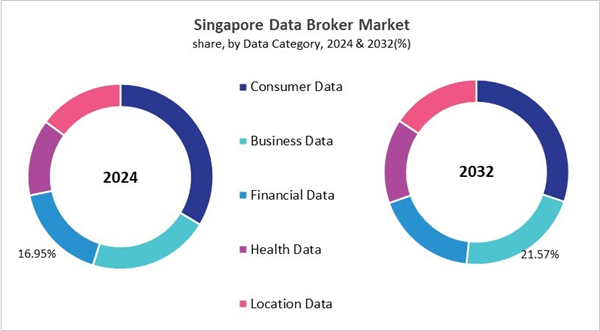
Country Outlook
The Cyberspace Administration of China runs China's data broker market, which is heavily regulated by the Personal Information Protection Law and the Data Security Law of China. The National Bureau of Statistics of China says that the country's digital economy is growing quickly. It creates a lot of data on e-commerce, fintech, telecommunications, and social media platforms, which increases the need for credit assessment, fraud detection, and analytics services. Strong regulatory oversight, such as rules about where data can be stored and strict rules about getting permission and transferring data across borders, has made data brokerage businesses official and limited unregulated data trading. The People's Bank of China gives permission for licensed credit reporting companies like Baihang Credit to operate. This makes the market structure more centralized and controlled. Domestic credit bureaus and big tech companies that follow the rules are the main players in the competition. Foreign data brokers, on the other hand, have to deal with operational problems. Overall, China's data broker landscape is still changing as fintech and AI-driven analytics grow. However, it is still defined by strong compliance oversight and national data sovereignty priorities.List of Key Companies Profiled
- Accenture PLC
- Equifax Inc.
- CoreLogic, Inc.
- Epsilon Data Management, LLC (Publicis Groupe)
- Oracle Corporation
- ZoomInfo Technologies Inc.
- Lusha Systems Inc.
- Clearbit (HubSpot, Inc.)
- IBM Corporation
- 6sense
Market Report Segmentation
By Data Type- Structured Data
- Unstructured Data
- Custom Structure Data
- Subscription
- Hybrid
- Pay-per-Use
- Consumer Data
- Business Data
- Financial Data
- Health Data
- Location Data
- BFSI
- Retail & E-commerce
- Media & Entertainment
- Healthcare
- IT & Telecom
- Government
- Automotive
- Other End-Use Industry
- China
- Japan
- India
- South Korea
- Singapore
- Malaysia
- Rest of Asia Pacific
Table of Contents
Chapter 1. Market Scope & Methodology
Chapter 2. Market at a Glance
Chapter 3. Market Overview
Chapter 10. Competition Analysis - Global
Chapter 11. Asia Pacific Data Broker Market by Data Type
Chapter 12. Asia Pacific Data Broker Market by Pricing
Chapter 13. Asia Pacific Data Broker Market by Data Category
Chapter 14. Asia Pacific Data Broker Market by End-Use Industry
Chapter 15. Asia Pacific Data Broker Market by Country
Chapter 16. Company Profiles
Companies Mentioned
- Accenture PLC
- Equifax Inc.
- CoreLogic, Inc.
- Epsilon Data Management, LLC (Publicis Groupe)
- Oracle Corporation
- ZoomInfo Technologies Inc.
- Lusha Systems Inc.
- Clearbit (HubSpot, Inc.)
- IBM Corporation
- 6sense


