



The North America Direct-to-Chip Liquid Cooling Market is expected to reach $1.15 billion by 2027 and is expected to witness market growth of 18.6% CAGR during the forecast period (2025-2032).
The US market dominated the North America Direct-to-Chip Liquid Cooling Market by country in 2024, and is expected to continue to be a dominant market till 2032; thereby, achieving a market value of $2.09 billion by 2032. The Canada market is exhibiting a CAGR of 21.5% during 2025-2032. Additionally, the Mexico market is expected to experience a CAGR of 20.4% during 2025-2032. The US and Canada led the North America Direct-to-Chip Liquid Cooling Market by Country with a market share of 80.2% and 9.7% in 2024.
The North America Direct-to-Chip Liquid Cooling Market grew because high-performance computers needed better ways to manage heat as traditional air-cooling systems hit their limits. At first, the technology was only used in specialized fields like aerospace and defense. But as semiconductor densities and computing workloads grew, it changed. New designs for microchannel cold plates, materials that don't rust, and better coolant formulations made it easier for data centers and enterprise IT infrastructure to use them. Over time, regulations that focused on energy efficiency and sustainability sped up the use of direct-to-chip cooling, turning it from a niche application into a commercially viable solution that works with modern data center architectures and digital monitoring systems.
The market is being shaped by a few key trends, such as the growing need for high-density computing and good heat management for AI and machine learning workloads. Sustainability efforts are also pushing people to use liquid cooling because it uses less energy and helps green data center goals. Also, the use of IoT-enabled sensors and smart monitoring systems is making operations more efficient and allowing for predictive maintenance. Innovation in thermal technologies, strategic partnerships, and investments in advanced materials and digital controls drive competition in the market. However, pricing strategies and customization options are still very important for wider adoption in large-scale data center environments.
The US market dominated the North America Direct-to-Chip Liquid Cooling Market by country in 2024, and is expected to continue to be a dominant market till 2032; thereby, achieving a market value of $2.09 billion by 2032. The Canada market is exhibiting a CAGR of 21.5% during 2025-2032. Additionally, the Mexico market is expected to experience a CAGR of 20.4% during 2025-2032. The US and Canada led the North America Direct-to-Chip Liquid Cooling Market by Country with a market share of 80.2% and 9.7% in 2024.
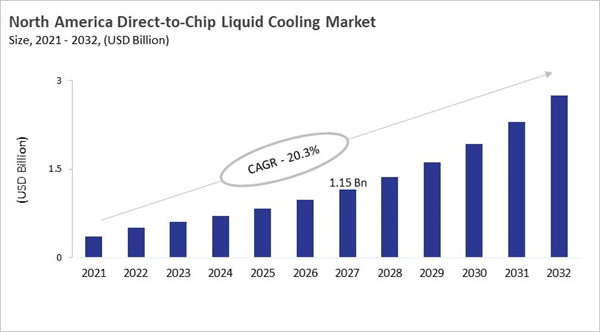
The North America Direct-to-Chip Liquid Cooling Market grew because high-performance computers needed better ways to manage heat as traditional air-cooling systems hit their limits. At first, the technology was only used in specialized fields like aerospace and defense. But as semiconductor densities and computing workloads grew, it changed. New designs for microchannel cold plates, materials that don't rust, and better coolant formulations made it easier for data centers and enterprise IT infrastructure to use them. Over time, regulations that focused on energy efficiency and sustainability sped up the use of direct-to-chip cooling, turning it from a niche application into a commercially viable solution that works with modern data center architectures and digital monitoring systems.
The market is being shaped by a few key trends, such as the growing need for high-density computing and good heat management for AI and machine learning workloads. Sustainability efforts are also pushing people to use liquid cooling because it uses less energy and helps green data center goals. Also, the use of IoT-enabled sensors and smart monitoring systems is making operations more efficient and allowing for predictive maintenance. Innovation in thermal technologies, strategic partnerships, and investments in advanced materials and digital controls drive competition in the market. However, pricing strategies and customization options are still very important for wider adoption in large-scale data center environments.
End-Use Industry Outlook
Based on End-Use Industry, the market is segmented into Telecommunications, Financial services, Healthcare & life sciences, Aerospace & defense, Oil & gas, and Other End-Use Industry. Among various US Direct-to-Chip Liquid Cooling Market by End-Use Industry; The Telecommunications market achieved a market size of USD $170.7 Million in 2024 and is expected to grow at a CAGR of 16.1 % during the forecast period. The Aerospace & defense market is predicted to experience a CAGR of 18.5% throughout the forecast period from (2025-2032).Liquid Coolant Type Outlook
Based on Liquid Coolant Type, the market is segmented into Water-based Coolants, Dielectric Fluids, Mineral Oils, and Engineered fluids. The Water-based Coolants market segment dominated the Canada Direct-to-Chip Liquid Cooling Market by Liquid Coolant Type is expected to grow at a CAGR of 20.5 % during the forecast period thereby continuing its dominance until 2032. Also, The Engineered fluids market is anticipated to grow as a CAGR of 21.8 % during the forecast period during 2025-2032.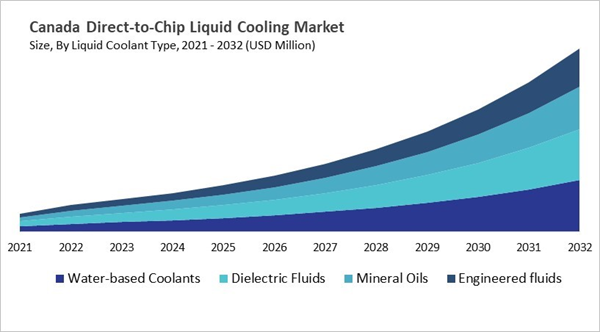
Country Outlook
The US Direct-to-Chip Liquid Cooling Market came about because data centers were getting more and more powerful servers, which made traditional air cooling less effective. The technology started out as simple cold-plate designs for niche high-performance computing environments. Over time, it evolved into more advanced single-phase and two-phase liquid cooling systems that worked better at getting rid of heat and using less energy. Hyperscale data centers and cloud providers are increasingly using direct-to-chip cooling, which makes it a strategic infrastructure solution for supporting AI and high-performance workloads. Some of the most important trends are rising AI-driven computing needs, strong efforts to improve energy efficiency and sustainability, and the use of smart monitoring systems to improve thermal management. Market players are working together with semiconductor and data center operators to come up with new ideas for modular cooling designs, advanced materials, and scalable architectures. Technological progress, the ability to integrate different systems, and cost-effective solutions that cut down on energy and operational costs all drive competition.List of Key Companies Profiled
- Asetek Inc. A/S
- Vertiv Group Corp.
- Schneider Electric SE
- Advanced Micro Devices, Inc.
- Chilldyne, Inc.
- Fujitsu Limited
- CoolIT Systems Inc.
- Iceotope Technologies Limited
- JETCOOL Technologies Inc. (FLEX LTD.)
- LiquidStack Holding B.V. (Bitfury Group Limited)
Market Report Segmentation
By Component Cooling- CPU cooling
- GPU cooling
- ASIC cooling
- Memory cooling
- Other Component Cooling
- Data centers
- High-performance computing (HPC)
- Supercomputers
- Workstations
- Edge computing devices
- Other Application
- Single-phase liquid cooling
- Two-phase liquid cooling
- Water-based Coolants
- Dielectric Fluids
- Mineral Oils
- Engineered fluids
- Telecommunications
- Financial services
- Healthcare & life sciences
- Aerospace & defense
- Oil & gas
- Other End-Use Industry
- US
- Canada
- Mexico
- Rest of North America
Table of Contents
Chapter 1. Market Scope & Methodology
Chapter 2. Market at a Glance
Chapter 3. Market Overview
Chapter 4. Market Trends - North America Direct-to-Chip Liquid Cooling Market
Chapter 5. State of Competition - North America Direct-to-Chip Liquid Cooling Market
Chapter 6. Market Consolidation - North America Direct-to-Chip Liquid Cooling Market
Chapter 7. Key Customer Criteria - North America Direct-to-Chip Liquid Cooling Market
Chapter 8. Product Life Cycle - North America Direct-to-Chip Liquid Cooling Market
Chapter 9. Value Chain Analysis of Direct-to-chip Liquid Cooling Market
Chapter 10. Competition Analysis - Global
Chapter 11. North America Direct-to-Chip Liquid Cooling Market by Component Cooling
Chapter 12. North America Direct-to-Chip Liquid Cooling Market by Application
Chapter 13. North America Direct-to-Chip Liquid Cooling Market by Solution Type
Chapter 14. North America Direct-to-Chip Liquid Cooling Market by Liquid Coolant Type
Chapter 15. North America Direct-to-Chip Liquid Cooling Market by End-Use Industry
Chapter 16. North America Direct-to-Chip Liquid Cooling Market by Country
Chapter 17. Company Profiles
Companies Mentioned
- Asetek Inc. A/S
- Vertiv Group Corp.
- Schneider Electric SE
- Advanced Micro Devices, Inc.
- Chilldyne, Inc.
- Fujitsu Limited
- CoolIT Systems Inc.
- Iceotope Technologies Limited
- JETCOOL Technologies Inc. (FLEX LTD.)
- LiquidStack Holding B.V. (Bitfury Group Limited)


