



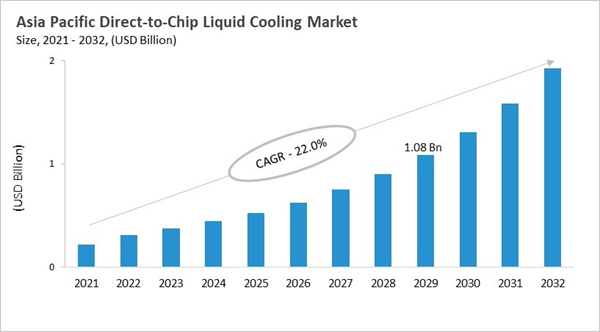
The Asia Pacific Direct-to-Chip Liquid Cooling Market is expected to reach $1.08 billion by 2029 and is expected to witness market growth of 20.4% CAGR during the forecast period (2025-2032).
The China market dominated the Asia Pacific Direct-to-Chip Liquid Cooling Market by country in 2024, and is expected to continue to be a dominant market till 2032; thereby, achieving a market value of $587.4 million by 2032. The Japan market is showcasing a CAGR of 19.5% during 2025-2032. Additionally, the India market would register a CAGR of 21.3% during 2025-2032. The China and Japan led the Asia Pacific Direct-to-Chip Liquid Cooling Market by Country with a market share of 34.4% and 17.4% in 2024.The Singapore market is expected to witness a CAGR of 21.8% during throughout the forecast period.
The Asia Pacific Direct-to-Chip Liquid Cooling Market came about because of the growing problems with thermal management in data centers and high-performance computing environments caused by more processors being used. As AI and HPC workloads grew, traditional air cooling became less effective. To better get rid of heat, direct-to-chip liquid cooling was used instead. Improvements in microchannel designs, cooling materials, and closed-loop systems made them more reliable and used less water. The shift from experimental deployments to widespread use across the region has sped up thanks to rapid digitalization, the rise of hyperscale data centers in places like China and India, and strong sustainability efforts.
Some of the most important trends in the market are the rise in AI and HPC workloads that need more powerful computers, the need for cooling technologies that are more energy-efficient and environmentally friendly, and the growth of localized manufacturing and supply chains to speed up deployment. People who work in the market are focusing on new ways to cool things down, making strategic partnerships with semiconductor and data center operators, and putting money into AI-driven thermal monitoring systems. In the competitive landscape, both global and regional companies are competing by coming up with new technologies, offering tailored solutions, building infrastructure that can grow, and using pricing strategies that are fair.
The China market dominated the Asia Pacific Direct-to-Chip Liquid Cooling Market by country in 2024, and is expected to continue to be a dominant market till 2032; thereby, achieving a market value of $587.4 million by 2032. The Japan market is showcasing a CAGR of 19.5% during 2025-2032. Additionally, the India market would register a CAGR of 21.3% during 2025-2032. The China and Japan led the Asia Pacific Direct-to-Chip Liquid Cooling Market by Country with a market share of 34.4% and 17.4% in 2024.The Singapore market is expected to witness a CAGR of 21.8% during throughout the forecast period.
The Asia Pacific Direct-to-Chip Liquid Cooling Market came about because of the growing problems with thermal management in data centers and high-performance computing environments caused by more processors being used. As AI and HPC workloads grew, traditional air cooling became less effective. To better get rid of heat, direct-to-chip liquid cooling was used instead. Improvements in microchannel designs, cooling materials, and closed-loop systems made them more reliable and used less water. The shift from experimental deployments to widespread use across the region has sped up thanks to rapid digitalization, the rise of hyperscale data centers in places like China and India, and strong sustainability efforts.
Some of the most important trends in the market are the rise in AI and HPC workloads that need more powerful computers, the need for cooling technologies that are more energy-efficient and environmentally friendly, and the growth of localized manufacturing and supply chains to speed up deployment. People who work in the market are focusing on new ways to cool things down, making strategic partnerships with semiconductor and data center operators, and putting money into AI-driven thermal monitoring systems. In the competitive landscape, both global and regional companies are competing by coming up with new technologies, offering tailored solutions, building infrastructure that can grow, and using pricing strategies that are fair.
Solution Type Outlook
Based on Solution Type, the market is segmented into Single-phase liquid cooling, and Two-phase liquid cooling. With a compound annual growth rate (CAGR) of 18.1% over the projection period, the Single-phase liquid cooling Market, dominate the China Direct-to-Chip Liquid Cooling Market by Solution Type in 2024 and would be a prominent market until 2032. The Two-phase liquid cooling market is expected to witness a CAGR of 19.3% during 2025-2032.End-Use Industry Outlook
Based on End-Use Industry, the market is segmented into Telecommunications, Financial services, Healthcare & life sciences, Aerospace & defense, Oil & gas, and Other End-Use Industry. The Telecommunications market segment dominated the Singapore Direct-to-Chip Liquid Cooling Market by End-Use Industry is expected to grow at a CAGR of 19.9 % during the forecast period thereby continuing its dominance until 2032. Also, The Oil & gas market is anticipated to grow as a CAGR of 23.1 % during the forecast period during 2025-2032.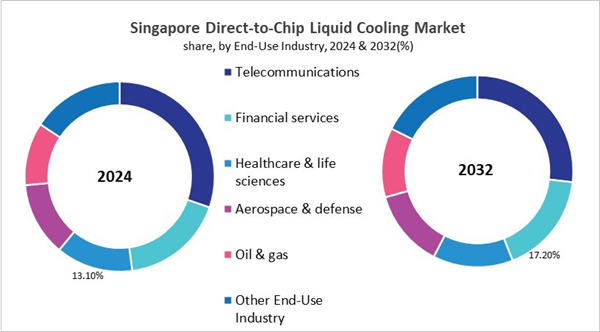
Country Outlook
As chip densities rose and AI, big data, and cloud computing infrastructure grew quickly, data centers had more thermal problems. This led to the growth of the China Direct-to-Chip Liquid Cooling Market. The market started with traditional air-cooling methods and moved on to direct-to-chip liquid cooling. This method circulates coolant directly over processors, which makes it easier for heat to escape. Adoption sped up because of technological advances like better coolant formulations, modular designs, and integrated manifold systems. Government policies that encourage green and energy-efficient data centers helped the market grow even more. Some important trends are the growth of AI infrastructure, stricter efforts to be environmentally friendly, and new ideas for scalable cooling architectures. In the market, both regional and global players compete by using advanced thermal technologies, making things locally, forming strategic partnerships, and offering cost-effective solutions for a wide range of data center needs.List of Key Companies Profiled
- Asetek Inc. A/S
- Vertiv Group Corp.
- Schneider Electric SE
- Advanced Micro Devices, Inc.
- Chilldyne, Inc.
- Fujitsu Limited
- CoolIT Systems Inc.
- Iceotope Technologies Limited
- JETCOOL Technologies Inc. (FLEX LTD.)
- LiquidStack Holding B.V. (Bitfury Group Limited)
Market Report Segmentation
By Component Cooling- CPU cooling
- GPU cooling
- ASIC cooling
- Memory cooling
- Other Component Cooling
- Data centers
- High-performance computing (HPC)
- Supercomputers
- Workstations
- Edge computing devices
- Other Application
- Single-phase liquid cooling
- Two-phase liquid cooling
- Water-based Coolants
- Dielectric Fluids
- Mineral Oils
- Engineered fluids
- Telecommunications
- Financial services
- Healthcare & life sciences
- Aerospace & defense
- Oil & gas
- Other End-Use Industry
- China
- Japan
- India
- South Korea
- Singapore
- Malaysia
- Rest of Asia Pacific
Table of Contents
Chapter 1. Market Scope & Methodology
Chapter 2. Market at a Glance
Chapter 3. Market Overview
Chapter 4. Market Trends - Asia Pacific direct-to-chip liquid cooling market
Chapter 5. State of Competition - Asia Pacific Direct-to-Chip Liquid Cooling Market
Chapter 6. Market Consolidation - Asia Pacific Direct-to-Chip Liquid Cooling Market
Chapter 7. Key Customer Criteria - Asia Pacific Direct-to-Chip Liquid Cooling Market
Chapter 8. Product Life Cycle - Asia Pacific Direct-to-Chip Liquid Cooling Market
Chapter 9. Value Chain Analysis of Direct-to-chip Liquid Cooling Market
Chapter 10. Competition Analysis - Global
Chapter 11. Asia Pacific Direct-to-Chip Liquid Cooling Market by Component Cooling
Chapter 12. Asia Pacific Direct-to-Chip Liquid Cooling Market by Application
Chapter 13. Asia Pacific Direct-to-Chip Liquid Cooling Market by Solution Type
Chapter 14. Asia Pacific Direct-to-Chip Liquid Cooling Market by Liquid Coolant Type
Chapter 15. Asia Pacific Direct-to-Chip Liquid Cooling Market by End-Use Industry
Chapter 16. Asia Pacific Direct-to-Chip Liquid Cooling Market by Country
Chapter 17. Company Profiles
Companies Mentioned
- Asetek Inc. A/S
- Vertiv Group Corp.
- Schneider Electric SE
- Advanced Micro Devices, Inc.
- Chilldyne, Inc.
- Fujitsu Limited
- CoolIT Systems Inc.
- Iceotope Technologies Limited
- JETCOOL Technologies Inc. (FLEX LTD.)
- LiquidStack Holding B.V. (Bitfury Group Limited)


