



The Asia Pacific Electric Boat Market is expected to reach $2.69 billion by 2029 and is expected to witness market growth of 14.1% CAGR during the forecast period (2025-2032).
The China market dominated the Asia Pacific Electric Boat Market by country in 2024, and is expected to continue to be a dominant market till 2032; thereby, achieving a market value of $1.36 billion by 2032. The Japan market is registering a CAGR of 13% during 2025-2032. Additionally, the India market is expected to showcase a CAGR of 15.3% during 2025-2032. The China and Japan led the Asia Pacific Electric Boat Market by Country with a market share of 37.5% and 13.7% in 2024. The Malaysia market is expected to witness a CAGR of 17.6% during throughout the forecast period.
The Asia Pacific Electric Boat Market has grown from a small part of the maritime industry that focused on small recreational and fishing boats to a quickly growing and strategically important part of the industry. People started using them early on because they were more aware of the environment and wanted to use less fossil fuels. Over time, improvements in battery technologies, especially lithium-ion and new solid-state solutions, have made electric boats more commercially viable by greatly increasing energy density, range, and charging efficiency. Government incentives, rules, and programs to cut down on emissions across the region sped up adoption even more, allowing for growth into passenger ferries, workboats, and luxury yachts. Today, the market shows that technological innovation, policy support, and a growing need for eco-friendly maritime transport solutions are all coming together.
Trends like better battery management systems, a greater focus on sustainability, and the integration of digital connectivity and automation are all shaping the market right now. Hybrid-electric solutions and improved propulsion efficiency are helping to overcome range limits. Eco-friendly materials and coatings, on the other hand, meet strict environmental standards. Also, smart technologies for monitoring and predictive maintenance are making operations more reliable and lowering the cost of ownership. Leading companies are solidifying their positions in the market by making ongoing investments in research and development, forming strategic partnerships, and adapting their products to different regions. They do this with the help of pilot projects and innovation initiatives. The competitive landscape is still changing. Regional companies focus on cost-effective, customized solutions, while global companies use advanced technologies. Together, these companies are driving innovation and adoption in the Asia Pacific electric boat market.
The China market dominated the Asia Pacific Electric Boat Market by country in 2024, and is expected to continue to be a dominant market till 2032; thereby, achieving a market value of $1.36 billion by 2032. The Japan market is registering a CAGR of 13% during 2025-2032. Additionally, the India market is expected to showcase a CAGR of 15.3% during 2025-2032. The China and Japan led the Asia Pacific Electric Boat Market by Country with a market share of 37.5% and 13.7% in 2024. The Malaysia market is expected to witness a CAGR of 17.6% during throughout the forecast period.
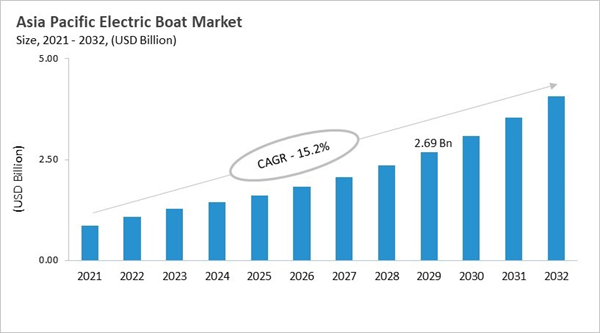
The Asia Pacific Electric Boat Market has grown from a small part of the maritime industry that focused on small recreational and fishing boats to a quickly growing and strategically important part of the industry. People started using them early on because they were more aware of the environment and wanted to use less fossil fuels. Over time, improvements in battery technologies, especially lithium-ion and new solid-state solutions, have made electric boats more commercially viable by greatly increasing energy density, range, and charging efficiency. Government incentives, rules, and programs to cut down on emissions across the region sped up adoption even more, allowing for growth into passenger ferries, workboats, and luxury yachts. Today, the market shows that technological innovation, policy support, and a growing need for eco-friendly maritime transport solutions are all coming together.
Trends like better battery management systems, a greater focus on sustainability, and the integration of digital connectivity and automation are all shaping the market right now. Hybrid-electric solutions and improved propulsion efficiency are helping to overcome range limits. Eco-friendly materials and coatings, on the other hand, meet strict environmental standards. Also, smart technologies for monitoring and predictive maintenance are making operations more reliable and lowering the cost of ownership. Leading companies are solidifying their positions in the market by making ongoing investments in research and development, forming strategic partnerships, and adapting their products to different regions. They do this with the help of pilot projects and innovation initiatives. The competitive landscape is still changing. Regional companies focus on cost-effective, customized solutions, while global companies use advanced technologies. Together, these companies are driving innovation and adoption in the Asia Pacific electric boat market.
Battery Type Outlook
Based on Battery Type, the market is segmented into Lithium-Ion, Lead Acid, and Nickel-Based. With a compound annual growth rate (CAGR) of 12% over the projection period, the Lithium-Ion Market, dominate the China Electric Boat Market by Battery Type in 2024 and would be a prominent market until 2032. The Nickel-Based market is expected to witness a CAGR of 13.2% during 2025-2032.Application Type Outlook
Based on Application Type, the market is segmented into Passenger, Cargo, and Other Application Type. The Passenger market segment dominated the Singapore Electric Boat Market by Application Type is expected to grow at a CAGR of 15.2 % during the forecast period thereby continuing its dominance until 2032. Also, The Other Application Type market is anticipated to grow as a CAGR of 16.7 % during the forecast period during 2025-2032.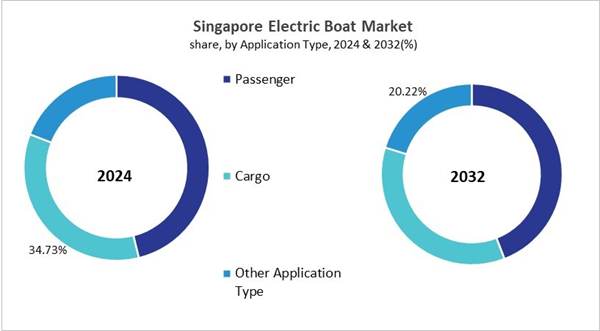
Country Outlook
The Chinese electric boat market has grown from small-scale electric propulsion projects to a technologically advanced and diverse ecosystem backed by strong government policies and fast innovation. Growth has been fueled by improvements in lithium-ion batteries, hybrid systems, and smart vessel technologies, as well as stricter rules that require companies to cut emissions and become carbon neutral. Some important trends are the widespread use of zero-emission ships, the merging of digital and autonomous technologies, and the rise of strategic partnerships that speed up innovation and make companies more competitive around the world. Market leaders are working on improving propulsion efficiency, building more charging stations, and creating integrated marine solutions. At the same time, fierce competition among domestic players keeps pushing technological progress, specialization, and the development of scalable, high-performance electric vessels.List of Key Companies Profiled
- Yamaha Motor Co., Ltd.
- HD Hyundai Heavy Industries Co., Ltd.
- Wartsila Corporation
- Brunswick Corporation
- Vision Marine Technologies Inc.
- Damen Shipyards Group
- Navier Boats
- Sanlorenzo S.p.A.
- Torqeedo GmbH
- General Dynamics Corporation (General Dynamics Electric Boat)
Market Report Segmentation
By Boat Type- Pure Electric
- Hybrid Electric
- Lithium-Ion
- Lead Acid
- Nickel-Based
- Passenger
- Cargo
- Other Application Type
- China
- Japan
- India
- South Korea
- Singapore
- Malaysia
- Rest of Asia Pacific
Table of Contents
Chapter 1. Market Scope & Methodology
Chapter 2. Market at a Glance
Chapter 3. Market Overview
Chapter 4. Market Trends - Asia Pacific Electric Boat Market
Chapter 5. State of Competition - Asia Pacific Electric Boat Market
Chapter 6. Market Consolidation - Asia Pacific Electric Boat Market
Chapter 7. Key Customer Criteria - Asia Pacific Electric Boat Market
Chapter 8. Product Life Cycle - Asia Pacific Electric Boat Market
Chapter 10. Competition Analysis - Global
Chapter 11. Asia Pacific Electric Boat Market by Boat Type
Chapter 12. Asia Pacific Electric Boat Market by Battery Type
Chapter 13. Asia Pacific Electric Boat Market by Application Type
Chapter 14. Asia Pacific Electric Boat Market by Country
Chapter 15. Company Profiles
Companies Mentioned
- Yamaha Motor Co., Ltd.
- HD Hyundai Heavy Industries Co., Ltd.
- Wartsila Corporation
- Brunswick Corporation
- Vision Marine Technologies Inc.
- Damen Shipyards Group
- Navier Boats
- Sanlorenzo S.p.A.
- Torqeedo GmbH
- General Dynamics Corporation (General Dynamics Electric Boat)


