



The Europe Industrial Data Management Market is expected to reach $73.38 billion by 2031 and is expected to witness market growth of 14.1% CAGR during the forecast period (2025-2032).
The Germany market dominated the Europe Industrial Data Management Market by country in 2024, and is expected to continue to be a dominant market till 2032; thereby, achieving a market value of $18.53 billion by 2032. The UK market is experiencing a CAGR of 12.9% during 2025-2032. Additionally, the France market is expected to exhibit a CAGR of 14.9% during 2025-2032. The Germany and UK led the Europe Industrial Data Management Market by Country with a market share of 24.1% and 17% in 2024. The Spain market is expected to witness a CAGR of 15.7% during throughout the forecast period.
The Europe Industrial Data Management Market has changed a lot because digital technologies are being used more in all kinds of industries. In the past, the market was focused on collecting data by hand and storing it in one place. Now, it is moving toward automated and integrated data management platforms. Industry 4.0, the Internet of Things (IoT), cloud computing, and industrial automation have all made it possible to process data in real time, do more advanced analytics, and make operations more efficient. European rules that stress data security, privacy, and integrity have also been very important in the growth of industrial data management solutions. The market today shows that cloud platforms, edge computing, and artificial intelligence are all working together to help smart factories, make supply chains more efficient, and handle large amounts of industrial data in a smart way.
Some of the most important trends in the market are the growing use of cloud and hybrid cloud infrastructures for managing large amounts of data, the growing use of edge computing for making decisions faster, and the use of AI and machine learning for predictive maintenance and improving operations. To improve their market position, top companies put money into research and development, make strategic partnerships, and follow EU data protection laws. There are both well-known industrial automation companies and new technology companies in the competitive landscape. Competition is based on new ideas, security features, and all-in-one solutions that help with digital transformation and sustainability goals in the industrial sector.
The Germany market dominated the Europe Industrial Data Management Market by country in 2024, and is expected to continue to be a dominant market till 2032; thereby, achieving a market value of $18.53 billion by 2032. The UK market is experiencing a CAGR of 12.9% during 2025-2032. Additionally, the France market is expected to exhibit a CAGR of 14.9% during 2025-2032. The Germany and UK led the Europe Industrial Data Management Market by Country with a market share of 24.1% and 17% in 2024. The Spain market is expected to witness a CAGR of 15.7% during throughout the forecast period.
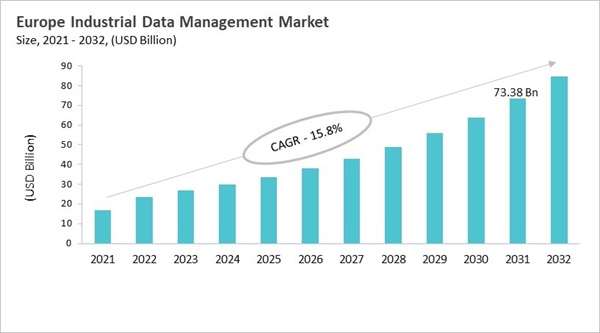
The Europe Industrial Data Management Market has changed a lot because digital technologies are being used more in all kinds of industries. In the past, the market was focused on collecting data by hand and storing it in one place. Now, it is moving toward automated and integrated data management platforms. Industry 4.0, the Internet of Things (IoT), cloud computing, and industrial automation have all made it possible to process data in real time, do more advanced analytics, and make operations more efficient. European rules that stress data security, privacy, and integrity have also been very important in the growth of industrial data management solutions. The market today shows that cloud platforms, edge computing, and artificial intelligence are all working together to help smart factories, make supply chains more efficient, and handle large amounts of industrial data in a smart way.
Some of the most important trends in the market are the growing use of cloud and hybrid cloud infrastructures for managing large amounts of data, the growing use of edge computing for making decisions faster, and the use of AI and machine learning for predictive maintenance and improving operations. To improve their market position, top companies put money into research and development, make strategic partnerships, and follow EU data protection laws. There are both well-known industrial automation companies and new technology companies in the competitive landscape. Competition is based on new ideas, security features, and all-in-one solutions that help with digital transformation and sustainability goals in the industrial sector.
Data Type Outlook
Based on Data Type, the market is segmented into Structured Data, Unstructured Data, and Semi-Structured Data. With a compound annual growth rate (CAGR) of 12.1% over the projection period, the Structured Data Market, dominate the Germany Industrial Data Management Market by Data Type in 2024 and would be a prominent market until 2032. The Semi-Structured Data market is expected to witness a CAGR of 13.1% during 2025-2032.End Use Outlook
Based on End Use, the market is segmented into Manufacturing & Processing, Energy & Utilities, Logistics & Supply Chain, BFSI, and Healthcare & Others. The Manufacturing & Processing market segment dominated the UK Industrial Data Management Market by End Use is expected to grow at a CAGR of 12.1 % during the forecast period thereby continuing its dominance until 2032. Also, The BFSI market is anticipated to grow as a CAGR of 14.2 % during the forecast period during 2025-2032.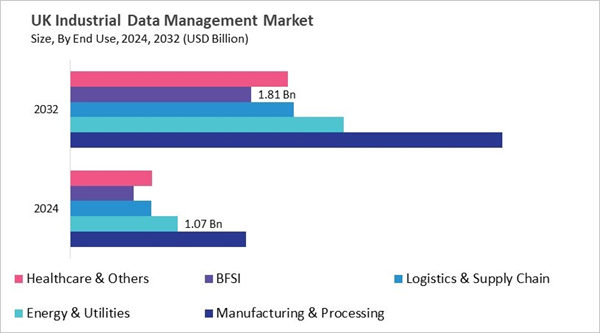
Country Outlook
The Germany Industrial Data Management Market has grown quickly because the country has a strong manufacturing base and was one of the first to use digital transformation tools. German industries have always focused on precision-driven manufacturing, but they are now using Industry 4.0 technologies like the Internet of Things (IoT), cloud computing, and real-time analytics to make their operations more efficient and help them make better decisions. The market has changed from separate data silos to unified platforms like data lakes and warehouses that help with quality control, predictive maintenance, and supply chain visibility. Smart factories that use the Internet of Things (IoT) are becoming more common, as are cloud and hybrid-cloud infrastructures for managing large amounts of data. AI and machine learning are also being used to improve production. The market is also being shaped by a strong focus on data governance, cybersecurity, and following European rules. To help with digital transformation and build cultures that areList of Key Companies Profiled
- Microsoft Corporation
- Amazon Web Services, Inc. (Amazon.com, Inc.)
- IBM Corporation
- SAP SE
- Oracle Corporation
- Informatica Inc.
- Google LLC
- Snowflake Inc.
- Siemens AG
- Honeywell International, Inc.
Market Report Segmentation
By Data Type- Structured Data
- Unstructured Data
- Semi-Structured Data
- Manufacturing & Processing
- Energy & Utilities
- Logistics & Supply Chain
- BFSI
- Healthcare & Others
- Data Storage & Integration
- Data Orchestration & Analytics
- Data Visualization
- Data Security
- Data Governance & Compliance
- Data Sharing
- Predictive Maintenance
- Asset Monitoring & Optimization
- Manufacturing Process Optimization
- Real-Time Operational Analytics
- Supply Chain & Inventory Management
- Regulatory Reporting & Compliance
- Other Application
- Germany
- UK
- France
- Russia
- Spain
- Italy
- Rest of Europe
Table of Contents
Chapter 1. Market Scope & Methodology
Chapter 2. Market at a Glance
Chapter 3. Market Overview
Chapter 4. Market Trends - Europe Industrial Data Management Market
Chapter 5. State of Competition - Europe Industrial Data Management Market
Chapter 6. Market Consolidation - Europe Industrial Data Management Market
Chapter 7. Key Customer Criteria - Europe Industrial Data Management Market
Chapter 8. Product Life Cycle - Europe Industrial Data Management Market
Chapter 9. Value Chain Analysis of Industrial Data Management Market
Chapter 10. Competition Analysis - Global
Chapter 11. Europe Industrial Data Management Market by Data Type
Chapter 12. Europe Industrial Data Management Market by End Use
Chapter 13. Europe Industrial Data Management Market by Solution Type
Chapter 14. Europe Industrial Data Management Market by Application
Chapter 15. Europe Industrial Data Management Market by Country
Chapter 16. Company Profiles
Companies Mentioned
- Microsoft Corporation
- Amazon Web Services, Inc. (Amazon.com, Inc.)
- IBM Corporation
- SAP SE
- Oracle Corporation
- Informatica Inc.
- Google LLC
- Snowflake Inc.
- Siemens AG
- Honeywell International, Inc.


