



The Asia Pacific Industrial Data Management Market is expected to reach $40.05 billion by 2027 and is expected to witness market growth of 15.4% CAGR during the forecast period (2025-2032).
The China market dominated the Asia Pacific Industrial Data Management Market by country in 2024, and is expected to continue to be a dominant market till 2032; thereby, achieving a market value of $24.56 billion by 2032. The Japan market is showcasing a CAGR of 14.5% during 2025-2032. Additionally, the India market would register a CAGR of 16.2% during 2025-2032. The China and Japan led the Asia Pacific Industrial Data Management Market by Country with a market share of 33.4% and 17.4% in 2024. The Singapore market is expected to witness a CAGR of 16.9% during throughout the forecast period.
The Asia Pacific Industrial Data Management Market has changed quickly because the region is industrializing quickly and more businesses are moving digitally. Before, many industries used broken legacy systems to handle industrial data. Now, with the rise of Industry 4.0 technologies, data can be shared between manufacturing plants, supply chains, and operational systems. Countries like China, Japan, South Korea, and India and Vietnam, which are still developing, are driving up the demand for advanced data management platforms. The growing use of IoT devices, sensors, and automation technologies has led to more real-time industrial data. This has led to more investments in cloud computing, edge analytics, and integrated software solutions to make operations more efficient and help people make better decisions.
AI-driven analytics are becoming more popular in the market because they can help with predictive maintenance, quality control, and supply chain optimization. Edge computing is also becoming more important for industrial operations because it allows for real-time data processing and lowers latency. To meet the needs of different industries and governments in the region, market leaders are focusing on strategic partnerships, research and development investments, localization strategies, and solutions that can grow. There are strong regional players and global technology companies competing in the Asia Pacific industrial sector by coming up with new ideas, offering integrated solutions, improving their cybersecurity skills, and offering flexible pricing models to meet the changing needs of the industry.
The China market dominated the Asia Pacific Industrial Data Management Market by country in 2024, and is expected to continue to be a dominant market till 2032; thereby, achieving a market value of $24.56 billion by 2032. The Japan market is showcasing a CAGR of 14.5% during 2025-2032. Additionally, the India market would register a CAGR of 16.2% during 2025-2032. The China and Japan led the Asia Pacific Industrial Data Management Market by Country with a market share of 33.4% and 17.4% in 2024. The Singapore market is expected to witness a CAGR of 16.9% during throughout the forecast period.
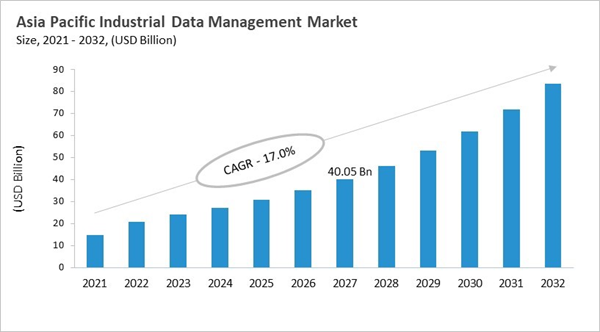
The Asia Pacific Industrial Data Management Market has changed quickly because the region is industrializing quickly and more businesses are moving digitally. Before, many industries used broken legacy systems to handle industrial data. Now, with the rise of Industry 4.0 technologies, data can be shared between manufacturing plants, supply chains, and operational systems. Countries like China, Japan, South Korea, and India and Vietnam, which are still developing, are driving up the demand for advanced data management platforms. The growing use of IoT devices, sensors, and automation technologies has led to more real-time industrial data. This has led to more investments in cloud computing, edge analytics, and integrated software solutions to make operations more efficient and help people make better decisions.
AI-driven analytics are becoming more popular in the market because they can help with predictive maintenance, quality control, and supply chain optimization. Edge computing is also becoming more important for industrial operations because it allows for real-time data processing and lowers latency. To meet the needs of different industries and governments in the region, market leaders are focusing on strategic partnerships, research and development investments, localization strategies, and solutions that can grow. There are strong regional players and global technology companies competing in the Asia Pacific industrial sector by coming up with new ideas, offering integrated solutions, improving their cybersecurity skills, and offering flexible pricing models to meet the changing needs of the industry.
End Use Outlook
Based on End Use, the market is segmented into Manufacturing & Processing, Energy & Utilities, Logistics & Supply Chain, BFSI, and Healthcare & Others. With a compound annual growth rate (CAGR) of 12.7% over the projection period, the Manufacturing & Processing Market, dominate the China Industrial Data Management Market by End Use in 2024 and would be a prominent market until 2032. The BFSI market is expected to witness a CAGR of 14.8% during 2025-2032.Data Type Outlook
Based on Data Type, the market is segmented into Structured Data, Unstructured Data, and Semi-Structured Data. The Structured Data market segment dominated the Singapore Industrial Data Management Market by Data Type is expected to grow at a CAGR of 16.3 % during the forecast period thereby continuing its dominance until 2032. Also, The Unstructured Data market is anticipated to grow as a CAGR of 17.2 % during the forecast period during 2025-2032.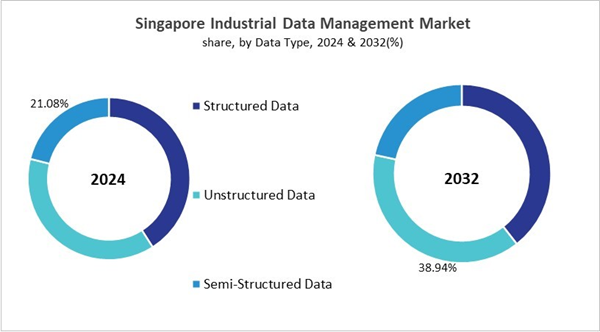
Country Outlook
The China Industrial Data Management Market has changed a lot as the country has quickly changed its industries and gone digital with projects like "Made in China 2025." At first, the market had simple and separate data management systems. Now, it has moved toward advanced platforms that combine cloud computing, big data analytics, IoT, and AI to support smart manufacturing. Growing industrial automation and the growth of China's digital economy have led to a need for strong data governance, real-time analytics, and predictive maintenance. Some important trends are the use of AI and machine learning together for advanced analytics, the growing use of cloud-based data management platforms for scalability, and a greater focus on data security and following the rules. To stay ahead in the market, market leaders focus on new technologies, strategic partnerships, cloud-native architectures, and making sure their products meet national regulatory standards. In the competitive landscape, both domestic technology leaders and international companies compete by coming up with new ideas, offering integrated solutions, and having industry-specific knowledge. The market is still changing, which helps China reach its bigger goals of modernizing its industries and going digital.List of Key Companies Profiled
- Microsoft Corporation
- Amazon Web Services, Inc. (Amazon.com, Inc.)
- IBM Corporation
- SAP SE
- Oracle Corporation
- Informatica Inc.
- Google LLC
- Snowflake Inc.
- Siemens AG
- Honeywell International, Inc.
Market Report Segmentation
By Data Type- Structured Data
- Unstructured Data
- Semi-Structured Data
- Manufacturing & Processing
- Energy & Utilities
- Logistics & Supply Chain
- BFSI
- Healthcare & Others
- Data Storage & Integration
- Data Orchestration & Analytics
- Data Visualization
- Data Security
- Data Governance & Compliance
- Data Sharing
- Predictive Maintenance
- Asset Monitoring & Optimization
- Manufacturing Process Optimization
- Real-Time Operational Analytics
- Supply Chain & Inventory Management
- Regulatory Reporting & Compliance
- Other Application
- China
- Japan
- India
- South Korea
- Singapore
- Malaysia
- Rest of Asia Pacific
Table of Contents
Chapter 1. Market Scope & Methodology
Chapter 2. Market at a Glance
Chapter 3. Market Overview
Chapter 4. Market Trends - Asia Pacific Intrinsically Safe Equipment Market
Chapter 5. State of Competition - Asia Pacific Intrinsically Safe Equipment Market
Chapter 6. Market Consolidation - Asia Pacific Intrinsically Safe Equipment Market
Chapter 7. Key Customer Criteria - Asia Pacific Intrinsically Safe Equipment Market
Chapter 8. Product Life Cycle - Asia Pacific Intrinsically Safe Equipment Market
Chapter 9. Value Chain Analysis of Intrinsically Safe Equipment Market
Chapter 10. Competition Analysis - Global
Chapter 11. Asia Pacific Intrinsically Safe Equipment Market by Class Type
Chapter 12. Asia Pacific Intrinsically Safe Equipment Market by End Use
Chapter 13. Asia Pacific Intrinsically Safe Equipment Market by Zone
Chapter 14. Asia Pacific Intrinsically Safe Equipment Market by Product
Chapter 15. Asia Pacific Intrinsically Safe Equipment Market by Country
Chapter 16. Company Profiles
Companies Mentioned
- Banner Engineering Corporation
- Honeywell International Inc.
- Eaton Corporation plc
- Emerson Electric Co.
- Rockwell Automation, Inc.
- Schneider Electric SE
- Siemens AG
- Fluke Corporation (Fortive Corporation)
- Pepperl+Fuchs SE
- R. STAHL AG


