



The North America Polyquaternium-7 Market is expected to reach $8.32 million by 2027 and is expected to witness market growth of 7.0% CAGR during the forecast period (2025-2032).
The US market dominated the North America Polyquaternium-7 Market by country in 2024, and is expected to continue to be a dominant market till 2032; thereby, achieving a market value of $8.2 million by 2032. The Canada market is experiencing a CAGR of 9.4% during 2025-2032. Additionally, the Mexico market is expected to exhibit a CAGR of 8% during 2025-2032. The US and Canada led the North America Polyquaternium-7 Market by Country with a market share of 73.1% and 11.1% in 2024.The US market is expected to witness a CAGR of 6.3% during throughout the forecast period.
The North America Polyquaternium-7 Market has grown out of the larger growth of water-soluble conditioning polymers into a niche area of the personal care industry. Polyquaternium-7 was first used in hair and skin care products because it improved texture, moisture retention, and manageability. It quickly became popular because it could be used in a wide range of formulations and made strong films. Advancements in material science made it possible to better control molecular weight and charge density, which greatly improved the performance of products and the experience of users. Adopting green chemistry practices and the growing demand for multifunctional ingredients were two important turning points that helped it strengthen its market position. The market today is a mature ecosystem that is driven by new ideas, following the rules, and customers wanting personal care products that work well, are safe, and last a long time.
Trends that are shaping the market right now include the growing demand for ingredients that can do more than one thing, a greater focus on sustainability, and the rise of personalized beauty solutions. More and more, polyquaternium-7 is being used in cosmetics not only to condition the skin but also to improve SPF retention and water resistance. At the same time, rules are pushing for the creation of eco-friendly ways to make things and clear labeling. The growth of e-commerce and personalized beauty products is pushing the development of new tailored formulations even more. To meet the needs of different customers, top companies are focusing on advanced molecular engineering, strategic partnerships, and developing products in specific areas. The competitive landscape is still changing. Global companies are using their strong research and development (R&D) capabilities, while regional companies are focusing on cost-effectiveness and niche applications. Together, these companies are driving innovation and growth in the North American Polyquaternium-7 market.
The US market dominated the North America Polyquaternium-7 Market by country in 2024, and is expected to continue to be a dominant market till 2032; thereby, achieving a market value of $8.2 million by 2032. The Canada market is experiencing a CAGR of 9.4% during 2025-2032. Additionally, the Mexico market is expected to exhibit a CAGR of 8% during 2025-2032. The US and Canada led the North America Polyquaternium-7 Market by Country with a market share of 73.1% and 11.1% in 2024.The US market is expected to witness a CAGR of 6.3% during throughout the forecast period.
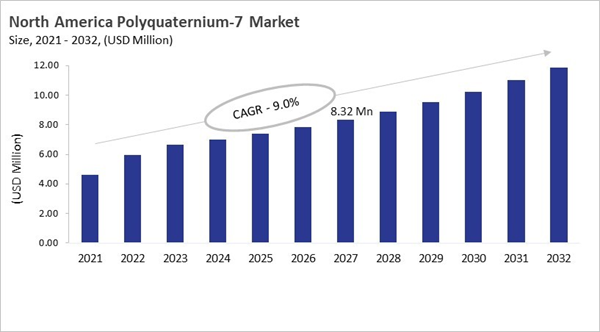
The North America Polyquaternium-7 Market has grown out of the larger growth of water-soluble conditioning polymers into a niche area of the personal care industry. Polyquaternium-7 was first used in hair and skin care products because it improved texture, moisture retention, and manageability. It quickly became popular because it could be used in a wide range of formulations and made strong films. Advancements in material science made it possible to better control molecular weight and charge density, which greatly improved the performance of products and the experience of users. Adopting green chemistry practices and the growing demand for multifunctional ingredients were two important turning points that helped it strengthen its market position. The market today is a mature ecosystem that is driven by new ideas, following the rules, and customers wanting personal care products that work well, are safe, and last a long time.
Trends that are shaping the market right now include the growing demand for ingredients that can do more than one thing, a greater focus on sustainability, and the rise of personalized beauty solutions. More and more, polyquaternium-7 is being used in cosmetics not only to condition the skin but also to improve SPF retention and water resistance. At the same time, rules are pushing for the creation of eco-friendly ways to make things and clear labeling. The growth of e-commerce and personalized beauty products is pushing the development of new tailored formulations even more. To meet the needs of different customers, top companies are focusing on advanced molecular engineering, strategic partnerships, and developing products in specific areas. The competitive landscape is still changing. Global companies are using their strong research and development (R&D) capabilities, while regional companies are focusing on cost-effectiveness and niche applications. Together, these companies are driving innovation and growth in the North American Polyquaternium-7 market.
Application Outlook
Based on Application, the market is segmented into Hair Care, Skin Care, Personal Hygiene, Cosmetic Formulations, and Other Application. Among various US Polyquaternium-7 Market by Application; The Hair Care market achieved a market size of USD $2.3 Million in 2024 and is expected to grow at a CAGR of 5.7 % during the forecast period. The Cosmetic Formulations market is predicted to experience a CAGR of 7.2% throughout the forecast period from (2025-2032).Distribution Channel Outlook
Based on Distribution Channel, the market is segmented into Indirect Sales, and Direct Sales. With a compound annual growth rate (CAGR) of 7.6% over the projection period, the Indirect Sales Market, dominate the Mexico Polyquaternium-7 Market by Distribution Channel in 2024 and would be a prominent market until 2032. The Direct Sales market is expected to witness a CAGR of 8.7% during 2025-2032.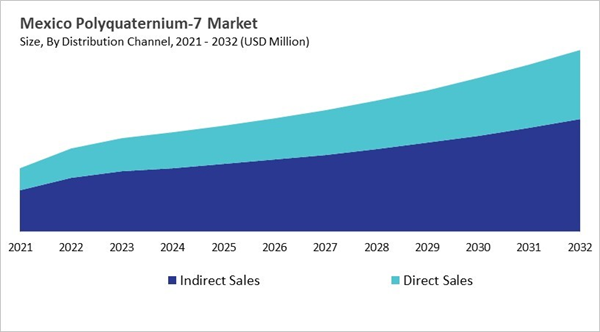
Country Outlook
The US Polyquaternium-7 market has grown from a small niche conditioning polymer segment to a mature and widely used part of personal care products. This is due to improvements in polymer chemistry and a growing need for ingredients that can do more than one thing. Better manufacturing processes, better performance, and meeting strict regulatory standards have all helped it grow. Some of the most important trends are the growing demand for eco-friendly and clean-label products, new technologies that make polymers more efficient and compatible, and the move toward multifunctional products that offer conditioning, moisturizing, and protection benefits. To meet changing consumer and regulatory needs, market leaders focus on new ideas, strategic partnerships, and making products in the same area as their customers. At the same time, competition between global and regional players keeps driving product differentiation, cost-effectiveness, and ongoing improvements in polymer technology.List of Key Companies Profiled
- AkzoNobel N.V.
- Ashland Inc.
- The Lubrizol Corporation (Berkshire Hathaway Inc.)
- BASF SE
- Clariant AG
- The Dow Chemical Company
- Evonik Industries AG (RAG-Stiftung)
- Solvay SA
Market Report Segmentation
By Form- Liquid
- Powder
- Hair Care
- Skin Care
- Personal Hygiene
- Cosmetic Formulations
- Other Application
- Indirect Sales
- Direct Sales
- Personal Care & Cosmetics
- Pharmaceuticals
- Industrial Applications
- Other End-Use Industry
- US
- Canada
- Mexico
- Rest of North America
Table of Contents
Chapter 1. Market Scope & Methodology
Chapter 2. Market at a Glance
Chapter 3. Market Overview
Chapter 4. Market Trends - North America Polyquaternium-7 market
Chapter 5. State of Competition - North America Polyquaternium-7 Market
Chapter 6. Market Consolidation - North America Polyquaternium Market
Chapter 7. Key Customer Criteria - North America Polyquaternium-7 Market
Chapter 8. Product Life Cycle - North America Polyquaternium-7 Market
Chapter 9. Value Chain Analysis of Polyquaternium-7 Market
Chapter 10. Competition Analysis - Global
Chapter 11. North America Polyquaternium-7 Market by Form
Chapter 12. North America Polyquaternium-7 Market by Application
Chapter 13. North America Polyquaternium-7 Market by Distribution Channel
Chapter 14. North America Polyquaternium-7 Market by End-Use Industry
Chapter 15. North America Polyquaternium-7 Market by Country
Chapter 16. Company Profiles
Companies Mentioned
- AkzoNobel N.V.
- Ashland Inc.
- The Lubrizol Corporation (Berkshire Hathaway Inc.)
- BASF SE
- Clariant AG
- The Dow Chemical Company
- Evonik Industries AG (RAG-Stiftung)
- Solvay SA


