



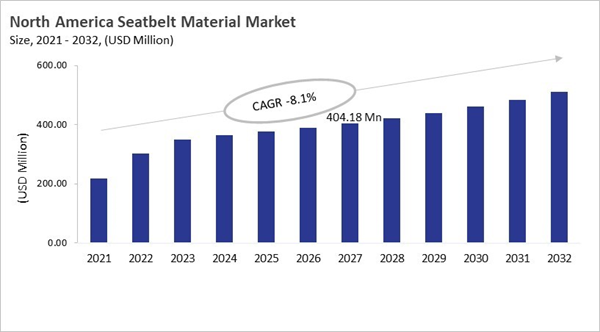
The North America Seatbelt Material Market is expected to reach $404.18 million by 2027 and is expected to witness market growth of 4.5% CAGR during the forecast period (2025-2032).
The US market dominated the North America Seatbelt Material Market by country in 2024, and is expected to continue to be a dominant market till 2032; thereby, achieving a market value of $369.5 million by 2032. The Canada market is experiencing a CAGR of 7.2% during 2025-2032. Additionally, the Mexico market is expected to exhibit a CAGR of 5.3% during 2025-2032. The US and Mexico led the North America Seatbelt Material Market by Country with a market share of 76.2% and 10.9% in 2024.
As the movement for safer cars and stricter safety rules grew, so did the North America Seatbelt Material Market. Early seatbelts were made of strong woven nylon fabrics that could handle a lot of stress during crashes. Over time, better high-strength polymers, multi-filament weaving, and composite materials made things last longer and work better. The use of three-point seatbelt systems, pre-tensioners, and force limiters made the need for stronger and more reliable materials even greater. Today, the market is mostly interested in mechanical strength, comfort, resistance to wear, and how well it works with advanced vehicle safety systems.
The market is changing because of things like the use of advanced safety technologies, the move toward using materials that are more environmentally friendly and recycled, and the creation of smart seatbelt systems that work with electronics and have sensors. To stay ahead of the competition, market leaders focus on new ideas, working with automotive OEMs, and expanding production in new areas. Technological progress and cost-effectiveness drive competition. Global suppliers use their size to their advantage, while regional players focus on customization and quicker delivery.
The US market dominated the North America Seatbelt Material Market by country in 2024, and is expected to continue to be a dominant market till 2032; thereby, achieving a market value of $369.5 million by 2032. The Canada market is experiencing a CAGR of 7.2% during 2025-2032. Additionally, the Mexico market is expected to exhibit a CAGR of 5.3% during 2025-2032. The US and Mexico led the North America Seatbelt Material Market by Country with a market share of 76.2% and 10.9% in 2024.
As the movement for safer cars and stricter safety rules grew, so did the North America Seatbelt Material Market. Early seatbelts were made of strong woven nylon fabrics that could handle a lot of stress during crashes. Over time, better high-strength polymers, multi-filament weaving, and composite materials made things last longer and work better. The use of three-point seatbelt systems, pre-tensioners, and force limiters made the need for stronger and more reliable materials even greater. Today, the market is mostly interested in mechanical strength, comfort, resistance to wear, and how well it works with advanced vehicle safety systems.
The market is changing because of things like the use of advanced safety technologies, the move toward using materials that are more environmentally friendly and recycled, and the creation of smart seatbelt systems that work with electronics and have sensors. To stay ahead of the competition, market leaders focus on new ideas, working with automotive OEMs, and expanding production in new areas. Technological progress and cost-effectiveness drive competition. Global suppliers use their size to their advantage, while regional players focus on customization and quicker delivery.
Material Type Outlook
Based on Material Type, the market is segmented into Steel & Aluminium, Nylon, and Polycarbonate. The Steel & Aluminium market segment dominated the Canada Seatbelt Material Market by Material Type is expected to grow at a CAGR of 6.6 % during the forecast period thereby continuing its dominance until 2032. Also, The Polycarbonate market is anticipated to grow as a CAGR of 7.9 % during the forecast period during 2025-2032.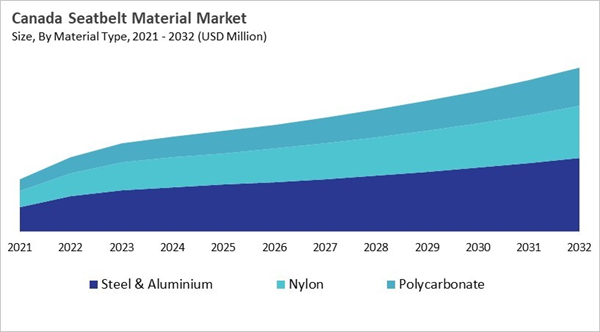
Component Outlook
Based on Component, the market is segmented into Retractor, Buckle, Anchor, and Other Component. Among various Mexico Seatbelt Material Market by Component; The Retractor market achieved a market size of USD $20.1 Million in 2024 and is expected to grow at a CAGR of 4.8 % during the forecast period. The Buckle market is predicted to experience a CAGR of 5.5% throughout the forecast period from (2025-2032).Country Outlook
The US seatbelt material market originated from mid-20th century automotive safety initiatives and regulatory mandates that encouraged the adoption of durable seatbelt fabrics such as nylon and polyester. Over time, materials evolved into high-tenacity fibers with enhanced coatings to improve durability, UV resistance, and load-bearing capacity, especially with the introduction of technologies like pre-tensioners and force limiters. Currently, the market is influenced by trends such as adaptive and inflatable seatbelt systems, stricter regulatory scrutiny following safety recalls, and increasing emphasis on environmentally sustainable and domestically sourced materials. Manufacturers are investing in advanced fibers, improved weaving techniques, and materials compatible with electronic safety systems. Strategic partnerships with automotive OEMs and investments in automation and localized production also support market development. Competition is driven by both innovation in high-performance materials and cost efficiency, with global suppliers leveraging strong R&D capabilities while regional manufacturers focus on localized customization and faster supply.List of Key Companies Profiled
- Autoliv, Inc.
- Joyson Safety Systems Aschaffenburg GmbH
- ZF Friedrichshafen AG
- Yanfeng International Automotive Technology Co. Ltd.
- GWR Safety Systems
- Holmbergs Safety System Holding AB
- Robert Bosch GmbH
- Tokai Rika Co., Ltd.
- Ashimori Industry Co., Ltd.
- Continental AG
Market Report Segmentation
By Material Type- Steel & Aluminium
- Nylon
- Polycarbonate
- Passenger Car
- Light Commercial Vehicle
- Heavy Commercial Vehicle
- Retractor
- Buckle
- Anchor
- Other Component
- US
- Canada
- Mexico
- Rest of North America
Table of Contents
Chapter 1. Market Scope & Methodology
Chapter 2. Market at a Glance
Chapter 3. Market Overview
Chapter 4. Market Trends - North America Seatbelt Material Market
Chapter 5. State of Competition - North America Seatbelt Material Market
Chapter 6. Market Consolidation - North America Seatbelt Material Market
Chapter 7. Key Customer Criteria - North America Seatbelt Material Market
Chapter 8. Product Life Cycle - North America Seatbelt Material Market
Chapter 9. Value Chain Analysis of Seatbelt Material Market
Chapter 10. Competitive Analysis - Global
Chapter 11. North America Seatbelt Material Market by Material Type
Chapter 12. North America Seatbelt Material Market by Vehicle Type
Chapter 13. North America Seatbelt Material Market by Component
Chapter 14. North America Seatbelt Material Market by Country
Chapter 15. Company Profiles
Companies Mentioned
- Autoliv, Inc.
- Joyson Safety Systems Aschaffenburg GmbH
- ZF Friedrichshafen AG
- Yanfeng International Automotive Technology Co. Ltd.
- GWR Safety Systems
- Holmbergs Safety System Holding AB
- Robert Bosch GmbH
- Tokai Rika Co., Ltd.
- Ashimori Industry Co., Ltd.
- Continental AG


