



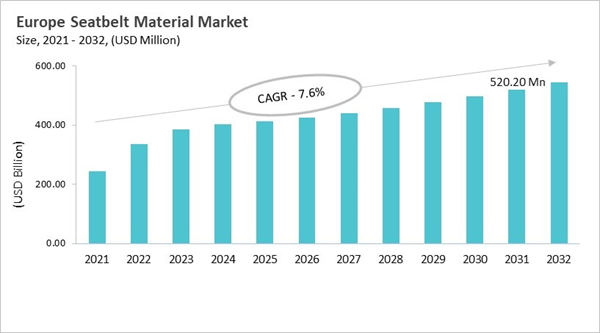
The Europe Seatbelt Material Market is expected to reach $520.20 billion by 2031 and is expected to witness market growth of 4.0% CAGR during the forecast period (2025-2032).
The Germany market dominated the Europe Seatbelt Material Market by country in 2024, and is expected to continue to be a dominant market till 2032; thereby, achieving a market value of $114.7 million by 2032. The UK market is exhibiting a CAGR of 2.4% during 2025-2032. Additionally, the France market is expected to showcase a CAGR of 4.9% during 2025-2032. The Germany and UK led the Europe Seatbelt Material Market by Country with a market share of 23.3% and 11.4% in 2024. The Italy market is expected to witness a CAGR of 4.6% during throughout the forecast period.
The Europe seatbelt material market originated from the early automotive safety movement in the mid-20th century when seatbelts were introduced to reduce injuries during collisions. Early materials mainly included durable woven fabrics such as nylon, later evolving into high-strength polyester and coated textiles to improve abrasion resistance, durability, and load-bearing capacity. Technological developments like pre-tensioners and force limiters required materials capable of handling variable stress conditions. Over time, stricter European safety regulations and rising consumer expectations encouraged the development of advanced polymer-based materials, smart textile integration, and environmentally sustainable production processes. As a result, the market has transitioned from basic mechanical restraint fabrics to sophisticated materials designed for enhanced safety, comfort, and compatibility with modern vehicle safety systems.
Currently, the market is shaped by trends such as smart seatbelt technologies with embedded sensors, increasing emphasis on sustainability in material sourcing and coatings, and the demand for lightweight materials to support vehicle efficiency and electrification goals. Leading companies focus on R&D investments, collaborations with automotive OEMs, and localized production within major European automotive hubs to enhance responsiveness and customization. Competition is intense, with global suppliers leveraging technological innovation and large R&D capabilities, while regional players focus on specialized expertise and localized solutions. Overall, the competitive landscape balances innovation, sustainability, and cost efficiency to meet evolving automotive safety standards.
The Germany market dominated the Europe Seatbelt Material Market by country in 2024, and is expected to continue to be a dominant market till 2032; thereby, achieving a market value of $114.7 million by 2032. The UK market is exhibiting a CAGR of 2.4% during 2025-2032. Additionally, the France market is expected to showcase a CAGR of 4.9% during 2025-2032. The Germany and UK led the Europe Seatbelt Material Market by Country with a market share of 23.3% and 11.4% in 2024. The Italy market is expected to witness a CAGR of 4.6% during throughout the forecast period.
The Europe seatbelt material market originated from the early automotive safety movement in the mid-20th century when seatbelts were introduced to reduce injuries during collisions. Early materials mainly included durable woven fabrics such as nylon, later evolving into high-strength polyester and coated textiles to improve abrasion resistance, durability, and load-bearing capacity. Technological developments like pre-tensioners and force limiters required materials capable of handling variable stress conditions. Over time, stricter European safety regulations and rising consumer expectations encouraged the development of advanced polymer-based materials, smart textile integration, and environmentally sustainable production processes. As a result, the market has transitioned from basic mechanical restraint fabrics to sophisticated materials designed for enhanced safety, comfort, and compatibility with modern vehicle safety systems.
Currently, the market is shaped by trends such as smart seatbelt technologies with embedded sensors, increasing emphasis on sustainability in material sourcing and coatings, and the demand for lightweight materials to support vehicle efficiency and electrification goals. Leading companies focus on R&D investments, collaborations with automotive OEMs, and localized production within major European automotive hubs to enhance responsiveness and customization. Competition is intense, with global suppliers leveraging technological innovation and large R&D capabilities, while regional players focus on specialized expertise and localized solutions. Overall, the competitive landscape balances innovation, sustainability, and cost efficiency to meet evolving automotive safety standards.
Material Type Outlook
Based on Material Type, the market is segmented into Steel & Aluminium, Nylon, and Polycarbonate. Among various UK Seatbelt Material Market by Material Type; The Steel & Aluminium market achieved a market size of USD $21.5 Million in 2024 and is expected to grow at a CAGR of 1.9 % during the forecast period. The Polycarbonate market is predicted to experience a CAGR of 3.1% throughout the forecast period from (2025-2032).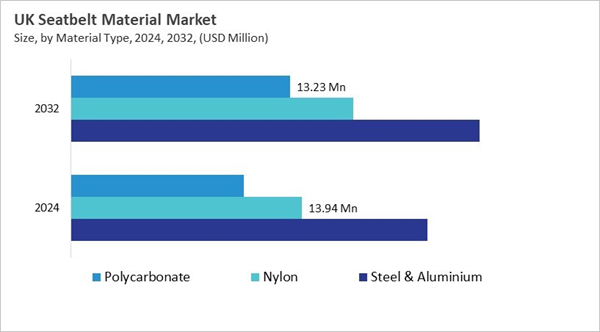
Vehicle Type Outlook
Based on Vehicle Type, the market is segmented into Passenger Car, Light Commercial Vehicle, and Heavy Commercial Vehicle. The Passenger Car market segment dominated the France Seatbelt Material Market by Vehicle Type is expected to grow at a CAGR of 4.6 % during the forecast period thereby continuing its dominance until 2032. Also, The Heavy Commercial Vehicle market is anticipated to grow as a CAGR of 5.2 % during the forecast period during 2025-2032.Country Outlook
The Germany Seatbelt Material Market originated in the mid-1970s following the mandatory introduction of seatbelts in vehicles in 1976, which established a strong foundation for automotive safety development. Over time, the market evolved from basic textile components to advanced composite materials featuring reinforced synthetic fibers and eco-friendly coatings for improved durability and sustainability. Today, the market is shaped by trends such as sustainable manufacturing practices, advancements in high-resistance materials, and the integration of digital technologies like sensor-embedded seatbelt systems. These innovations support the development of smarter and safer restraint systems aligned with semi-autonomous and AI-driven vehicle technologies. Leading companies focus on research and development, strategic partnerships with automotive manufacturers, and localized production to strengthen supply chains and meet regulatory requirements. Competition remains dynamic, balancing cost efficiency with technological innovation, where regional firms leverage proximity to automotive hubs while global players contribute advanced technological expertise and large-scale capabilities.List of Key Companies Profiled
- Autoliv, Inc.
- Joyson Safety Systems Aschaffenburg GmbH
- ZF Friedrichshafen AG
- Yanfeng International Automotive Technology Co. Ltd.
- GWR Safety Systems
- Holmbergs Safety System Holding AB
- Robert Bosch GmbH
- Tokai Rika Co., Ltd.
- Ashimori Industry Co., Ltd.
- Continental AG
Market Report Segmentation
By Material Type- Steel & Aluminium
- Nylon
- Polycarbonate
- Passenger Car
- Light Commercial Vehicle
- Heavy Commercial Vehicle
- Retractor
- Buckle
- Anchor
- Other Component
- Germany
- UK
- France
- Russia
- Spain
- Italy
- Rest of Europe
Table of Contents
Chapter 1. Market Scope & Methodology
Chapter 2. Market at a Glance
Chapter 3. Market Overview
Chapter 4. Market Trends - Europe Seatbelt Material Market
Chapter 5. State of Competition - Europe Seatbelt Material Market
Chapter 6. Market Consolidation - Europe Seatbelt Material Market
Chapter 7. Key Criteria Customer - Europe Seatbelt Material Market
Chapter 8. Product Life Cycle - Europe Seatbelt Material Market
Chapter 9. Value Chain Analysis of Seatbelt Material Market
Chapter 10. Competitive Analysis - Global
Chapter 11. Europe Seatbelt Material Market by Material Type
Chapter 12. Europe Seatbelt Material Market by Vehicle Type
Chapter 13. Europe Seatbelt Material Market by Component
Chapter 14. Europe Seatbelt Material Market by Country
Chapter 15. Company Profiles
Companies Mentioned
- Autoliv, Inc.
- Joyson Safety Systems Aschaffenburg GmbH
- ZF Friedrichshafen AG
- Yanfeng International Automotive Technology Co. Ltd.
- GWR Safety Systems
- Holmbergs Safety System Holding AB
- Robert Bosch GmbH
- Tokai Rika Co., Ltd.
- Ashimori Industry Co., Ltd.
- Continental AG


