



The Asia Pacific Generative AI In Agriculture Market is expected to reach $212.25 million by 2029 and is expected to witness market growth of 28.7% CAGR during the forecast period (2025-2032).
The China market dominated the Asia Pacific Generative AI In Agriculture Market by country in 2024, and is expected to continue to be a dominant market till 2032; thereby, achieving a market value of $124 million by 2032. The Japan market is showcasing a CAGR of 27.5% during 2025-2032. Additionally, the India market is expected to witness a CAGR of 29.4% during 2025-2032. The China and India led the Asia Pacific Generative AI In Agriculture Market by Country with a market share of 30.4% and 18.3% in 2024. The Singapore market is expected to witness a CAGR of 31.1% during throughout the forecast period.
Generative AI in Asia Pacific agriculture has evolved from early precision farming into advanced systems that simulate crop responses, model climate scenarios, and generate adaptive farming strategies. Its development is strongly driven by government-led digital transformation and food security programs supported by bodies such as the Food and Agriculture Organization. Countries including Japan, India, and Australia promote smart agriculture through national initiatives, with institutions like Ministry of Agriculture, Forestry and Fisheries and CSIRO integrating AI into irrigation planning, yield forecasting, and climate resilience tools.
Key trends include policy-backed smart agriculture projects, climate-adaptive AI models, and the integration of AI into connected machinery and cloud platforms. OEMs such as Kubota embed AI into equipment, while technology firms like Microsoft provide scalable analytics infrastructure. Public-private collaboration and support from institutions such as the Asian Development Bank strengthen ecosystem-wide adoption. Overall, competition centers on interoperability, access to agricultural data, and alignment with sustainability and climate adaptation goals across diverse farming systems.
The China market dominated the Asia Pacific Generative AI In Agriculture Market by country in 2024, and is expected to continue to be a dominant market till 2032; thereby, achieving a market value of $124 million by 2032. The Japan market is showcasing a CAGR of 27.5% during 2025-2032. Additionally, the India market is expected to witness a CAGR of 29.4% during 2025-2032. The China and India led the Asia Pacific Generative AI In Agriculture Market by Country with a market share of 30.4% and 18.3% in 2024. The Singapore market is expected to witness a CAGR of 31.1% during throughout the forecast period.
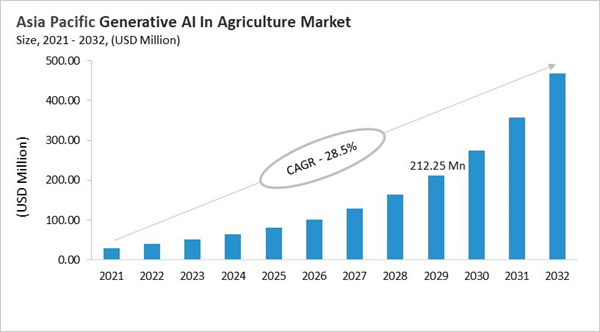
Generative AI in Asia Pacific agriculture has evolved from early precision farming into advanced systems that simulate crop responses, model climate scenarios, and generate adaptive farming strategies. Its development is strongly driven by government-led digital transformation and food security programs supported by bodies such as the Food and Agriculture Organization. Countries including Japan, India, and Australia promote smart agriculture through national initiatives, with institutions like Ministry of Agriculture, Forestry and Fisheries and CSIRO integrating AI into irrigation planning, yield forecasting, and climate resilience tools.
Key trends include policy-backed smart agriculture projects, climate-adaptive AI models, and the integration of AI into connected machinery and cloud platforms. OEMs such as Kubota embed AI into equipment, while technology firms like Microsoft provide scalable analytics infrastructure. Public-private collaboration and support from institutions such as the Asian Development Bank strengthen ecosystem-wide adoption. Overall, competition centers on interoperability, access to agricultural data, and alignment with sustainability and climate adaptation goals across diverse farming systems.
Technology Outlook
Based on technology, the generative AI In agriculture market is segmented into machine learning, computer vision, natural language processing (NLP), and GANs. With a compound annual growth rate (CAGR) of 25.7% over the projection period, the Machine Learning Market, dominate the China Generative AI In Agriculture Market by Technology in 2024 and would be a prominent market until 2032. The Natural Language Processing (NLP) market is expected to witness a CAGR of 27.3% during 2025-2032.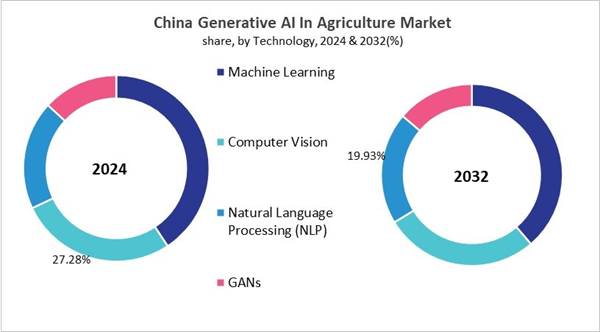
Application Outlook
Based on application, the generative AI In agriculture market is segmented into agricultural robotics & automation, precision farming, livestock management, weather forecasting, and other application. The Agricultural Robotics & Automation market segment dominated the Japan Generative AI In Agriculture Market by Application is expected to grow at a CAGR of 25.9 % during the forecast period thereby continuing its dominance until 2032. Also, The Weather Forecasting market is anticipated to grow as a CAGR of 28.8 % during the forecast period during 2025-2032.Country Outlook
As part of its larger smart agriculture and rural revitalization strategy, China is quickly incorporating generative AI into its farming sector. Government policy encourages AI, IoT, and data-driven systems to help businesses become more productive, environmentally friendly, and secure in their food supply. Key factors include the needs of large-scale farming, a strong digital infrastructure, and the desire to reduce rural poverty while making the best use of resources. Market trends show a move away from pilot projects and toward using AI-powered drones, autonomous machines, and field robots for crop and soil monitoring in real life. Researchers also use generative AI to speed up the growth of crops by using it in breeding programs and genotype-environment analysis. Collaboration between state institutions, universities, and tech companies that make integrated data platforms and predictive tools is a big part of competition. Even though there are still problems with data interoperability and regional diversity, continued policy support and coordination between the public and private sectors are expected to make generative AI a part of core farming operations. This will improve China's long-term productivity and sustainability.List of Key Companies Profiled
- Microsoft Corporation
- Bayer AG
- BASF SE
- IBM Corporation
- Trimble, Inc.
- AgEagle Aerial Systems, Inc.
- AGCO Corporation
- Valmont Industries, Inc.
- Raven Industries, Inc.
- A.A.A Taranis Visual Ltd.
Market Report Segmentation
By Technology- Machine Learning
- Computer Vision
- Natural Language Processing (NLP)
- GANs
- Agricultural Robotics & Automation
- Precision Farming
- Livestock Management
- Weather Forecasting
- Other Application
- China
- Japan
- India
- South Korea
- Singapore
- Malaysia
- Rest of Asia Pacific
Table of Contents
Chapter 1. Market Scope & Methodology
Chapter 2. Market at a Glance
Chapter 3. Market Overview
Chapter 10. Competition Analysis - Global
Chapter 11. Asia Pacific Generative AI In Agriculture Market by Technology
Chapter 12. Asia Pacific Generative AI In Agriculture Market by Application
Chapter 13. Asia Pacific Generative AI In Agriculture Market by Country
Chapter 14. Company Profiles
Chapter 15. Company Profiles
Companies Mentioned
- Microsoft Corporation
- Bayer AG
- BASF SE
- IBM Corporation
- Trimble, Inc.
- AgEagle Aerial Systems, Inc.
- AGCO Corporation
- Valmont Industries, Inc.
- Raven Industries, Inc.
- A.A.A Taranis Visual Ltd.


