



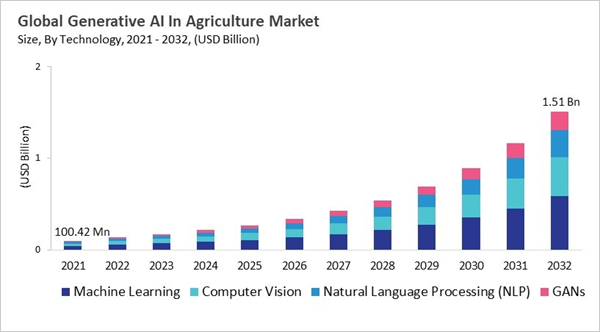
The Global Generative AI In Agriculture Market size is estimated at $267.46 million in 2025 and is expected to reach $1.51 billion by 2032, rising at a market growth of 28.1% CAGR during the forecast period (2025-2032). The market’s projected expansion reflects accelerating adoption of AI-driven precision farming, automated crop monitoring, and predictive analytics to boost yields and reduce costs. Rising global food demand, climate variability, and government support for smart agriculture are driving investments in generative AI solutions, justifying strong growth expectations through 2032.
Generative AI in agriculture showcases a major transformation from traditional data analysis toward predictive, scenario-based, and decision-support systems. Generative AI allows agribusinesses and farmers to optimize resource use, simulate crop outcomes, and plan for climate variability. AI adoption has developed from experimental yield prediction tools into commercially deployed platforms that improve sustainability, productivity, and food system resilience. This is because of increasing support by global institutions such as the FAO and national bodies like the US Department of Agriculture and the European Commission. Further, the maturing cloud computing and large-scale data infrastructure have surged this shift, enabling generative models to integrate agronomic, environmental, and market data into actionable insights.
The generative AI in agriculture market is flourishing, supported by trends like integration of generative AI with precision farming, cloud-based advisory platforms, and climate-smart agriculture. Equipment manufacturers like John Deere embed AI directly into connected and autonomous machinery, while technology providers such as IBM and Microsoft deliver scalable AI platforms that democratize access to advanced analytics for farms of all sizes. Organizations such as the World Economic Forum prioritize generative AI’s role in addressing uncertainties of climate by modelling alternative crop, soil strategies, and irrigation. The market competition largely centers on ecosystem integration, combining software, hardware, data, and advisory services, thereby positioning generative AI as a core component for next-generation, sustainable digital agriculture systems.
The leading players in the market are competing with diverse innovative offerings to remain competitive in the market. The above illustration shows the percentage of revenue shared by some of the leading companies in the market. The leading players of the market are adopting various strategies to cater demand coming from the different industries. The key developmental strategies in the market are Acquisitions, and Partnerships & Collaborations.
The generative AI in agriculture market is anticipated to expand at a significant rate in the Asia Pacific region. This is due to rapid digital connectivity expansion, a large agricultural population, and government programmes in nations such as India, China, and Japan that promote AI-enabled advisory services and agricultural modernization. Moreover, LAMEA generative AI in the agriculture market is growing significantly. This is because regional nations are largely experimenting with AI for climate adaptation and yield prediction. Also, in the Middle East and Africa, generative AI applications like climate-resilient crop modelling and irrigation scheduling are gaining traction as solutions to food security and water scarcity challenges.
Key Market Trends & Insights:
- The North America market dominated Global Generative AI In Agriculture Market in 2024, accounting for a 36.80% revenue share in 2024.
- The U.S. market is projected to maintain its leadership in North America, reaching a market size of USD 359.07 million by 2032.
- Among the various Application, the Agricultural Robotics & Automation segment dominated the global market, contributing a revenue share of 37.16% in 2024.
- In terms of Technology, Machine Learning segments are expected to lead the global market, with a projected revenue share of 38.93% by 2032.
Generative AI in agriculture showcases a major transformation from traditional data analysis toward predictive, scenario-based, and decision-support systems. Generative AI allows agribusinesses and farmers to optimize resource use, simulate crop outcomes, and plan for climate variability. AI adoption has developed from experimental yield prediction tools into commercially deployed platforms that improve sustainability, productivity, and food system resilience. This is because of increasing support by global institutions such as the FAO and national bodies like the US Department of Agriculture and the European Commission. Further, the maturing cloud computing and large-scale data infrastructure have surged this shift, enabling generative models to integrate agronomic, environmental, and market data into actionable insights.
The generative AI in agriculture market is flourishing, supported by trends like integration of generative AI with precision farming, cloud-based advisory platforms, and climate-smart agriculture. Equipment manufacturers like John Deere embed AI directly into connected and autonomous machinery, while technology providers such as IBM and Microsoft deliver scalable AI platforms that democratize access to advanced analytics for farms of all sizes. Organizations such as the World Economic Forum prioritize generative AI’s role in addressing uncertainties of climate by modelling alternative crop, soil strategies, and irrigation. The market competition largely centers on ecosystem integration, combining software, hardware, data, and advisory services, thereby positioning generative AI as a core component for next-generation, sustainable digital agriculture systems.
Driving and Restraining Factors
Drivers- Precision Agriculture and Data-Driven Farm Management
- Climate Change Adaptation and Risk Mitigation
- Labor Shortages and Automation Imperatives
- Supply Chain Transparency and Consumer Demand For Food Safety
- Data Governance, Quality, And Sharing Limitations
- Technical Infrastructure, Implementation Costs, And Accessibility Barriers
- Trust, Reliability, And Decision-Support Uncertainty
- Personalized Agronomic and Farm Advisory Platforms Powered by Generative AI
- Intelligent Crop Health Monitoring, Early Detection, and Predictive Resilience Modeling
- Farm Automation, Robotics Integration, and Decision Generation Across the Value Chain
- Data Governance, Privacy, And Ethical Use of Generative AI In Agriculture
- Technical Integration, Infrastructure Limitations, And Farm-Level Connectivity
- Skills Gap, Workforce Readiness, And Interpretability of Generative AI Outputs
Market Share Analysis
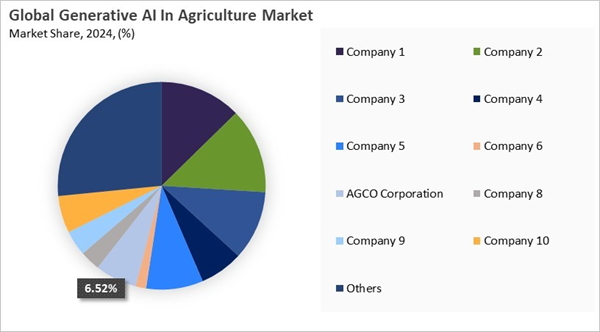
The leading players in the market are competing with diverse innovative offerings to remain competitive in the market. The above illustration shows the percentage of revenue shared by some of the leading companies in the market. The leading players of the market are adopting various strategies to cater demand coming from the different industries. The key developmental strategies in the market are Acquisitions, and Partnerships & Collaborations.
COVID-19 Impact Analysis
At first, the COVID-19 pandemic slowed down Generative AI in Agriculture market because it messed up the supply chain, limited movement, and delayed the rollout of AI-enabled hardware and systems. Lockdowns pushed back pilot projects for crop planning, yield prediction, and soil analysis because farms cared more about staying alive in the short term than using new technology. Financial stress made people less likely to invest, especially in small and medium-sized farms that were having trouble getting cash and finding workers. Investors moved away from agri-tech startups and toward more important sectors, which led to a drop in venture funding for these companies. Limited field operations and a lack of workers made it hard to collect data and train models. There were big delays in the installation, integration, and training of farmers. Uncertainty in trade and limits on exports made it even harder to move to digital. In general, the early days of the pandemic made people more careful about how they spent their money and slowed down the commercialization of generative AI solutions in agriculture. Thus, the COVID-19 pandemic had a negative impact on the market.Technology Outlook
Based on technology, the generative AI In agriculture market is segmented into machine learning, computer vision, natural language processing (NLP), and GANs. The Computer Vision segment attained 28% revenue share in the market in 2024. This technology plays a transformative role in modern agriculture by enabling machines to interpret and analyze visual data captured through cameras, drones, and satellite systems. Computer vision applications are extensively used for crop monitoring, plant disease detection, weed identification, and fruit grading.Application Outlook
Based on application, the generative AI In agriculture market is segmented into agricultural robotics & automation, precision farming, livestock management, weather forecasting, and other application. The precision farming segment attained 30% revenue share in the market in 2024. This application leverages generative AI to optimize agricultural inputs and maximize crop productivity through data-driven decision-making. Precision farming systems analyze real-time data collected from soil sensors, satellite imagery, weather stations, and farm equipment to tailor irrigation, fertilization, and pest control measures to specific field zones.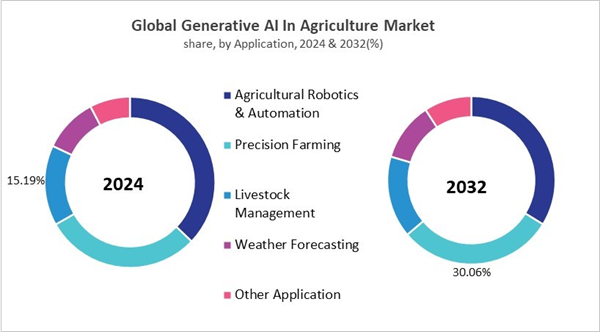
Regional Outlook
Region-wise, the generative AI in agriculture market is analyzed across North America, Europe, Asia Pacific, and LAMEA. In the North America region, the generative AI in agriculture market is estimated to experience prominent expansion. The market growth is supported by widespread precision farming adoption, advanced digital infrastructure, and strong investment in R&D. The regional nations lead with robust AI integration in autonomous equipment, crop modelling, and data-driven decision tools, propelled by favourable policy incentives and agritech innovation partnerships that surge practical deployment on large commercial farms. Regional farmers benefit from early adoption of generative AI tools that enhance yield forecasting, optimize resource use, and automate labor-intensive tasks, thereby fuelling market growth. Furthermore, Europe’s generative AI in agriculture market is also showcasing lucrative opportunities. This is due to strong regulatory focus on cross-border digital farming initiatives and climate-smart agriculture. Regional nations like France, Germany, and the Netherlands are advancing AI-based solutions for environmental monitoring, precision farming, and efficient resource management, thus supporting the market expansion.The generative AI in agriculture market is anticipated to expand at a significant rate in the Asia Pacific region. This is due to rapid digital connectivity expansion, a large agricultural population, and government programmes in nations such as India, China, and Japan that promote AI-enabled advisory services and agricultural modernization. Moreover, LAMEA generative AI in the agriculture market is growing significantly. This is because regional nations are largely experimenting with AI for climate adaptation and yield prediction. Also, in the Middle East and Africa, generative AI applications like climate-resilient crop modelling and irrigation scheduling are gaining traction as solutions to food security and water scarcity challenges.
List of Key Companies Profiled
- Microsoft Corporation
- Bayer AG
- BASF SE
- IBM Corporation
- Trimble, Inc.
- AgEagle Aerial Systems, Inc.
- AGCO Corporation
- Valmont Industries, Inc.
- Raven Industries, Inc.
- A.A.A Taranis Visual Ltd.
Market Report Segmentation
By Technology- Machine Learning
- Computer Vision
- Natural Language Processing (NLP)
- GANs
- Agricultural Robotics & Automation
- Precision Farming
- Livestock Management
- Weather Forecasting
- Other Application
- North America
- US
- Canada
- Mexico
- Rest of North America
- Europe
- Germany
- UK
- France
- Russia
- Spain
- Italy
- Rest of Europe
- Asia Pacific
- China
- Japan
- India
- South Korea
- Singapore
- Malaysia
- Rest of Asia Pacific
- LAMEA
- Brazil
- Argentina
- UAE
- Saudi Arabia
- South Africa
- Nigeria
- Rest of LAMEA
Table of Contents
Chapter 1. Market Scope & Methodology
Chapter 2. Market at a Glance
Chapter 3. Market Overview
Chapter 10. Competition Analysis - Global
Chapter 11. Global Generative AI In Agriculture Market by Technology
Chapter 12. Global Generative AI In Agriculture Market by Application
Chapter 13. Global Generative AI In Agriculture Market by Region
Chapter 14. Company Profiles
Chapter 15. Company Profiles
Companies Mentioned
- Microsoft Corporation
- Bayer AG
- BASF SE
- IBM Corporation
- Trimble, Inc.
- AgEagle Aerial Systems, Inc.
- AGCO Corporation
- Valmont Industries, Inc.
- Raven Industries, Inc.
- A.A.A Taranis Visual Ltd.


