



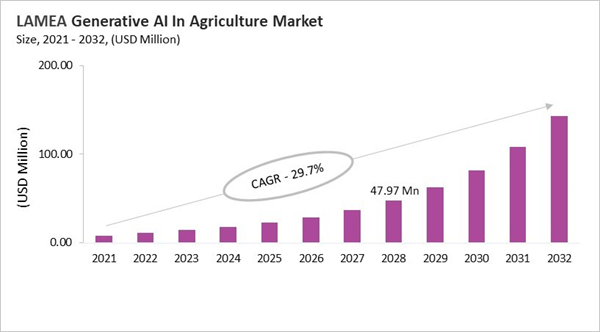
The Latin America, Middle East and Africa Generative AI In Agriculture Market is expected to reach $47.97 million by 2028 and is expected to witness market growth of 30.1% CAGR during the forecast period (2025-2032).
The Brazil market dominated the LAMEA Generative AI In Agriculture Market by country in 2024, and is expected to continue to be a dominant market till 2032; thereby, achieving a market value of $43.9 million by 2032. The Argentina market is showcasing a CAGR of 30.6% during 2025-2032. Additionally, the UAE market would register a CAGR of 27.9% during 2025-2032. The Brazil and Argentina led the LAMEA Generative AI In Agriculture Market by Country with a market share of 33.2% and 14.6% in 2024. The South Africa market is expected to witness a CAGR of 31.3% during throughout the forecast period.
Generative AI in LAMEA agriculture has evolved from early satellite monitoring and mobile advisory tools into advanced systems that simulate climate scenarios and generate adaptive farming strategies. Its growth is driven by food security and resilience priorities supported by organizations such as the Food and Agriculture Organization, the Inter-American Development Bank, and the African Development Bank. In Latin America, research bodies like Embrapa integrate climate and soil data into AI advisory platforms, while in Africa and the Middle East, generative AI supports drought management, irrigation planning, and controlled-environment farming.
Key trends include the use of generative AI for climate adaptation, expansion of AI-based advisory services for smallholder farmers, and the adoption of connected machinery and data ecosystems. OEMs such as John Deere embed sensors and cloud connectivity into equipment to enable real-time, scenario-based recommendations. Market development relies heavily on public-private partnerships and development finance programs that promote inclusive digital transformation. Competitive advantage depends on localized AI models, access to regional datasets, and alignment with sustainability and national policy goals, positioning generative AI as a strategic tool for resilience and productivity across diverse LAMEA farming systems.
The Brazil market dominated the LAMEA Generative AI In Agriculture Market by country in 2024, and is expected to continue to be a dominant market till 2032; thereby, achieving a market value of $43.9 million by 2032. The Argentina market is showcasing a CAGR of 30.6% during 2025-2032. Additionally, the UAE market would register a CAGR of 27.9% during 2025-2032. The Brazil and Argentina led the LAMEA Generative AI In Agriculture Market by Country with a market share of 33.2% and 14.6% in 2024. The South Africa market is expected to witness a CAGR of 31.3% during throughout the forecast period.
Generative AI in LAMEA agriculture has evolved from early satellite monitoring and mobile advisory tools into advanced systems that simulate climate scenarios and generate adaptive farming strategies. Its growth is driven by food security and resilience priorities supported by organizations such as the Food and Agriculture Organization, the Inter-American Development Bank, and the African Development Bank. In Latin America, research bodies like Embrapa integrate climate and soil data into AI advisory platforms, while in Africa and the Middle East, generative AI supports drought management, irrigation planning, and controlled-environment farming.
Key trends include the use of generative AI for climate adaptation, expansion of AI-based advisory services for smallholder farmers, and the adoption of connected machinery and data ecosystems. OEMs such as John Deere embed sensors and cloud connectivity into equipment to enable real-time, scenario-based recommendations. Market development relies heavily on public-private partnerships and development finance programs that promote inclusive digital transformation. Competitive advantage depends on localized AI models, access to regional datasets, and alignment with sustainability and national policy goals, positioning generative AI as a strategic tool for resilience and productivity across diverse LAMEA farming systems.
Technology Outlook
Based on technology, the generative AI In agriculture market is segmented into machine learning, computer vision, natural language processing (NLP), and GANs. With a compound annual growth rate (CAGR) of 28% over the projection period, the Machine Learning Market, dominate the Brazil Generative AI In Agriculture Market by Technology in 2024 and would be a prominent market until 2032. The Natural Language Processing (NLP) market is expected to witness a CAGR of 29.7% during 2025-2032.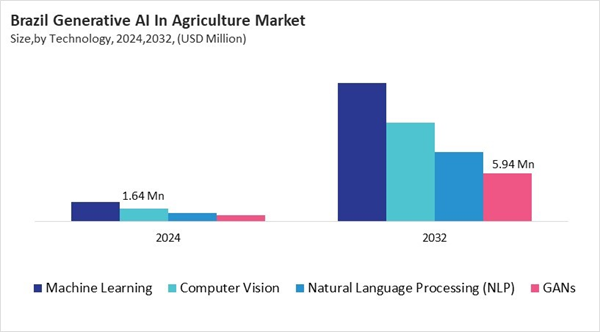
Application Outlook
Based on application, the generative AI In agriculture market is segmented into agricultural robotics & automation, precision farming, livestock management, weather forecasting, and other application. The Agricultural Robotics & Automation market segment dominated the South Africa Generative AI In Agriculture Market by Application is expected to grow at a CAGR of 31.5 % during the forecast period thereby continuing its dominance until 2032. Also, The Weather Forecasting market is anticipated to grow as a CAGR of 32.7 % during the forecast period during 2025-2032.Country Outlook
Brazil's agriculture sector is using generative AI increasingly as part of its larger Agro 4.0 and digital transformation plans. This is because of large-scale farming, being ready for digital technology, and climate change. Farmers and agribusinesses use AI to combine satellite, soil, and weather data into useful information for planning irrigation, using inputs, and harvesting. Organizations like Embrapa and state agencies help with technology transfer and training for farmers so that they can use it. Market trends stress making decisionsList of Key Companies Profiled
- Microsoft Corporation
- Bayer AG
- BASF SE
- IBM Corporation
- Trimble, Inc.
- AgEagle Aerial Systems, Inc.
- AGCO Corporation
- Valmont Industries, Inc.
- Raven Industries, Inc.
- A.A.A Taranis Visual Ltd.
Market Report Segmentation
By Technology- Machine Learning
- Computer Vision
- Natural Language Processing (NLP)
- GANs
- Agricultural Robotics & Automation
- Precision Farming
- Livestock Management
- Weather Forecasting
- Other Application
- Brazil
- Argentina
- UAE
- Saudi Arabia
- South Africa
- Nigeria
- Rest of LAMEA
Table of Contents
Chapter 1. Market Scope & Methodology
Chapter 2. Market at a Glance
Chapter 3. Market Overview
Chapter 10. Competition Analysis - Global
Chapter 11. LAMEA Generative AI In Agriculture Market by Technology
Chapter 12. LAMEA Generative AI In Agriculture Market by Application
Chapter 13. LAMEA Generative AI In Agriculture Market by Country
Chapter 14. Company Profiles
Chapter 15. Company Profiles
Companies Mentioned
- Microsoft Corporation
- Bayer AG
- BASF SE
- IBM Corporation
- Trimble, Inc.
- AgEagle Aerial Systems, Inc.
- AGCO Corporation
- Valmont Industries, Inc.
- Raven Industries, Inc.
- A.A.A Taranis Visual Ltd.


