



The LAMEA Automotive Metal Stamping Market size is projected to reach USD 9.64 billion by 2029, growing at a CAGR of 6.2% during the forecast period 2026-2033.
The LAMEA Automotive Metal Stamping Market is witnessing stable growth due to increasing automotive production, rising infrastructure activities, and expanding industrialization across Latin America, the Middle East, and Africa. The growing demand for passenger and commercial vehicles, along with increasing investments in regional automotive manufacturing facilities, is supporting the demand for stamped automotive components such as chassis systems, body structures, reinforcements, and engine-related parts.
The market is also benefiting from increasing localization initiatives, government support for domestic automotive manufacturing, and gradual adoption of advanced manufacturing technologies. Automotive OEMs and component suppliers are increasingly integrating automation, robotic stamping systems, and precision tooling technologies to improve manufacturing efficiency and reduce operational costs.
Brazil continues to lead the regional market owing to its strong automotive manufacturing base, increasing localization of vehicle production, and expanding investments in advanced stamping technologies. South Africa and Saudi Arabia are also contributing significantly due to increasing industrialization, infrastructure development, and rising commercial vehicle demand. Nigeria and the Rest of LAMEA region are witnessing gradual expansion supported by growing urbanization, improving logistics networks, and government initiatives aimed at strengthening domestic automotive supply chains. Furthermore, increasing adoption of lightweight materials and automation technologies is supporting long-term market development across the region.
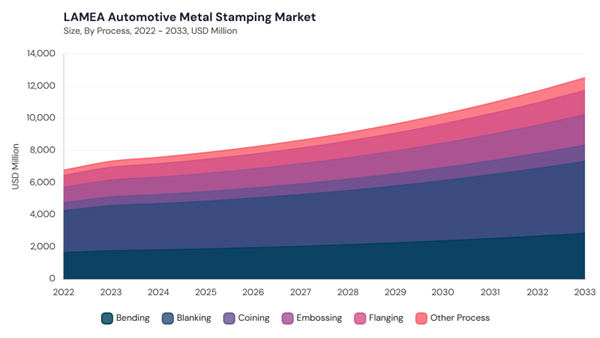
The LAMEA Automotive Metal Stamping Market is witnessing stable growth due to increasing automotive production, rising infrastructure activities, and expanding industrialization across Latin America, the Middle East, and Africa. The growing demand for passenger and commercial vehicles, along with increasing investments in regional automotive manufacturing facilities, is supporting the demand for stamped automotive components such as chassis systems, body structures, reinforcements, and engine-related parts.
The market is also benefiting from increasing localization initiatives, government support for domestic automotive manufacturing, and gradual adoption of advanced manufacturing technologies. Automotive OEMs and component suppliers are increasingly integrating automation, robotic stamping systems, and precision tooling technologies to improve manufacturing efficiency and reduce operational costs.
By Process Outlook
Based on Process, the market is segmented into Blanking, Bending, Embossing, Flanging, Coining, and Other Process. The Blanking segment dominated the LAMEA Automotive Metal Stamping Market in 2025 and is expected to continue to be a dominant segment till 2029; thereby, achieving a market value of USD 3.54 billion by 2029. The Other Process segment is expected to witness a CAGR of 8.3% during 2026-2033. Additionally, the Blanking segment accounted for a market share of 37.7% in 2025.By Application Outlook
Based on Application, the market is segmented into Passenger Cars, Light Commercial Vehicles, Heavy Commercial Vehicles, and Recreational Vehicles. The Passenger Cars segment dominated the LAMEA Automotive Metal Stamping Market in 2025 and is expected to continue to be a dominant segment till 2029; thereby, achieving a market value of USD 5.60 billion by 2029. The Heavy Commercial Vehicles segment is expected to witness a CAGR of 7.1% during 2026-2033. Additionally, the Passenger Cars segment accounted for a market share of 59.0% in 2025.By Country Outlook
Based on Country, the market is segmented into Brazil, Argentina, Saudi Arabia, South Africa, United Arab Emirates, Nigeria, and Rest of LAMEA. Brazil dominated the LAMEA Automotive Metal Stamping Market by country in 2025 and is expected to continue to be a dominant market till 2029; thereby, achieving a market value of USD 2.94 billion by 2029. The Nigeria market is expected to witness a CAGR of 8.1% during 2026-2033. Additionally, Brazil accounted for a market share of 31.8% in 2025.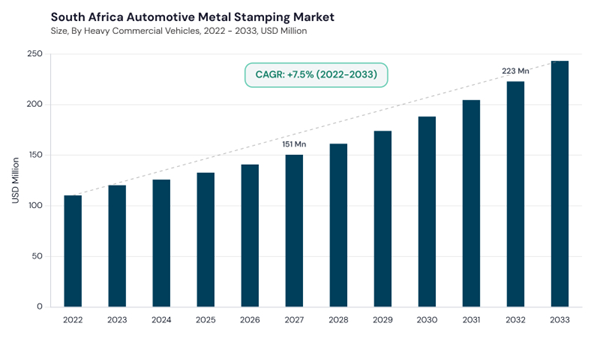
Brazil continues to lead the regional market owing to its strong automotive manufacturing base, increasing localization of vehicle production, and expanding investments in advanced stamping technologies. South Africa and Saudi Arabia are also contributing significantly due to increasing industrialization, infrastructure development, and rising commercial vehicle demand. Nigeria and the Rest of LAMEA region are witnessing gradual expansion supported by growing urbanization, improving logistics networks, and government initiatives aimed at strengthening domestic automotive supply chains. Furthermore, increasing adoption of lightweight materials and automation technologies is supporting long-term market development across the region.
List of Key Companies Profiled
- Gestamp Automoción S.A.
- Magna International Inc.
- Martinrea International Inc.
- Schuler Group GmbH
- Tower International
- voestalpine AG
- thyssenkrupp AG
- Böllhoff Group
- KUKA AG
- GEDIA Automotive Group
Market Report Segmentation
By Process- Blanking
- Bending
- Embossing
- Flanging
- Coining
- Other Process
- Passenger Cars
- Light Commercial Vehicles
- Heavy Commercial Vehicles
- Recreational Vehicles
- Brazil
- Argentina
- Saudi Arabia
- South Africa
- United Arab Emirates
- Nigeria
- Rest of LAMEA
Table of Contents
Chapter 1. LAMEA Market1.1 Market Overview
1.2 Key Factors Impacting Market
1.2.1 Market Drivers
1.2.2 Market Restraints
1.2.3 Market Opportunities
1.2.4 Market Challenges
1.2.5 Market Trends
1.2.6 State of Competition
1.2.7 Market Consolidation
1.2.8 Key Customer Criteria
1.3 Product Life Cycle
1.4 Segmentation By Process
1.4.1 Blanking
1.4.2 Embossing
1.4.3 Bending
1.4.4 Coining
1.4.5 Flanging
1.4.6 Other Process
1.5 Segmentation By Application
1.5.1 Passenger Cars
1.5.2 Light Commercial Vehicles
1.5.3 Heavy Commercial Vehicles
1.5.4 Recreational Vehicles
1.6 Segmentation By Country
1.6.1 Brazil
1.6.1.1 Segmentation By Process
1.6.1.1.1 Blanking
1.6.1.1.2 Embossing
1.6.1.1.3 Bending
1.6.1.1.4 Coining
1.6.1.1.5 Flanging
1.6.1.1.6 Other Process
1.6.1.2 Segmentation By Application
1.6.1.2.1 Passenger Cars
1.6.1.2.2 Light Commercial Vehicles
1.6.1.2.3 Heavy Commercial Vehicles
1.6.1.2.4 Recreational Vehicles
1.6.2 Argentina
1.6.2.1 Segmentation By Process
1.6.2.1.1 Blanking
1.6.2.1.2 Embossing
1.6.2.1.3 Bending
1.6.2.1.4 Coining
1.6.2.1.5 Flanging
1.6.2.1.6 Other Process
1.6.2.2 Segmentation By Application
1.6.2.2.1 Passenger Cars
1.6.2.2.2 Light Commercial Vehicles
1.6.2.2.3 Heavy Commercial Vehicles
1.6.2.2.4 Recreational Vehicles
1.6.3 UAE
1.6.3.1 Segmentation By Process
1.6.3.1.1 Blanking
1.6.3.1.2 Embossing
1.6.3.1.3 Bending
1.6.3.1.4 Coining
1.6.3.1.5 Flanging
1.6.3.1.6 Other Process
1.6.3.2 Segmentation By Application
1.6.3.2.1 Passenger Cars
1.6.3.2.2 Light Commercial Vehicles
1.6.3.2.3 Heavy Commercial Vehicles
1.6.3.2.4 Recreational Vehicles
1.6.4 Saudi Arabia
1.6.4.1 Segmentation By Process
1.6.4.1.1 Blanking
1.6.4.1.2 Embossing
1.6.4.1.3 Bending
1.6.4.1.4 Coining
1.6.4.1.5 Flanging
1.6.4.1.6 Other Process
1.6.4.2 Segmentation By Application
1.6.4.2.1 Passenger Cars
1.6.4.2.2 Light Commercial Vehicles
1.6.4.2.3 Heavy Commercial Vehicles
1.6.4.2.4 Recreational Vehicles
1.6.5 South Africa
1.6.5.1 Segmentation By Process
1.6.5.1.1 Blanking
1.6.5.1.2 Embossing
1.6.5.1.3 Bending
1.6.5.1.4 Coining
1.6.5.1.5 Flanging
1.6.5.1.6 Other Process
1.6.5.2 Segmentation By Application
1.6.5.2.1 Passenger Cars
1.6.5.2.2 Light Commercial Vehicles
1.6.5.2.3 Heavy Commercial Vehicles
1.6.5.2.4 Recreational Vehicles
1.6.6 Nigeria
1.6.6.1 Segmentation By Process
1.6.6.1.1 Blanking
1.6.6.1.2 Embossing
1.6.6.1.3 Bending
1.6.6.1.4 Coining
1.6.6.1.5 Flanging
1.6.6.1.6 Other Process
1.6.6.2 Segmentation By Application
1.6.6.2.1 Passenger Cars
1.6.6.2.2 Light Commercial Vehicles
1.6.6.2.3 Heavy Commercial Vehicles
1.6.6.2.4 Recreational Vehicles
1.6.7 Rest of LAMEA
1.6.7.1 Segmentation By Process
1.6.7.1.1 Blanking
1.6.7.1.2 Embossing
1.6.7.1.3 Bending
1.6.7.1.4 Coining
1.6.7.1.5 Flanging
1.6.7.1.6 Other Process
1.6.7.2 Segmentation By Application
1.6.7.2.1 Passenger Cars
1.6.7.2.2 Light Commercial Vehicles
1.6.7.2.3 Heavy Commercial Vehicles
1.6.7.2.4 Recreational Vehicles
Chapter 2. Company Snapshot
2.1 Magna International Inc.
2.1.1 Business Overview
2.1.2 Key Information
2.1.3 Company Focus
2.1.4 Strategic Insights
2.1.5 Strategy Deployed
2.1.6 Product & Service Portfolio
2.1.7 Capability Overview
2.1.8 Technology & Innovation Focus
2.1.9 Customers / End Users
2.1.10 Competitive Positioning
2.1.11 Key Differentiators
2.1.12 Portfolio Matrix
2.1.13 SWOT Analysis
2.1.14 Future Outlook
2.2 Gestamp Servicios, S.A.
2.2.1 Business Overview
2.2.2 Key Information
2.2.3 Company Focus
2.2.4 Strategic Insights
2.2.5 Strategy Deployed
2.2.6 Product & Service Portfolio
2.2.7 Capability Overview
2.2.8 Technology & Innovation Focus
2.2.9 Customers / End Users
2.2.10 Competitive Positioning
2.2.11 Key Differentiators
2.2.12 Portfolio Matrix
2.2.13 SWOT Analysis
2.2.14 Future Outlook
2.3 Martinrea International Inc.
2.3.1 Business Overview
2.3.2 Key Information
2.3.3 Company Focus
2.3.4 Strategic Insights
2.3.5 Strategy Deployed
2.3.6 Product & Service Portfolio
2.3.7 Capability Overview
2.3.8 Technology & Innovation Focus
2.3.9 Customers / End Users
2.3.10 Competitive Positioning
2.3.11 Key Differentiators
2.3.12 Portfolio Matrix
2.3.13 SWOT Analysis
2.3.14 Future Outlook
2.4 Autokiniton Global Group, LP
2.4.1 Business Overview
2.4.2 Key Information
2.4.3 Company Focus
2.4.4 Strategic Insights
2.4.5 Strategy Deployed
2.4.6 Product & Service Portfolio
2.4.7 Capability Overview
2.4.8 Technology & Innovation Focus
2.4.9 Customers / End Users
2.4.10 Competitive Positioning
2.4.11 Key Differentiators
2.4.12 Portfolio Matrix
2.4.13 SWOT Analysis
2.4.14 Future Outlook
2.5 BENTELER Group
2.5.1 Business Overview
2.5.2 Key Information
2.5.3 Company Focus
2.5.4 Strategic Insights
2.5.5 Strategy Deployed
2.5.6 Product & Service Portfolio
2.5.7 Capability Overview
2.5.8 Technology & Innovation Focus
2.5.9 Customers / End Users
2.5.10 Competitive Positioning
2.5.11 Key Differentiators
2.5.12 Portfolio Matrix
2.5.13 SWOT Analysis
2.5.14 Future Outlook
2.6 AISIN CORPORATION
2.6.1 Business Overview
2.6.2 Key Information
2.6.3 Company Focus
2.6.4 Strategic Insights
2.6.5 Strategy Deployed
2.6.6 Product & Service Portfolio
2.6.7 Capability Overview
2.6.8 Technology & Innovation Focus
2.6.9 Customers / End Users
2.6.10 Competitive Positioning
2.6.11 Key Differentiators
2.6.12 Portfolio Matrix
2.6.13 SWOT Analysis
2.6.14 Future Outlook
2.7 HIROTEC Corporation
2.7.1 Business Overview
2.7.2 Key Information
2.7.3 Company Focus
2.7.4 Strategic Insights
2.7.5 Strategy Deployed
2.7.6 Product & Service Portfolio
2.7.7 Capability Overview
2.7.8 Technology & Innovation Focus
2.7.9 Customers / End Users
2.7.10 Competitive Positioning
2.7.11 Key Differentiators
2.7.12 Portfolio Matrix
2.7.13 SWOT Analysis
2.7.14 Future Outlook
2.8 Thyssenkrupp AG
2.8.1 Business Overview
2.8.2 Key Information
2.8.3 Company Focus
2.8.4 Strategic Insights
2.8.5 Strategy Deployed
2.8.6 Product & Service Portfolio
2.8.7 Capability Overview
2.8.8 Technology & Innovation Focus
2.8.9 Customers / End Users
2.8.10 Competitive Positioning
2.8.11 Key Differentiators
2.8.12 Portfolio Matrix
2.8.13 SWOT Analysis
2.8.14 Future Outlook
2.9 Voestalpine AG
2.9.1 Business Overview
2.9.2 Key Information
2.9.3 Company Focus
2.9.4 Strategic Insights
2.9.5 Strategy Deployed
2.9.6 Product & Service Portfolio
2.9.7 Capability Overview
2.9.8 Technology & Innovation Focus
2.9.9 Customers / End Users
2.9.10 Competitive Positioning
2.9.11 Key Differentiators
2.9.12 Portfolio Matrix
2.9.13 SWOT Analysis
2.9.14 Future Outlook
2.10 Minth Group Limited
2.10.1 Business Overview
2.10.2 Key Information
2.10.3 Company Focus
2.10.4 Strategic Insights
2.10.5 Strategy Deployed
2.10.6 Product & Service Portfolio
2.10.7 Capability Overview
2.10.8 Technology & Innovation Focus
2.10.9 Customers / End Users
2.10.10 Competitive Positioning
2.10.11 Key Differentiators
2.10.12 Portfolio Matrix
2.10.13 SWOT Analysis
2.10.14 Future Outlook
Companies Mentioned
- Gestamp Automoción S.A.
- Magna International Inc.
- Martinrea International Inc.
- Schuler Group GmbH
- Tower International
- voestalpine AG
- thyssenkrupp AG
- Böllhoff Group
- KUKA AG
- GEDIA Automotive Group


