



The Europe Digital Healthcare Supply Chain Management Market is expected to witness market growth of 7.9% CAGR during the forecast period (2026-2033) and would attain a market size of USD 1.44 Billion by 2030.
The Germany market dominated the Europe Digital Healthcare Supply Chain Management Market by country in 2025, and is expected to continue to be a dominant market till 2033; thereby, achieving a market value of around USD 352.6 million by 2033. The UK market is expected to witness a CAGR of about 6.9% during the forecast period, while France is expected to grow at a CAGR of roughly 8.7%, showing stronger acceleration in selected country markets even as Germany retains the lead.
The Europe market has developed around a highly regulated healthcare and MedTech environment where technology providers, logistics players, healthcare institutions, and compliance bodies all influence how digital supply chains are built. Early digitalization focused on visibility, coordination, and traceability, but the scope has widened as product complexity, data requirements, and cross-border operating needs have increased. The market now relies more heavily on connected analytics, cloud platforms, and real-time monitoring tools that can support both efficiency and regulatory discipline. This evolution has made digital healthcare supply chain systems more central to resilience, transparency, and operational planning across Europe. It is now a market shaped as much by compliance sophistication as by pure technology adoption.
Europe is seeing stronger use of AI, cloud computing, blockchain, and digital twin technologies as organizations seek more intelligent and adaptive supply chain models. Regulatory demands continue to push digital transformation, especially where product traceability, data integrity, and patient safety are involved. Automation and workforce pressure are also influencing operating models, with supply chain teams looking for better planning accuracy and lower manual friction. Regional competition depends not only on product capability but also on the ability to work across fragmented regulatory and infrastructure conditions. These trends are driving a market that values both innovation depth and disciplined execution.
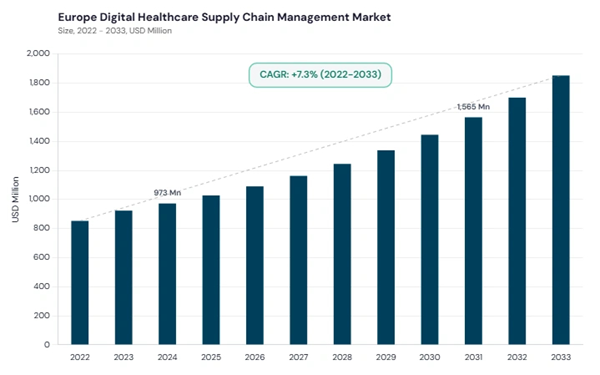
The Germany market dominated the Europe Digital Healthcare Supply Chain Management Market by country in 2025, and is expected to continue to be a dominant market till 2033; thereby, achieving a market value of around USD 352.6 million by 2033. The UK market is expected to witness a CAGR of about 6.9% during the forecast period, while France is expected to grow at a CAGR of roughly 8.7%, showing stronger acceleration in selected country markets even as Germany retains the lead.
The Europe market has developed around a highly regulated healthcare and MedTech environment where technology providers, logistics players, healthcare institutions, and compliance bodies all influence how digital supply chains are built. Early digitalization focused on visibility, coordination, and traceability, but the scope has widened as product complexity, data requirements, and cross-border operating needs have increased. The market now relies more heavily on connected analytics, cloud platforms, and real-time monitoring tools that can support both efficiency and regulatory discipline. This evolution has made digital healthcare supply chain systems more central to resilience, transparency, and operational planning across Europe. It is now a market shaped as much by compliance sophistication as by pure technology adoption.
Europe is seeing stronger use of AI, cloud computing, blockchain, and digital twin technologies as organizations seek more intelligent and adaptive supply chain models. Regulatory demands continue to push digital transformation, especially where product traceability, data integrity, and patient safety are involved. Automation and workforce pressure are also influencing operating models, with supply chain teams looking for better planning accuracy and lower manual friction. Regional competition depends not only on product capability but also on the ability to work across fragmented regulatory and infrastructure conditions. These trends are driving a market that values both innovation depth and disciplined execution.
Deployment Outlook
Based on Deployment, the market is segmented into Cloud-based and On-Premise. The Cloud-based market dominated the Europe Digital Healthcare Supply Chain Management Market by Deployment in 2025, and is expected to continue to be a dominant market till 2033; thereby, achieving a market value of USD 955.3 million by 2033, growing at a CAGR of 8.0% during the forecast period. The On-Premise market is expected to witness a CAGR of 7.7% during 2026-2033. Cloud-based delivery leads because healthcare organizations across Europe increasingly need scalable collaboration, stronger multi-site visibility, and easier data access across distributed networks. On-Premise still holds relevance where sovereignty, legacy integration, and compliance control remain especially important.Component Outlook
Based on Component, the market is segmented into Software, Services, and Hardware. The Software market dominated the Europe Digital Healthcare Supply Chain Management Market by Component in 2025, and is expected to continue to be a dominant market till 2033; thereby, achieving a market value of USD 899.4 million by 2033, growing at a CAGR of 7.5% during the forecast period. The Hardware market is expected to witness the highest CAGR of 8.5% during 2026-2033, while Services is expected to grow at 8.1%. Software remains the largest component because it drives visibility, planning, analytics, and integration across highly regulated supply environments. Faster hardware growth reflects increasing investment in connected monitoring, real-time sensing, and track-and-trace infrastructure.Application Outlook
Based on Application, the market is segmented into Inventory Management, Demand Forecasting & Planning, Procurement & Sourcing, Logistics & Distribution Management, Track & Trace / Serialization, Cold Chain Monitoring, and Supplier Relationship Management. The Inventory Management market dominated the Europe market in 2025 and is expected to reach USD 459.7 million by 2033, growing at a CAGR of 6.9% during the forecast period. The Procurement & Sourcing market is expected to witness the highest CAGR of 8.2% during 2026-2033. Inventory management continues to lead because healthcare systems across Europe need stronger stock discipline, lower waste, and better supply continuity. Procurement is growing faster as organizations push for more transparent sourcing, supplier coordination, and risk-aware purchasing models.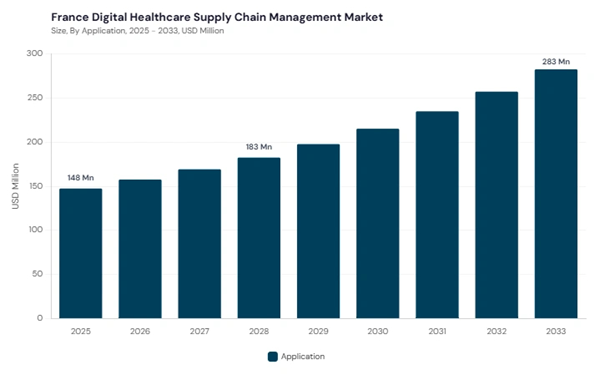
End Use Outlook
Based on End Use, the market is segmented into Pharmaceutical Companies, Hospitals & Healthcare Providers, Medical Device Companies, Biotechnology & Vaccine Companies, and Diagnostic Laboratories. The Pharmaceutical Companies market dominated the Europe market in 2025 and is expected to reach USD 635.9 million by 2033, growing at a CAGR of 7.1% during the forecast period. The Medical Device Companies market is expected to witness the highest CAGR of 8.2% during 2026-2033, while Hospitals & Healthcare Providers is expected to grow at 7.7%. Pharmaceutical companies remain the leading users because of strict product handling, serialization, and compliance requirements. Faster device-sector growth reflects rising digital coordination needs across more specialized and technically demanding supply chains.Country Outlook
Germany remains the leading country market in Europe because of its strong industrial, pharmaceutical, and healthcare operating base, along with a disciplined approach to compliance and system integration. Organizations in the country increasingly need digital platforms that can manage traceability, optimize supply continuity, and support regulated product movement across complex networks. Germany also benefits from steady demand for more resilient logistics and better data-driven procurement planning. While cloud adoption is rising, platform decisions still depend heavily on interoperability, control, and alignment with regulatory expectations. That combination keeps Germany strategically important both in scale and in influence over how digital supply chain solutions are deployed across Europe.List of Key Companies Profiled
- McKesson Corporation
- Cardinal Health
- SAP SE
- Oracle Corporation
- IBM Corporation
- Siemens Healthineers
- Medline Industries
- Henry Schein
- Global Healthcare Exchange
- Tecsys
Market Report Segmentation
By Component- Software
- Hardware
- Services
- On-Premise
- Cloud-based
- Inventory Management
- Demand Forecasting & Planning
- Procurement & Sourcing
- Logistics & Distribution Management
- Track & Trace / Serialization
- Cold Chain Monitoring
- Supplier Relationship Management
- Pharmaceutical Companies
- Medical Device Companies
- Biotechnology & Vaccine Companies
- Hospitals & Healthcare Providers
- Diagnostic Laboratories
- Germany
- UK
- France
- Russia
- Spain
- Italy
- Rest of Europe
Table of Contents
Chapter 1. Europe Market1.1 Market Overview
1.2 Key Factors Impacting Market
1.2.1 Market Drivers
1.2.2 Market Restraints
1.2.3 Market Opportunities
1.2.4 Market Challenges
1.2.5 Market Trends
1.2.6 State of Competition
1.2.7 Market Consolidation
1.2.8 Key Customer Criteria
1.3 Product Life Cycle
1.4 Segmentation By Component
1.4.1 Software
1.4.2 Hardware
1.4.3 Services
1.5 Segmentation By Deployment Mode
1.5.1 On-Premise
1.5.2 Cloud-based
1.6 Segmentation By Application
1.6.1 Inventory Management
1.6.2 Demand Forecasting & Planning
1.6.3 Procurement & Sourcing
1.6.4 Logistics & Distribution Management
1.6.5 Track & Trace / Serialization
1.6.6 Cold Chain Monitoring
1.6.7 Supplier Relationship Management
1.7 Segmentation By End Use
1.7.1 Pharmaceutical Companies
1.7.2 Medical Device Companies
1.7.3 Biotechnology & Vaccine Companies
1.7.4 Hospitals & Healthcare Providers
1.7.5 Diagnostic Laboratories
1.8 Segmentation By Country
1.8.1 Germany
1.8.1.1 Segmentation By Deployment Mode
1.8.1.1.1 Cloud-based
1.8.1.1.2 On-Premise
1.8.1.2 Segmentation By Component
1.8.1.2.1 Software
1.8.1.2.2 Services
1.8.1.2.3 Hardware
1.8.1.3 Segmentation By End Use
1.8.1.3.1 Pharmaceutical Companies
1.8.1.3.2 Hospitals & Healthcare Providers
1.8.1.3.3 Medical Device Companies
1.8.1.3.4 Biotechnology & Vaccine Companies
1.8.1.3.5 Diagnostic Laboratories
1.8.1.4 Segmentation By Application
1.8.1.4.1 Inventory Management
1.8.1.4.2 Logistics & Distribution Management
1.8.1.4.3 Procurement & Sourcing
1.8.1.4.4 Demand Forecasting & Planning
1.8.1.4.5 Track & Trace / Serialization
1.8.1.4.6 Cold Chain Monitoring
1.8.1.4.7 Supplier Relationship Management
1.8.2 UK
1.8.2.1 Segmentation By Deployment Mode
1.8.2.1.1 Cloud-based
1.8.2.1.2 On-Premise
1.8.2.2 Segmentation By Component
1.8.2.2.1 Software
1.8.2.2.2 Services
1.8.2.2.3 Hardware
1.8.2.3 Segmentation By End Use
1.8.2.3.1 Pharmaceutical Companies
1.8.2.3.2 Hospitals & Healthcare Providers
1.8.2.3.3 Medical Device Companies
1.8.2.3.4 Biotechnology & Vaccine Companies
1.8.2.3.5 Diagnostic Laboratories
1.8.2.4 Segmentation By Application
1.8.2.4.1 Inventory Management
1.8.2.4.2 Logistics & Distribution Management
1.8.2.4.3 Procurement & Sourcing
1.8.2.4.4 Demand Forecasting & Planning
1.8.2.4.5 Track & Trace / Serialization
1.8.2.4.6 Cold Chain Monitoring
1.8.2.4.7 Supplier Relationship Management
1.8.3 France
1.8.3.1 Segmentation By Deployment Mode
1.8.3.1.1 Cloud-based
1.8.3.1.2 On-Premise
1.8.3.2 Segmentation By Component
1.8.3.2.1 Software
1.8.3.2.2 Services
1.8.3.2.3 Hardware
1.8.3.3 Segmentation By End Use
1.8.3.3.1 Pharmaceutical Companies
1.8.3.3.2 Hospitals & Healthcare Providers
1.8.3.3.3 Medical Device Companies
1.8.3.3.4 Biotechnology & Vaccine Companies
1.8.3.3.5 Diagnostic Laboratories
1.8.3.4 Segmentation By Application
1.8.3.4.1 Inventory Management
1.8.3.4.2 Logistics & Distribution Management
1.8.3.4.3 Procurement & Sourcing
1.8.3.4.4 Demand Forecasting & Planning
1.8.3.4.5 Track & Trace / Serialization
1.8.3.4.6 Cold Chain Monitoring
1.8.3.4.7 Supplier Relationship Management
1.8.4 Russia
1.8.4.1 Segmentation By Deployment Mode
1.8.4.1.1 Cloud-based
1.8.4.1.2 On-Premise
1.8.4.2 Segmentation By Component
1.8.4.2.1 Software
1.8.4.2.2 Services
1.8.4.2.3 Hardware
1.8.4.3 Segmentation By End Use
1.8.4.3.1 Pharmaceutical Companies
1.8.4.3.2 Hospitals & Healthcare Providers
1.8.4.3.3 Medical Device Companies
1.8.4.3.4 Biotechnology & Vaccine Companies
1.8.4.3.5 Diagnostic Laboratories
1.8.4.4 Segmentation By Application
1.8.4.4.1 Inventory Management
1.8.4.4.2 Logistics & Distribution Management
1.8.4.4.3 Procurement & Sourcing
1.8.4.4.4 Demand Forecasting & Planning
1.8.4.4.5 Track & Trace / Serialization
1.8.4.4.6 Cold Chain Monitoring
1.8.4.4.7 Supplier Relationship Management
1.8.5 Spain
1.8.5.1 Segmentation By Deployment Mode
1.8.5.1.1 Cloud-based
1.8.5.1.2 On-Premise
1.8.5.2 Segmentation By Component
1.8.5.2.1 Software
1.8.5.2.2 Services
1.8.5.2.3 Hardware
1.8.5.3 Segmentation By End Use
1.8.5.3.1 Pharmaceutical Companies
1.8.5.3.2 Hospitals & Healthcare Providers
1.8.5.3.3 Medical Device Companies
1.8.5.3.4 Biotechnology & Vaccine Companies
1.8.5.3.5 Diagnostic Laboratories
1.8.5.4 Segmentation By Application
1.8.5.4.1 Inventory Management
1.8.5.4.2 Logistics & Distribution Management
1.8.5.4.3 Procurement & Sourcing
1.8.5.4.4 Demand Forecasting & Planning
1.8.5.4.5 Track & Trace / Serialization
1.8.5.4.6 Cold Chain Monitoring
1.8.5.4.7 Supplier Relationship Management
1.8.6 Italy
1.8.6.1 Segmentation By Deployment Mode
1.8.6.1.1 Cloud-based
1.8.6.1.2 On-Premise
1.8.6.2 Segmentation By Component
1.8.6.2.1 Software
1.8.6.2.2 Services
1.8.6.2.3 Hardware
1.8.6.3 Segmentation By End Use
1.8.6.3.1 Pharmaceutical Companies
1.8.6.3.2 Hospitals & Healthcare Providers
1.8.6.3.3 Medical Device Companies
1.8.6.3.4 Biotechnology & Vaccine Companies
1.8.6.3.5 Diagnostic Laboratories
1.8.6.4 Segmentation By Application
1.8.6.4.1 Inventory Management
1.8.6.4.2 Logistics & Distribution Management
1.8.6.4.3 Procurement & Sourcing
1.8.6.4.4 Demand Forecasting & Planning
1.8.6.4.5 Track & Trace / Serialization
1.8.6.4.6 Cold Chain Monitoring
1.8.6.4.7 Supplier Relationship Management
1.8.7 Rest of Europe
1.8.7.1 Segmentation By Deployment Mode
1.8.7.1.1 Cloud-based
1.8.7.1.2 On-Premise
1.8.7.2 Segmentation By Component
1.8.7.2.1 Software
1.8.7.2.2 Services
1.8.7.2.3 Hardware
1.8.7.3 Segmentation By End Use
1.8.7.3.1 Pharmaceutical Companies
1.8.7.3.2 Hospitals & Healthcare Providers
1.8.7.3.3 Medical Device Companies
1.8.7.3.4 Biotechnology & Vaccine Companies
1.8.7.3.5 Diagnostic Laboratories
1.8.7.4 Segmentation By Application
1.8.7.4.1 Inventory Management
1.8.7.4.2 Logistics & Distribution Management
1.8.7.4.3 Procurement & Sourcing
1.8.7.4.4 Demand Forecasting & Planning
1.8.7.4.5 Track & Trace / Serialization
1.8.7.4.6 Cold Chain Monitoring
1.8.7.4.7 Supplier Relationship Management
Chapter 2. Company Snapshot
2.1 McKesson Corporation
2.1.1 Business Overview
2.1.2 Key Information
2.1.3 Company Focus on Digital Healthcare Supply Chain Management Market
2.1.4 Strategic Insights on Digital Healthcare Supply Chain Management Market
2.1.5 Strategy Deployed for Digital Healthcare Supply Chain Management Market
2.1.6 Product & Service Portfolio
2.1.7 Capability Overview
2.1.8 Technology & Innovation Focus
2.1.9 SWOT Analysis (Digital Healthcare Supply Chain Management Market)
2.1.10 Customers / End Users
2.1.11 Competitive Positioning
2.1.12 Key Differentiators
2.1.13 Portfolio Matrix
2.1.14 Analyst View
2.1.15 Future Outlook for Digital Healthcare Supply Chain Management Market
2.2 Cardinal Health, Inc.
2.2.1 Business Overview
2.2.2 Key Information
2.2.3 Company Focus on Digital Healthcare Supply Chain Management Market
2.2.4 Strategic Insights on Digital Healthcare Supply Chain Management Market
2.2.5 Strategy Deployed for Digital Healthcare Supply Chain Management Market
2.2.6 Product & Service Portfolio
2.2.7 Key Products / Services
2.2.8 Capability Overview
2.2.9 Technology & Innovation Focus
2.2.10 SWOT Analysis (Digital Healthcare Supply Chain Management Market)
2.2.11 Customers / End Users
2.2.12 Competitive Positioning
2.2.13 Key Differentiators
2.2.14 Portfolio Matrix
2.2.15 Analyst View
2.2.16 Future Outlook for Digital Healthcare Supply Chain Management Market
2.3 IBM Corporation
2.3.1 Business Overview
2.3.2 Key Information
2.3.3 Company Focus on Digital Healthcare Supply Chain Management Market
2.3.4 Strategic Insights on Digital Healthcare Supply Chain Management Market
2.3.5 Strategy Deployed for Digital Healthcare Supply Chain Management Market
2.3.6 Product & Service Portfolio
2.3.7 Capability Overview
2.3.8 Technology & Innovation Focus
2.3.9 SWOT Analysis (Digital Healthcare Supply Chain Management Market)
2.3.10 Customers / End Users
2.3.11 Competitive Positioning
2.3.12 Key Differentiators
2.3.13 Portfolio Matrix
2.3.14 Analyst View
2.3.15 Future Outlook for Digital Healthcare Supply Chain Management Market
2.4 Oracle Corporation
2.4.1 Business Overview
2.4.2 Key Information
2.4.3 Company Focus on Digital Healthcare Supply Chain Management Market
2.4.4 Strategic Insights on Digital Healthcare Supply Chain Management Market
2.4.5 Strategy Deployed for Digital Healthcare Supply Chain Management Market
2.4.6 Product & Service Portfolio
2.4.7 Capability Overview
2.4.8 Technology & Innovation Focus
2.4.9 SWOT Analysis (Digital Healthcare Supply Chain Management Market)
2.4.10 Customers / End Users
2.4.11 Competitive Positioning
2.4.12 Key Differentiators
2.4.13 Portfolio Matrix
2.4.14 Analyst View
2.4.15 Future Outlook for Digital Healthcare Supply Chain Management Market
2.5 SAP SE
2.5.1 Business Overview
2.5.2 Key Information
2.5.3 Company Focus on Digital Healthcare Supply Chain Management Market
2.5.4 Strategic Insights on Digital Healthcare Supply Chain Management Market
2.5.5 Strategy Deployed for Digital Healthcare Supply Chain Management Market
2.5.6 Product & Service Portfolio
2.5.7 Capability Overview
2.5.8 Technology & Innovation Focus
2.5.9 SWOT Analysis (Digital Healthcare Supply Chain Management Market)
2.5.10 Customers / End Users
2.5.11 Competitive Positioning
2.5.12 Key Differentiators
2.5.13 Portfolio Matrix
2.5.14 Analyst View
2.5.15 Future Outlook for Digital Healthcare Supply Chain Management Market
2.6 Siemens Healthineers AG
2.6.1 Business Overview
2.6.2 Key Information
2.6.3 Company Focus on Digital Healthcare Supply Chain Management Market
2.6.4 Strategic Insights on Digital Healthcare Supply Chain Management Market
2.6.5 Strategy Deployed for Digital Healthcare Supply Chain Management Market
2.6.6 Product & Service Portfolio
2.6.7 Key Products / Services
2.6.8 Capability Overview
2.6.9 Technology & Innovation Focus
2.6.10 SWOT Analysis (Digital Healthcare Supply Chain Management Market)
2.6.11 Customers / End Users
2.6.12 Competitive Positioning
2.6.13 Key Differentiators
2.6.14 Portfolio Matrix
2.6.15 Analyst View
2.6.16 Future Outlook for Digital Healthcare Supply Chain Management Market
2.7 Medline Industries, LP
2.7.1 Business Overview
2.7.2 Key Information
2.7.3 Company Focus on Digital Healthcare Supply Chain Management Market
2.7.4 Strategic Insights on Digital Healthcare Supply Chain Management Market
2.7.5 Strategy Deployed for Digital Healthcare Supply Chain Management Market
2.7.6 Product & Service Portfolio
2.7.7 Key Products / Services (Representative)
2.7.8 Capability Overview
2.7.9 Technology & Innovation Focus
2.7.10 SWOT Analysis (Digital Healthcare Supply Chain Management Market)
2.7.11 Customers / End Users
2.7.12 Competitive Positioning
2.7.13 Key Differentiators
2.7.14 Portfolio Matrix
2.7.15 Analyst View
2.7.16 Future Outlook for Digital Healthcare Supply Chain Management Market
2.8 Henry Schein, Inc.
2.8.1 Business Overview
2.8.2 Company Profile
2.8.3 Company Focus on Digital Healthcare Supply Chain Management Market
2.8.4 Strategic Insights on Digital Healthcare Supply Chain Management Market
2.8.5 Strategy Deployed for Digital Healthcare Supply Chain Management Market
2.8.6 Product & Service Portfolio
2.8.7 Portfolio Categories
2.8.8 Key Products / Services (Representative)
2.8.9 Capability Overview
2.8.10 Technology & Innovation Focus
2.8.11 SWOT Analysis (Digital Healthcare Supply Chain Management Market)
2.8.12 Customers / End Users
2.8.13 Competitive Positioning
2.8.14 Key Differentiators
2.8.15 Portfolio Matrix
2.8.16 Analyst View
2.8.17 Future Outlook for Digital Healthcare Supply Chain Management Market
2.9 Global Healthcare Exchange, LLC
2.9.1 Business Overview
2.9.2 Key Information
2.9.3 Company Focus on Digital Healthcare Supply Chain Management Market
2.9.4 Strategic Insights on Digital Healthcare Supply Chain Management Market
2.9.5 Strategy Deployed for Digital Healthcare Supply Chain Management Market
2.9.6 Product & Service Portfolio
2.9.7 Portfolio Categories
2.9.8 Key Products / Services (Representative)
2.9.9 Capability Overview
2.9.10 Technology & Innovation Focus
2.9.11 SWOT Analysis (Digital Healthcare Supply Chain Management Market)
2.9.12 Customers / End Users
2.9.13 Competitive Positioning
2.9.14 Key Differentiators
2.9.15 Portfolio Matrix
2.9.16 Analyst View
2.9.17 Future Outlook for Digital Healthcare Supply Chain Management Market
2.10 Tecsys, Inc.
2.10.1 Business Overview
2.10.2 Key Information
2.10.3 Company Focus on Digital Healthcare Supply Chain Management Market
2.10.4 Strategic Insights on Digital Healthcare Supply Chain Management Market
2.10.5 Strategy Deployed for Digital Healthcare Supply Chain Management Market
2.10.6 Product & Service Portfolio
2.10.7 Portfolio Categories
2.10.8 Key Products / Services (Representative)
2.10.9 Capability Overview
2.10.10 Technology & Innovation Focus
2.10.11 SWOT Analysis (Digital Healthcare Supply Chain Management Market)
2.10.12 Customers / End Users
2.10.13 Competitive Positioning
2.10.14 Key Differentiators
2.10.15 Portfolio Matrix
2.10.16 Analyst View
2.10.17 Future Outlook for Digital Healthcare Supply Chain Management Market
Companies Mentioned
- McKesson Corporation
- Cardinal Health
- SAP SE
- Oracle Corporation
- IBM Corporation
- Siemens Healthineers
- Medline Industries
- Henry Schein
- Global Healthcare Exchange
- Tecsys


