



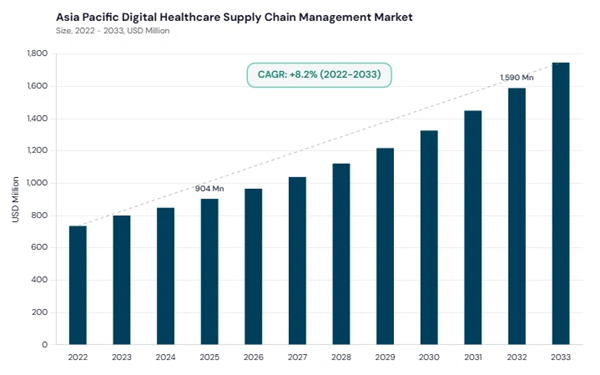
The Asia Pacific Digital Healthcare Supply Chain Management Market is expected to witness market growth of 8.8% CAGR during the forecast period (2026-2033) and is forecasted to reach USD 1.45 Billion by 2031.
The China market dominated the Asia Pacific Digital Healthcare Supply Chain Management Market by country in 2025, and is expected to continue to be a dominant market till 2033; thereby, achieving a market value of around USD 488.5 million by 2033. Japan is projected to witness a CAGR of around 8.0% during the forecast period, while India is expected to grow at about 9.6%, underlining the region’s stronger upside in several fast-modernizing national markets.
The Asia Pacific market has formed around an increasingly interconnected ecosystem of healthcare providers, pharmaceutical manufacturers, distributors, and digital platform vendors trying to manage growing product complexity and fragmented supply networks. Early digital adoption often focused on improving visibility and basic coordination, but the market has broadened as organizations seek stronger automation, better data flow, and more reliable compliance control. Investments in analytics, cloud systems, and tracking technologies have become more relevant as healthcare delivery scales and cross-border complexity rises. This has shifted the market toward more integrated and responsive operating models. As a result, the region now combines strong modernization demand with a clear push toward intelligent, scalable supply chain systems.
Asia Pacific is being shaped by rapid digital transformation, rising healthcare investment, and increasing pressure to build more coordinated and resilient supply networks. Cloud-based platforms, AI-driven planning, and automation tools are gaining traction as organizations try to manage more fragmented logistics environments and faster-growing demand. Regulatory evolution is also helping digital systems gain importance, especially where product handling, patient safety, and traceability are involved. The region’s diversity means competitive success depends on localization, scalability, and practical deployment across different digital maturity levels. Together, these trends are pushing the market toward more adaptive and data-driven supply chain ecosystems.
The China market dominated the Asia Pacific Digital Healthcare Supply Chain Management Market by country in 2025, and is expected to continue to be a dominant market till 2033; thereby, achieving a market value of around USD 488.5 million by 2033. Japan is projected to witness a CAGR of around 8.0% during the forecast period, while India is expected to grow at about 9.6%, underlining the region’s stronger upside in several fast-modernizing national markets.
The Asia Pacific market has formed around an increasingly interconnected ecosystem of healthcare providers, pharmaceutical manufacturers, distributors, and digital platform vendors trying to manage growing product complexity and fragmented supply networks. Early digital adoption often focused on improving visibility and basic coordination, but the market has broadened as organizations seek stronger automation, better data flow, and more reliable compliance control. Investments in analytics, cloud systems, and tracking technologies have become more relevant as healthcare delivery scales and cross-border complexity rises. This has shifted the market toward more integrated and responsive operating models. As a result, the region now combines strong modernization demand with a clear push toward intelligent, scalable supply chain systems.
Asia Pacific is being shaped by rapid digital transformation, rising healthcare investment, and increasing pressure to build more coordinated and resilient supply networks. Cloud-based platforms, AI-driven planning, and automation tools are gaining traction as organizations try to manage more fragmented logistics environments and faster-growing demand. Regulatory evolution is also helping digital systems gain importance, especially where product handling, patient safety, and traceability are involved. The region’s diversity means competitive success depends on localization, scalability, and practical deployment across different digital maturity levels. Together, these trends are pushing the market toward more adaptive and data-driven supply chain ecosystems.
Deployment Outlook
Based on Deployment, the market is segmented into Cloud-based and On-Premise. The Cloud-based market dominated the Asia Pacific Digital Healthcare Supply Chain Management Market by Deployment in 2025, and is expected to continue to be a dominant market till 2033; thereby, achieving a market value of USD 818.9 million by 2032, growing at a CAGR of 9.0% during the forecast period. The On-Premise market is expected to witness a CAGR of 8.7% during 2026-2033. Cloud-based deployment leads because the region increasingly values scalability, multi-site coordination, and lower infrastructure burden as healthcare systems expand. On-Premise remains important where internal control and legacy compatibility still influence digital investment decisions.Component Outlook
Based on Component, the market is segmented into Software, Services, and Hardware. The Software market dominated the Asia Pacific Digital Healthcare Supply Chain Management Market by Component in 2025, and is expected to continue to be a dominant market till 2033; thereby, achieving a market value of USD 848.8 million by 2033, growing at a CAGR of 8.4% during the forecast period. The Hardware market is expected to witness the highest CAGR of 9.5% during 2026-2033, while Services is expected to grow at 9.1%. Software leads because it provides the planning, analytics, and orchestration layer needed to manage increasingly complex healthcare flows. Faster hardware growth reflects expanding use of connected devices, sensors, and monitoring infrastructure in more digitally enabled supply chains.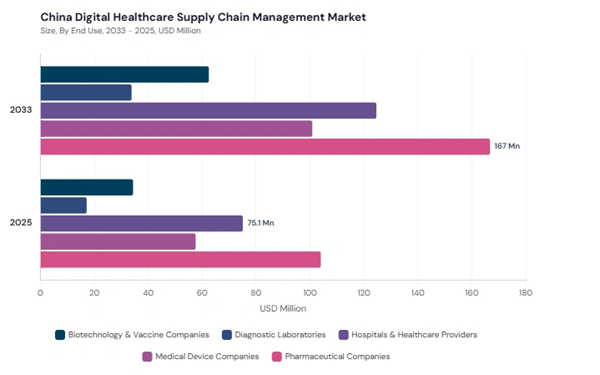
Application Outlook
Based on Application, the market is segmented into Inventory Management, Demand Forecasting & Planning, Procurement & Sourcing, Logistics & Distribution Management, Track & Trace / Serialization, Cold Chain Monitoring, and Supplier Relationship Management. The Inventory Management market dominated the Asia Pacific market in 2025 and is expected to reach USD 433.8 million by 2033, growing at a CAGR of 7.8% during the forecast period. The Procurement & Sourcing market is expected to witness the highest CAGR of 9.2% during 2026-2033. Inventory management remains the leading application because healthcare organizations need stronger availability control and lower operational waste across large and fragmented systems. Faster procurement growth reflects increasing interest in digitally coordinated sourcing and supplier-risk management.End Use Outlook
Based on End Use, the market is segmented into Pharmaceutical Companies, Hospitals & Healthcare Providers, Medical Device Companies, Biotechnology & Vaccine Companies, and Diagnostic Laboratories. The Pharmaceutical Companies market dominated the Asia Pacific market in 2025 and is expected to reach USD 600.1 million by 2033, growing at a CAGR of 8.1% during the forecast period. The Medical Device Companies market is expected to witness the highest CAGR of 9.2% during 2026-2033, while Hospitals & Healthcare Providers is expected to grow at 8.6%. Pharmaceutical companies remain the largest users because they require tight traceability, better planning, and broader distribution control. Faster medical device growth reflects the region’s expanding need for more specialized and digitally coordinated supply chain execution.Country Outlook
China remains the leading country market in Asia Pacific because of its large healthcare demand base, broad manufacturing footprint, and growing reliance on more coordinated digital logistics systems. Organizations in the country increasingly need stronger inventory control, better demand planning, and more reliable product visibility across rapidly scaling healthcare and pharmaceutical networks. The market also benefits from rising interest in cloud platforms, AI-enabled analytics, and automated monitoring tools that improve responsiveness and reduce operational friction. At the same time, system deployment still depends on interoperability and practical integration with diverse local and regional supply environments. That makes China both the largest market and one of the most influential in shaping regional digital healthcare supply chain modernization.List of Key Companies Profiled
- McKesson Corporation
- Cardinal Health
- SAP SE
- Oracle Corporation
- IBM Corporation
- Siemens Healthineers
- Medline Industries
- Henry Schein
- Global Healthcare Exchange
- Tecsys
Market Report Segmentation
By Component- Software
- Hardware
- Services
- On-Premise
- Cloud-based
- Inventory Management
- Demand Forecasting & Planning
- Procurement & Sourcing
- Logistics & Distribution Management
- Track & Trace / Serialization
- Cold Chain Monitoring
- Supplier Relationship Management
- Pharmaceutical Companies
- Medical Device Companies
- Biotechnology & Vaccine Companies
- Hospitals & Healthcare Providers
- Diagnostic Laboratories
- Japan
- China
- India
- South Korea
- Singapore
- Malaysia
- Rest of Asia Pacific
Table of Contents
Chapter 1. Asia Pacific Market1.1 Market Overview
1.2 Key Factors Impacting Market
1.2.1 Market Drivers
1.2.2 Market Restraints
1.2.3 Market Opportunities
1.2.4 Market Challenges
1.2.5 Market Trends
1.2.6 State of Competition
1.2.7 Market Consolidation
1.2.8 Key Customer Criteria
1.3 Product Life Cycle
1.4 Segmentation By Component
1.4.1 Software
1.4.2 Hardware
1.4.3 Services
1.5 Segmentation By Deployment Mode
1.5.1 On-Premise
1.5.2 Cloud-based
1.6 Segmentation By Application
1.6.1 Inventory Management
1.6.2 Demand Forecasting & Planning
1.6.3 Procurement & Sourcing
1.6.4 Logistics & Distribution Management
1.6.5 Track & Trace / Serialization
1.6.6 Cold Chain Monitoring
1.6.7 Supplier Relationship Management
1.7 Segmentation By End Use
1.7.1 Pharmaceutical Companies
1.7.2 Medical Device Companies
1.7.3 Biotechnology & Vaccine Companies
1.7.4 Hospitals & Healthcare Providers
1.7.5 Diagnostic Laboratories
1.8 Segmentation By Country
1.8.1 China
1.8.1.1 Segmentation By Deployment Mode
1.8.1.1.1 Cloud-based
1.8.1.1.2 On-Premise
1.8.1.2 Segmentation By Component
1.8.1.2.1 Software
1.8.1.2.2 Services
1.8.1.2.3 Hardware
1.8.1.3 Segmentation By End Use
1.8.1.3.1 Pharmaceutical Companies
1.8.1.3.2 Hospitals & Healthcare Providers
1.8.1.3.3 Medical Device Companies
1.8.1.3.4 Biotechnology & Vaccine Companies
1.8.1.3.5 Diagnostic Laboratories
1.8.1.4 Segmentation By Application
1.8.1.4.1 Inventory Management
1.8.1.4.2 Logistics & Distribution Management
1.8.1.4.3 Procurement & Sourcing
1.8.1.4.4 Demand Forecasting & Planning
1.8.1.4.5 Track & Trace / Serialization
1.8.1.4.6 Cold Chain Monitoring
1.8.1.4.7 Supplier Relationship Management
1.8.2 Japan
1.8.2.1 Segmentation By Deployment Mode
1.8.2.1.1 Cloud-based
1.8.2.1.2 On-Premise
1.8.2.2 Segmentation By Component
1.8.2.2.1 Software
1.8.2.2.2 Services
1.8.2.2.3 Hardware
1.8.2.3 Segmentation By End Use
1.8.2.3.1 Pharmaceutical Companies
1.8.2.3.2 Hospitals & Healthcare Providers
1.8.2.3.3 Medical Device Companies
1.8.2.3.4 Biotechnology & Vaccine Companies
1.8.2.3.5 Diagnostic Laboratories
1.8.2.4 Segmentation By Application
1.8.2.4.1 Inventory Management
1.8.2.4.2 Logistics & Distribution Management
1.8.2.4.3 Procurement & Sourcing
1.8.2.4.4 Demand Forecasting & Planning
1.8.2.4.5 Track & Trace / Serialization
1.8.2.4.6 Cold Chain Monitoring
1.8.2.4.7 Supplier Relationship Management
1.8.3 India
1.8.3.1 Segmentation By Deployment Mode
1.8.3.1.1 Cloud-based
1.8.3.1.2 On-Premise
1.8.3.2 Segmentation By Component
1.8.3.2.1 Software
1.8.3.2.2 Services
1.8.3.2.3 Hardware
1.8.3.3 Segmentation By End Use
1.8.3.3.1 Pharmaceutical Companies
1.8.3.3.2 Hospitals & Healthcare Providers
1.8.3.3.3 Medical Device Companies
1.8.3.3.4 Biotechnology & Vaccine Companies
1.8.3.3.5 Diagnostic Laboratories
1.8.3.4 Segmentation By Application
1.8.3.4.1 Inventory Management
1.8.3.4.2 Logistics & Distribution Management
1.8.3.4.3 Procurement & Sourcing
1.8.3.4.4 Demand Forecasting & Planning
1.8.3.4.5 Track & Trace / Serialization
1.8.3.4.6 Cold Chain Monitoring
1.8.3.4.7 Supplier Relationship Management
1.8.4 South Korea
1.8.4.1 Segmentation By Deployment Mode
1.8.4.1.1 Cloud-based
1.8.4.1.2 On-Premise
1.8.4.2 Segmentation By Component
1.8.4.2.1 Software
1.8.4.2.2 Services
1.8.4.2.3 Hardware
1.8.4.3 Segmentation By End Use
1.8.4.3.1 Pharmaceutical Companies
1.8.4.3.2 Hospitals & Healthcare Providers
1.8.4.3.3 Medical Device Companies
1.8.4.3.4 Biotechnology & Vaccine Companies
1.8.4.3.5 Diagnostic Laboratories
1.8.4.4 Segmentation By Application
1.8.4.4.1 Inventory Management
1.8.4.4.2 Logistics & Distribution Management
1.8.4.4.3 Procurement & Sourcing
1.8.4.4.4 Demand Forecasting & Planning
1.8.4.4.5 Track & Trace / Serialization
1.8.4.4.6 Cold Chain Monitoring
1.8.4.4.7 Supplier Relationship Management
1.8.5 Singapore
1.8.5.1 Segmentation By Deployment Mode
1.8.5.1.1 Cloud-based
1.8.5.1.2 On-Premise
1.8.5.2 Segmentation By Component
1.8.5.2.1 Software
1.8.5.2.2 Services
1.8.5.2.3 Hardware
1.8.5.3 Segmentation By End Use
1.8.5.3.1 Pharmaceutical Companies
1.8.5.3.2 Hospitals & Healthcare Providers
1.8.5.3.3 Medical Device Companies
1.8.5.3.4 Biotechnology & Vaccine Companies
1.8.5.3.5 Diagnostic Laboratories
1.8.5.4 Segmentation By Application
1.8.5.4.1 Inventory Management
1.8.5.4.2 Logistics & Distribution Management
1.8.5.4.3 Procurement & Sourcing
1.8.5.4.4 Demand Forecasting & Planning
1.8.5.4.5 Track & Trace / Serialization
1.8.5.4.6 Cold Chain Monitoring
1.8.5.4.7 Supplier Relationship Management
1.8.6 Malaysia
1.8.6.1 Segmentation By Deployment Mode
1.8.6.1.1 Cloud-based
1.8.6.1.2 On-Premise
1.8.6.2 Segmentation By Component
1.8.6.2.1 Software
1.8.6.2.2 Services
1.8.6.2.3 Hardware
1.8.6.3 Segmentation By End Use
1.8.6.3.1 Pharmaceutical Companies
1.8.6.3.2 Hospitals & Healthcare Providers
1.8.6.3.3 Medical Device Companies
1.8.6.3.4 Biotechnology & Vaccine Companies
1.8.6.3.5 Diagnostic Laboratories
1.8.6.4 Segmentation By Application
1.8.6.4.1 Inventory Management
1.8.6.4.2 Logistics & Distribution Management
1.8.6.4.3 Procurement & Sourcing
1.8.6.4.4 Demand Forecasting & Planning
1.8.6.4.5 Track & Trace / Serialization
1.8.6.4.6 Cold Chain Monitoring
1.8.6.4.7 Supplier Relationship Management
1.8.7 Rest of Asia Pacific
1.8.7.1 Segmentation By Deployment Mode
1.8.7.1.1 Cloud-based
1.8.7.1.2 On-Premise
1.8.7.2 Segmentation By Component
1.8.7.2.1 Software
1.8.7.2.2 Services
1.8.7.2.3 Hardware
1.8.7.3 Segmentation By End Use
1.8.7.3.1 Pharmaceutical Companies
1.8.7.3.2 Hospitals & Healthcare Providers
1.8.7.3.3 Medical Device Companies
1.8.7.3.4 Biotechnology & Vaccine Companies
1.8.7.3.5 Diagnostic Laboratories
1.8.7.4 Segmentation By Application
1.8.7.4.1 Inventory Management
1.8.7.4.2 Logistics & Distribution Management
1.8.7.4.3 Procurement & Sourcing
1.8.7.4.4 Demand Forecasting & Planning
1.8.7.4.5 Track & Trace / Serialization
1.8.7.4.6 Cold Chain Monitoring
1.8.7.4.7 Supplier Relationship Management
Chapter 2. Company Snapshot
2.1 McKesson Corporation
2.1.1 Business Overview
2.1.2 Key Information
2.1.3 Company Focus on Digital Healthcare Supply Chain Management Market
2.1.4 Strategic Insights on Digital Healthcare Supply Chain Management Market
2.1.5 Strategy Deployed for Digital Healthcare Supply Chain Management Market
2.1.6 Product & Service Portfolio
2.1.7 Capability Overview
2.1.8 Technology & Innovation Focus
2.1.9 SWOT Analysis (Digital Healthcare Supply Chain Management Market)
2.1.10 Customers / End Users
2.1.11 Competitive Positioning
2.1.12 Key Differentiators
2.1.13 Portfolio Matrix
2.1.14 Analyst View
2.1.15 Future Outlook for Digital Healthcare Supply Chain Management Market
2.2 Cardinal Health, Inc.
2.2.1 Business Overview
2.2.2 Key Information
2.2.3 Company Focus on Digital Healthcare Supply Chain Management Market
2.2.4 Strategic Insights on Digital Healthcare Supply Chain Management Market
2.2.5 Strategy Deployed for Digital Healthcare Supply Chain Management Market
2.2.6 Product & Service Portfolio
2.2.7 Key Products / Services
2.2.8 Capability Overview
2.2.9 Technology & Innovation Focus
2.2.10 SWOT Analysis (Digital Healthcare Supply Chain Management Market)
2.2.11 Customers / End Users
2.2.12 Competitive Positioning
2.2.13 Key Differentiators
2.2.14 Portfolio Matrix
2.2.15 Analyst View
2.2.16 Future Outlook for Digital Healthcare Supply Chain Management Market
2.3 IBM Corporation
2.3.1 Business Overview
2.3.2 Key Information
2.3.3 Company Focus on Digital Healthcare Supply Chain Management Market
2.3.4 Strategic Insights on Digital Healthcare Supply Chain Management Market
2.3.5 Strategy Deployed for Digital Healthcare Supply Chain Management Market
2.3.6 Product & Service Portfolio
2.3.7 Capability Overview
2.3.8 Technology & Innovation Focus
2.3.9 SWOT Analysis (Digital Healthcare Supply Chain Management Market)
2.3.10 Customers / End Users
2.3.11 Competitive Positioning
2.3.12 Key Differentiators
2.3.13 Portfolio Matrix
2.3.14 Analyst View
2.3.15 Future Outlook for Digital Healthcare Supply Chain Management Market
2.4 Oracle Corporation
2.4.1 Business Overview
2.4.2 Key Information
2.4.3 Company Focus on Digital Healthcare Supply Chain Management Market
2.4.4 Strategic Insights on Digital Healthcare Supply Chain Management Market
2.4.5 Strategy Deployed for Digital Healthcare Supply Chain Management Market
2.4.6 Product & Service Portfolio
2.4.7 Capability Overview
2.4.8 Technology & Innovation Focus
2.4.9 SWOT Analysis (Digital Healthcare Supply Chain Management Market)
2.4.10 Customers / End Users
2.4.11 Competitive Positioning
2.4.12 Key Differentiators
2.4.13 Portfolio Matrix
2.4.14 Analyst View
2.4.15 Future Outlook for Digital Healthcare Supply Chain Management Market
2.5 SAP SE
2.5.1 Business Overview
2.5.2 Key Information
2.5.3 Company Focus on Digital Healthcare Supply Chain Management Market
2.5.4 Strategic Insights on Digital Healthcare Supply Chain Management Market
2.5.5 Strategy Deployed for Digital Healthcare Supply Chain Management Market
2.5.6 Product & Service Portfolio
2.5.7 Capability Overview
2.5.8 Technology & Innovation Focus
2.5.9 SWOT Analysis (Digital Healthcare Supply Chain Management Market)
2.5.10 Customers / End Users
2.5.11 Competitive Positioning
2.5.12 Key Differentiators
2.5.13 Portfolio Matrix
2.5.14 Analyst View
2.5.15 Future Outlook for Digital Healthcare Supply Chain Management Market
2.6 Siemens Healthineers AG
2.6.1 Business Overview
2.6.2 Key Information
2.6.3 Company Focus on Digital Healthcare Supply Chain Management Market
2.6.4 Strategic Insights on Digital Healthcare Supply Chain Management Market
2.6.5 Strategy Deployed for Digital Healthcare Supply Chain Management Market
2.6.6 Product & Service Portfolio
2.6.7 Key Products / Services
2.6.8 Capability Overview
2.6.9 Technology & Innovation Focus
2.6.10 SWOT Analysis (Digital Healthcare Supply Chain Management Market)
2.6.11 Customers / End Users
2.6.12 Competitive Positioning
2.6.13 Key Differentiators
2.6.14 Portfolio Matrix
2.6.15 Analyst View
2.6.16 Future Outlook for Digital Healthcare Supply Chain Management Market
2.7 Medline Industries, LP
2.7.1 Business Overview
2.7.2 Key Information
2.7.3 Company Focus on Digital Healthcare Supply Chain Management Market
2.7.4 Strategic Insights on Digital Healthcare Supply Chain Management Market
2.7.5 Strategy Deployed for Digital Healthcare Supply Chain Management Market
2.7.6 Product & Service Portfolio
2.7.7 Key Products / Services (Representative)
2.7.8 Capability Overview
2.7.9 Technology & Innovation Focus
2.7.10 SWOT Analysis (Digital Healthcare Supply Chain Management Market)
2.7.11 Customers / End Users
2.7.12 Competitive Positioning
2.7.13 Key Differentiators
2.7.14 Portfolio Matrix
2.7.15 Analyst View
2.7.16 Future Outlook for Digital Healthcare Supply Chain Management Market
2.8 Henry Schein, Inc.
2.8.1 Business Overview
2.8.2 Company Profile
2.8.3 Company Focus on Digital Healthcare Supply Chain Management Market
2.8.4 Strategic Insights on Digital Healthcare Supply Chain Management Market
2.8.5 Strategy Deployed for Digital Healthcare Supply Chain Management Market
2.8.6 Product & Service Portfolio
2.8.7 Portfolio Categories
2.8.8 Key Products / Services (Representative)
2.8.9 Capability Overview
2.8.10 Technology & Innovation Focus
2.8.11 SWOT Analysis (Digital Healthcare Supply Chain Management Market)
2.8.12 Customers / End Users
2.8.13 Competitive Positioning
2.8.14 Key Differentiators
2.8.15 Portfolio Matrix
2.8.16 Analyst View
2.8.17 Future Outlook for Digital Healthcare Supply Chain Management Market
2.9 Global Healthcare Exchange, LLC
2.9.1 Business Overview
2.9.2 Key Information
2.9.3 Company Focus on Digital Healthcare Supply Chain Management Market
2.9.4 Strategic Insights on Digital Healthcare Supply Chain Management Market
2.9.5 Strategy Deployed for Digital Healthcare Supply Chain Management Market
2.9.6 Product & Service Portfolio
2.9.7 Portfolio Categories
2.9.8 Key Products / Services (Representative)
2.9.9 Capability Overview
2.9.10 Technology & Innovation Focus
2.9.11 SWOT Analysis (Digital Healthcare Supply Chain Management Market)
2.9.12 Customers / End Users
2.9.13 Competitive Positioning
2.9.14 Key Differentiators
2.9.15 Portfolio Matrix
2.9.16 Analyst View
2.9.17 Future Outlook for Digital Healthcare Supply Chain Management Market
2.10 Tecsys, Inc.
2.10.1 Business Overview
2.10.2 Key Information
2.10.3 Company Focus on Digital Healthcare Supply Chain Management Market
2.10.4 Strategic Insights on Digital Healthcare Supply Chain Management Market
2.10.5 Strategy Deployed for Digital Healthcare Supply Chain Management Market
2.10.6 Product & Service Portfolio
2.10.7 Portfolio Categories
2.10.8 Key Products / Services (Representative)
2.10.9 Capability Overview
2.10.10 Technology & Innovation Focus
2.10.11 SWOT Analysis (Digital Healthcare Supply Chain Management Market)
2.10.12 Customers / End Users
2.10.13 Competitive Positioning
2.10.14 Key Differentiators
2.10.15 Portfolio Matrix
2.10.16 Analyst View
2.10.17 Future Outlook for Digital Healthcare Supply Chain Management Market
Companies Mentioned
- McKesson Corporation
- Cardinal Health
- SAP SE
- Oracle Corporation
- IBM Corporation
- Siemens Healthineers
- Medline Industries
- Henry Schein
- Global Healthcare Exchange
- Tecsys


