



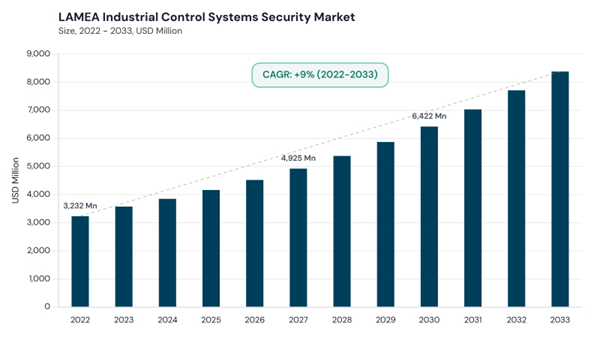
The LAMEA Industrial Control Systems Security Market is expected to witness market growth of 9.3% CAGR during the forecast period (2026-2033) and is projected to reach a market value of USD 4.18 billion by 2033.
The Brazil market dominated the LAMEA Industrial Control Systems Security Market by country in 2025, and is expected to continue to be a dominant market till 2033; thereby, achieving a market value of USD 668.23 million by 2033. The Argentina market is expected to witness a CAGR of 10% during 2026-2033. Additionally, the UAE market is expected to witness a CAGR of 8% during 2026-2033.
The LAMEA Industrial Control Systems Security Market is experiencing steady growth driven by rising investments in industrial automation, increasing adoption of digital transformation initiatives, and growing cybersecurity concerns across critical infrastructure sectors. Industrial organizations across Latin America, the Middle East, and Africa are increasingly integrating connected operational technologies, smart industrial systems, and cloud-enabled industrial platforms into manufacturing, energy, transportation, and utility operations. This growing digitalization is significantly increasing exposure to cyber threats, thereby accelerating demand for advanced industrial control systems security solutions across the region.
The Middle East region is emerging as a significant growth hub due to extensive investments in smart cities, oil & gas digitalization, power infrastructure modernization, and industrial automation initiatives. Countries such as the UAE and Saudi Arabia are heavily investing in cybersecurity infrastructure to protect mission-critical industrial assets and national energy networks from sophisticated cyber threats. Meanwhile, Latin American countries including Brazil and Argentina are increasingly focusing on industrial modernization, manufacturing digitization, and operational resilience strategies, further supporting market expansion across the region.
Africa is also witnessing growing adoption of industrial cybersecurity solutions due to increasing investments in mining operations, energy infrastructure, telecommunications, and manufacturing industries. Organizations across the region are gradually adopting advanced industrial network security frameworks to improve operational continuity and protect industrial control systems against cyberattacks. Additionally, increasing adoption of industrial IoT devices, remote operational technologies, and cloud-connected industrial applications is expected to further strengthen long-term market growth opportunities across LAMEA.
The growing convergence of IT and OT systems across industrial environments is significantly increasing the complexity of cybersecurity management across industrial operations. As a result, enterprises are increasingly deploying AI-powered cybersecurity platforms, industrial anomaly detection systems, SIEM platforms, encryption technologies, and managed security services to improve operational visibility, strengthen threat detection capabilities, and enhance industrial cyber resilience across connected infrastructure environments.
The IDS/IPS and SIEM segments continue to witness strong adoption due to increasing deployment of real-time threat detection, industrial anomaly monitoring, and centralized security management platforms across industrial operations. Additionally, Security & Vulnerability Management solutions are increasingly being implemented to identify operational risks, improve cybersecurity compliance, and strengthen industrial infrastructure resilience against evolving cyber threats.
Professional services continue to witness strong demand due to increasing enterprise requirements for industrial cybersecurity consulting, risk assessment, compliance auditing, penetration testing, and ICS security implementation services. Meanwhile, Managed Services are rapidly gaining traction as organizations increasingly outsource threat monitoring, incident response, vulnerability management, and security operations center (SOC) functions to specialized cybersecurity providers.
The Endpoint segment is expected to witness significant growth due to increasing deployment of connected industrial endpoints, remote operational devices, and industrial IoT systems across manufacturing and energy sectors. The Application segment is also gaining traction as organizations increasingly deploy cloud-based industrial applications and digital operational platforms across industrial environments. Additionally, the Database segment is witnessing growing adoption due to increasing enterprise focus on securing industrial data assets, operational records, and sensitive infrastructure information against cyber threats.
The Manufacturing segment continues to witness strong growth due to increasing adoption of industrial automation technologies, connected production systems, and smart manufacturing initiatives across Latin America and the Middle East. The Transportation System segment is also witnessing increasing cybersecurity adoption across ports, airports, railway systems, and connected logistics infrastructure. Furthermore, the Automotive sector is gradually integrating advanced industrial cybersecurity solutions to secure automated manufacturing facilities and connected industrial operations.
The UAE Industrial Control Systems Security Market is witnessing strong growth driven by extensive investments in smart city projects, industrial automation, energy infrastructure modernization, and digital transformation initiatives. Enterprises across oil & gas, utilities, transportation, and manufacturing sectors are increasingly implementing advanced industrial cybersecurity frameworks to secure mission-critical infrastructure and strengthen operational continuity.
The Saudi Arabia Industrial Control Systems Security Market is also experiencing substantial growth owing to increasing investments in industrial digitalization, smart manufacturing, and critical infrastructure protection initiatives aligned with Vision 2030 objectives. Additionally, growing focus on cybersecurity resilience across energy and industrial sectors is further accelerating demand for industrial cybersecurity solutions across the country.
The Brazil market dominated the LAMEA Industrial Control Systems Security Market by country in 2025, and is expected to continue to be a dominant market till 2033; thereby, achieving a market value of USD 668.23 million by 2033. The Argentina market is expected to witness a CAGR of 10% during 2026-2033. Additionally, the UAE market is expected to witness a CAGR of 8% during 2026-2033.
The LAMEA Industrial Control Systems Security Market is experiencing steady growth driven by rising investments in industrial automation, increasing adoption of digital transformation initiatives, and growing cybersecurity concerns across critical infrastructure sectors. Industrial organizations across Latin America, the Middle East, and Africa are increasingly integrating connected operational technologies, smart industrial systems, and cloud-enabled industrial platforms into manufacturing, energy, transportation, and utility operations. This growing digitalization is significantly increasing exposure to cyber threats, thereby accelerating demand for advanced industrial control systems security solutions across the region.
The Middle East region is emerging as a significant growth hub due to extensive investments in smart cities, oil & gas digitalization, power infrastructure modernization, and industrial automation initiatives. Countries such as the UAE and Saudi Arabia are heavily investing in cybersecurity infrastructure to protect mission-critical industrial assets and national energy networks from sophisticated cyber threats. Meanwhile, Latin American countries including Brazil and Argentina are increasingly focusing on industrial modernization, manufacturing digitization, and operational resilience strategies, further supporting market expansion across the region.
Africa is also witnessing growing adoption of industrial cybersecurity solutions due to increasing investments in mining operations, energy infrastructure, telecommunications, and manufacturing industries. Organizations across the region are gradually adopting advanced industrial network security frameworks to improve operational continuity and protect industrial control systems against cyberattacks. Additionally, increasing adoption of industrial IoT devices, remote operational technologies, and cloud-connected industrial applications is expected to further strengthen long-term market growth opportunities across LAMEA.
The growing convergence of IT and OT systems across industrial environments is significantly increasing the complexity of cybersecurity management across industrial operations. As a result, enterprises are increasingly deploying AI-powered cybersecurity platforms, industrial anomaly detection systems, SIEM platforms, encryption technologies, and managed security services to improve operational visibility, strengthen threat detection capabilities, and enhance industrial cyber resilience across connected infrastructure environments.
Component Outlook
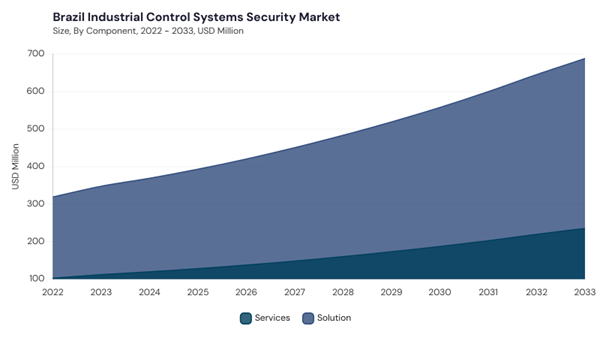
Based on Component, the market is segmented into Solution and Services. The Solution market dominated the LAMEA Industrial Control Systems Security Market by Component in 2025, and is expected to continue to be a dominant market till 2033; thereby, achieving a market value of USD 2.87 billion by 2033. The Services market is expected to witness a CAGR of 9.6% during 2026-2033.Solution Outlook
Based on Solution, the market is segmented into Firewall, Identity & Access Management (IAM), IDS/IPS, Anti-malware/Antivirus, Security & Vulnerability Management, SIEM, Encryption, DDoS, and Other Solutions. The Firewall segment dominated the market in 2025 due to increasing enterprise focus on securing industrial communication networks and strengthening perimeter defense systems across critical infrastructure environments. Identity & Access Management (IAM) solutions are witnessing strong growth owing to increasing enterprise demand for secure authentication systems, privileged access management, and identity governance across connected industrial environments.The IDS/IPS and SIEM segments continue to witness strong adoption due to increasing deployment of real-time threat detection, industrial anomaly monitoring, and centralized security management platforms across industrial operations. Additionally, Security & Vulnerability Management solutions are increasingly being implemented to identify operational risks, improve cybersecurity compliance, and strengthen industrial infrastructure resilience against evolving cyber threats.
Services Outlook
Based on Services, the market is segmented into Professional Services and Managed Services. The Professional Services market dominated the LAMEA Industrial Control Systems Security Market by Services in 2025 and is expected to continue to maintain its dominance till 2033; thereby, achieving a market value of USD 773.62 million by 2033. The Managed Services market is expected to witness a CAGR of 10.2% during 2026-2033.Professional services continue to witness strong demand due to increasing enterprise requirements for industrial cybersecurity consulting, risk assessment, compliance auditing, penetration testing, and ICS security implementation services. Meanwhile, Managed Services are rapidly gaining traction as organizations increasingly outsource threat monitoring, incident response, vulnerability management, and security operations center (SOC) functions to specialized cybersecurity providers.
Security Type Outlook
Based on Security Type, the market is segmented into Network, Endpoint, Application, and Database. The Network market dominated the LAMEA Industrial Control Systems Security Market by Security Type in 2025 and is expected to continue to be a dominant market till 2033; thereby, achieving a market value of USD 1.52 billion by 2033.The Endpoint segment is expected to witness significant growth due to increasing deployment of connected industrial endpoints, remote operational devices, and industrial IoT systems across manufacturing and energy sectors. The Application segment is also gaining traction as organizations increasingly deploy cloud-based industrial applications and digital operational platforms across industrial environments. Additionally, the Database segment is witnessing growing adoption due to increasing enterprise focus on securing industrial data assets, operational records, and sensitive infrastructure information against cyber threats.
End Use Outlook
Based on End Use, the market is segmented into Energy & Utilities, Manufacturing, Transportation System, Power, Automotive, and Other End Use. The Energy & Utilities market dominated the LAMEA Industrial Control Systems Security Market by End Use in 2025 due to increasing cybersecurity investments aimed at protecting oil & gas infrastructure, renewable energy networks, utility operations, and smart grid systems from sophisticated cyberattacks.The Manufacturing segment continues to witness strong growth due to increasing adoption of industrial automation technologies, connected production systems, and smart manufacturing initiatives across Latin America and the Middle East. The Transportation System segment is also witnessing increasing cybersecurity adoption across ports, airports, railway systems, and connected logistics infrastructure. Furthermore, the Automotive sector is gradually integrating advanced industrial cybersecurity solutions to secure automated manufacturing facilities and connected industrial operations.
Country Outlook
The Brazil Industrial Control Systems Security Market continues to lead the LAMEA region due to increasing investments in industrial modernization, manufacturing automation, and critical infrastructure cybersecurity initiatives. Organizations across manufacturing, utilities, mining, and energy sectors are increasingly deploying advanced industrial cybersecurity solutions to improve operational resilience and protect industrial assets from cyber threats.The UAE Industrial Control Systems Security Market is witnessing strong growth driven by extensive investments in smart city projects, industrial automation, energy infrastructure modernization, and digital transformation initiatives. Enterprises across oil & gas, utilities, transportation, and manufacturing sectors are increasingly implementing advanced industrial cybersecurity frameworks to secure mission-critical infrastructure and strengthen operational continuity.
The Saudi Arabia Industrial Control Systems Security Market is also experiencing substantial growth owing to increasing investments in industrial digitalization, smart manufacturing, and critical infrastructure protection initiatives aligned with Vision 2030 objectives. Additionally, growing focus on cybersecurity resilience across energy and industrial sectors is further accelerating demand for industrial cybersecurity solutions across the country.
List of Key Companies Profiled
- Cisco Systems, Inc.
- Fortinet, Inc.
- Palo Alto Networks, Inc.
- Honeywell International, Inc.
- Siemens AG
- Schneider Electric SE
- IBM Corporation
- ABB Ltd.
- Dragos, Inc.
- Nozomi Networks Inc.
- CrowdStrike Holdings, Inc.
- Check Point Software Technologies Ltd.
Market Report Segmentation
By Component- Solution
- Firewall
- IAM
- IDS/IPS
- Anti-malware/Antivirus
- Security & Vulnerability Management
- SIEM
- Encryption
- DDoS
- Other Solution
- Services
- Professional Services
- Managed Services
- Network
- Endpoint
- Application
- Database
- Energy & Utilities
- Manufacturing
- Transportation Systems
- Power
- Automotive
- Other End Use
- Brazil
- Argentina
- UAE
- Saudi Arabia
- South Africa
- Nigeria
- Rest of LAMEA
Table of Contents
Chapter 1. LAMEA MARKET1.1 Market Overview
1.2 Key Factors Impacting Market
1.2.1 Market Drivers
1.2.2 Market Restraints
1.2.3 Market Opportunities
1.2.4 Market Challenges
1.2.5 Market Trends
1.2.6 State of Competition
1.2.7 Market Consolidation
1.2.8 Key Customer Criteria
1.3 Product Life Cycle
1.4 Segmentation By Component
1.4.1 Solution
1.4.1.1 Anti-malware/Antivirus
1.4.1.2 Firewall
1.4.1.3 Encryption
1.4.1.4 Identity and Access Management (IAM)
1.4.1.5 Security and Vulnerability Management
1.4.1.6 Security Information and Event Management (SIEM)
1.4.1.7 Distributed Denial-of-Service (DDoS)
1.4.1.8 Intrusion Detection Systems (IDS)/Intrusion Prevention System (IPS)
1.4.1.9 Other Solution
1.4.2 Services
1.4.2.1 Professional Services
1.4.2.2 Managed Services
1.5 Segmentation By Security Type
1.5.1 Network
1.5.2 Endpoint
1.5.3 Application
1.5.4 Database
1.6 Segmentation By End Use
1.6.1 Energy & Utilities
1.6.2 Manufacturing
1.6.3 Power
1.6.4 Transportation Systems
1.6.5 Automotive
1.6.6 Other End Use
1.7 Segmentation By Country
1.7.1 Brazil
1.7.1.1 Segmentation By Component
1.7.1.1.1 Solution
1.7.1.1.1.1 Anti-malware/Antivirus
1.7.1.1.1.2 Firewall
1.7.1.1.1.3 Encryption
1.7.1.1.1.4 Identity and Access Management (IAM)
1.7.1.1.1.5 Security and Vulnerability Management
1.7.1.1.1.6 Security Information and Event Management (SIEM)
1.7.1.1.1.7 Distributed Denial-of-Service (DDoS)
1.7.1.1.1.8 Intrusion Detection Systems (IDS)/Intrusion Prevention Systems (IPS)
1.7.1.1.1.9 Other Solution
1.7.1.2 Services
1.7.1.2.1.1 Professional Services
1.7.1.2.1.2 Managed Services
1.7.1.3 Segmentation By Security Type
1.7.1.3.1 Network
1.7.1.3.2 Endpoint
1.7.1.3.3 Application
1.7.1.3.4 Database
1.7.1.4 Segmentation By End Use
1.7.1.4.1 Energy & Utilities
1.7.1.4.2 Manufacturing
1.7.1.4.3 Power
1.7.1.4.4 Transportation Systems
1.7.1.4.5 Automotive
1.7.1.4.6 Other End Use
1.7.2 Argentina
1.7.2.1 Segmentation By Component
1.7.2.1.1 Solution
1.7.2.1.1.1 Anti-malware/Antivirus
1.7.2.1.1.2 Firewall
1.7.2.1.1.3 Encryption
1.7.2.1.1.4 Identity and Access Management (IAM)
1.7.2.1.1.5 Security and Vulnerability Management
1.7.2.1.1.6 Security Information and Event Management (SIEM)
1.7.2.1.1.7 Distributed Denial-of-Service (DDoS)
1.7.2.1.1.8 Intrusion Detection Systems (IDS)/Intrusion Prevention Systems (IPS)
1.7.2.1.1.9 Other Solution
1.7.2.2 Services
1.7.2.2.1.1 Professional Services
1.7.2.2.1.2 Managed Services
1.7.2.3 Segmentation By Security Type
1.7.2.3.1 Network
1.7.2.3.2 Endpoint
1.7.2.3.3 Application
1.7.2.3.4 Database
1.7.2.4 Segmentation By End Use
1.7.2.4.1 Energy & Utilities
1.7.2.4.2 Manufacturing
1.7.2.4.3 Power
1.7.2.4.4 Transportation Systems
1.7.2.4.5 Automotive
1.7.2.4.6 Other End Use
1.7.3 UAE
1.7.3.1 Segmentation By Component
1.7.3.1.1 Solution
1.7.3.1.1.1 Anti-malware/Antivirus
1.7.3.1.1.2 Firewall
1.7.3.1.1.3 Encryption
1.7.3.1.1.4 Identity and Access Management (IAM)
1.7.3.1.1.5 Security and Vulnerability Management
1.7.3.1.1.6 Security Information and Event Management (SIEM)
1.7.3.1.1.7 Distributed Denial-of-Service (DDoS)
1.7.3.1.1.8 Intrusion Detection Systems (IDS)/Intrusion Prevention Systems (IPS)
1.7.3.1.1.9 Other Solution
1.7.3.2 Services
1.7.3.2.1.1 Professional Services
1.7.3.2.1.2 Managed Services
1.7.3.3 Segmentation By Security Type
1.7.3.3.1 Network
1.7.3.3.2 Endpoint
1.7.3.3.3 Application
1.7.3.3.4 Database
1.7.3.4 Segmentation By End Use
1.7.3.4.1 Energy & Utilities
1.7.3.4.2 Manufacturing
1.7.3.4.3 Power
1.7.3.4.4 Transportation Systems
1.7.3.4.5 Automotive
1.7.3.4.6 Other End Use
1.7.4 Saudi Arabia
1.7.4.1 Segmentation By Component
1.7.4.1.1 Solution
1.7.4.1.1.1 Anti-malware/Antivirus
1.7.4.1.1.2 Firewall
1.7.4.1.1.3 Encryption
1.7.4.1.1.4 Identity and Access Management (IAM)
1.7.4.1.1.5 Security and Vulnerability Management
1.7.4.1.1.6 Security Information and Event Management (SIEM)
1.7.4.1.1.7 Distributed Denial-of-Service (DDoS)
1.7.4.1.1.8 Intrusion Detection Systems (IDS)/Intrusion Prevention Systems (IPS)
1.7.4.1.1.9 Other Solution
1.7.4.2 Services
1.7.4.2.1.1 Professional Services
1.7.4.2.1.2 Managed Services
1.7.4.3 Segmentation By Security Type
1.7.4.3.1 Network
1.7.4.3.2 Endpoint
1.7.4.3.3 Application
1.7.4.3.4 Database
1.7.4.4 Segmentation By End Use
1.7.4.4.1 Energy & Utilities
1.7.4.4.2 Manufacturing
1.7.4.4.3 Power
1.7.4.4.4 Transportation Systems
1.7.4.4.5 Automotive
1.7.4.4.6 Other End Use
1.7.5 South Africa
1.7.5.1 Segmentation By Component
1.7.5.1.1 Solution
1.7.5.1.1.1 Anti-malware/Antivirus
1.7.5.1.1.2 Firewall
1.7.5.1.1.3 Encryption
1.7.5.1.1.4 Identity and Access Management (IAM)
1.7.5.1.1.5 Security and Vulnerability Management
1.7.5.1.1.6 Security Information and Event Management (SIEM)
1.7.5.1.1.7 Distributed Denial-of-Service (DDoS)
1.7.5.1.1.8 Intrusion Detection Systems (IDS)/Intrusion Prevention Systems (IPS)
1.7.5.1.1.9 Other Solution
1.7.5.2 Services
1.7.5.2.1.1 Professional Services
1.7.5.2.1.2 Managed Services
1.7.5.3 Segmentation By Security Type
1.7.5.3.1 Network
1.7.5.3.2 Endpoint
1.7.5.3.3 Application
1.7.5.3.4 Database
1.7.5.4 Segmentation By End Use
1.7.5.4.1 Energy & Utilities
1.7.5.4.2 Manufacturing
1.7.5.4.3 Power
1.7.5.4.4 Transportation Systems
1.7.5.4.5 Automotive
1.7.5.4.6 Other End Use
1.7.6 Nigeria
1.7.6.1 Segmentation By Component
1.7.6.1.1 Solution
1.7.6.1.1.1 Anti-malware/Antivirus
1.7.6.1.1.2 Firewall
1.7.6.1.1.3 Encryption
1.7.6.1.1.4 Identity and Access Management (IAM)
1.7.6.1.1.5 Security and Vulnerability Management
1.7.6.1.1.6 Security Information and Event Management (SIEM)
1.7.6.1.1.7 Distributed Denial-of-Service (DDoS)
1.7.6.1.1.8 Intrusion Detection Systems (IDS)/Intrusion Prevention Systems (IPS)
1.7.6.1.1.9 Other Solution
1.7.6.2 Services
1.7.6.2.1.1 Professional Services
1.7.6.2.1.2 Managed Services
1.7.6.3 Segmentation By Security Type
1.7.6.3.1 Network
1.7.6.3.2 Endpoint
1.7.6.3.3 Application
1.7.6.3.4 Database
1.7.6.4 Segmentation By End Use
1.7.6.4.1 Energy & Utilities
1.7.6.4.2 Manufacturing
1.7.6.4.3 Power
1.7.6.4.4 Transportation Systems
1.7.6.4.5 Automotive
1.7.6.4.6 Other End Use
1.7.7 Rest of LAMEA
1.7.7.1 Segmentation By Component
1.7.7.1.1 Solution
1.7.7.1.1.1 Anti-malware/Antivirus
1.7.7.1.1.2 Firewall
1.7.7.1.1.3 Encryption
1.7.7.1.1.4 Identity and Access Management (IAM)
1.7.7.1.1.5 Security and Vulnerability Management
1.7.7.1.1.6 Security Information and Event Management (SIEM)
1.7.7.1.1.7 Distributed Denial-of-Service (DDoS)
1.7.7.1.1.8 Intrusion Detection Systems (IDS)/Intrusion Prevention Systems (IPS)
1.7.7.1.1.9 Other Solution
1.7.7.2 Services
1.7.7.2.1.1 Professional Services
1.7.7.2.1.2 Managed Services
1.7.7.3 Segmentation By Security Type
1.7.7.3.1 Network
1.7.7.3.2 Endpoint
1.7.7.3.3 Application
1.7.7.3.4 Database
1.7.7.4 Segmentation By End Use
1.7.7.4.1 Energy & Utilities
1.7.7.4.2 Manufacturing
1.7.7.4.3 Power
1.7.7.4.4 Transportation Systems
1.7.7.4.5 Automotive
1.7.7.4.6 Other End Use
Chapter 2. Company Profiles
2.1 ABB Ltd.
2.1.1 Company Overview
2.1.2 Recent Strategies and Developments
2.1.2.1 Product Launches and Product Expansions
2.1.3 Company Focus
2.1.2 Strategic Insights
2.1.5 Strategy Deployed
2.1.6 SWOT Analysis
2.1.7 Future Outlook
2.2 Schneider Electric SE
2.2.1 Company Overview
2.2.2 Financial Analysis
2.2.3 Segmental and Regional Analysis
2.2.2 Research & Development Expense
2.2.5 Recent Strategies and Developments
2.2.5.1 Product Launches and Product Expansions
2.2.5.2 Geographical Expansions
2.2.6 Company Focus
2.2.7 Strategic Insights
2.2.8 Strategy Deployed
2.2.9 SWOT Analysis
2.2.10 Future Outlook
2.3 Siemens AG
2.3.1 Company Overview
2.3.2 Financial Analysis
2.3.3 Segmental and Regional Analysis
2.3.2 Research & Development Expense
2.3.5 Recent Strategies and Developments
2.3.5.1 Partnerships, Collaborations, and Agreements
2.3.6 Company Focus
2.3.7 Strategic Insights
2.3.8 Strategy Deployed
2.3.9 SWOT Analysis
2.3.10 Future Outlook
2.2 Eaton Corporation PLC
2.2.1 Company Overview
2.2.2 Financial Analysis
2.2.3 Segmental and Regional Analysis
2.2.2 Research & Development Expense
2.2.5 Company Focus
2.2.6 Strategic Insights
2.2.7 Strategy Deployed
2.2.8 SWOT Analysis
2.2.9 Future Outlook
2.5 Mitsubishi Electric Corporation
2.5.1 Company Overview
2.5.2 Financial Analysis
2.5.3 Segmental and Regional Analysis
2.5.2 Research & Development Expense
2.5.5 Recent Strategies and Developments
2.5.5.1 Partnerships, Collaborations, and Agreements
2.5.5.2 Product Launches and Product Expansions
2.5.6 Company Focus
2.5.7 Strategic Insights
2.5.8 Strategy Deployed
2.5.9 SWOT Analysis
2.5.10 Future Outlook
2.6 Legrand S.A. (Legrand Group)
2.6.1 Company Overview
2.6.2 Financial Analysis
2.6.3 Regional Analysis
2.6.2 Research & Development Expense
2.6.5 Recent Strategies and Developments
2.6.5.1 Product Launches and Product Expansions
2.6.6 Company Focus
2.6.7 Strategic Insights
2.6.8 Strategy Deployed
2.6.9 SWOT Analysis
2.6.10 Future Outlook
2.7 General Electric Company
2.7.1 Company Overview
2.7.2 Company Focus
2.7.3 Strategic Insights
2.7.2 Strategy Deployed
2.7.5 SWOT Analysis
2.7.6 Future Outlook
2.8 Hager Group
2.8.1 Company Overview
2.8.2 Company Focus
2.8.3 Strategic Insights
2.8.2 Strategy Deployed
2.8.5 SWOT Analysis
2.8.6 Future Outlook
2.9 Fuji Electric Co. Ltd.
2.9.1 Company Overview
2.9.2 Financial Analysis
2.9.3 Segmental and Regional Analysis
2.9.2 Research & Development Expense
2.9.5 Company Focus
2.9.6 Strategic Insights
2.9.7 Strategy Deployed
2.9.8 SWOT Analysis
2.9.9 Future Outlook
2.1 CHINT Group Co., Ltd.
2.10.1 Company Overview
2.10.2 Recent Strategies and Developments
2.10.2.1 Partnerships, Collaborations, and Agreements
2.10.2.2 Geographical Expansions
2.10.3 Company Focus
2.10.2 Strategic Insights
2.10.5 Strategy Deployed
2.10.6 SWOT Analysis
2.10.7 Future Outlook
Companies Mentioned
- Cisco Systems, Inc.
- Fortinet, Inc.
- Palo Alto Networks, Inc.
- Honeywell International, Inc.
- Siemens AG
- Schneider Electric SE
- IBM Corporation
- ABB Ltd.
- Dragos, Inc.
- Nozomi Networks Inc.
- CrowdStrike Holdings, Inc.
- Check Point Software Technologies Ltd.


