



The Europe PFAS-Free Food Packaging Market is expected to reach USD 17.20 billion by 2031, growing at a CAGR of 6.2% during the forecast period (2026-2033).
The Europe PFAS-Free Food Packaging Market is witnessing substantial growth due to stringent European Union regulations restricting the use of per- and polyfluoroalkyl substances (PFAS) in food-contact materials. Rising environmental awareness, increasing consumer preference for sustainable food packaging, and growing concerns regarding the health risks associated with PFAS exposure are accelerating the adoption of eco-friendly packaging alternatives throughout Europe. Foodservice providers, retailers, and packaged food manufacturers are increasingly shifting toward recyclable, biodegradable, and compostable packaging solutions to comply with sustainability mandates and circular economy initiatives.
Furthermore, increasing investments in fluorine-free barrier coatings, molded fiber packaging, cellulose films, and bio-based materials are driving technological innovation across the market. The rapid expansion of takeaway food services, online food delivery platforms, and sustainable retail-ready packaging is supporting demand for PFAS-free wraps, trays, pouches, and containers. Additionally, the growing implementation of advanced recyclable barrier technologies and eco-friendly packaging materials is strengthening the competitive landscape across Europe.
The increasing expansion of sustainable foodservice infrastructure, eco-friendly retail packaging, and biodegradable takeaway packaging across Europe is expected to continue supporting market growth. Regulatory support for eliminating PFAS chemicals from food-contact applications and rising investments in recyclable and compostable packaging technologies are further accelerating adoption of PFAS-free food packaging materials across the region.
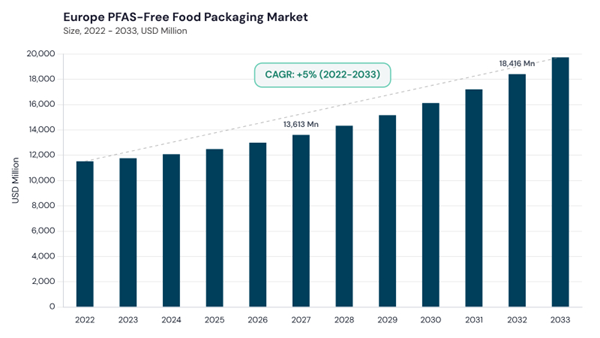
The Europe PFAS-Free Food Packaging Market is witnessing substantial growth due to stringent European Union regulations restricting the use of per- and polyfluoroalkyl substances (PFAS) in food-contact materials. Rising environmental awareness, increasing consumer preference for sustainable food packaging, and growing concerns regarding the health risks associated with PFAS exposure are accelerating the adoption of eco-friendly packaging alternatives throughout Europe. Foodservice providers, retailers, and packaged food manufacturers are increasingly shifting toward recyclable, biodegradable, and compostable packaging solutions to comply with sustainability mandates and circular economy initiatives.
Furthermore, increasing investments in fluorine-free barrier coatings, molded fiber packaging, cellulose films, and bio-based materials are driving technological innovation across the market. The rapid expansion of takeaway food services, online food delivery platforms, and sustainable retail-ready packaging is supporting demand for PFAS-free wraps, trays, pouches, and containers. Additionally, the growing implementation of advanced recyclable barrier technologies and eco-friendly packaging materials is strengthening the competitive landscape across Europe.
Packaging Type Outlook
Based on Packaging Type, the market is segmented into Wraps & Liners, Clamshells & Hinged Containers, Plates, Bowls & Trays, Cups & Lids, and Bags & Pouches. The Wraps & Liners segment dominated the Europe PFAS-Free Food Packaging Market in 2025 and is expected to continue to be a dominant segment till 2031; thereby, achieving a market value of USD 5.52 billion by 2031. The Clamshells & Hinged Containers segment accounted for a market share of 19.4% in 2025 owing to increasing demand from takeaway and ready-to-eat meal packaging applications. Additionally, the Bags & Pouches segment is expected to witness a CAGR of 7.1% during 2026-2033.Material Type Outlook
Based on Material Type, the market is segmented into Paper & Paperboard, Molded Fiber/Pulp, Bioplastics, Cellulose Films, and Clay/Wax-Coated Paper. The Paper & Paperboard segment acquired the largest revenue share in the Europe PFAS-Free Food Packaging Market in 2025 and is expected to continue to be a dominant segment till 2031; thereby, achieving a market value of USD 7.37 billion by 2031. The Molded Fiber/Pulp segment held a market share of 19.1% in 2025 due to increasing adoption of biodegradable and compostable packaging materials across foodservice applications. Additionally, the Bioplastics segment is expected to witness a CAGR of 6.5% during 2026-2033.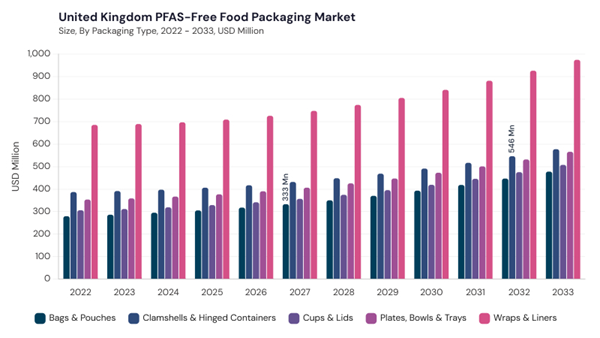
End-user Outlook
Based on End-user, the market is segmented into Quick-Service Restaurants (QSRs), Retail & Supermarkets, Cafes & Bakeries, Institutional Catering, and Frozen & Ready-Meal Producers. The Quick-Service Restaurants (QSRs) segment dominated the Europe PFAS-Free Food Packaging Market in 2025 and is expected to continue to be a dominant segment till 2031; thereby, achieving a market value of USD 6.30 billion by 2031. The Retail & Supermarkets segment accounted for a market share of 21.6% in 2025 owing to increasing adoption of PFAS-free packaging for fresh food and ready-to-eat products. Additionally, the Cafes & Bakeries segment is expected to witness a CAGR of 7.2% during 2026-2033.Country Outlook
Based on Country, the market is segmented into Germany, UK, France, Russia, Spain, Italy, and Rest of Europe. Germany market dominated the Europe PFAS-Free Food Packaging Market by country in 2025 and is expected to continue to be a dominant market till 2031; thereby, achieving a market value of USD 3.34 billion by 2031. The UK market accounted for a market share of 21.09% in 2025 owing to increasing demand for sustainable takeaway and retail food packaging solutions. Additionally, the France market is expected to witness a CAGR of 6.9% during 2026-2033.The increasing expansion of sustainable foodservice infrastructure, eco-friendly retail packaging, and biodegradable takeaway packaging across Europe is expected to continue supporting market growth. Regulatory support for eliminating PFAS chemicals from food-contact applications and rising investments in recyclable and compostable packaging technologies are further accelerating adoption of PFAS-free food packaging materials across the region.
List of Key Companies Profiled
- Amcor Plc
- Mondi Plc
- Huhtamaki Oyj
- Stora Enso Oyj
- DS Smith Plc
- Smurfit Westrock Plc
- Graphic Packaging International, LLC
- Sealed Air Corporation
- Berry Global Group, Inc.
- Novolex Holdings, LLC
Market Report Segmentation
By Packaging Type- Wraps & Liners
- Clamshells & Hinged Containers
- Plates, Bowls & Trays
- Cups & Lids
- Bags & Pouches
- Paper & Paperboard
- Molded Fiber/Pulp
- Bioplastics
- Cellulose Films
- Clay/Wax-Coated Paper
- Quick-Service Restaurants (QSRs)
- Retail & Supermarkets
- Cafes & Bakeries
- Institutional Catering
- Frozen & Ready-Meal Producers
- Germany
- UK
- France
- Russia
- Spain
- Italy
- Rest of Europe
Table of Contents
Chapter 1. Europe Market1.1 Market Overview
1.2 Key Factors Impacting Market
1.2.1 Market Drivers
1.2.2 Market Restraints
1.2.3 Market Opportunities
1.2.4 Market Challenges
1.2.5 Market Trends
1.2.6 State of Competition
1.2.7 Market Consolidation
1.2.8 Key Customer Criteria
1.3 Product Life Cycle
1.4 Segmentation By Packaging Type
1.4.1 Wraps & Liners
1.4.2 Clamshells & Hinged Containers
1.4.3 Plates, Bowls & Trays
1.4.4 Cups & Lids
1.4.5 Bags & Pouches
1.5 Segmentation By Material Type
1.5.1 Paper & Paperboard
1.5.2 Molded Fiber/Pulp
1.5.3 Bioplastics
1.5.4 Cellulose Films
1.5.5 Clay/Wax-Coated Paper
1.6 Segmentation By End-user
1.6.1 Quick-Service Restaurants (QSRs)
1.6.2 Retail & Supermarkets
1.6.3 Cafes & Bakeries
1.6.4 Institutional Catering
1.6.5 Frozen & Ready-Meal Producers
1.7 Segmentation By Country
1.7.1 Germany
1.7.1.1 Segmentation By Packaging Type
1.7.1.1.1 Wraps & Liners
1.7.1.1.2 Clamshells & Hinged Containers
1.7.1.1.3 Plates, Bowls & Trays
1.7.1.1.4 Cups & Lids
1.7.1.1.5 Bags & Pouches
1.7.1.2 Segmentation By Material Type
1.7.1.2.1 Paper & Paperboard
1.7.1.2.2 Molded Fiber/Pulp
1.7.1.2.3 Bioplastics
1.7.1.2.4 Cellulose Films
1.7.1.2.5 Clay/Wax-Coated Paper
1.7.1.3 Segmentation By End-user
1.7.1.3.1 Quick-Service Restaurants (QSRs)
1.7.1.3.2 Retail & Supermarkets
1.7.1.3.3 Cafes & Bakeries
1.7.1.3.4 Institutional Catering
1.7.1.3.5 Frozen & Ready-Meal Producers
1.7.2 UK
1.7.2.1 Segmentation By Packaging Type
1.7.2.1.1 Wraps & Liners
1.7.2.1.2 Clamshells & Hinged Containers
1.7.2.1.3 Plates, Bowls & Trays
1.7.2.1.4 Cups & Lids
1.7.2.1.5 Bags & Pouches
1.7.2.2 Segmentation By Material Type
1.7.2.2.1 Paper & Paperboard
1.7.2.2.2 Molded Fiber/Pulp
1.7.2.2.3 Bioplastics
1.7.2.2.4 Cellulose Films
1.7.2.2.5 Clay/Wax-Coated Paper
1.7.2.3 Segmentation By End-user
1.7.2.3.1 Quick-Service Restaurants (QSRs)
1.7.2.3.2 Retail & Supermarkets
1.7.2.3.3 Cafes & Bakeries
1.7.2.3.4 Institutional Catering
1.7.2.3.5 Frozen & Ready-Meal Producers
1.7.3 France
1.7.3.1 Segmentation By Packaging Type
1.7.3.1.1 Wraps & Liners
1.7.3.1.2 Clamshells & Hinged Containers
1.7.3.1.3 Plates, Bowls & Trays
1.7.3.1.4 Cups & Lids
1.7.3.1.5 Bags & Pouches
1.7.3.2 Segmentation By Material Type
1.7.3.2.1 Paper & Paperboard
1.7.3.2.2 Molded Fiber/Pulp
1.7.3.2.3 Bioplastics
1.7.3.2.4 Cellulose Films
1.7.3.2.5 Clay/Wax-Coated Paper
1.7.3.3 Segmentation By End-user
1.7.3.3.1 Quick-Service Restaurants (QSRs)
1.7.3.3.2 Retail & Supermarkets
1.7.3.3.3 Cafes & Bakeries
1.7.3.3.4 Institutional Catering
1.7.3.3.5 Frozen & Ready-Meal Producers
1.7.4 Russia
1.7.4.1 Segmentation By Packaging Type
1.7.4.1.1 Wraps & Liners
1.7.4.1.2 Clamshells & Hinged Containers
1.7.4.1.3 Plates, Bowls & Trays
1.7.4.1.4 Cups & Lids
1.7.4.1.5 Bags & Pouches
1.7.4.2 Segmentation By Material Type
1.7.4.2.1 Paper & Paperboard
1.7.4.2.2 Molded Fiber/Pulp
1.7.4.2.3 Bioplastics
1.7.4.2.4 Cellulose Films
1.7.4.2.5 Clay/Wax-Coated Paper
1.7.4.3 Segmentation By End-user
1.7.4.3.1 Quick-Service Restaurants (QSRs)
1.7.4.3.2 Retail & Supermarkets
1.7.4.3.3 Cafes & Bakeries
1.7.4.3.4 Institutional Catering
1.7.4.3.5 Frozen & Ready-Meal Producers
1.7.5 Spain
1.7.5.1 Segmentation By Packaging Type
1.7.5.1.1 Wraps & Liners
1.7.5.1.2 Clamshells & Hinged Containers
1.7.5.1.3 Plates, Bowls & Trays
1.7.5.1.4 Cups & Lids
1.7.5.1.5 Bags & Pouches
1.7.5.2 Segmentation By Material Type
1.7.5.2.1 Paper & Paperboard
1.7.5.2.2 Molded Fiber/Pulp
1.7.5.2.3 Bioplastics
1.7.5.2.4 Cellulose Films
1.7.5.2.5 Clay/Wax-Coated Paper
1.7.5.3 Segmentation By End-user
1.7.5.3.1 Quick-Service Restaurants (QSRs)
1.7.5.3.2 Retail & Supermarkets
1.7.5.3.3 Cafes & Bakeries
1.7.5.3.4 Institutional Catering
1.7.5.3.5 Frozen & Ready-Meal Producers
1.7.6 Italy
1.7.6.1 Segmentation By Packaging Type
1.7.6.1.1 Wraps & Liners
1.7.6.1.2 Clamshells & Hinged Containers
1.7.6.1.3 Plates, Bowls & Trays
1.7.6.1.4 Cups & Lids
1.7.6.1.5 Bags & Pouches
1.7.6.2 Segmentation By Material Type
1.7.6.2.1 Paper & Paperboard
1.7.6.2.2 Molded Fiber/Pulp
1.7.6.2.3 Bioplastics
1.7.6.2.4 Cellulose Films
1.7.6.2.5 Clay/Wax-Coated Paper
1.7.6.3 Segmentation By End-user
1.7.6.3.1 Quick-Service Restaurants (QSRs)
1.7.6.3.2 Retail & Supermarkets
1.7.6.3.3 Cafes & Bakeries
1.7.6.3.4 Institutional Catering
1.7.6.3.5 Frozen & Ready-Meal Producers
1.7.7 Rest of Europe
1.7.7.1 Segmentation By Packaging Type
1.7.7.1.1 Wraps & Liners
1.7.7.1.2 Clamshells & Hinged Containers
1.7.7.1.3 Plates, Bowls & Trays
1.7.7.1.4 Cups & Lids
1.7.7.1.5 Bags & Pouches
1.7.7.2 Segmentation By Material Type
1.7.7.2.1 Paper & Paperboard
1.7.7.2.2 Molded Fiber/Pulp
1.7.7.2.3 Bioplastics
1.7.7.2.4 Cellulose Films
1.7.7.2.5 Clay/Wax-Coated Paper
1.7.7.3 Segmentation By End-user
1.7.7.3.1 Quick-Service Restaurants (QSRs)
1.7.7.3.2 Retail & Supermarkets
1.7.7.3.3 Cafes & Bakeries
1.7.7.3.4 Institutional Catering
1.7.7.3.5 Frozen & Ready-Meal Producers
Chapter 2. Company Snapshot
2.1 Stora Enso Oyj
2.1.1 Business Overview
2.1.2 Key Information
2.1.3 Company Focus on PFAS-Free Food Packaging Market
2.1.4 Strategic Insights on PFAS-Free Food Packaging Market
2.1.5 Strategy Deployed for PFAS-Free Food Packaging Market
2.1.6 Product & Service Portfolio
2.1.7 Portfolio Categories
2.1.8 Key Products / Services (Representative)
2.1.9 Capability Overview
2.1.10 Technology & Innovation Focus
2.1.11 SWOT Analysis (PFAS-Free Food Packaging Market)
2.1.12 Customers / End Users
2.1.13 Competitive Positioning
2.1.14 Key Differentiators
2.1.15 Portfolio Matrix
2.1.16 Analyst View
2.1.17 Future Outlook for PFAS-Free Food Packaging Market
2.2 Smurfit Westrock plc.
2.2.1 Business Overview
2.2.2 Key Information
2.2.3 Company Focus on PFAS-Free Food Packaging Market
2.2.4 Strategic Insights on PFAS-Free Food Packaging Market
2.2.5 Strategy Deployed for PFAS-Free Food Packaging Market
2.2.6 Product & Service Portfolio
2.2.7 Portfolio Categories
2.2.8 Key Products / Services (Representative)
2.2.9 Capability Overview
2.2.10 Technology & Innovation Focus
2.2.11 SWOT Analysis (PFAS-Free Food Packaging Market)
2.2.12 Customers / End Users
2.2.13 Competitive Positioning
2.2.14 Key Differentiators
2.2.15 Portfolio Matrix
2.2.16 Analyst View
2.2.17 Future Outlook for PFAS-Free Food Packaging Market
2.3 UPM-Kymmene Corporation
2.3.1 Business Overview
2.3.2 Key Information
2.3.3 Company Focus on PFAS-Free Food Packaging Market
2.3.4 Strategic Insights on PFAS-Free Food Packaging Market
2.3.5 Strategy Deployed for PFAS-Free Food Packaging Market
2.3.6 Product & Service Portfolio
2.3.7 Portfolio Categories
2.3.8 Key Products / Services (Representative)
2.3.9 Capability Overview
2.3.10 Technology & Innovation Focus
2.3.11 SWOT Analysis (PFAS-Free Food Packaging Market)
2.3.12 Customers / End Users
2.3.13 Competitive Positioning
2.3.14 Key Differentiators
2.3.15 Portfolio Matrix
2.3.16 Analyst View
2.3.17 Future Outlook for PFAS-Free Food Packaging Market
2.4 Novolex Holdings, LLC
2.4.1 Business Overview
2.4.2 Key Information
2.4.3 Company Focus on PFAS-Free Food Packaging Market
2.4.4 Strategic Insights on PFAS-Free Food Packaging Market
2.4.5 Strategy Deployed for PFAS-Free Food Packaging Market
2.4.6 Product & Service Portfolio
2.4.7 Portfolio Categories
2.4.8 Key Products / Services (Representative)
2.4.9 Capability Overview
2.4.10 Technology & Innovation Focus
2.4.11 SWOT Analysis (PFAS-Free Food Packaging Market Context)
2.4.12 Customers / End Users
2.4.13 Competitive Positioning
2.4.14 Key Differentiators
2.4.15 Portfolio Matrix
2.4.16 Analyst View
2.4.17 Future Outlook for PFAS-Free Food Packaging Market
2.5 Footprint LLC
2.5.1 Business Overview
2.5.2 Key Information
2.5.3 Company Focus on PFAS-Free Food Packaging Market
2.5.4 Strategic Insights on PFAS-Free Food Packaging Market
2.5.5 Strategy Deployed for PFAS-Free Food Packaging Market
2.5.6 Product & Service Portfolio
2.5.7 Portfolio Categories
2.5.8 Key Products / Services (Representative)
2.5.9 Capability Overview
2.5.10 Technology & Innovation Focus
2.5.11 SWOT Analysis (PFAS-Free Food Packaging Market)
2.5.12 Customers / End Users
2.5.13 Competitive Positioning
2.5.14 Key Differentiators
2.5.15 Portfolio Matrix
2.5.16 Analyst View
2.5.17 Future Outlook for PFAS-Free Food Packaging Market
2.6 Huhtamäki Oyj
2.6.1 Business Overview
2.6.2 Key Information
2.6.3 Company Focus on PFAS-Free Food Packaging Market
2.6.4 Strategic Insights on PFAS-Free Food Packaging Market
2.6.5 Strategy Deployed for PFAS-Free Food Packaging Market
2.6.6 Product & Service Portfolio
2.6.7 Portfolio Categories
2.6.8 Key Products / Services (Representative)
2.6.9 Capability Overview
2.6.10 Technology & Innovation Focus
2.6.11 SWOT Analysis (PFAS-Free Food Packaging Market)
2.6.12 Customers / End Users
2.6.13 Competitive Positioning
2.6.14 Key Differentiators
2.6.15 Portfolio Matrix
2.6.16 Analyst View
2.6.17 Future Outlook for PFAS-Free Food Packaging Market
2.7 Georgia-Pacific LLC
2.7.1 Business Overview
2.7.2 Key Information
2.7.3 Company Focus on PFAS-Free Food Packaging Market
2.7.4 Strategic Insights on PFAS-Free Food Packaging Market
2.7.5 Strategy Deployed for PFAS-Free Food Packaging Market
2.7.6 Product & Service Portfolio
2.7.7 Portfolio Categories
2.7.8 Key Products / Services (Representative)
2.7.9 Capability Overview
2.7.10 Technology & Innovation Focus
2.7.11 SWOT Analysis (PFAS-Free Food Packaging Market)
2.7.12 Customers / End Users
2.7.13 Competitive Positioning
2.7.14 Key Differentiators
2.7.15 Portfolio Matrix
2.7.16 Analyst View
2.7.17 Future Outlook for PFAS-Free Food Packaging Market
2.8 Sabert Corporation
2.8.1 Business Overview
2.8.2 Key Information
2.8.3 Company Focus on PFAS-Free Food Packaging Market
2.8.4 Strategic Insights on PFAS-Free Food Packaging Market
2.8.5 Strategy Deployed for PFAS-Free Food Packaging Market
2.8.6 Product & Service Portfolio
2.8.7 Portfolio Categories
2.8.8 Key Products / Services (Representative)
2.8.9 Capability Overview
2.8.10 Technology & Innovation Focus
2.8.11 SWOT Analysis (PFAS-Free Food Packaging Market)
2.8.12 Customers / End Users
2.8.13 Competitive Positioning
2.8.14 Key Differentiators
2.8.15 Portfolio Matrix
2.8.16 Analyst View
2.8.17 Future Outlook for PFAS-Free Food Packaging Market
2.9 DuPont de Nemours, Inc.
2.9.1 Business Overview
2.9.2 Key Information
2.9.3 Company Focus on PFAS-Free Food Packaging Market
2.9.4 Strategic Insights on PFAS-Free Food Packaging Market
2.9.5 Strategy Deployed for PFAS-Free Food Packaging Market
2.9.6 Product & Service Portfolio
2.9.7 Portfolio Categories
2.9.8 Key Products / Services (Representative)
2.9.9 Capability Overview
2.9.10 Technology & Innovation Focus
2.9.11 SWOT Analysis (PFAS-Free Food Packaging Market)
2.9.12 Customers / End Users
2.9.13 Competitive Positioning
2.9.14 Key Differentiators
2.9.15 Portfolio Matrix
2.9.16 Analyst View
2.9.17 Future Outlook for PFAS-Free Food Packaging Market
2.10 Shenzhen YUTO Packaging Technology Co., Ltd.
2.10.1 Business Overview
2.10.2 Key Information
2.10.3 Company Focus on PFAS-Free Food Packaging Market
2.10.4 Strategic Insights on PFAS-Free Food Packaging Market
2.10.5 Strategy Deployed for PFAS-Free Food Packaging Market
2.10.6 Product & Service Portfolio
2.10.7 Portfolio Categories
2.10.8 Key Products / Services (Representative)
2.10.9 Capability Overview
2.10.10 Technology & Innovation Focus
2.10.11 SWOT Analysis (PFAS-Free Food Packaging Market)
2.10.12 Customers / End Users
2.10.13 Competitive Positioning
2.10.14 Key Differentiators
2.10.15 Portfolio Matrix
2.10.16 Analyst View
2.10.17 Future Outlook for PFAS-Free Food Packaging Market
Companies Mentioned
- Amcor Plc
- Mondi Plc
- Huhtamaki Oyj
- Stora Enso Oyj
- DS Smith Plc
- Smurfit Westrock Plc
- Graphic Packaging International, LLC
- Sealed Air Corporation
- Berry Global Group, Inc.
- Novolex Holdings, LLC


