



The Asia Pacific RF Front End Module Market is predicted to reach USD 30.01 billion by 2031, growing at a CAGR of 5.1% during 2026-2033.
The Asia Pacific RF Front End Module Market is witnessing substantial growth due to rapid expansion of 5G networks, increasing smartphone adoption, and rising demand for high-speed wireless connectivity across emerging and developed economies in the region. RF front end modules are essential components in wireless communication devices, enabling efficient signal transmission and reception across multiple frequency bands. Growing deployment of connected devices, industrial IoT systems, smart consumer electronics, and automotive communication technologies is significantly driving market demand throughout Asia Pacific.
China dominates the regional market owing to its large-scale semiconductor manufacturing ecosystem, strong telecommunications infrastructure investments, and aggressive 5G deployment initiatives. Countries such as India, South Korea, Singapore, and Malaysia are also experiencing robust growth due to increasing digitalization, rising penetration of smart devices, and expansion of telecom infrastructure projects. Additionally, advancements in RF semiconductor technologies including GaAs and GaN materials, combined with increasing integration of filters, amplifiers, and switches into compact modules, are supporting continuous innovation and market expansion across the Asia Pacific region.
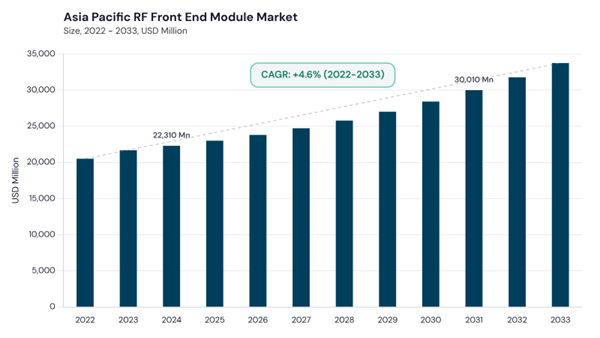
The Asia Pacific RF Front End Module Market is witnessing substantial growth due to rapid expansion of 5G networks, increasing smartphone adoption, and rising demand for high-speed wireless connectivity across emerging and developed economies in the region. RF front end modules are essential components in wireless communication devices, enabling efficient signal transmission and reception across multiple frequency bands. Growing deployment of connected devices, industrial IoT systems, smart consumer electronics, and automotive communication technologies is significantly driving market demand throughout Asia Pacific.
China dominates the regional market owing to its large-scale semiconductor manufacturing ecosystem, strong telecommunications infrastructure investments, and aggressive 5G deployment initiatives. Countries such as India, South Korea, Singapore, and Malaysia are also experiencing robust growth due to increasing digitalization, rising penetration of smart devices, and expansion of telecom infrastructure projects. Additionally, advancements in RF semiconductor technologies including GaAs and GaN materials, combined with increasing integration of filters, amplifiers, and switches into compact modules, are supporting continuous innovation and market expansion across the Asia Pacific region.
Type Outlook
Based on Type, the market is segmented into Filters, Power Amplifier (PA), Switches, Low-Noise Amplifier (LNA), and Other Type. The Filters segment acquired the largest revenue share in the Asia Pacific RF Front End Module Market in 2025 and is expected to continue to be a dominant segment till 2031; thereby, achieving a market value of USD 10.03 billion by 2031. The Power Amplifier (PA) segment held a market share of 30.5% in 2025. Additionally, the Switches segment is expected to witness a CAGR of 5.9% during 2026-2033.Technology Outlook
Based on Technology, the market is segmented into 2G / 3G, 4G LTE, 5G, Wi-Fi, Bluetooth, and Other Technology. The 5G segment acquired the largest revenue share in the Asia Pacific RF Front End Module Market in 2025 and is expected to continue to be a dominant segment till 2031; thereby, achieving a market value of USD 7.53 billion by 2031. The 4G LTE segment held a market share of 31.1% in 2025. Additionally, the Other Technology segment is expected to witness a CAGR of 6.8% during 2026-2033.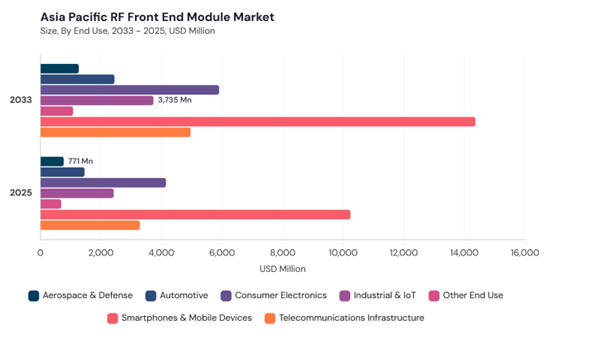
End Use Outlook
Based on End Use, the market is segmented into Smartphones & Mobile Devices, Consumer Electronics, Telecommunications Infrastructure, Industrial & IoT, Automotive, Aerospace & Defense, and Other End Use. The Smartphones & Mobile Devices segment acquired the largest revenue share in the Asia Pacific RF Front End Module Market in 2025 and is expected to continue to be a dominant segment till 2031; thereby, achieving a market value of USD 12.91 billion by 2031. The Consumer Electronics segment held a market share of 18.0% in 2025. Additionally, the Automotive segment is expected to witness a CAGR of 6.9% during 2026-2033.Country Outlook
Based on Country, the market is segmented into China, Japan, India, South Korea, Singapore, Malaysia, and Rest of Asia Pacific. The China market dominated the Asia Pacific RF Front End Module Market by country in 2025 and is expected to continue to be a dominant market till 2031; thereby, achieving a market value of USD 12.30 billion by 2031. The Japan market accounted for a market share of 10.4% in 2025. Additionally, the India market is expected to witness a CAGR of 6.3% during 2026-2033.Asia Pacific RF Front End Module Market Report Segmentation
By Type- Filters
- Power Amplifier (PA)
- Switches
- Low-Noise Amplifier (LNA)
- Other Type
- 2G / 3G
- 4G LTE
- 5G
- Wi-Fi
- Bluetooth
- Other Technology
- Smartphones & Mobile Devices
- Consumer Electronics
- Telecommunications Infrastructure
- Industrial & IoT
- Automotive
- Aerospace & Defense
- Other End Use
- China
- Japan
- India
- South Korea
- Singapore
- Malaysia
- Rest of Asia Pacific
List of Key Companies Profiled
- SAP SE
- Oracle Corporation
- Coupa Software Inc.
- IBM Corporation
- GEP Worldwide
- Jaggaer
- Ivalua Inc.
- Procurify Technologies Inc.
- Zycus Inc.
- Basware Corporation
Market Report Segmentation
By Type- Filters
- Power Amplifier (PA)
- Switches
- Low-Noise Amplifier (LNA)
- Other Type
- 2G / 3G
- 4G LTE
- 5G
- Wi-Fi
- Bluetooth
- Other Technology
- Smartphones & Mobile Devices
- Consumer Electronics
- Telecommunications Infrastructure
- Industrial & IoT
- Automotive
- Aerospace & Defense
- Other End Use
- China
- Japan
- India
- South Korea
- Singapore
- Malaysia
- Rest of Asia Pacific
Table of Contents
Chapter 1. Asia Pacific Market1.1 Market Overview
1.2 Key Factors Impacting Market
1.2.1 Market Drivers
1.2.2 Market Restraints
1.2.3 Market Opportunities
1.2.4 Market Challenges
1.2.5 Market Trends
1.2.6 State of Competition
1.2.7 Market Consolidation
1.2.8 Key Customer Criteria
1.3 Product Life Cycle
1.4 Segmentation By Type
1.4.1 Power Amplifier (PA)
1.4.2 Low-Noise Amplifier (LNA)
1.4.3 Filters
1.4.4 Switches
1.4.5 Other Type
1.5 Segmentation By Technology
1.5.1 2G / 3G
1.5.2 4G LTE
1.5.3 5G
1.5.4 Wi-Fi
1.5.5 Bluetooth
1.5.6 Other Technology
1.6 Segmentation By End Use
1.6.1 Smartphones & Mobile Devices
1.6.2 Consumer Electronics
1.6.3 Automotive
1.6.4 Industrial & IoT
1.6.5 Telecommunications Infrastructure
1.6.6 Aerospace & Defense
1.6.7 Other End Use
1.7 Segmentation By Country
1.7.1 China
1.7.1.1 Segmentation By Type
1.7.1.1.1 Power Amplifier (PA)
1.7.1.1.2 Low-Noise Amplifier (LNA)
1.7.1.1.3 Filters
1.7.1.1.4 Switches
1.7.1.1.5 Other Type
1.7.1.2 Segmentation By Technology
1.7.1.2.1 2G / 3G
1.7.1.2.2 4G LTE
1.7.1.2.3 5G
1.7.1.2.4 Wi-Fi
1.7.1.2.5 Bluetooth
1.7.1.2.6 Other Technology
1.7.1.3 Segmentation By End Use
1.7.1.3.1 Smartphones & Mobile Devices
1.7.1.3.2 Consumer Electronics
1.7.1.3.3 Automotive
1.7.1.3.4 Industrial & IoT
1.7.1.3.5 Telecommunications Infrastructure
1.7.1.3.6 Aerospace & Defense
1.7.1.3.7 Other End Use
1.7.2 Japan
1.7.2.1 Segmentation By Type
1.7.2.1.1 Power Amplifier (PA)
1.7.2.1.2 Low-Noise Amplifier (LNA)
1.7.2.1.3 Filters
1.7.2.1.4 Switches
1.7.2.1.5 Other Type
1.7.2.2 Segmentation By Technology
1.7.2.2.1 2G / 3G
1.7.2.2.2 4G LTE
1.7.2.2.3 5G
1.7.2.2.4 Wi-Fi
1.7.2.2.5 Bluetooth
1.7.2.2.6 Other Technology
1.7.2.3 Segmentation By End Use
1.7.2.3.1 Smartphones & Mobile Devices
1.7.2.3.2 Consumer Electronics
1.7.2.3.3 Automotive
1.7.2.3.4 Industrial & IoT
1.7.2.3.5 Telecommunications Infrastructure
1.7.2.3.6 Aerospace & Defense
1.7.2.3.7 Other End Use
1.7.3 India
1.7.3.1 Segmentation By Type
1.7.3.1.1 Power Amplifier (PA)
1.7.3.1.2 Low-Noise Amplifier (LNA)
1.7.3.1.3 Filters
1.7.3.1.4 Switches
1.7.3.1.5 Other Type
1.7.3.2 Segmentation By Technology
1.7.3.2.1 2G / 3G
1.7.3.2.2 4G LTE
1.7.3.2.3 5G
1.7.3.2.4 Wi-Fi
1.7.3.2.5 Bluetooth
1.7.3.2.6 Other Technology
1.7.3.3 Segmentation By End Use
1.7.3.3.1 Smartphones & Mobile Devices
1.7.3.3.2 Consumer Electronics
1.7.3.3.3 Automotive
1.7.3.3.4 Industrial & IoT
1.7.3.3.5 Telecommunications Infrastructure
1.7.3.3.6 Aerospace & Defense
1.7.3.3.7 Other End Use
1.7.4 South Korea
1.7.4.1 Segmentation By Type
1.7.4.1.1 Power Amplifier (PA)
1.7.4.1.2 Low-Noise Amplifier (LNA)
1.7.4.1.3 Filters
1.7.4.1.4 Switches
1.7.4.1.5 Other Type
1.7.4.2 Segmentation By Technology
1.7.4.2.1 2G / 3G
1.7.4.2.2 4G LTE
1.7.4.2.3 5G
1.7.4.2.4 Wi-Fi
1.7.4.2.5 Bluetooth
1.7.4.2.6 Other Technology
1.7.4.3 Segmentation By End Use
1.7.4.3.1 Smartphones & Mobile Devices
1.7.4.3.2 Consumer Electronics
1.7.4.3.3 Automotive
1.7.4.3.4 Industrial & IoT
1.7.4.3.5 Telecommunications Infrastructure
1.7.4.3.6 Aerospace & Defense
1.7.4.3.7 Other End Use
1.7.5 Singapore
1.7.5.1 Segmentation By Type
1.7.5.1.1 Power Amplifier (PA)
1.7.5.1.2 Low-Noise Amplifier (LNA)
1.7.5.1.3 Filters
1.7.5.1.4 Switches
1.7.5.1.5 Other Type
1.7.5.2 Segmentation By Technology
1.7.5.2.1 2G / 3G
1.7.5.2.2 4G LTE
1.7.5.2.3 5G
1.7.5.2.4 Wi-Fi
1.7.5.2.5 Bluetooth
1.7.5.2.6 Other Technology
1.7.5.3 Segmentation By End Use
1.7.5.3.1 Smartphones & Mobile Devices
1.7.5.3.2 Consumer Electronics
1.7.5.3.3 Automotive
1.7.5.3.4 Industrial & IoT
1.7.5.3.5 Telecommunications Infrastructure
1.7.5.3.6 Aerospace & Defense
1.7.5.3.7 Other End Use
1.7.6 Malaysia
1.7.6.1 Segmentation By Type
1.7.6.1.1 Power Amplifier (PA)
1.7.6.1.2 Low-Noise Amplifier (LNA)
1.7.6.1.3 Filters
1.7.6.1.4 Switches
1.7.6.1.5 Other Type
1.7.6.2 Segmentation By Technology
1.7.6.2.1 2G / 3G
1.7.6.2.2 4G LTE
1.7.6.2.3 5G
1.7.6.2.4 Wi-Fi
1.7.6.2.5 Bluetooth
1.7.6.2.6 Other Technology
1.7.6.3 Segmentation By End Use
1.7.6.3.1 Smartphones & Mobile Devices
1.7.6.3.2 Consumer Electronics
1.7.6.3.3 Automotive
1.7.6.3.4 Industrial & IoT
1.7.6.3.5 Telecommunications Infrastructure
1.7.6.3.6 Aerospace & Defense
1.7.6.3.7 Other End Use
1.7.7 Rest of Asia Pacific
1.7.7.1 Segmentation By Type
1.7.7.1.1 Power Amplifier (PA)
1.7.7.1.2 Low-Noise Amplifier (LNA)
1.7.7.1.3 Filters
1.7.7.1.4 Switches
1.7.7.1.5 Other Type
1.7.7.2 Segmentation By Technology
1.7.7.2.1 2G / 3G
1.7.7.2.2 4G LTE
1.7.7.2.3 5G
1.7.7.2.4 Wi-Fi
1.7.7.2.5 Bluetooth
1.7.7.2.6 Other Technology
1.7.7.3 Segmentation By End Use
1.7.7.3.1 Smartphones & Mobile Devices
1.7.7.3.2 Consumer Electronics
1.7.7.3.3 Automotive
1.7.7.3.4 Industrial & IoT
1.7.7.3.5 Telecommunications Infrastructure
1.7.7.3.6 Aerospace & Defense
1.7.7.3.7 Other End Use
Chapter 2. Company Profiles
2.1 Skyworks Solutions, Inc.
2.1.1 Company Overview
2.1.2 Financial Analysis
2.1.3 Regional Analysis
2.1.4 Research & Development Expenses
2.1.5 Company Focus
2.1.6 Strategic Insights
2.1.7 Strategy Deployed
2.1.8 SWOT Analysis
2.1.9 Future Outlook
2.2 Qorvo, Inc.
2.2.1 Company Overview
2.2.2 Financial Analysis
2.2.3 Segmental and Regional Analysis
2.2.4 Research & Development Expenses
2.2.5 Recent Strategies and Developments
2.2.5.1 Product Launches and Product Expansions
2.2.6 Company Focus
2.2.7 Strategic Insights
2.2.8 Strategy Deployed
2.2.9 SWOT Analysis
2.2.10 Future Outlook
2.3 Broadcom Inc.
2.3.1 Company Overview
2.3.2 Financial Analysis
2.3.3 Segmental Analysis
2.3.4 Research & Development Expenses
2.3.5 Recent Strategies and Developments
2.3.5.1 Product Launches and Product Expansions
2.3.6 Company Focus
2.3.7 Strategic Insights
2.3.8 Strategy Deployed
2.3.9 SWOT Analysis
2.3.10 Future Outlook
2.2 Qualcomm Incorporated
2.2.1 Company Overview
2.2.2 Financial Analysis
2.2.3 Segmental and Regional Analysis
2.2.4 Research & Development Expenses
2.2.5 Company Focus
2.2.6 Strategic Insights
2.2.7 Strategy Deployed
2.2.8 SWOT Analysis
2.2.9 Future Outlook
2.5 Murata Manufacturing Co., Ltd.
2.5.1 Company Overview
2.5.2 Financial Analysis
2.5.3 Segmental and Regional Analysis
2.5.4 Research & Development Expenses
2.5.5 Recent Strategies and Developments
2.5.5.1 Partnerships, Collaborations, and Agreements
2.5.6 Company Focus
2.5.7 Strategic Insights
2.5.8 Strategy Deployed
2.5.9 SWOT Analysis
2.5.10 Future Outlook
2.6 Infineon Technologies AG
2.6.1 Company Overview
2.6.2 Financial Analysis
2.6.3 Segmental and Regional Analysis
2.6.4 Research & Development Expenses
2.6.5 Company Focus
2.6.6 Strategic Insights
2.6.7 Strategy Deployed
2.6.8 SWOT Analysis
2.6.9 Future Outlook
2.7 NXP Semiconductors N.V.
2.7.1 Company Overview
2.7.2 Financial Analysis
2.7.3 Segmental and Regional Analysis
2.7.4 Research & Development Expenses
2.7.5 Company Focus
2.7.6 Strategic Insights
2.7.7 Strategy Deployed
2.7.8 SWOT Analysis
2.7.9 Future Outlook
2.8 Analog Devices, Inc.
2.8.1 Company Overview
2.8.2 Financial Analysis
2.8.3 Segmental and Regional Analysis
2.8.4 Research & Development Expenses
2.8.5 Recent Strategies and Developments
2.8.5.1 Product Launches and Product Expansions
2.8.6 Company Focus
2.8.7 Strategic Insights
2.8.8 Strategy Deployed
2.8.9 SWOT Analysis
2.8.10 Future Outlook
2.9 MediaTek, Inc.
2.9.1 Company Overview
2.9.2 Financial Analysis
2.9.3 Research & Development Expenses
2.9.4 Company Focus
2.9.5 Strategic Insights
2.9.6 Strategy Deployed
2.9.7 SWOT Analysis
2.9.8 Future Outlook
2.1 Semiconductor Components Industries, LLC (onsemi)
2.10.1 Company Overview
2.10.2 Financial Analysis
2.10.3 Segmental and Regional Analysis
2.10.4 Research & Development Expense
2.10.5 Company Focus
2.10.6 Strategic Insights
2.10.7 Strategy Deployed
2.10.8 SWOT Analysis
Companies Mentioned
- Qualcomm Incorporated
- Broadcom Inc.
- Skyworks Solutions, Inc.
- Qorvo, Inc.
- Murata Manufacturing Co., Ltd.
- Infineon Technologies AG
- NXP Semiconductors N.V.
- Analog Devices, Inc.
- MediaTek Inc.
- onsemi


