+353-1-416-8900REST OF WORLD
+44-20-3973-8888REST OF WORLD
1-917-300-0470EAST COAST U.S
1-800-526-8630U.S. (TOLL FREE)

Global RF Front End Module Market Size, Share & Industry Analysis Report by Type, Technology, End Use, Regional Outlook and Forecast, 2026-2033

  • PDF Icon

    Report

  • 700 Pages
  • May 2026
  • Marqual IT Solutions Pvt. Ltd (KBV Research)
  • ID: 6276006
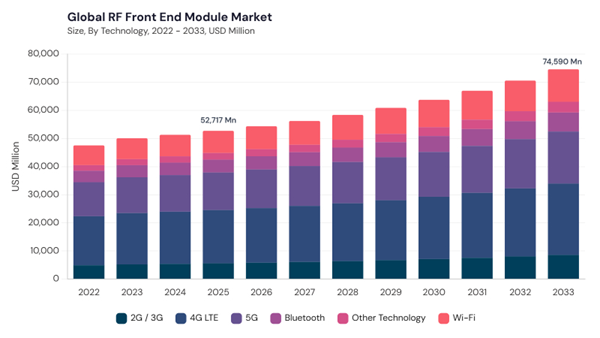
The Global RF Front End Module (FEM) Market size is expected to reach USD 74.59 billion by 2033, rising at a market growth of 4.6% CAGR during the forecast period.


The market growth is driven by the rapid deployment of 5G infrastructure, increasing smartphone penetration, rising adoption of IoT-enabled devices, and growing demand for high-speed wireless communication technologies. Organizations and device manufacturers are increasingly deploying advanced RF front-end solutions to optimize signal transmission, improve connectivity performance, reduce interference, and support multi-band communication systems across smartphones, telecom infrastructure, automotive systems, industrial IoT, and consumer electronics.

The market has evolved from discrete RF component architectures toward highly integrated module ecosystems combining power amplifiers, filters, switches, low-noise amplifiers, antenna tuners, and advanced packaging technologies. Increasing adoption of mmWave communication, Wi-Fi 6/7 technologies, AI-enabled RF optimization, and advanced semiconductor materials such as GaN, GaAs, and RF-SOI are further supporting market expansion globally.

Key Market Trends & Insights

  • The Asia Pacific RF Front End Module Market dominated the Global Market in 2025 accounting for 43.6% revenue share owing to strong semiconductor manufacturing capabilities and rapid 5G deployment.
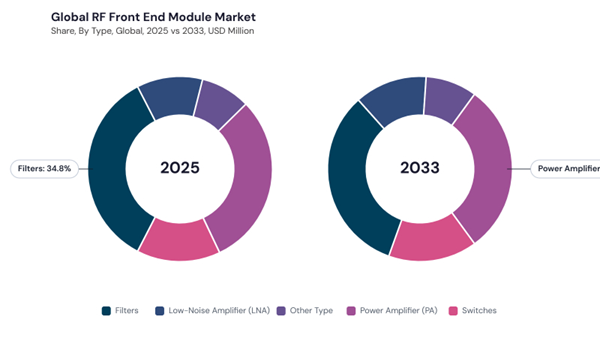
  • The Filters segment led the market by Type in 2025 with 34.8% share and is projected to reach USD 24.54 billion by 2033.
  • The 4G LTE segment dominated the market by Technology in 2025 with 35.9% share due to widespread global LTE infrastructure and continued smartphone adoption.
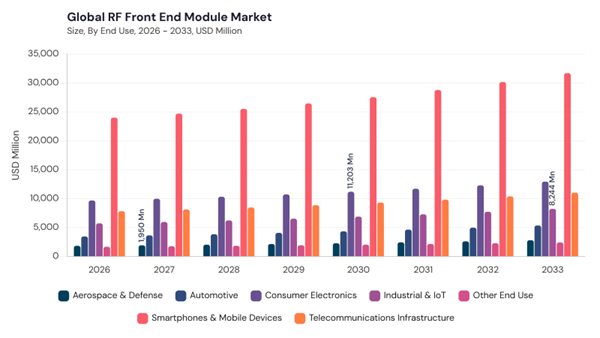
  • The Smartphones & Mobile Devices segment accounted for 44.4% revenue share in 2025 and is projected to attain USD 31.45 billion by 2033.
  • The 5G segment is expected to witness the fastest CAGR during 2026-2033 supported by increasing telecom infrastructure investments and mmWave deployment.
  • Increasing adoption of AI-enabled RF optimization, advanced System-in-Package (SiP) integration, and smart antenna technologies are emerging as major market growth accelerators.
The market has significantly evolved from traditional discrete RF component integration toward intelligent and highly integrated front-end architectures supporting advanced wireless ecosystems. Growing adoption of connected devices, industrial automation, smart vehicles, and smart city infrastructure is further supporting demand for advanced RF front-end solutions globally. Manufacturers are increasingly focusing on improving power efficiency, miniaturization, thermal management, and multi-band compatibility to support next-generation wireless communication systems.


Furthermore, rising emphasis on ultra-fast connectivity, low-latency communication, and energy-efficient wireless systems is encouraging companies to invest in advanced RF front-end technologies. The integration of predictive signal optimization, beamforming technologies, dynamic spectrum management, and AI-powered communication systems is transforming RF front-end modules into intelligent connectivity solutions, thereby supporting long-term market expansion across developed and emerging economies.

Driving and Restraining Factors

Drivers
  • Rapid deployment of 5G infrastructure and advanced wireless technologies
  • Increasing smartphone and connected device penetration globally
  • Advancements in semiconductor materials and packaging technologies
  • Expansion of IoT ecosystems and automotive connectivity solutions
Restraints
  • High manufacturing and advanced integration costs
  • Semiconductor supply chain vulnerabilities and raw material dependency
  • Regulatory complexity and spectrum allocation challenges
Opportunities
  • Integration of AI-enabled RF optimization technologies
  • Expansion of satellite communication and aerospace connectivity systems
  • Growing adoption of Wi-Fi 6/7 and edge connectivity infrastructure
Challenges
  • Complexity associated with multi-band and multi-standard integration
  • Thermal management and power efficiency constraints
  • Standardization and interoperability limitations across wireless ecosystems

Market Share Analysis

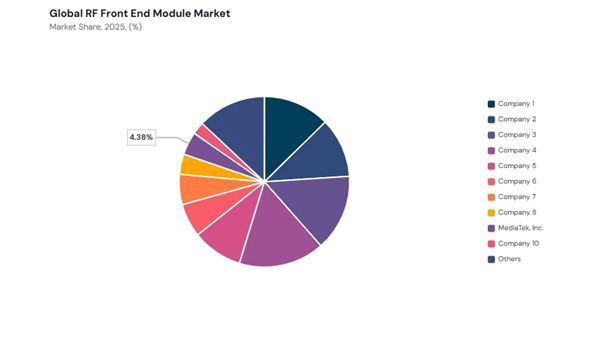
The RF Front End Module Market is characterized by a highly technology-intensive and moderately consolidated competitive landscape. Global semiconductor leaders compete through integrated RF platforms, advanced filter technologies, AI-enabled communication architectures, and high-performance wireless connectivity solutions.


Qualcomm Incorporated accounted for approximately 16.3% market share in 2025 supported by its strong modem-to-antenna integration strategy and extensive smartphone OEM partnerships. Broadcom Inc., Skyworks Solutions, Inc., and Qorvo, Inc. collectively reinforced the dominance of large-scale RF semiconductor providers through advanced filter technologies, integrated front-end modules, and high-frequency communication solutions.

Technology-focused companies such as Murata Manufacturing Co., Ltd., Infineon Technologies AG, NXP Semiconductors N.V., Analog Devices, Inc., MediaTek Inc., and onsemi continue to influence market dynamics through innovations in RF filters, power amplifiers, mmWave technologies, automotive communication systems, and wireless connectivity platforms.

Type Outlook

On the basis of Type, the RF Front End Module Market is classified into Filters, Power Amplifier (PA), Switches, Low-Noise Amplifier (LNA), and Other Type. The Filters segment acquired the largest revenue share in 2025 accounting for 34.8% of the global market and is projected to reach USD 24.54 billion by 2033. The growth of this segment is primarily driven by increasing demand for advanced signal filtering and interference mitigation technologies across 4G LTE, 5G, Wi-Fi, and IoT communication systems. Meanwhile, the Power Amplifier (PA) segment is expected to witness strong growth during 2026-2033 owing to rising deployment of 5G infrastructure, increasing smartphone penetration, and growing demand for high-speed wireless communication systems globally.

Technology Outlook

Based on Technology, the market is segmented into 2G / 3G, 4G LTE, 5G, Wi-Fi, Bluetooth, and Other Technology. The 4G LTE segment dominated the market in 2025 accounting for 35.9% share owing to extensive LTE infrastructure deployment and continued global adoption of LTE-enabled smartphones and connected devices. However, the 5G segment is expected to register the fastest CAGR during 2026-2033 supported by rapid deployment of next-generation wireless infrastructure, increasing investments in mmWave communication technologies, and growing demand for ultra-fast mobile connectivity solutions across industrial, automotive, and telecom applications.

End Use Outlook

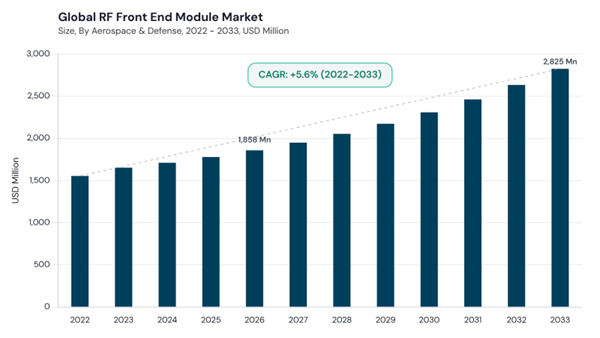
By End Use, the RF Front End Module Market is segmented into Smartphones & Mobile Devices, Consumer Electronics, Telecommunications Infrastructure, Industrial & IoT, Automotive, Aerospace & Defense, and Other End Use. The Smartphones & Mobile Devices segment dominated the market in 2025 accounting for 44.4% share and is projected to attain a market value of USD 31.70 billion by 2033 owing to increasing smartphone penetration and rising integration of advanced wireless communication technologies. Meanwhile, the Industrial & IoT segment is expected to witness strong growth during the forecast period driven by increasing adoption of industrial automation systems, smart factories, connected industrial ecosystems, and machine-to-machine communication technologies globally.

Regional Outlook

Region-wise, the RF Front End Module Market is analyzed across North America, Europe, Asia Pacific, and LAMEA. Asia Pacific dominated the market in 2025 accounting for 43.6% share due to strong semiconductor manufacturing infrastructure, increasing smartphone production volumes, and rapid deployment of 5G communication networks across China, South Korea, Japan, and Taiwan. The region is expected to maintain its dominance throughout the forecast period. Meanwhile, North America is anticipated to witness significant growth during 2026-2033 supported by early adoption of advanced wireless technologies, increasing telecom investments, and rising demand for AI-enabled and high-frequency communication systems across industrial and defense applications.

Market Competition and Attributes

The RF Front End Module Market is innovation-driven and highly technology-intensive. Competition is increasingly centered around advanced semiconductor integration, mmWave technologies, AI-enabled communication optimization, beamforming capabilities, and energy-efficient wireless communication architectures.


Companies are differentiating themselves through advanced filter technologies, integrated System-in-Package (SiP) solutions, RF optimization platforms, and high-frequency semiconductor innovations. Strategic partnerships, mergers and acquisitions, telecom collaborations, and regional semiconductor expansion initiatives remain core competitive strategies among major market participants.

Additionally, the convergence of AI, wireless communication technologies, advanced packaging systems, and smart connectivity infrastructure is reshaping long-term competitive dynamics across the RF Front End Module industry.
Recent Strategies Deployed in the Market

  • Feb-2025: Qualcomm Incorporated expanded its integrated RF front-end portfolio to strengthen AI-enabled wireless communication solutions.
  • Nov-2024: Broadcom Inc. introduced advanced RF filter technologies optimized for next-generation 5G and Wi-Fi 7 applications.
  • Aug-2024: Qorvo, Inc. partnered with telecom infrastructure providers to strengthen mmWave communication capabilities.
  • Jul-2024: Skyworks Solutions, Inc. expanded its integrated RF front-end module production capacity to support rising smartphone demand.
  • Mar-2024: Murata Manufacturing Co., Ltd. introduced compact RF modules optimized for automotive connectivity and industrial IoT applications.
  • Jan-2024: Infineon Technologies AG strengthened its automotive RF communication portfolio through advanced semiconductor integration initiatives.

List of Key Companies Profiled

  • SAP SE
  • Oracle Corporation
  • Coupa Software Inc.
  • IBM Corporation
  • GEP Worldwide
  • Jaggaer
  • Ivalua Inc.
  • Procurify Technologies Inc.
  • Zycus Inc.
  • Basware Corporation

Market Report Segmentation

By Type
  • Filters
  • Power Amplifier (PA)
  • Switches
  • Low-Noise Amplifier (LNA)
  • Other Type
By Technology
  • 2G / 3G
  • 4G LTE
  • 5G
  • Wi-Fi
  • Bluetooth
  • Other Technology
By End Use
  • Smartphones & Mobile Devices
  • Consumer Electronics
  • Telecommunications Infrastructure
  • Industrial & IoT
  • Automotive
  • Aerospace & Defense
  • Other End Use
By Geography
  • North America
    • US
    • Canada
    • Mexico
    • Rest of North America

  • Europe
    • Germany
    • UK
    • France
    • Russia
    • Spain
    • Italy
    • Rest of Europe

  • Asia Pacific
    • China
    • Japan
    • India
    • South Korea
    • Singapore
    • Malaysia
    • Rest of Asia Pacific

  • LAMEA
    • Brazil
    • Argentina
    • UAE
    • Saudi Arabia
    • South Africa
    • Nigeria
    • Rest of LAMEA

Table of Contents

Chapter 1. Global Market Overview
1.1 COVID-19 Impact
1.2 Market Composition and Scenario
Chapter 2. Key Factors Impacting Market
2.1 Market Drivers
2.2 Market Restraints
2.3 Market Opportunities
2.4 Market Challenges
2.5 Market Trends
2.6 State of Competition
2.7 Market Consolidation
2.8 Key Customer Criteria
Chapter 3. Product Life CycleChapter 4. Value Chain Analysis
Chapter 5. Competition Analysis
5.1 Market Share Analysis, 2025
Chapter 6. Segmentation By Type
6.1 Power Amplifier (PA)
6.2 Low-Noise Amplifier (LNA)
6.3 Filters
6.4 Switches
6.5 Other Type
Chapter 7. Segmentation By Technology
7.1 2G / 3G
7.2 4G LTE
7.3 5G
7.4 Wi-Fi
7.5 Bluetooth
7.6 Other Technology
Chapter 8. Segmentation By End Use
8.1 Smartphones & Mobile Devices
8.2 Consumer Electronics
8.3 Automotive
8.4 Industrial & IoT
8.5 Telecommunications Infrastructure
8.6 Aerospace & Defense
8.7 Other End Use
Chapter 9. North America Market
9.1 Market Overview
9.2 Key Factors Impacting Market
9.2.1 Market Drivers
9.2.2 Market Restraints
9.2.3 Market Opportunities
9.2.4 Market Challenges
9.2.5 Market Trends
9.2.6 State of Competition
9.2.7 Market Consolidation
9.2.8 Key Customer Criteria
9.3 Product Life Cycle
9.4 Segmentation By Type
9.4.1 Power Amplifier (PA)
9.4.2 Low-Noise Amplifier (LNA)
9.4.3 Filters
9.4.4 Switches
9.4.5 Other Type
9.5 Segmentation By Technology
9.5.1 2G / 3G
9.5.2 4G LTE
9.5.3 5G
9.5.4 Wi-Fi
9.5.5 Bluetooth
9.5.6 Other Technology
9.6 Segmentation By End Use
9.6.1 Smartphones & Mobile Devices
9.6.2 Consumer Electronics
9.6.3 Automotive
9.6.4 Industrial & IoT
9.6.5 Telecommunications Infrastructure
9.6.6 Aerospace & Defense
9.6.7 Other End Use
9.7 Segmentation By Country
9.7.1 United States
9.7.1.1 Segmentation By Type
9.7.1.1.1 Power Amplifier (PA)
9.7.1.1.2 Low-Noise Amplifier (LNA)
9.7.1.1.3 Filters
9.7.1.1.4 Switches
9.7.1.1.5 Other Type
9.7.1.2 Segmentation By Technology
9.7.1.2.1 2G / 3G
9.7.1.2.2 4G LTE
9.7.1.2.3 5G
9.7.1.2.4 Wi-Fi
9.7.1.2.5 Bluetooth
9.7.1.2.6 Other Technology
9.7.1.3 Segmentation By End Use
9.7.1.3.1 Smartphones & Mobile Devices
9.7.1.3.2 Consumer Electronics
9.7.1.3.3 Automotive
9.7.1.3.4 Industrial & IoT
9.7.1.3.5 Telecommunications Infrastructure
9.7.1.3.6 Aerospace & Defense
9.7.1.3.7 Other End Use
9.7.2 Canada
9.7.2.1 Segmentation By Type
9.7.2.1.1 Power Amplifier (PA)
9.7.2.1.2 Low-Noise Amplifier (LNA)
9.7.2.1.3 Filters
9.7.2.1.4 Switches
9.7.2.1.5 Other Type
9.7.2.2 Segmentation By Technology
9.7.2.2.1 2G / 3G
9.7.2.2.2 4G LTE
9.7.2.2.3 5G
9.7.2.2.4 Wi-Fi
9.7.2.2.5 Bluetooth
9.7.2.2.6 Other Technology
9.7.2.3 Segmentation By End Use
9.7.2.3.1 Smartphones & Mobile Devices
9.7.2.3.2 Consumer Electronics
9.7.2.3.3 Automotive
9.7.2.3.4 Industrial & IoT
9.7.2.3.5 Telecommunications Infrastructure
9.7.2.3.6 Aerospace & Defense
9.7.2.3.7 Other End Use
9.7.3 Mexico
9.7.3.1 Segmentation By Type
9.7.3.1.1 Power Amplifier (PA)
9.7.3.1.2 Low-Noise Amplifier (LNA)
9.7.3.1.3 Filters
9.7.3.1.4 Switches
9.7.3.1.5 Other Type
9.7.3.2 Segmentation By Technology
9.7.3.2.1 2G / 3G
9.7.3.2.2 4G LTE
9.7.3.2.3 5G
9.7.3.2.4 Wi-Fi
9.7.3.2.5 Bluetooth
9.7.3.2.6 Other Technology
9.7.3.3 Segmentation By End Use
9.7.3.3.1 Smartphones & Mobile Devices
9.7.3.3.2 Consumer Electronics
9.7.3.3.3 Automotive
9.7.3.3.4 Industrial & IoT
9.7.3.3.5 Telecommunications Infrastructure
9.7.3.3.6 Aerospace & Defense
9.7.3.3.7 Other End Use
9.7.4 Rest of North America
9.7.4.1 Segmentation By Type
9.7.4.1.1 Power Amplifier (PA)
9.7.4.1.2 Low-Noise Amplifier (LNA)
9.7.4.1.3 Filters
9.7.4.1.4 Switches
9.7.4.1.5 Other Type
9.7.4.2 Segmentation By Technology
9.7.4.2.1 2G / 3G
9.7.4.2.2 4G LTE
9.7.4.2.3 5G
9.7.4.2.4 Wi-Fi
9.7.4.2.5 Bluetooth
9.7.4.2.6 Other Technology
9.7.4.3 Segmentation By End Use
9.7.4.3.1 Smartphones & Mobile Devices
9.7.4.3.2 Consumer Electronics
9.7.4.3.3 Automotive
9.7.4.3.4 Industrial & IoT
9.7.4.3.5 Telecommunications Infrastructure
9.7.4.3.6 Aerospace & Defense
9.7.4.3.7 Other End Use
Chapter 10. Europe Market
10.1 Market Overview
10.2 Key Factors Impacting Market
10.2.1 Market Drivers
10.2.2 Market Restraints
10.2.3 Market Opportunities
10.2.4 Market Challenges
10.2.5 Market Trends
10.2.6 State of Competition
10.2.7 Market Consolidation
10.2.8 Key Customer Criteria
10.3 Product Life Cycle
10.4 Segmentation By Type
10.4.1 Power Amplifier (PA)
10.4.2 Low-Noise Amplifier (LNA)
10.4.3 Filters
10.4.4 Switches
10.4.5 Other Type
10.5 Segmentation By Technology
10.5.1 2G / 3G
10.5.2 4G LTE
10.5.3 5G
10.5.4 Wi-Fi
10.5.5 Bluetooth
10.5.6 Other Technology
10.6 Segmentation By End Use
10.6.1 Smartphones & Mobile Devices
10.6.2 Consumer Electronics
10.6.3 Automotive
10.6.4 Industrial & IoT
10.6.5 Telecommunications Infrastructure
10.6.6 Aerospace & Defense
10.6.7 Other End Use
10.7 Segmentation By Country
10.7.1 Germany
10.7.1.1 Segmentation By Type
10.7.1.1.1 Power Amplifier (PA)
10.7.1.1.2 Low-Noise Amplifier (LNA)
10.7.1.1.3 Filters
10.7.1.1.4 Switches
10.7.1.1.5 Other Type
10.7.1.2 Segmentation By Technology
10.7.1.2.1 2G / 3G
10.7.1.2.2 4G LTE
10.7.1.2.3 5G
10.7.1.2.4 Wi-Fi
10.7.1.2.5 Bluetooth
10.7.1.2.6 Other Technology
10.7.1.3 Segmentation By End Use
10.7.1.3.1 Smartphones & Mobile Devices
10.7.1.3.2 Consumer Electronics
10.7.1.3.3 Automotive
10.7.1.3.4 Industrial & IoT
10.7.1.3.5 Telecommunications Infrastructure
10.7.1.3.6 Aerospace & Defense
10.7.1.3.7 Other End Use
10.7.2 United Kingdom
10.7.2.1 Segmentation By Type
10.7.2.1.1 Power Amplifier (PA)
10.7.2.1.2 Low-Noise Amplifier (LNA)
10.7.2.1.3 Filters
10.7.2.1.4 Switches
10.7.2.1.5 Other Type
10.7.2.2 Segmentation By Technology
10.7.2.2.1 2G / 3G
10.7.2.2.2 4G LTE
10.7.2.2.3 5G
10.7.2.2.4 Wi-Fi
10.7.2.2.5 Bluetooth
10.7.2.2.6 Other Technology
10.7.2.3 Segmentation By End Use
10.7.2.3.1 Smartphones & Mobile Devices
10.7.2.3.2 Consumer Electronics
10.7.2.3.3 Automotive
10.7.2.3.4 Industrial & IoT
10.7.2.3.5 Telecommunications Infrastructure
10.7.2.3.6 Aerospace & Defense
10.7.2.3.7 Other End Use
10.7.3 France
10.7.3.1 Segmentation By Type
10.7.3.1.1 Power Amplifier (PA)
10.7.3.1.2 Low-Noise Amplifier (LNA)
10.7.3.1.3 Filters
10.7.3.1.4 Switches
10.7.3.1.5 Other Type
10.7.3.2 Segmentation By Technology
10.7.3.2.1 2G / 3G
10.7.3.2.2 4G LTE
10.7.3.2.3 5G
10.7.3.2.4 Wi-Fi
10.7.3.2.5 Bluetooth
10.7.3.2.6 Other Technology
10.7.3.3 Segmentation By End Use
10.7.3.3.1 Smartphones & Mobile Devices
10.7.3.3.2 Consumer Electronics
10.7.3.3.3 Automotive
10.7.3.3.4 Industrial & IoT
10.7.3.3.5 Telecommunications Infrastructure
10.7.3.3.6 Aerospace & Defense
10.7.3.3.7 Other End Use
10.7.4 Russia
10.7.4.1 Segmentation By Type
10.7.4.1.1 Power Amplifier (PA)
10.7.4.1.2 Low-Noise Amplifier (LNA)
10.7.4.1.3 Filters
10.7.4.1.4 Switches
10.7.4.1.5 Other Type
10.7.4.2 Segmentation By Technology
10.7.4.2.1 2G / 3G
10.7.4.2.2 4G LTE
10.7.4.2.3 5G
10.7.4.2.4 Wi-Fi
10.7.4.2.5 Bluetooth
10.7.4.2.6 Other Technology
10.7.4.3 Segmentation By End Use
10.7.4.3.1 Smartphones & Mobile Devices
10.7.4.3.2 Consumer Electronics
10.7.4.3.3 Automotive
10.7.4.3.4 Industrial & IoT
10.7.4.3.5 Telecommunications Infrastructure
10.7.4.3.6 Aerospace & Defense
10.7.4.3.7 Other End Use
10.7.5 Spain
10.7.5.1 Segmentation By Type
10.7.5.1.1 Power Amplifier (PA)
10.7.5.1.2 Low-Noise Amplifier (LNA)
10.7.5.1.3 Filters
10.7.5.1.4 Switches
10.7.5.1.5 Other Type
10.7.5.2 Segmentation By Technology
10.7.5.2.1 2G / 3G
10.7.5.2.2 4G LTE
10.7.5.2.3 5G
10.7.5.2.4 Wi-Fi
10.7.5.2.5 Bluetooth
10.7.5.2.6 Other Technology
10.7.5.3 Segmentation By End Use
10.7.5.3.1 Smartphones & Mobile Devices
10.7.5.3.2 Consumer Electronics
10.7.5.3.3 Automotive
10.7.5.3.4 Industrial & IoT
10.7.5.3.5 Telecommunications Infrastructure
10.7.5.3.6 Aerospace & Defense
10.7.5.3.7 Other End Use
10.7.6 Italy
10.7.6.1 Segmentation By Type
10.7.6.1.1 Power Amplifier (PA)
10.7.6.1.2 Low-Noise Amplifier (LNA)
10.7.6.1.3 Filters
10.7.6.1.4 Switches
10.7.6.1.5 Other Type
10.7.6.2 Segmentation By Technology
10.7.6.2.1 2G / 3G
10.7.6.2.2 4G LTE
10.7.6.2.3 5G
10.7.6.2.4 Wi-Fi
10.7.6.2.5 Bluetooth
10.7.6.2.6 Other Technology
10.7.6.3 Segmentation By End Use
10.7.6.3.1 Smartphones & Mobile Devices
10.7.6.3.2 Consumer Electronics
10.7.6.3.3 Automotive
10.7.6.3.4 Industrial & IoT
10.7.6.3.5 Telecommunications Infrastructure
10.7.6.3.6 Aerospace & Defense
10.7.6.3.7 Other End Use
10.7.7 Rest of Europe
10.7.7.1 Segmentation By Type
10.7.7.1.1 Power Amplifier (PA)
10.7.7.1.2 Low-Noise Amplifier (LNA)
10.7.7.1.3 Filters
10.7.7.1.4 Switches
10.7.7.1.5 Other Type
10.7.7.2 Segmentation By Technology
10.7.7.2.1 2G / 3G
10.7.7.2.2 4G LTE
10.7.7.2.3 5G
10.7.7.2.4 Wi-Fi
10.7.7.2.5 Bluetooth
10.7.7.2.6 Other Technology
10.7.7.3 Segmentation By End Use
10.7.7.3.1 Smartphones & Mobile Devices
10.7.7.3.2 Consumer Electronics
10.7.7.3.3 Automotive
10.7.7.3.4 Industrial & IoT
10.7.7.3.5 Telecommunications Infrastructure
10.7.7.3.6 Aerospace & Defense
10.7.7.3.7 Other End Use
Chapter 11. Asia Pacific Market
11.1 Market Overview
11.2 Key Factors Impacting Market
11.2.1 Market Drivers
11.2.2 Market Restraints
11.2.3 Market Opportunities
11.2.4 Market Challenges
11.2.5 Market Trends
11.2.6 State of Competition
11.2.7 Market Consolidation
11.2.8 Key Customer Criteria
11.3 Product Life Cycle
11.4 Segmentation By Type
11.4.1 Power Amplifier (PA)
11.4.2 Low-Noise Amplifier (LNA)
11.4.3 Filters
11.4.4 Switches
11.4.5 Other Type
11.5 Segmentation By Technology
11.5.1 2G / 3G
11.5.2 4G LTE
11.5.3 5G
11.5.4 Wi-Fi
11.5.5 Bluetooth
11.5.6 Other Technology
11.6 Segmentation By End Use
11.6.1 Smartphones & Mobile Devices
11.6.2 Consumer Electronics
11.6.3 Automotive
11.6.4 Industrial & IoT
11.6.5 Telecommunications Infrastructure
11.6.6 Aerospace & Defense
11.6.7 Other End Use
11.7 Segmentation By Country
11.7.1 China
11.7.1.1 Segmentation By Type
11.7.1.1.1 Power Amplifier (PA)
11.7.1.1.2 Low-Noise Amplifier (LNA)
11.7.1.1.3 Filters
11.7.1.1.4 Switches
11.7.1.1.5 Other Type
11.7.1.2 Segmentation By Technology
11.7.1.2.1 2G / 3G
11.7.1.2.2 4G LTE
11.7.1.2.3 5G
11.7.1.2.4 Wi-Fi
11.7.1.2.5 Bluetooth
11.7.1.2.6 Other Technology
11.7.1.3 Segmentation By End Use
11.7.1.3.1 Smartphones & Mobile Devices
11.7.1.3.2 Consumer Electronics
11.7.1.3.3 Automotive
11.7.1.3.4 Industrial & IoT
11.7.1.3.5 Telecommunications Infrastructure
11.7.1.3.6 Aerospace & Defense
11.7.1.3.7 Other End Use
11.7.2 Japan
11.7.2.1 Segmentation By Type
11.7.2.1.1 Power Amplifier (PA)
11.7.2.1.2 Low-Noise Amplifier (LNA)
11.7.2.1.3 Filters
11.7.2.1.4 Switches
11.7.2.1.5 Other Type
11.7.2.2 Segmentation By Technology
11.7.2.2.1 2G / 3G
11.7.2.2.2 4G LTE
11.7.2.2.3 5G
11.7.2.2.4 Wi-Fi
11.7.2.2.5 Bluetooth
11.7.2.2.6 Other Technology
11.7.2.3 Segmentation By End Use
11.7.2.3.1 Smartphones & Mobile Devices
11.7.2.3.2 Consumer Electronics
11.7.2.3.3 Automotive
11.7.2.3.4 Industrial & IoT
11.7.2.3.5 Telecommunications Infrastructure
11.7.2.3.6 Aerospace & Defense
11.7.2.3.7 Other End Use
11.7.3 India
11.7.3.1 Segmentation By Type
11.7.3.1.1 Power Amplifier (PA)
11.7.3.1.2 Low-Noise Amplifier (LNA)
11.7.3.1.3 Filters
11.7.3.1.4 Switches
11.7.3.1.5 Other Type
11.7.3.2 Segmentation By Technology
11.7.3.2.1 2G / 3G
11.7.3.2.2 4G LTE
11.7.3.2.3 5G
11.7.3.2.4 Wi-Fi
11.7.3.2.5 Bluetooth
11.7.3.2.6 Other Technology
11.7.3.3 Segmentation By End Use
11.7.3.3.1 Smartphones & Mobile Devices
11.7.3.3.2 Consumer Electronics
11.7.3.3.3 Automotive
11.7.3.3.4 Industrial & IoT
11.7.3.3.5 Telecommunications Infrastructure
11.7.3.3.6 Aerospace & Defense
11.7.3.3.7 Other End Use
11.7.4 South Korea
11.7.4.1 Segmentation By Type
11.7.4.1.1 Power Amplifier (PA)
11.7.4.1.2 Low-Noise Amplifier (LNA)
11.7.4.1.3 Filters
11.7.4.1.4 Switches
11.7.4.1.5 Other Type
11.7.4.2 Segmentation By Technology
11.7.4.2.1 2G / 3G
11.7.4.2.2 4G LTE
11.7.4.2.3 5G
11.7.4.2.4 Wi-Fi
11.7.4.2.5 Bluetooth
11.7.4.2.6 Other Technology
11.7.4.3 Segmentation By End Use
11.7.4.3.1 Smartphones & Mobile Devices
11.7.4.3.2 Consumer Electronics
11.7.4.3.3 Automotive
11.7.4.3.4 Industrial & IoT
11.7.4.3.5 Telecommunications Infrastructure
11.7.4.3.6 Aerospace & Defense
11.7.4.3.7 Other End Use
11.7.5 Singapore
11.7.5.1 Segmentation By Type
11.7.5.1.1 Power Amplifier (PA)
11.7.5.1.2 Low-Noise Amplifier (LNA)
11.7.5.1.3 Filters
11.7.5.1.4 Switches
11.7.5.1.5 Other Type
11.7.5.2 Segmentation By Technology
11.7.5.2.1 2G / 3G
11.7.5.2.2 4G LTE
11.7.5.2.3 5G
11.7.5.2.4 Wi-Fi
11.7.5.2.5 Bluetooth
11.7.5.2.6 Other Technology
11.7.5.3 Segmentation By End Use
11.7.5.3.1 Smartphones & Mobile Devices
11.7.5.3.2 Consumer Electronics
11.7.5.3.3 Automotive
11.7.5.3.4 Industrial & IoT
11.7.5.3.5 Telecommunications Infrastructure
11.7.5.3.6 Aerospace & Defense
11.7.5.3.7 Other End Use
11.7.6 Malaysia
11.7.6.1 Segmentation By Type
11.7.6.1.1 Power Amplifier (PA)
11.7.6.1.2 Low-Noise Amplifier (LNA)
11.7.6.1.3 Filters
11.7.6.1.4 Switches
11.7.6.1.5 Other Type
11.7.6.2 Segmentation By Technology
11.7.6.2.1 2G / 3G
11.7.6.2.2 4G LTE
11.7.6.2.3 5G
11.7.6.2.4 Wi-Fi
11.7.6.2.5 Bluetooth
11.7.6.2.6 Other Technology
11.7.6.3 Segmentation By End Use
11.7.6.3.1 Smartphones & Mobile Devices
11.7.6.3.2 Consumer Electronics
11.7.6.3.3 Automotive
11.7.6.3.4 Industrial & IoT
11.7.6.3.5 Telecommunications Infrastructure
11.7.6.3.6 Aerospace & Defense
11.7.6.3.7 Other End Use
11.7.7 Rest of Asia Pacific
11.7.7.1 Segmentation By Type
11.7.7.1.1 Power Amplifier (PA)
11.7.7.1.2 Low-Noise Amplifier (LNA)
11.7.7.1.3 Filters
11.7.7.1.4 Switches
11.7.7.1.5 Other Type
11.7.7.2 Segmentation By Technology
11.7.7.2.1 2G / 3G
11.7.7.2.2 4G LTE
11.7.7.2.3 5G
11.7.7.2.4 Wi-Fi
11.7.7.2.5 Bluetooth
11.7.7.2.6 Other Technology
11.7.7.3 Segmentation By End Use
11.7.7.3.1 Smartphones & Mobile Devices
11.7.7.3.2 Consumer Electronics
11.7.7.3.3 Automotive
11.7.7.3.4 Industrial & IoT
11.7.7.3.5 Telecommunications Infrastructure
11.7.7.3.6 Aerospace & Defense
11.7.7.3.7 Other End Use
Chapter 12. LAMEA Market
12.1 Market Overview
12.2 Key Factors Impacting Market
12.2.1 Market Drivers
12.2.2 Market Restraints
12.2.3 Market Opportunities
12.2.4 Market Challenges
12.2.5 Market Trends
12.2.6 State Of Competition
12.2.7 Market Consolidation
12.2.8 Key Customer Criteria
12.3 Product Life Cycle
12.4 Segmentation By Type
12.4.1 Power Amplifier (PA)
12.4.2 Low-Noise Amplifier (LNA)
12.4.3 Filters
12.4.4 Switches
12.4.5 Other Type
12.5 Segmentation By Technology
12.5.1 2G / 3G
12.5.2 4G LTE
12.5.3 5G
12.5.4 Wi-Fi
12.5.5 Bluetooth
12.5.6 Other Technology
12.6 Segmentation By End Use
12.6.1 Smartphones & Mobile Devices
12.6.2 Consumer Electronics
12.6.3 Automotive
12.6.4 Industrial & IoT
12.6.5 Telecommunications Infrastructure
12.6.6 Aerospace & Defense
12.6.7 Other End Use
12.7 Segmentation By Country
12.7.1 Brazil
12.7.1.1 Segmentation By Type
12.7.1.1.1 Power Amplifier (PA)
12.7.1.1.2 Low-Noise Amplifier (LNA)
12.7.1.1.3 Filters
12.7.1.1.4 Switches
12.7.1.1.5 Other Type
12.7.1.2 Segmentation By Technology
12.7.1.2.1 2G / 3G
12.7.1.2.2 4G LTE
12.7.1.2.3 5G
12.7.1.2.4 Wi-Fi
12.7.1.2.5 Bluetooth
12.7.1.2.6 Other Technology
12.7.1.3 Segmentation By End Use
12.7.1.3.1 Smartphones & Mobile Devices
12.7.1.3.2 Consumer Electronics
12.7.1.3.3 Automotive
12.7.1.3.4 Industrial & IoT
12.7.1.3.5 Telecommunications Infrastructure
12.7.1.3.6 Aerospace & Defense
12.7.1.3.7 Other End Use
12.7.2 Argentina
12.7.2.1 Segmentation By Type
12.7.2.1.1 Power Amplifier (PA)
12.7.2.1.2 Low-Noise Amplifier (LNA)
12.7.2.1.3 Filters
12.7.2.1.4 Switches
12.7.2.1.5 Other Type
12.7.2.2 Segmentation By Technology
12.7.2.2.1 2G / 3G
12.7.2.2.2 4G LTE
12.7.2.2.3 5G
12.7.2.2.4 Wi-Fi
12.7.2.2.5 Bluetooth
12.7.2.2.6 Other Technology
12.7.2.3 Segmentation By End Use
12.7.2.3.1 Smartphones & Mobile Devices
12.7.2.3.2 Consumer Electronics
12.7.2.3.3 Automotive
12.7.2.3.4 Industrial & IoT
12.7.2.3.5 Telecommunications Infrastructure
12.7.2.3.6 Aerospace & Defense
12.7.2.3.7 Other End Use
12.7.3 UAE
12.7.3.1 Segmentation By Type
12.7.3.1.1 Power Amplifier (PA)
12.7.3.1.2 Low-Noise Amplifier (LNA)
12.7.3.1.3 Filters
12.7.3.1.4 Switches
12.7.3.1.5 Other Type
12.7.3.2 Segmentation By Technology
12.7.3.2.1 2G / 3G
12.7.3.2.2 4G LTE
12.7.3.2.3 5G
12.7.3.2.4 Wi-Fi
12.7.3.2.5 Bluetooth
12.7.3.2.6 Other Technology
12.7.3.3 Segmentation By End Use
12.7.3.3.1 Smartphones & Mobile Devices
12.7.3.3.2 Consumer Electronics
12.7.3.3.3 Automotive
12.7.3.3.4 Industrial & IoT
12.7.3.3.5 Telecommunications Infrastructure
12.7.3.3.6 Aerospace & Defense
12.7.3.3.7 Other End Use
12.7.4 Saudi Arabia
12.7.4.1 Segmentation By Type
12.7.4.1.1 Power Amplifier (PA)
12.7.4.1.2 Low-Noise Amplifier (LNA)
12.7.4.1.3 Filters
12.7.4.1.4 Switches
12.7.4.1.5 Other Type
12.7.4.2 Segmentation By Technology
12.7.4.2.1 2G / 3G
12.7.4.2.2 4G LTE
12.7.4.2.3 5G
12.7.4.2.4 Wi-Fi
12.7.4.2.5 Bluetooth
12.7.4.2.6 Other Technology
12.7.4.3 Segmentation By End Use
12.7.4.3.1 Smartphones & Mobile Devices
12.7.4.3.2 Consumer Electronics
12.7.4.3.3 Automotive
12.7.4.3.4 Industrial & IoT
12.7.4.3.5 Telecommunications Infrastructure
12.7.4.3.6 Aerospace & Defense
12.7.4.3.7 Other End Use
12.7.5 South Africa
12.7.5.1 Segmentation By Type
12.7.5.1.1 Power Amplifier (PA)
12.7.5.1.2 Low-Noise Amplifier (LNA)
12.7.5.1.3 Filters
12.7.5.1.4 Switches
12.7.5.1.5 Other Type
12.7.5.2 Segmentation By Technology
12.7.5.2.1 2G / 3G
12.7.5.2.2 4G LTE
12.7.5.2.3 5G
12.7.5.2.4 Wi-Fi
12.7.5.2.5 Bluetooth
12.7.5.2.6 Other Technology
12.7.5.3 Segmentation By End Use
12.7.5.3.1 Smartphones & Mobile Devices
12.7.5.3.2 Consumer Electronics
12.7.5.3.3 Automotive
12.7.5.3.4 Industrial & IoT
12.7.5.3.5 Telecommunications Infrastructure
12.7.5.3.6 Aerospace & Defense
12.7.5.3.7 Other End Use
12.7.6 Nigeria
12.7.6.1 Segmentation By Type
12.7.6.1.1 Power Amplifier (PA)
12.7.6.1.2 Low-Noise Amplifier (LNA)
12.7.6.1.3 Filters
12.7.6.1.4 Switches
12.7.6.1.5 Other Type
12.7.6.2 Segmentation By Technology
12.7.6.2.1 2G / 3G
12.7.6.2.2 4G LTE
12.7.6.2.3 5G
12.7.6.2.4 Wi-Fi
12.7.6.2.5 Bluetooth
12.7.6.2.6 Other Technology
12.7.6.3 Segmentation By End Use
12.7.6.3.1 Smartphones & Mobile Devices
12.7.6.3.2 Consumer Electronics
12.7.6.3.3 Automotive
12.7.6.3.4 Industrial & IoT
12.7.6.3.5 Telecommunications Infrastructure
12.7.6.3.6 Aerospace & Defense
12.7.6.3.7 Other End Use
12.7.7 Rest of LAMEA
12.7.7.1 Segmentation By Type
12.7.7.1.1 Power Amplifier (PA)
12.7.7.1.2 Low-Noise Amplifier (LNA)
12.7.7.1.3 Filters
12.7.7.1.4 Switches
12.7.7.1.5 Other Type
12.7.7.2 Segmentation By Technology
12.7.7.2.1 2G / 3G
12.7.7.2.2 4G LTE
12.7.7.2.3 5G
12.7.7.2.4 Wi-Fi
12.7.7.2.5 Bluetooth
12.7.7.2.6 Other Technology
12.7.7.3 Segmentation By End Use
12.7.7.3.1 Smartphones & Mobile Devices
12.7.7.3.2 Consumer Electronics
12.7.7.3.3 Automotive
12.7.7.3.4 Industrial & IoT
12.7.7.3.5 Telecommunications Infrastructure
12.7.7.3.6 Aerospace & Defense
12.7.7.3.7 Other End Use
Chapter 13. Company Profiles
13.1 Skyworks Solutions, Inc.
13.1.1 Company Overview
13.1.2 Financial Analysis
13.1.3 Regional Analysis
13.1.4 Research & Development Expenses
13.1.5 Company Focus
13.1.6 Strategic Insights
13.1.7 Strategy Deployed
13.1.8 SWOT Analysis
13.1.9 Future Outlook
13.13 Qorvo, Inc.
13.13.1 Company Overview
13.13.2 Financial Analysis
13.13.3 Segmental and Regional Analysis
13.13.4 Research & Development Expenses
13.13.5 Recent Strategies and Developments
13.13.5.1 Product Launches and Product Expansions
13.13.6 Company Focus
13.13.7 Strategic Insights
13.13.8 Strategy Deployed
13.13.9 SWOT Analysis
13.13.10 Future Outlook
13.3 Broadcom Inc.
13.3.1 Company Overview
13.3.13 Financial Analysis
13.3.3 Segmental Analysis
13.3.4 Research & Development Expenses
13.3.5 Recent Strategies and Developments
13.3.5.1 Product Launches and Product Expansions
13.3.6 Company Focus
13.3.7 Strategic Insights
13.3.8 Strategy Deployed
13.3.9 SWOT Analysis
13.3.10 Future Outlook
13.13 Qualcomm Incorporated
13.13.1 Company Overview
13.13.2 Financial Analysis
13.13.3 Segmental and Regional Analysis
13.13.4 Research & Development Expenses
13.13.5 Company Focus
13.13.6 Strategic Insights
13.13.7 Strategy Deployed
13.13.8 SWOT Analysis
13.13.9 Future Outlook
13.5 Murata Manufacturing Co., Ltd.
13.5.1 Company Overview
13.5.2 Financial Analysis
13.5.3 Segmental and Regional Analysis
13.5.4 Research & Development Expenses
13.5.5 Recent Strategies and Developments
13.5.5.1 Partnerships, Collaborations, and Agreements
13.5.6 Company Focus
13.5.7 Strategic Insights
13.5.8 Strategy Deployed
13.5.9 SWOT Analysis
13.5.10 Future Outlook
13.6 Infineon Technologies AG
13.6.1 Company Overview
13.6.2 Financial Analysis
13.6.3 Segmental and Regional Analysis
13.6.4 Research & Development Expenses
13.6.5 Company Focus
13.6.6 Strategic Insights
13.6.7 Strategy Deployed
13.6.8 SWOT Analysis
13.6.9 Future Outlook
13.7 NXP Semiconductors N.V.
13.7.1 Company Overview
13.7.13 Financial Analysis
13.7.3 Segmental and Regional Analysis
13.7.4 Research & Development Expenses
13.7.5 Company Focus
13.7.6 Strategic Insights
13.7.7 Strategy Deployed
13.7.8 SWOT Analysis
13.7.9 Future Outlook
13.8 Analog Devices, Inc.
13.8.1 Company Overview
13.8.2 Financial Analysis
13.8.3 Segmental and Regional Analysis
13.8.4 Research & Development Expenses
13.8.5 Recent Strategies and Developments
13.8.5.1 Product Launches and Product Expansions
13.8.6 Company Focus
13.8.7 Strategic Insights
13.8.8 Strategy Deployed
13.8.9 SWOT Analysis
13.8.10 Future Outlook
13.9 MediaTek, Inc.
13.9.1 Company Overview
13.9.13 Financial Analysis
13.9.3 Research & Development Expenses
13.9.4 Company Focus
13.9.5 Strategic Insights
13.9.6 Strategy Deployed
13.9.7 SWOT Analysis
13.9.8 Future Outlook
13.1 Semiconductor Components Industries, LLC (onsemi)
13.10.1 Company Overview
13.10.2 Financial Analysis
13.10.3 Segmental and Regional Analysis
13.10.4 Research & Development Expense
13.10.5 Company Focus
13.10.6 Strategic Insights
13.10.7 Strategy Deployed
13.10.8 SWOT Analysis
Chapter 14. Winning Imperatives of RF Front End Module Market

Companies Mentioned

  • Qualcomm Incorporated
  • Broadcom Inc.
  • Skyworks Solutions, Inc.
  • Qorvo, Inc.
  • Murata Manufacturing Co., Ltd.
  • Infineon Technologies AG
  • NXP Semiconductors N.V.
  • Analog Devices, Inc.
  • MediaTek Inc.
  • onsemi