



The Asia Pacific Supply Chain ERP Market is expected to witness market growth of 7.8% CAGR during the forecast period (2026-2033), attaining a market value of USD 5.15 billion by 2030.
The China market dominated the Asia Pacific Supply Chain ERP Market by country in 2025, and is expected to continue to be a dominant market till 2033; thereby, achieving a market value of USD 1.85 billion by 2033. The Japan market is expected to witness a CAGR of 6.9% during 2026-2033. Additionally, the India market is expected to witness a CAGR of 8.6% during 2026-2033. The China and Japan markets led the Asia Pacific Supply Chain ERP Market by Country with market shares of 31.88% and 16.20% respectively in 2025. The Singapore market is expected to witness a CAGR of 9.6% throughout the forecast period.
The Asia Pacific Supply Chain ERP Market has evolved rapidly due to increasing industrialization, accelerating digital transformation, and rising investments in intelligent supply chain infrastructure across major economies such as China, Japan, India, South Korea, Singapore, and Southeast Asia. The growing complexity of manufacturing ecosystems, rising cross-border trade activities, and increasing adoption of Industry 4.0 technologies have encouraged enterprises to implement integrated ERP solutions for improving operational efficiency, supplier coordination, demand forecasting, procurement optimization, and warehouse management. Organizations across manufacturing, automotive, healthcare, retail, food & beverage, and consumer goods industries are increasingly adopting cloud-enabled ERP platforms to achieve real-time visibility and improve resilience against supply chain disruptions.
Cloud-based deployment models are becoming increasingly dominant across Asia Pacific due to flexibility, scalability, reduced infrastructure costs, and faster implementation capabilities. Businesses are increasingly integrating artificial intelligence, predictive analytics, IoT connectivity, machine learning, blockchain-based traceability, and real-time monitoring tools into ERP systems to improve production planning, inventory management, and logistics visibility. Additionally, the expansion of regional e-commerce networks and omnichannel retail operations has accelerated the demand for agile and data-driven supply chain ERP solutions.
The competitive environment across Asia Pacific remains highly dynamic, with global ERP providers and regional software vendors continuously investing in AI integration, cloud-native architectures, cybersecurity enhancements, and industry-specific ERP customization. Long-term growth across the market is expected to be supported by increasing enterprise focus on supply chain resilience, automation, sustainability tracking, and smart manufacturing transformation initiatives.
The Japan Supply Chain ERP Market continues to witness strong adoption due to increasing enterprise focus on operational precision, automation, and intelligent manufacturing systems. Organizations across automotive, electronics, and semiconductor sectors are increasingly integrating AI-driven analytics and IoT-enabled ERP platforms to improve supply chain visibility and operational efficiency.
The India Supply Chain ERP Market is emerging as one of the fastest-growing markets in the region due to rapid SME digitization, growing cloud adoption, expanding e-commerce ecosystems, and increasing enterprise demand for scalable and cost-effective ERP deployment models. Government initiatives promoting digital transformation and smart manufacturing are also supporting long-term market growth across India.
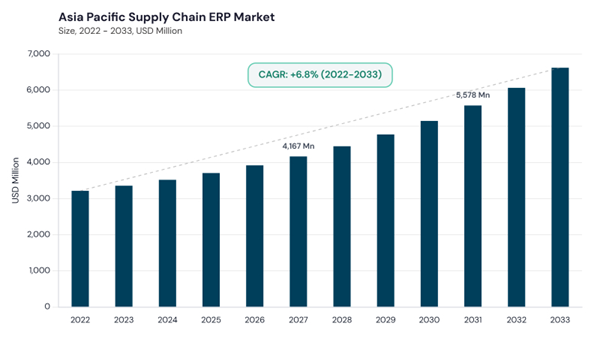
The China market dominated the Asia Pacific Supply Chain ERP Market by country in 2025, and is expected to continue to be a dominant market till 2033; thereby, achieving a market value of USD 1.85 billion by 2033. The Japan market is expected to witness a CAGR of 6.9% during 2026-2033. Additionally, the India market is expected to witness a CAGR of 8.6% during 2026-2033. The China and Japan markets led the Asia Pacific Supply Chain ERP Market by Country with market shares of 31.88% and 16.20% respectively in 2025. The Singapore market is expected to witness a CAGR of 9.6% throughout the forecast period.
The Asia Pacific Supply Chain ERP Market has evolved rapidly due to increasing industrialization, accelerating digital transformation, and rising investments in intelligent supply chain infrastructure across major economies such as China, Japan, India, South Korea, Singapore, and Southeast Asia. The growing complexity of manufacturing ecosystems, rising cross-border trade activities, and increasing adoption of Industry 4.0 technologies have encouraged enterprises to implement integrated ERP solutions for improving operational efficiency, supplier coordination, demand forecasting, procurement optimization, and warehouse management. Organizations across manufacturing, automotive, healthcare, retail, food & beverage, and consumer goods industries are increasingly adopting cloud-enabled ERP platforms to achieve real-time visibility and improve resilience against supply chain disruptions.
Cloud-based deployment models are becoming increasingly dominant across Asia Pacific due to flexibility, scalability, reduced infrastructure costs, and faster implementation capabilities. Businesses are increasingly integrating artificial intelligence, predictive analytics, IoT connectivity, machine learning, blockchain-based traceability, and real-time monitoring tools into ERP systems to improve production planning, inventory management, and logistics visibility. Additionally, the expansion of regional e-commerce networks and omnichannel retail operations has accelerated the demand for agile and data-driven supply chain ERP solutions.
The competitive environment across Asia Pacific remains highly dynamic, with global ERP providers and regional software vendors continuously investing in AI integration, cloud-native architectures, cybersecurity enhancements, and industry-specific ERP customization. Long-term growth across the market is expected to be supported by increasing enterprise focus on supply chain resilience, automation, sustainability tracking, and smart manufacturing transformation initiatives.
Organization Size Outlook
Based on Organization Size, the market is segmented into Large Enterprises and Small & Medium Enterprises (SMEs). The Large Enterprises market dominated the Asia Pacific Supply Chain ERP Market by Organization Size in 2025 and is expected to continue to be a dominant market till 2033. The Small & Medium Enterprises (SMEs) market is expected to witness substantial growth during the forecast period due to increasing affordability and accessibility of cloud-based ERP solutions among emerging enterprises.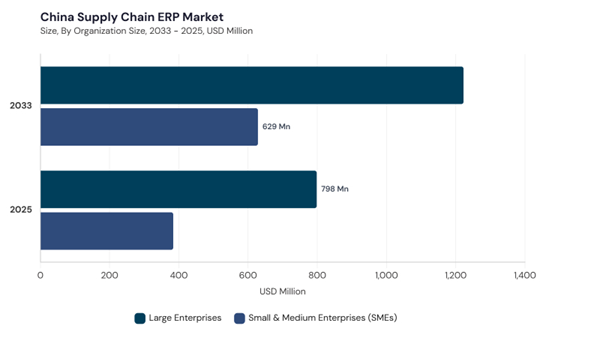
Component Outlook
Based on Component, the market is segmented into Software and Services. The Software market dominated the Asia Pacific Supply Chain ERP Market by Component in 2025 and is expected to continue to maintain its dominance till 2033 owing to increasing demand for integrated supply chain planning, inventory management, procurement optimization, warehouse automation, and predictive analytics capabilities. The Services market is expected to witness strong growth driven by rising demand for ERP consulting, implementation, customization, integration, and managed services across enterprises.Deployment Mode Outlook
Based on Deployment Mode, the market is segmented into Cloud-Based, On-Premise, and Hybrid. The Cloud-Based market dominated the Asia Pacific Supply Chain ERP Market by Deployment Mode in 2025 and is expected to continue to be a dominant market till 2033 due to increasing cloud migration initiatives, scalability benefits, and reduced infrastructure costs. The On-Premise market is expected to maintain steady growth owing to strong demand from enterprises requiring higher levels of data security and operational control. Additionally, the Hybrid market is expected to witness significant growth during the forecast period due to increasing enterprise preference for flexible deployment environments.End-User Outlook
Based on End-User, the market is segmented into Manufacturing, Retail & E-commerce, Healthcare & Pharmaceuticals, Consumer Goods, Food & Beverage, Automotive, and Other End-User. The Manufacturing market dominated the Asia Pacific Supply Chain ERP Market by End-User in 2025 and is expected to continue to be a dominant market till 2033 owing to rapid industrial expansion and increasing adoption of smart manufacturing technologies across the region. The Retail & E-commerce market is expected to witness strong growth driven by expanding digital commerce activities and rising demand for omnichannel inventory management solutions. Additionally, the Healthcare & Pharmaceuticals market is expected to witness notable growth due to increasing regulatory compliance requirements and growing focus on supply chain transparency.Country Outlook
The China Supply Chain ERP Market remains the largest market across Asia Pacific due to extensive industrialization, large-scale manufacturing operations, and rapid digital transformation initiatives. Enterprises across China are increasingly deploying AI-enabled ERP systems to optimize production planning, warehouse operations, procurement efficiency, and logistics visibility. Government-backed smart manufacturing programs and increasing investments in industrial automation are further accelerating ERP adoption across the country.The Japan Supply Chain ERP Market continues to witness strong adoption due to increasing enterprise focus on operational precision, automation, and intelligent manufacturing systems. Organizations across automotive, electronics, and semiconductor sectors are increasingly integrating AI-driven analytics and IoT-enabled ERP platforms to improve supply chain visibility and operational efficiency.
The India Supply Chain ERP Market is emerging as one of the fastest-growing markets in the region due to rapid SME digitization, growing cloud adoption, expanding e-commerce ecosystems, and increasing enterprise demand for scalable and cost-effective ERP deployment models. Government initiatives promoting digital transformation and smart manufacturing are also supporting long-term market growth across India.
List of Key Companies Profiled
- SAP SE
- Oracle Corporation
- Microsoft Corporation
- Infor
- Blue Yonder Group, Inc.
- Epicor Software Corporation
- Workday, Inc.
- Manhattan Associates, Inc.
- Sage Group plc
- Acumatica, Inc.
- IFS AB
- QAD Inc.
Market Report Segmentation
By Organization Size- Large Enterprises
- Small & Medium Enterprises (SMEs)
- Software
- Services
- Cloud-Based
- On-Premise
- Hybrid
- Manufacturing
- Retail & E-commerce
- Healthcare & Pharmaceuticals
- Consumer Goods
- Food & Beverage
- Automotive
- Other End-User
- China
- Japan
- India
- South Korea
- Singapore
- Malaysia
- Rest of Asia Pacific
Table of Contents
Chapter 1. Asia Pacific Market1.1 Market Overview
1.2 Key Factors Impacting Market
1.2.1 Market Drivers
1.2.2 Market Restraints
1.2.3 Market Opportunities
1.2.4 Market Challenges
1.2.5 Market Trends
1.2.6 State of Competition
1.2.7 Market Consolidation
1.2.8 Key Customer Criteria
1.3 Product Life Cycle
1.4 Segmentation By Component
1.4.1 Software
1.4.2 Services
1.5 Segmentation By Deployment Mode
1.5.1 Cloud-Based
1.5.2 On-Premise
1.5.3 Hybrid
1.6 Segmentation By End-User
1.6.1 Manufacturing
1.6.2 Retail & E-commerce
1.6.3 Healthcare & Pharmaceuticals
1.6.4 Food & Beverage
1.6.5 Consumer Goods
1.6.6 Automotive
1.6.7 Other End-User
1.7 Segmentation By Organization Size
1.7.1 Large Enterprises
1.7.2 Small & Medium Enterprises (SMEs)
1.8 Segmentation By Country
1.8.1 China
1.8.1.1 Segmentation By Component
1.8.1.1.1 Software
1.8.1.1.2 Services
1.8.1.2 Segmentation By Deployment Mode
1.8.1.2.1 Cloud-Based
1.8.1.2.2 On-Premise
1.8.1.2.3 Hybrid
1.8.1.3 Segmentation By End-User
1.8.1.3.1 Manufacturing
1.8.1.3.2 Retail & E-commerce
1.8.1.3.3 Healthcare & Pharmaceuticals
1.8.1.3.4 Food & Beverage
1.8.1.3.5 Consumer Goods
1.8.1.3.6 Automotive
1.8.1.3.7 Other End-User
1.8.1.4 Segmentation By Organization Size
1.8.1.4.1 Large Enterprises
1.8.1.4.2 Small & Medium Enterprises (SMEs)
1.8.2 Japan
1.8.2.1 Segmentation By Component
1.8.2.1.1 Software
1.8.2.1.2 Services
1.8.2.2 Segmentation By Deployment Mode
1.8.2.2.1 Cloud-Based
1.8.2.2.2 On-Premise
1.8.2.2.3 Hybrid
1.8.2.3 Segmentation By End-User
1.8.2.3.1 Manufacturing
1.8.2.3.2 Retail & E-commerce
1.8.2.3.3 Healthcare & Pharmaceuticals
1.8.2.3.4 Food & Beverage
1.8.2.3.5 Consumer Goods
1.8.2.3.6 Automotive
1.8.2.3.7 Other End-User
1.8.2.4 Segmentation By Organization Size
1.8.2.4.1 Large Enterprises
1.8.2.4.2 Small & Medium Enterprises (SMEs)
1.8.3 India
1.8.3.1 Segmentation By Component
1.8.3.1.1 Software
1.8.3.1.2 Services
1.8.3.2 Segmentation By Deployment Mode
1.8.3.2.1 Cloud-Based
1.8.3.2.2 On-Premise
1.8.3.2.3 Hybrid
1.8.3.3 Segmentation By End-User
1.8.3.3.1 Manufacturing
1.8.3.3.2 Retail & E-commerce
1.8.3.3.3 Healthcare & Pharmaceuticals
1.8.3.3.4 Food & Beverage
1.8.3.3.5 Consumer Goods
1.8.3.3.6 Automotive
1.8.3.3.7 Other End-User
1.8.3.4 Segmentation By Organization Size
1.8.3.4.1 Large Enterprises
1.8.3.4.2 Small & Medium Enterprises (SMEs)
1.8.4 South Korea
1.8.4.1 Segmentation By Component
1.8.4.1.1 Software
1.8.4.1.2 Services
1.8.4.2 Segmentation By Deployment Mode
1.8.4.2.1 Cloud-Based
1.8.4.2.2 On-Premise
1.8.4.2.3 Hybrid
1.8.4.3 Segmentation By End-User
1.8.4.3.1 Manufacturing
1.8.4.3.2 Retail & E-commerce
1.8.4.3.3 Healthcare & Pharmaceuticals
1.8.4.3.4 Food & Beverage
1.8.4.3.5 Consumer Goods
1.8.4.3.6 Automotive
1.8.4.3.7 Other End-User
1.8.4.4 Segmentation By Organization Size
1.8.4.4.1 Large Enterprises
1.8.4.4.2 Small & Medium Enterprises (SMEs)
1.8.5 Singapore
1.8.5.1 Segmentation By Component
1.8.5.1.1 Software
1.8.5.1.2 Services
1.8.5.2 Segmentation By Deployment Mode
1.8.5.2.1 Cloud-Based
1.8.5.2.2 On-Premise
1.8.5.2.3 Hybrid
1.8.5.3 Segmentation By End-User
1.8.5.3.1 Manufacturing
1.8.5.3.2 Retail & E-commerce
1.8.5.3.3 Healthcare & Pharmaceuticals
1.8.5.3.4 Food & Beverage
1.8.5.3.5 Consumer Goods
1.8.5.3.6 Automotive
1.8.5.3.7 Other End-User
1.8.5.4 Segmentation By Organization Size
1.8.5.4.1 Large Enterprises
1.8.5.4.2 Small & Medium Enterprises (SMEs)
1.8.6 Malaysia
1.8.6.1 Segmentation By Component
1.8.6.1.1 Software
1.8.6.1.2 Services
1.8.6.2 Segmentation By Deployment Mode
1.8.6.2.1 Cloud-Based
1.8.6.2.2 On-Premise
1.8.6.2.3 Hybrid
1.8.6.3 Segmentation By End-User
1.8.6.3.1 Manufacturing
1.8.6.3.2 Retail & E-commerce
1.8.6.3.3 Healthcare & Pharmaceuticals
1.8.6.3.4 Food & Beverage
1.8.6.3.5 Consumer Goods
1.8.6.3.6 Automotive
1.8.6.3.7 Other End-User
1.8.6.4 Segmentation By Organization Size
1.8.6.4.1 Large Enterprises
1.8.6.4.2 Small & Medium Enterprises (SMEs)
1.8.7 Rest of Asia Pacific
1.8.7.1 Segmentation By Component
1.8.7.1.1 Software
1.8.7.1.2 Services
1.8.7.2 Segmentation By Deployment Mode
1.8.7.2.1 Cloud-Based
1.8.7.2.2 On-Premise
1.8.7.2.3 Hybrid
1.8.7.3 Segmentation By End-User
1.8.7.3.1 Manufacturing
1.8.7.3.2 Retail & E-commerce
1.8.7.3.3 Healthcare & Pharmaceuticals
1.8.7.3.4 Food & Beverage
1.8.7.3.5 Consumer Goods
1.8.7.3.6 Automotive
1.8.7.3.7 Other End-User
1.8.7.4 Segmentation By Organization Size
1.8.7.4.1 Large Enterprises
1.8.7.4.2 Small & Medium Enterprises (SMEs)
Chapter 2. Company Snapshot
2.1 SAP SE
2.1.1 Business Overview
2.1.2 Key Information
2.1.3 Company Focus
2.1.4 Strategic Insights
2.1.5 Strategy Deployed
2.1.6 Product & Service Portfolio
2.1.7 Capability Overview
2.1.8 Technology & Innovation Focus
2.1.9 Customers / End Users
2.1.10 Competitive Positioning
2.1.11 Key Differentiators
2.1.12 Portfolio Matrix
2.1.13 SWOT Analysis
2.1.14 Future Outlook
2.2 Oracle Corporation
2.2.1 Business Overview
2.2.2 Key Information
2.2.3 Company Focus
2.2.4 Strategic Insights
2.2.5 Strategy Deployed
2.2.6 Product & Service Portfolio
2.2.7 Capability Overview
2.2.8 Technology & Innovation Focus
2.2.9 Customers / End Users
2.2.10 Competitive Positioning
2.2.11 Key Differentiators
2.2.12 Portfolio Matrix
2.2.13 SWOT Analysis
2.2.14 Future Outlook
2.3 Microsoft Corporation
2.3.1 Business Overview
2.3.2 Key Information
2.3.3 Company Focus
2.3.4 Strategic Insights
2.3.5 Strategy Deployed
2.3.6 Product & Service Portfolio
2.3.7 Capability Overview
2.3.8 Technology & Innovation Focus
2.3.9 Customers / End Users
2.3.10 Competitive Positioning
2.3.11 Key Differentiators
2.3.12 Portfolio Matrix
2.3.13 SWOT Analysis
2.3.14 Future Outlook
2.4 Blue Yonder Group, Inc. (Panasonic Holdings Corporation)
2.4.1 Business Overview
2.4.2 Key Information
2.4.3 Company Focus
2.4.4 Strategic Insights
2.4.5 Strategy Deployed
2.4.6 Product & Service Portfolio
2.4.7 Capability Overview
2.4.8 Technology & Innovation Focus
2.4.9 Customers / End Users
2.4.10 Competitive Positioning
2.4.11 Key Differentiators
2.4.12 Portfolio Matrix
2.4.13 SWOT Analysis
2.4.14 Future Outlook
2.5 Kinaxis, Inc.
2.5.1 Business Overview
2.5.2 Key Information
2.5.3 Company Focus
2.5.4 Strategic Insights
2.5.5 Strategy Deployed
2.5.6 Product & Service Portfolio
2.5.7 Capability Overview
2.5.8 Technology & Innovation Focus
2.5.9 Customers / End Users
2.5.10 Competitive Positioning
2.5.11 Key Differentiators
2.5.12 Portfolio Matrix
2.5.13 SWOT Analysis
2.5.14 Future Outlook
2.6 Epicor Software Corporation
2.6.1 Business Overview
2.6.2 Key Information
2.6.3 Company Focus
2.6.4 Strategic Insights
2.6.5 Strategy Deployed
2.6.6 Product & Service Portfolio
2.6.7 Capability Overview
2.6.8 Technology & Innovation Focus
2.6.9 Customers / End Users
2.6.10 Competitive Positioning
2.6.11 Key Differentiators
2.6.12 Portfolio Matrix
2.6.13 SWOT Analysis
2.6.14 Future Outlook
2.7 The Sage Group plc
2.7.1 Business Overview
2.7.2 Key Information
2.7.3 Company Focus
2.7.4 Strategic Insights
2.7.5 Strategy Deployed
2.7.6 Product & Service Portfolio
2.7.7 Capability Overview
2.7.8 Technology & Innovation Focus
2.7.9 Customers / End Users
2.7.10 Competitive Positioning
2.7.11 Key Differentiators
2.7.12 Portfolio Matrix
2.7.13 SWOT Analysis
2.7.14 Future Outlook
2.8 Manhattan Associates, Inc.
2.8.1 Business Overview
2.8.2 Key Information
2.8.3 Company Focus
2.8.4 Strategic Insights
2.8.5 Strategy Deployed
2.8.6 Product & Service Portfolio
2.8.7 Capability Overview
2.8.8 Technology & Innovation Focus
2.8.9 Customers / End Users
2.8.10 Competitive Positioning
2.8.11 Key Differentiators
2.8.12 Portfolio Matrix
2.8.13 SWOT Analysis
2.8.14 Future Outlook
2.9 Infor, Inc. (Koch Industries)
2.9.1 Business Overview
2.9.2 Key Information
2.9.3 Company Focus
2.9.4 Strategic Insights
2.9.5 Strategy Deployed
2.9.6 Product & Service Portfolio
2.9.7 Capability Overview
2.9.8 Technology & Innovation Focus
2.9.9 Customers / End Users
2.9.10 Competitive Positioning
2.9.11 Key Differentiators
2.9.12 Portfolio Matrix
2.9.13 SWOT Analysis
2.9.14 Future Outlook
2.10 Workday, Inc.
2.10.1 Business Overview
2.10.2 Key Information
2.10.3 Company Focus
2.10.4 Strategic Insights
2.10.5 Strategy Deployed
2.10.6 Product & Service Portfolio
2.10.7 Capability Overview
2.10.8 Technology & Innovation Focus
2.10.9 Customers / End Users
2.10.10 Competitive Positioning
2.10.11 Key Differentiators
2.10.12 Portfolio Matrix
2.10.13 SWOT Analysis
2.10.14 Future Outlook
Companies Mentioned
- SAP SE
- Oracle Corporation
- Microsoft Corporation
- Infor
- Blue Yonder Group, Inc.
- Epicor Software Corporation
- Workday, Inc.
- Manhattan Associates, Inc.
- Sage Group plc
- Acumatica, Inc.
- IFS AB
- QAD Inc.


