



The Asia Pacific Wi-Fi Range Extender Market is projected to reach USD 1.32 billion by 2030, experiencing a growth of 11.6% CAGR during the forecast period (2026-2033).
The Asia Pacific Wi-Fi Range Extender Market is witnessing strong growth due to increasing internet penetration, rapid adoption of smart home devices, and rising demand for uninterrupted wireless connectivity across residential, commercial, and public environments. Wi-Fi range extenders are widely used to eliminate dead zones, improve signal coverage, and enhance network performance in homes, offices, educational institutions, and industrial facilities. The expansion of connected devices such as smartphones, smart TVs, gaming consoles, laptops, and IoT-enabled systems is further accelerating market demand across the region.
The adoption of advanced wireless technologies including Wi-Fi 6, Wi-Fi 6E, and emerging Wi-Fi 7 standards is driving innovation in the regional market. Consumers and enterprises are increasingly demanding high-speed, low-latency connectivity to support streaming, online gaming, video conferencing, cloud applications, and hybrid work models. In addition, the increasing deployment of mesh networking systems, AI-powered network optimization, and smart city infrastructure is reshaping the competitive landscape. Countries such as China, India, Japan, and South Korea continue to dominate the regional market due to strong digital infrastructure development, increasing broadband penetration, and growing investments in smart connectivity solutions.
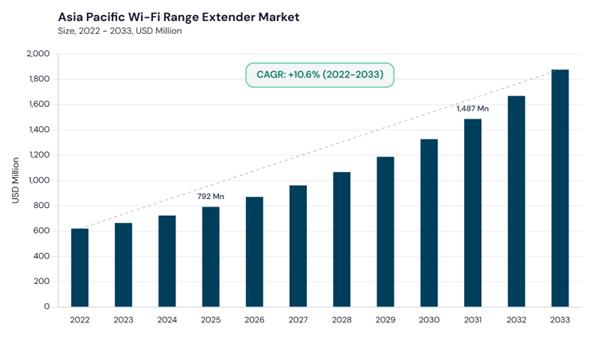
The Asia Pacific Wi-Fi Range Extender Market is witnessing strong growth due to increasing internet penetration, rapid adoption of smart home devices, and rising demand for uninterrupted wireless connectivity across residential, commercial, and public environments. Wi-Fi range extenders are widely used to eliminate dead zones, improve signal coverage, and enhance network performance in homes, offices, educational institutions, and industrial facilities. The expansion of connected devices such as smartphones, smart TVs, gaming consoles, laptops, and IoT-enabled systems is further accelerating market demand across the region.
The adoption of advanced wireless technologies including Wi-Fi 6, Wi-Fi 6E, and emerging Wi-Fi 7 standards is driving innovation in the regional market. Consumers and enterprises are increasingly demanding high-speed, low-latency connectivity to support streaming, online gaming, video conferencing, cloud applications, and hybrid work models. In addition, the increasing deployment of mesh networking systems, AI-powered network optimization, and smart city infrastructure is reshaping the competitive landscape. Countries such as China, India, Japan, and South Korea continue to dominate the regional market due to strong digital infrastructure development, increasing broadband penetration, and growing investments in smart connectivity solutions.
Type Outlook
Based on Type, the market is segmented into Indoor Wi-Fi and Outdoor Wi-Fi. The Indoor Wi-Fi segment dominated the Asia Pacific Wi-Fi Range Extender Market with a major revenue share in 2025 and is expected to reach USD 956.5 million by 2030. Meanwhile, the Outdoor Wi-Fi segment is projected to witness notable growth owing to increasing deployment of smart city infrastructure and public Wi-Fi projects across the region.Product Outlook
Based on Product, the market is segmented into Wi-Fi Range Extenders / Repeaters, Mesh Wi-Fi Systems, Powerline Wi-Fi Extenders, and Outdoor Range Extenders. The Mesh Wi-Fi Systems segment is anticipated to register strong growth during the forecast period due to rising demand for seamless connectivity across larger residential and enterprise spaces. In addition, the Wi-Fi Range Extenders / Repeaters segment continued to account for the highest market share and is expected to attain USD 579.9 million by 2030.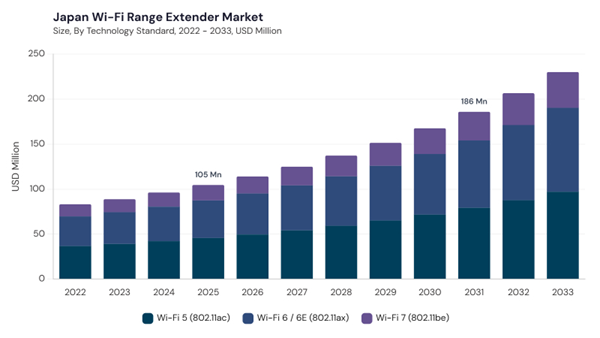
Technology Standard Outlook
Based on Technology Standard, the market is segmented into Wi-Fi 5 (802.11ac), Wi-Fi 6 / 6E (802.11ax), and Wi-Fi 7 (802.11be). The Wi-Fi 6 / 6E (802.11ax) segment is expected to witness robust CAGR during the forecast period (2026-2033) driven by increasing adoption of high-speed broadband and connected devices. However, the Wi-Fi 5 (802.11ac) segment maintained the leading revenue contribution in the market and is projected to reach USD 572.1 million by 2030.End User Outlook
Based on End User, the market is segmented into Residential, Small & Medium Enterprises (SMEs), Large Enterprises, and Public & Municipal. The Residential segment held the dominant share of the Asia Pacific Wi-Fi Range Extender Market in 2025 owing to rising smart home adoption and growing remote working trends. The segment is further projected to achieve a market value of USD 761.2 million by 2030, while the SMEs segment is expected to expand at a considerable CAGR throughout the forecast period.Sales Channel Outlook
Based on Sales Channel, the market is segmented into Online, Offline Retail, and B2B / System Integrators. The Online segment continues to dominate the market supported by strong e-commerce penetration and increasing consumer preference for digital purchasing channels. On the other hand, the B2B / System Integrators segment is witnessing steady growth due to increasing enterprise-grade deployments and customized networking requirements across commercial establishments and institutional environments.List of Companies Profiled
- Companies Profiled
- TP-Link Technologies Co., Ltd.
- NETGEAR, Inc.
- D-Link Corporation
- ASUSTek Computer Inc.
- Linksys Holdings, Inc.
- Xiaomi Corporation
- Huawei Technologies Co., Ltd.
- Belkin International, Inc.
- CommScope Holding Company, Inc.
- Zyxel Communications Corp.
Asia Pacific Wi-Fi Range Extender Market Segmentation
By Type- Indoor Wi-Fi
- Outdoor Wi-Fi
- Wi-Fi Range Extenders / Repeaters
- Mesh Wi-Fi Systems
- Powerline Wi-Fi Extenders
- Outdoor Range Extenders
- Wi-Fi 5 (802.11ac)
- Wi-Fi 6 / 6E (802.11ax)
- Wi-Fi 7 (802.11be)
- Residential
- Small & Medium Enterprises (SMEs)
- Large Enterprises
- Public & Municipal
- Online
- Offline Retail
- B2B / System Integrators
- China
- India
- Japan
- South Korea
- Taiwan
- Malaysia
- Rest of Asia Pacific
List of Key Companies Profiled
- TP-Link Technologies Co., Ltd.
- NETGEAR, Inc.
- D-Link Corporation
- ASUSTek Computer Inc.
- Linksys Holdings, Inc.
- Xiaomi Corporation
- Huawei Technologies Co., Ltd.
- Belkin International, Inc.
- CommScope Holding Company, Inc.
- Zyxel Communications Corp.
Market Report Segmentation
By Type- Indoor Wi-Fi
- Outdoor Wi-Fi
- Wi-Fi Range Extenders / Repeaters
- Mesh Wi-Fi Systems
- Powerline Wi-Fi Extenders
- Outdoor Range Extenders
- Wi-Fi 5 (802.11ac)
- Wi-Fi 6 / 6E (802.11ax)
- Wi-Fi 7 (802.11be)
- Residential
- Small & Medium Enterprises (SMEs)
- Large Enterprises
- Public & Municipal
- Online
- Offline Retail
- B2B / System Integrators
- China
- India
- Japan
- South Korea
- Taiwan
- Malaysia
- Rest of Asia Pacific
Table of Contents
Chapter 1. Asia Pacific Market1.1 Market Overview
1.2 Key Factors Impacting Market
1.2.1 Market Drivers
1.2.2 Market Restraints
1.2.3 Market Opportunities
1.2.4 Market Challenges
1.2.5 Market Trends
1.2.6 State of Competition
1.2.7 Market Consolidation
1.2.8 Key Customer Criteria
1.3 Product Life Cycle
1.4 Segmentation By Type
1.4.1 Indoor Wi-Fi
1.4.2 Outdoor Wi-Fi
1.5 Segmentation By Product
1.5.1 Wi-Fi Range Extenders / Repeaters
1.5.2 Powerline Wi-Fi Extenders
1.5.3 Mesh Wi-Fi Systems
1.5.4 Outdoor Range Extenders
1.6 Segmentation By Technology Standard
1.6.1 Wi-Fi 5 (802.11ac)
1.6.2 Wi-Fi 6 / 6E (802.11ax)
1.6.3 Wi-Fi 7 (802.11be)
1.7 Segmentation By End User
1.7.1 Residential
1.7.2 Small & Medium Enterprises (SMEs)
1.7.3 Large Enterprises
1.7.4 Public & Municipal
1.8 Segmentation By Sales Channel
1.8.1 Online (E-commerce / Direct-to-Consumer)
1.8.2 Offline Retail
1.8.3 B2B / System Integrators
1.9 Segmentation By Country
1.9.1 China
1.9.1.1 Segmentation By Type
1.9.1.1.1 Indoor Wi-Fi
1.9.1.1.2 Outdoor Wi-Fi
1.9.1.2 Segmentation By Product
1.9.1.2.1 Wi-Fi Range Extenders / Repeaters
1.9.1.2.2 Powerline Wi-Fi Extenders
1.9.1.2.3 Mesh Wi-Fi Systems
1.9.1.2.4 Outdoor Range Extenders
1.9.1.3 Segmentation By Technology Standard
1.9.1.3.1 Wi-Fi 5 (802.11ac)
1.9.1.3.2 Wi-Fi 6 / 6E (802.11ax)
1.9.1.3.3 Wi-Fi 7 (802.11be)
1.9.1.4 Segmentation By End User
1.9.1.4.1 Residential
1.9.1.4.2 Small & Medium Enterprises (SMEs)
1.9.1.4.3 Large Enterprises
1.9.1.4.4 Public & Municipal
1.9.1.5 Segmentation By Sales Channel
1.9.1.5.1 Online (E-commerce / Direct-to-Consumer)
1.9.1.5.2 Offline Retail
1.9.1.5.3 B2B / System Integrators
1.9.2 Japan
1.9.2.1 Segmentation By Type
1.9.2.1.1 Indoor Wi-Fi
1.9.2.1.2 Outdoor Wi-Fi
1.9.2.2 Segmentation By Product
1.9.2.2.1 Wi-Fi Range Extenders / Repeaters
1.9.2.2.2 Powerline Wi-Fi Extenders
1.9.2.2.3 Mesh Wi-Fi Systems
1.9.2.2.4 Outdoor Range Extenders
1.9.2.3 Segmentation By Technology Standard
1.9.2.3.1 Wi-Fi 5 (802.11ac)
1.9.2.3.2 Wi-Fi 6 / 6E (802.11ax)
1.9.2.3.3 Wi-Fi 7 (802.11be)
1.9.2.4 Segmentation By End User
1.9.2.4.1 Residential
1.9.2.4.2 Small & Medium Enterprises (SMEs)
1.9.2.4.3 Large Enterprises
1.9.2.4.4 Public & Municipal
1.9.2.5 Segmentation By Sales Channel
1.9.2.5.1 Online (E-commerce / Direct-to-Consumer)
1.9.2.5.2 Offline Retail
1.9.2.5.3 B2B / System Integrators
1.9.3 India
1.9.3.1 Segmentation By Type
1.9.3.1.1 Indoor Wi-Fi
1.9.3.1.2 Outdoor Wi-Fi
1.9.3.2 Segmentation By Product
1.9.3.2.1 Wi-Fi Range Extenders / Repeaters
1.9.3.2.2 Powerline Wi-Fi Extenders
1.9.3.2.3 Mesh Wi-Fi Systems
1.9.3.2.4 Outdoor Range Extenders
1.9.3.3 Segmentation By Technology Standard
1.9.3.3.1 Wi-Fi 5 (802.11ac)
1.9.3.3.2 Wi-Fi 6 / 6E (802.11ax)
1.9.3.3.3 Wi-Fi 7 (802.11be)
1.9.3.4 Segmentation By End User
1.9.3.4.1 Residential
1.9.3.4.2 Small & Medium Enterprises (SMEs)
1.9.3.4.3 Large Enterprises
1.9.3.4.4 Public & Municipal
1.9.3.5 Segmentation By Sales Channel
1.9.3.5.1 Online (E-commerce / Direct-to-Consumer)
1.9.3.5.2 Offline Retail
1.9.3.5.3 B2B / System Integrators
1.9.4 South Korea
1.9.4.1 Segmentation By Type
1.9.4.1.1 Indoor Wi-Fi
1.9.4.1.2 Outdoor Wi-Fi
1.9.4.2 Segmentation By Product
1.9.4.2.1 Wi-Fi Range Extenders / Repeaters
1.9.4.2.2 Powerline Wi-Fi Extenders
1.9.4.2.3 Mesh Wi-Fi Systems
1.9.4.2.4 Outdoor Range Extenders
1.9.4.3 Segmentation By Technology Standard
1.9.4.3.1 Wi-Fi 5 (802.11ac)
1.9.4.3.2 Wi-Fi 6 / 6E (802.11ax)
1.9.4.3.3 Wi-Fi 7 (802.11be)
1.9.4.4 Segmentation By End User
1.9.4.4.1 Residential
1.9.4.4.2 Small & Medium Enterprises (SMEs)
1.9.4.4.3 Large Enterprises
1.9.4.4.4 Public & Municipal
1.9.4.5 Segmentation By Sales Channel
1.9.4.5.1 Online (E-commerce / Direct-to-Consumer)
1.9.4.5.2 Offline Retail
1.9.4.5.3 B2B / System Integrators
1.9.5 Taiwan
1.9.5.1 Segmentation By Type
1.9.5.1.1 Indoor Wi-Fi
1.9.5.1.2 Outdoor Wi-Fi
1.9.5.2 Segmentation By Product
1.9.5.2.1 Wi-Fi Range Extenders / Repeaters
1.9.5.2.2 Powerline Wi-Fi Extenders
1.9.5.2.3 Mesh Wi-Fi Systems
1.9.5.2.4 Outdoor Range Extenders
1.9.5.3 Segmentation By Technology Standard
1.9.5.3.1 Wi-Fi 5 (802.11ac)
1.9.5.3.2 Wi-Fi 6 / 6E (802.11ax)
1.9.5.3.3 Wi-Fi 7 (802.11be)
1.9.5.4 Segmentation By End User
1.9.5.4.1 Residential
1.9.5.4.2 Small & Medium Enterprises (SMEs)
1.9.5.4.3 Large Enterprises
1.9.5.4.4 Public & Municipal
1.9.5.5 Segmentation By Sales Channel
1.9.5.5.1 Online (E-commerce / Direct-to-Consumer)
1.9.5.5.2 Offline Retail
1.9.5.5.3 B2B / System Integrators
1.9.6 Malaysia
1.9.6.1 Segmentation By Type
1.9.6.1.1 Indoor Wi-Fi
1.9.6.1.2 Outdoor Wi-Fi
1.9.6.2 Segmentation By Product
1.9.6.2.1 Wi-Fi Range Extenders / Repeaters
1.9.6.2.2 Powerline Wi-Fi Extenders
1.9.6.2.3 Mesh Wi-Fi Systems
1.9.6.2.4 Outdoor Range Extenders
1.9.6.3 Segmentation By Technology Standard
1.9.6.3.1 Wi-Fi 5 (802.11ac)
1.9.6.3.2 Wi-Fi 6 / 6E (802.11ax)
1.9.6.3.3 Wi-Fi 7 (802.11be)
1.9.6.4 Segmentation By End User
1.9.6.4.1 Residential
1.9.6.4.2 Small & Medium Enterprises (SMEs)
1.9.6.4.3 Large Enterprises
1.9.6.4.4 Public & Municipal
1.9.6.5 Segmentation By Sales Channel
1.9.6.5.1 Online (E-commerce / Direct-to-Consumer)
1.9.6.5.2 Offline Retail
1.9.6.5.3 B2B / System Integrators
1.9.7 Rest of Asia Pacific
1.9.7.1 Segmentation By Type
1.9.7.1.1 Indoor Wi-Fi
1.9.7.1.2 Outdoor Wi-Fi
1.9.7.2 Segmentation By Product
1.9.7.2.1 Wi-Fi Range Extenders / Repeaters
1.9.7.2.2 Powerline Wi-Fi Extenders
1.9.7.2.3 Mesh Wi-Fi Systems
1.9.7.2.4 Outdoor Range Extenders
1.9.7.3 Segmentation By Technology Standard
1.9.7.3.1 Wi-Fi 5 (802.11ac)
1.9.7.3.2 Wi-Fi 6 / 6E (802.11ax)
1.9.7.3.3 Wi-Fi 7 (802.11be)
1.9.7.4 Segmentation By End User
1.9.7.4.1 Residential
1.9.7.4.2 Small & Medium Enterprises (SMEs)
1.9.7.4.3 Large Enterprises
1.9.7.4.4 Public & Municipal
1.9.7.5 Segmentation By Sales Channel
1.9.7.5.1 Online (E-commerce / Direct-to-Consumer)
1.9.7.5.2 Offline Retail
1.9.7.5.3 B2B / System Integrators
Chapter 2. Company Profiles
2.1 TP-Link Technologies Co. Ltd.
2.1.1 Company Overview
2.1.1 Company Focus
2.1.2 Strategic Insights
2.1.3 Strategy Deployed
2.1.4 SWOT Analysis
2.1.5 Future Outlook
2.2 Netgear, Inc.
2.2.1 Company Overview
2.2.2 Financial Analysis
2.2.3 Segmental and Regional Analysis
2.2.4 Research & Development Expenses
2.2.5 Company Focus
2.2.6 Strategic Insights
2.2.7 Strategy Deployed
2.2.8 SWOT Analysis
2.2.9 Future Outlook
2.3 D-Link Corporation
2.3.1 Company Overview
2.3.2 Financial Analysis
2.3.3 Regional Analysis
2.3.4 Research & Development Expenses
2.3.5 Recent Strategies and Developments
2.3.5.1 Product Launches and Product Expansions
2.3.6 Company Focus
2.3.7 Strategic Insights
2.3.8 Strategy Deployed
2.3.9 SWOT Analysis
2.3.10 Future Outlook
2.2 Belkin International, Inc. (Foxconn Interconnect Technology Limited)
2.2.1 Company Overview
2.2.2 Company Focus
2.2.3 Strategic Insights
2.2.4 Strategy Deployed
2.2.5 SWOT Analysis
2.2.6 Future Outlook
2.5 Huawei Technologies Co., Ltd.
2.5.1 Company Overview
2.5.2 Financial Analysis
2.5.3 Segmental and Regional Analysis
2.5.4 Research & Development Expenses
2.5.5 Company Focus
2.5.6 Strategic Insights
2.5.7 Strategy Deployed
2.5.8 SWOT Analysis
2.5.9 Future Outlook
2.6 ASUSTeK Computer Inc.
2.6.1 Company Overview
2.6.2 Financial Analysis
2.6.3 Research & Development Expenses
2.6.4 Company Focus
2.6.5 Strategic Insights
2.6.6 Strategy Deployed
2.6.7 SWOT Analysis
2.6.8 Future Outlook
2.7 Xiaomi Corporation
2.7.1 Company Overview
2.7.2 Financial Analysis
2.7.3 Segmental and Regional Analysis
2.7.4 Research & Development Expenses
2.7.5 Company Focus
2.7.6 Strategic Insights
2.7.7 Strategy Deployed
2.7.8 SWOT Analysis
2.7.9 Future Outlook
2.8 Shenzhen Tenda Technology Co., Ltd.
2.8.1 Company Overview
2.8.2 Company Focus
2.8.3 Strategic Insights
2.8.4 Strategy Deployed
2.8.5 SWOT Analysis
2.8.6 Future Outlook
2.9 Zyxel Communications Corp.
2.9.1 Company Overview
2.9.2 Financial Analysis
2.9.3 Research & Development Expenses
2.9.4 Recent Strategies and Developments
2.9.2.1 Product Launches and Product Expansions
2.9.5 Company Focus
2.9.6 Strategic Insights
2.9.7 Strategy Deployed
2.9.8 SWOT Analysis
2.9.9 Future Outlook
2.1 Ubiquiti Inc.
2.10.1 Company Overview
2.10.2 Financial Analysis
2.10.3 Segmental and Regional Analysis
2.10.4 Research & Development Expenses
2.10.5 Recent Strategies and Developments
2.10.5.1 Product Launches and Product Expansions
2.10.6 Company Focus
2.10.7 Strategic Insights
2.10.8 Strategy Deployed
2.10.9 SWOT Analysis
2.10.10 Future Outlook
Companies Mentioned
- TP-Link Technologies Co., Ltd.
- NETGEAR, Inc.
- D-Link Corporation
- ASUSTek Computer Inc.
- Linksys Holdings, Inc.
- Xiaomi Corporation
- Huawei Technologies Co., Ltd.
- Belkin International, Inc.
- CommScope Holding Company, Inc.
- Zyxel Communications Corp.


