+353-1-416-8900REST OF WORLD
+44-20-3973-8888REST OF WORLD
1-917-300-0470EAST COAST U.S
1-800-526-8630U.S. (TOLL FREE)

Global Network Operations Center as a Service Market Size, Share & Industry Analysis Report by Enterprise Size, Support Model, Service Type, End use, Regional Outlook and Forecast, 2026-2033

  • PDF Icon

    Report

  • 759 Pages
  • May 2026
  • Marqual IT Solutions Pvt. Ltd (KBV Research)
  • ID: 6276039
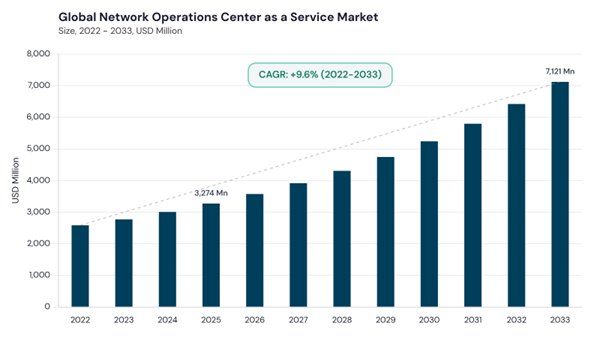
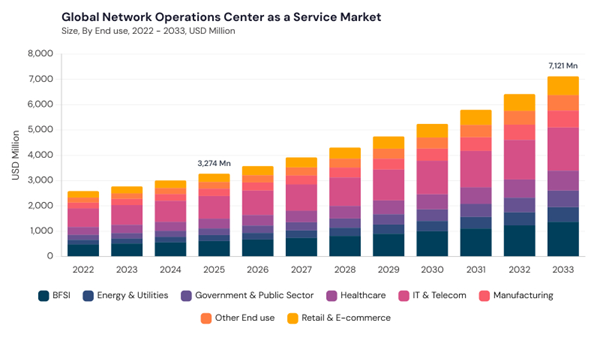
The Global Network Operations Center As A Service Market size is expected to reach USD 7.12 billion by 2033, rising at a market growth of 10.3% CAGR during the forecast period.


The market growth is driven by increasing adoption of AI-enabled automation, growing demand for proactive network monitoring, rising cybersecurity concerns, expansion of hybrid and multi-cloud infrastructures, and increasing need for scalable managed network operations. Enterprises across industries are increasingly outsourcing network monitoring and management functions to improve operational efficiency, reduce downtime, and ensure continuous network visibility. Telecom operators, cloud service providers, enterprises, and managed service providers are aggressively investing in AI-powered monitoring platforms, predictive analytics, automated incident response systems, and integrated cybersecurity operations to strengthen network resilience and optimize digital infrastructure performance.

The market has evolved from traditional in-house network monitoring environments toward intelligent, cloud-native, and AI-driven NOC ecosystems integrating predictive analytics, automation, cybersecurity orchestration, and real-time observability frameworks. Network Operations Center As A Service solutions are increasingly enabling organizations to support distributed enterprise architectures, cloud-native applications, software-defined networking environments, edge computing ecosystems, and digital transformation initiatives while maintaining high network availability and operational agility.

Key Market Trends & Insights

  • North America dominated the Network Operations Center As A Service Market in 2025 owing to advanced IT infrastructure, strong managed service adoption, and increasing enterprise investments in AI-driven network operations.
  • The Large Enterprise segment led the market by Enterprise Size in 2025 and is projected to continue dominating through 2033.
  • The Offsite segment accounted for the largest share by Support Model in 2025 and is expected to reach USD 3.68 billion by 2033.
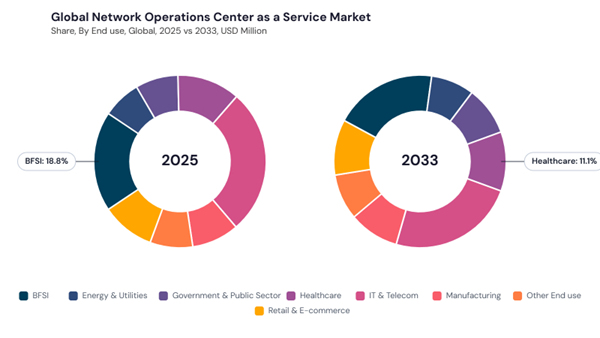
  • The IT & Telecom segment dominated the market by End Use in 2025 due to rising demand for uninterrupted network connectivity and cloud-based infrastructure management.
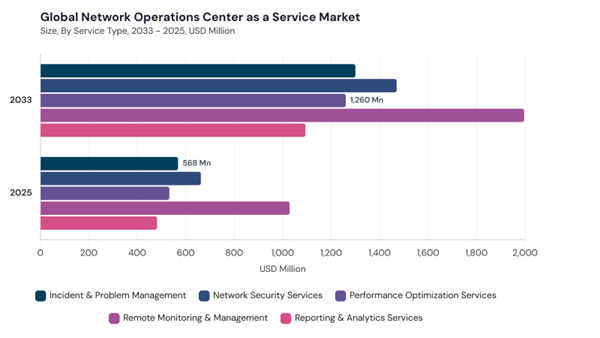
  • The Incident & Problem Management segment is expected to witness one of the fastest growth rates during 2026-2033.
  • AI-powered automation, predictive network analytics, integrated NOC-SOC convergence, cloud-native monitoring architectures, and proactive incident management are emerging as major industry trends.
The Network Operations Center As A Service Market is undergoing rapid transformation as organizations increasingly migrate toward distributed, cloud-native, and software-defined infrastructures requiring continuous monitoring and intelligent network management. Integration of AI-powered analytics, automation frameworks, and cybersecurity orchestration is significantly improving network uptime, fault detection accuracy, operational scalability, and service reliability.


Furthermore, increasing demand for real-time observability, digital business continuity, remote infrastructure management, and secure hybrid cloud operations is accelerating deployment of intelligent NOCaaS solutions globally.

Driving and Restraining Factors

Drivers
  • AI-enabled automation driving proactive network management
  • Growing adoption of cloud-native and hybrid IT infrastructures
  • Increasing cybersecurity concerns elevating demand for outsourced NOC services
  • Rising complexity of distributed enterprise network environments
  • Growing need for scalable 24/7 monitoring and incident management capabilities
Restraints
  • High deployment and operational management costs
  • Complexity associated with integrating legacy and multi-vendor network infrastructures
  • Data privacy and cybersecurity compliance concerns
Opportunities
  • Expansion of AI-driven autonomous network management platforms
  • Increasing demand for cloud-native and edge-enabled network operations
  • Rising integration of NOC and SOC operations for unified visibility
  • Growing adoption among SMEs seeking scalable managed network services
Challenges
  • Managing highly complex hybrid and multi-cloud infrastructures
  • Data security and regulatory compliance management
  • Skilled workforce shortages and operational cost optimization
  • Integration and interoperability challenges across heterogeneous networks

Market Share Analysis

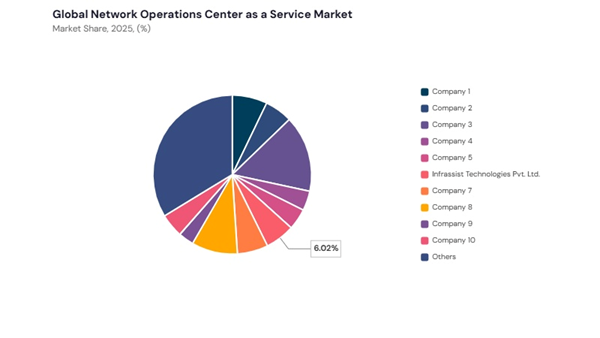
The Network Operations Center As A Service Market demonstrates a moderately fragmented competitive landscape characterized by participation from global IT service providers, managed service providers, and specialized NOC solution vendors. Major companies are increasingly investing in AI-powered automation, predictive analytics, integrated cybersecurity operations, cloud-native monitoring platforms, and intelligent incident management solutions.


Fujitsu accounted for approximately 15.56% market share in 2025 supported by its strong managed services portfolio, enterprise network expertise, and global IT infrastructure capabilities. Park Place Technologies and ConnectWise strengthened their market positioning through automation-driven remote monitoring platforms, AI-enabled network management solutions, and scalable managed service ecosystems.

Other major market participants include Netrio, Infrassist, ExterNetworks, Netenrich, INOC, iGLASS, and Mission Control. These companies are increasingly focusing on advanced analytics, proactive monitoring, cloud-native observability, cybersecurity integration, and AI-driven incident response capabilities to strengthen competitive positioning.

Enterprise Size Outlook

Based on Enterprise Size, the market is segmented into Large Enterprise and Small & Medium Enterprise (SMEs). The Large Enterprise segment dominated the market in 2025 with 63.90% revenue share owing to increasing deployment of AI-driven monitoring systems, complex multi-cloud infrastructure management, and growing investments in automated network operations. Meanwhile, the Small & Medium Enterprise (SMEs) segment is projected to reach USD 2.67 billion by 2033 driven by increasing cloud adoption, rising dependence on outsourced IT operations, and growing demand for cost-efficient network monitoring solutions among small businesses.

Support Model Outlook

Based on Support Model, the market is segmented into Offsite, Hybrid, and Onsite. The Offsite segment accounted for the highest revenue share of 53.25% in 2025 supported by increasing demand for centralized remote monitoring, scalable cloud-native management platforms, and reduced operational overhead. In addition, the Hybrid segment is anticipated to witness a CAGR of 10.6% during 2026-2033 owing to growing enterprise preference for combining onsite operational control with outsourced monitoring expertise across hybrid IT environments.

Service Type Outlook

Based on Service Type, the market is segmented into Remote Monitoring & Management, Network Security Services, Incident & Problem Management, Performance Optimization Services, and Reporting & Analytics Services. The Remote Monitoring & Management segment dominated the market in 2025 and is expected to attain a market value of USD 1.99 billion by 2033 due to increasing demand for continuous network visibility, proactive infrastructure management, and AI-powered anomaly detection capabilities. However, the Incident & Problem Management segment is expected to register a CAGR of 11.0% during the forecast period supported by rising need for rapid fault resolution, predictive diagnostics, and automated remediation workflows.

End Use Outlook

Based on End Use, the market is segmented into IT & Telecom, BFSI, Healthcare, Retail & E-commerce, Manufacturing, Government & Public Sector, Energy & Utilities, and Other End Use. The IT & Telecom segment held the largest revenue share of 27.31% in 2025 owing to growing cloud traffic volumes, expansion of telecom infrastructure, and increasing demand for uninterrupted digital connectivity. Meanwhile, the Government & Public Sector segment is projected to reach USD 652.5 Million by 2033 driven by increasing investments in secure public infrastructure, smart governance initiatives, and digital public service modernization programs globally.

Regional Outlook

Region-wise, the market is analyzed across North America, Europe, Asia Pacific, and LAMEA. North America dominated the market in 2025 accounting for 38.85% revenue share owing to advanced IT infrastructure, rapid adoption of managed services, and increasing implementation of AI-powered network monitoring solutions. On the other hand, Asia Pacific is expected to witness a CAGR of 11.5% during 2026-2033 supported by rapid digital transformation, expanding enterprise cloud infrastructure, rising internet penetration, and increasing outsourcing of network management operations across emerging economies.

Market Competition and Attributes

The Network Operations Center As A Service Market is highly innovation-driven and operationally intensive. Competition is centered around AI-driven automation, predictive analytics, integrated cybersecurity monitoring, cloud-native observability platforms, and intelligent incident response orchestration.

Major market participants are increasingly differentiating themselves through advanced automation capabilities, AI-enabled predictive maintenance, integrated NOC-SOC operations, customizable service delivery models, and scalable multi-cloud monitoring solutions. Strategic collaborations among cloud providers, telecom operators, cybersecurity firms, and managed service providers are reshaping long-term competitive dynamics across the industry.
Recent Strategies Deployed in the Market

  • Jan-2026: Splunk promoted integrated AI-driven NOC-SOC collaboration models supporting unified network visibility and threat intelligence operations.
  • Nov-2025: ConnectWise expanded its Asio platform with advanced automation, RMM, and intelligent monitoring capabilities.
  • 2025: Whale Cloud introduced AI-enabled OSS/BSS solutions enhancing predictive network analytics and operational automation.
  • May-2024: ExtNOC expanded outsourced NOC service deployment supporting enterprise-scale 24/7 monitoring operations.
  • 2024: Externetworks strengthened global managed NOC service capabilities supporting distributed infrastructure environments.

List of Key Companies Profiled

  • Cisco Systems, Inc.
  • IBM Corporation
  • AT&T Inc.
  • Verizon Communications Inc.
  • Lumen Technologies, Inc.
  • Orange Business Services
  • Hewlett Packard Enterprise Company
  • Tata Communications Ltd.
  • Broadcom, Inc.
  • NEC Corporation

Market Report Segmentation

By Enterprise Size
  • Large Enterprise
  • Small & Medium Enterprise (SMEs)
By Support Model
  • Offsite
  • Hybrid
  • Onsite
By Service Type
  • Remote Monitoring & Management
  • Network Security Services
  • Incident & Problem Management
  • Performance Optimization Services
  • Reporting & Analytics Services
By End Use
  • IT & Telecom
  • BFSI
  • Healthcare
  • Retail & E-commerce
  • Manufacturing
  • Government & Public Sector
  • Energy & Utilities
  • Other End Use
By Geography
  • North America
    • US
    • Canada
    • Mexico
    • Rest of North America

  • Europe
    • Germany
    • UK
    • France
    • Russia
    • Spain
    • Italy
    • Rest of Europe

  • Asia Pacific
    • China
    • Japan
    • India
    • South Korea
    • Singapore
    • Malaysia
    • Rest of Asia Pacific

  • LAMEA
    • Brazil
    • Argentina
    • UAE
    • Saudi Arabia
    • South Africa
    • Nigeria
    • Rest of LAMEA

Table of Contents

Chapter 1. Market Overview
1.1 COVID-19 Impact
1.2 Market Composition and Scenario
Chapter 2. Key Factors Impacting Market
2.1 Market Drivers
2.2 Market Restraints
2.3 Market Opportunities
2.4 Market Challenges
2.5 Market Trends
2.6 State of Competition
2.7 Market Consolidation
2.8 Key Customer Criteria
Chapter 3. Product Life CycleChapter 4. Value Chain Analysis of Network Operations Center As A Service Market
Chapter 5. Competition Analysis - Global
5.1 Market Share Analysis
5.2 Recent Development and Strategies
5.2.1 Mergers & Acquisitions
5.2.2 Product Launch & Product Expansion
5.2.3 Partnership, Collaboration & Agreements
5.2.4 Geographical Expansion
Chapter 6. Segmentation By Service Type
6.1 Remote Monitoring & Management
6.2 Network Security Services
6.3 Incident & Problem Management
6.4 Performance Optimization Services
6.5 Reporting & Analytics Services
Chapter 7. Segmentation By Support Model
7.1 Onsite
7.2 Offsite
7.3 Hybrid
Chapter 8. Segmentation By Enterprise Size
8.1 Large Enterprise
8.2 Small & Medium Enterprise (SMEs)
Chapter 9. Segmentation By End Use
9.1 IT & Telecom
9.2 BFSI
9.3 Healthcare
9.4 Retail & E-commerce
9.5 Manufacturing
9.6 Government & Public Sector
9.7 Energy & Utilities
9.8 Others End use
Chapter 10. North America Market
10.1 Market Overview
10.2 Key Factors Impacting Market
10.2.1 Market Drivers
10.2.2 Market Restraints
10.2.3 Market Opportunities
10.2.4 Market Challenges
10.2.5 Market Trends
10.2.6 State of Competition
10.2.7 Market Consolidation
10.2.8 Key Customer Criteria
10.3 Product Life Cycle
10.4 Segmentation By Service Type
10.4.1 Remote Monitoring & Management
10.4.2 Network Security Services
10.4.3 Incident & Problem Management
10.4.4 Performance Optimization Services
10.4.5 Reporting & Analytics Services
10.5 Segmentation By Support Model
10.5.1 Onsite
10.5.2 Offsite
10.5.3 Hybrid
10.6 Segmentation By Enterprise Size
10.6.1 Large Enterprise
10.6.2 Small & Medium Enterprise (SMEs)
10.7 Segmentation By End Use
10.7.1 IT & Telecom
10.7.2 BFSI
10.7.3 Healthcare
10.7.4 Retail & E-commerce
10.7.5 Manufacturing
10.7.6 Government & Public Sector
10.7.7 Energy & Utilities
10.7.8 Other End use
10.8 Segmentation By Country
10.8.1 US
10.8.1.1 Segmentation By Service Type
10.8.1.1.1 Remote Monitoring & Management
10.8.1.1.2 Network Security Services
10.8.1.1.3 Incident & Problem Management
10.8.1.1.4 Performance Optimization Services
10.8.1.1.5 Reporting & Analytics Services
10.8.1.2 Segmentation By Support Model
10.8.1.2.1 Onsite
10.8.1.2.2 Offsite
10.8.1.2.3 Hybrid
10.8.1.3 Segmentation By Enterprise Size
10.8.1.3.1 Large Enterprise
10.8.1.3.2 Small & Medium Enterprise (SMEs)
10.8.1.4 Segmentation By End Use
10.8.1.4.1 IT & Telecom
10.8.1.4.2 BFSI
10.8.1.4.3 Healthcare
10.8.1.4.4 Retail & E-commerce
10.8.1.4.5 Manufacturing
10.8.1.4.6 Government & Public Sector
10.8.1.4.7 Energy & Utilities
10.8.1.4.8 Others End use
10.8.2 Canada
10.8.2.1 Segmentation By Service Type
10.8.2.1.1 Remote Monitoring & Management
10.8.2.1.2 Network Security Services
10.8.2.1.3 Incident & Problem Management
10.8.2.1.4 Performance Optimization Services
10.8.2.1.5 Reporting & Analytics Services
10.8.2.2 Segmentation By Support Model
10.8.2.2.1 Onsite
10.8.2.2.2 Offsite
10.8.2.2.3 Hybrid
10.8.2.3 Segmentation By Enterprise Size
10.8.2.3.1 Large Enterprise
10.8.2.3.2 Small & Medium Enterprise (SMEs)
10.8.2.4 Segmentation By End Use
10.8.2.4.1 IT & Telecom
10.8.2.4.2 BFSI
10.8.2.4.3 Healthcare
10.8.2.4.4 Retail & E-commerce
10.8.2.4.5 Manufacturing
10.8.2.4.6 Government & Public Sector
10.8.2.4.7 Energy & Utilities
10.8.2.4.8 Others End use
10.8.3 Mexico
10.8.3.1 Segmentation By Service Type
10.8.3.1.1 Remote Monitoring & Management
10.8.3.1.2 Network Security Services
10.8.3.1.3 Incident & Problem Management
10.8.3.1.4 Performance Optimization Services
10.8.3.1.5 Reporting & Analytics Services
10.8.3.2 Segmentation By Support Model
10.8.3.2.1 Onsite
10.8.3.2.2 Offsite
10.8.3.2.3 Hybrid
10.8.3.3 Segmentation By Enterprise Size
10.8.3.3.1 Large Enterprise
10.8.3.3.2 Small & Medium Enterprise (SMEs)
10.8.3.4 Segmentation By End Use
10.8.3.4.1 IT & Telecom
10.8.3.4.2 BFSI
10.8.3.4.3 Healthcare
10.8.3.4.4 Retail & E-commerce
10.8.3.4.5 Manufacturing
10.8.3.4.6 Government & Public Sector
10.8.3.4.7 Energy & Utilities
10.8.3.4.8 Others End use
10.8.4 Rest of North America
10.8.4.1 Segmentation By Service Type
10.8.4.1.1 Remote Monitoring & Management
10.8.4.1.2 Network Security Services
10.8.4.1.3 Incident & Problem Management
10.8.4.1.4 Performance Optimization Services
10.8.4.1.5 Reporting & Analytics Services
10.8.4.2 Segmentation By Support Model
10.8.4.2.1 Onsite
10.8.4.2.2 Offsite
10.8.4.2.3 Hybrid
10.8.4.3 Segmentation By Enterprise Size
10.8.4.3.1 Large Enterprise
10.8.4.3.2 Small & Medium Enterprise (SMEs)
10.8.4.4 Segmentation By End Use
10.8.4.4.1 IT & Telecom
10.8.4.4.2 BFSI
10.8.4.4.3 Healthcare
10.8.4.4.4 Retail & E-commerce
10.8.4.4.5 Manufacturing
10.8.4.4.6 Government & Public Sector
10.8.4.4.7 Energy & Utilities
10.8.4.4.8 Others End use
Chapter 11. Europe Market
11.1 Market Overview
11.2 Key Factors Impacting Market
11.2.1 Market Drivers
11.2.2 Market Restraints
11.2.3 Market Opportunities
11.2.4 Market Challenges
11.2.5 Market Trends
11.2.6 State of Competition
11.2.7 Market Consolidation
11.2.8 Key Customer Criteria
11.3 Product Life Cycle
11.4 Segmentation By Service Type
11.4.1 Remote Monitoring & Management
11.4.2 Network Security Services
11.4.3 Incident & Problem Management
11.4.4 Performance Optimization Services
11.4.5 Reporting & Analytics Services
11.5 Segmentation By Support Model
11.5.1 Onsite
11.5.2 Offsite
11.5.3 Hybrid
11.6 Segmentation By Enterprise Size
11.6.1 Large Enterprise
11.6.2 Small & Medium Enterprise (SMEs)
11.7 Segmentation By End Use
11.7.1 IT & Telecom
11.7.2 BFSI
11.7.3 Healthcare
11.7.4 Retail & E-commerce
11.7.5 Manufacturing
11.7.6 Government & Public Sector
11.7.7 Energy & Utilities
11.7.8 Other End use
11.8 Segmentation By Country
11.8.1 Germany
11.8.1.1 Segmentation By Service Type
11.8.1.1.1 Remote Monitoring & Management
11.8.1.1.2 Network Security Services
11.8.1.1.3 Incident & Problem Management
11.8.1.1.4 Performance Optimization Services
11.8.1.1.5 Reporting & Analytics Services
11.8.1.2 Segmentation By Support Model
11.8.1.2.1 Onsite
11.8.1.2.2 Offsite
11.8.1.2.3 Hybrid
11.8.1.3 Segmentation By Enterprise Size
11.8.1.3.1 Large Enterprise
11.8.1.3.2 Small & Medium Enterprise (SMEs)
11.8.1.4 Segmentation By End Use
11.8.1.4.1 IT & Telecom
11.8.1.4.2 BFSI
11.8.1.4.3 Healthcare
11.8.1.4.4 Retail & E-commerce
11.8.1.4.5 Manufacturing
11.8.1.4.6 Government & Public Sector
11.8.1.4.7 Energy & Utilities
11.8.1.4.8 Others End use
11.8.2 UK
11.8.2.1 Segmentation By Service Type
11.8.2.1.1 Remote Monitoring & Management
11.8.2.1.2 Network Security Services
11.8.2.1.3 Incident & Problem Management
11.8.2.1.4 Performance Optimization Services
11.8.2.1.5 Reporting & Analytics Services
11.8.2.2 Segmentation By Support Model
11.8.2.2.1 Onsite
11.8.2.2.2 Offsite
11.8.2.2.3 Hybrid
11.8.2.3 Segmentation By Enterprise Size
11.8.2.3.1 Large Enterprise
11.8.2.3.2 Small & Medium Enterprise (SMEs)
11.8.2.4 Segmentation By End Use
11.8.2.4.1 IT & Telecom
11.8.2.4.2 BFSI
11.8.2.4.3 Healthcare
11.8.2.4.4 Retail & E-commerce
11.8.2.4.5 Manufacturing
11.8.2.4.6 Government & Public Sector
11.8.2.4.7 Energy & Utilities
11.8.2.4.8 Others End use
11.8.3 France
11.8.3.1 Segmentation By Service Type
11.8.3.1.1 Remote Monitoring & Management
11.8.3.1.2 Network Security Services
11.8.3.1.3 Incident & Problem Management
11.8.3.1.4 Performance Optimization Services
11.8.3.1.5 Reporting & Analytics Services
11.8.3.2 Segmentation By Support Model
11.8.3.2.1 Onsite
11.8.3.2.2 Offsite
11.8.3.2.3 Hybrid
11.8.3.3 Segmentation By Enterprise Size
11.8.3.3.1 Large Enterprise
11.8.3.3.2 Small & Medium Enterprise (SMEs)
11.8.3.4 Segmentation By End Use
11.8.3.4.1 IT & Telecom
11.8.3.4.2 BFSI
11.8.3.4.3 Healthcare
11.8.3.4.4 Retail & E-commerce
11.8.3.4.5 Manufacturing
11.8.3.4.6 Government & Public Sector
11.8.3.4.7 Energy & Utilities
11.8.3.4.8 Others End use
11.8.4 Russia
11.8.4.1 Segmentation By Service Type
11.8.4.1.1 Remote Monitoring & Management
11.8.4.1.2 Network Security Services
11.8.4.1.3 Incident & Problem Management
11.8.4.1.4 Performance Optimization Services
11.8.4.1.5 Reporting & Analytics Services
11.8.4.2 Segmentation By Support Model
11.8.4.2.1 Onsite
11.8.4.2.2 Offsite
11.8.4.2.3 Hybrid
11.8.4.3 Segmentation By Enterprise Size
11.8.4.3.1 Large Enterprise
11.8.4.3.2 Small & Medium Enterprise (SMEs)
11.8.4.4 Segmentation By End Use
11.8.4.4.1 IT & Telecom
11.8.4.4.2 BFSI
11.8.4.4.3 Healthcare
11.8.4.4.4 Retail & E-commerce
11.8.4.4.5 Manufacturing
11.8.4.4.6 Government & Public Sector
11.8.4.4.7 Energy & Utilities
11.8.4.4.8 Others End use
11.8.5 Spain
11.8.5.1 Segmentation By Service Type
11.8.5.1.1 Remote Monitoring & Management
11.8.5.1.2 Network Security Services
11.8.5.1.3 Incident & Problem Management
11.8.5.1.4 Performance Optimization Services
11.8.5.1.5 Reporting & Analytics Services
11.8.5.2 Segmentation By Support Model
11.8.5.2.1 Onsite
11.8.5.2.2 Offsite
11.8.5.2.3 Hybrid
11.8.5.3 Segmentation By Enterprise Size
11.8.5.3.1 Large Enterprise
11.8.5.3.2 Small & Medium Enterprise (SMEs)
11.8.5.4 Segmentation By End Use
11.8.5.4.1 IT & Telecom
11.8.5.4.2 BFSI
11.8.5.4.3 Healthcare
11.8.5.4.4 Retail & E-commerce
11.8.5.4.5 Manufacturing
11.8.5.4.6 Government & Public Sector
11.8.5.4.7 Energy & Utilities
11.8.5.4.8 Others End use
11.8.6 Italy
11.8.6.1 Segmentation By Service Type
11.8.6.1.1 Remote Monitoring & Management
11.8.6.1.2 Network Security Services
11.8.6.1.3 Incident & Problem Management
11.8.6.1.4 Performance Optimization Services
11.8.6.1.5 Reporting & Analytics Services
11.8.6.2 Segmentation By Support Model
11.8.6.2.1 Onsite
11.8.6.2.2 Offsite
11.8.6.2.3 Hybrid
11.8.6.3 Segmentation By Enterprise Size
11.8.6.3.1 Large Enterprise
11.8.6.3.2 Small & Medium Enterprise (SMEs)
11.8.6.4 Segmentation By End Use
11.8.6.4.1 IT & Telecom
11.8.6.4.2 BFSI
11.8.6.4.3 Healthcare
11.8.6.4.4 Retail & E-commerce
11.8.6.4.5 Manufacturing
11.8.6.4.6 Government & Public Sector
11.8.6.4.7 Energy & Utilities
11.8.6.4.8 Others End use
11.8.7 Rest of Europe
11.8.7.1 Segmentation By Service Type
11.8.7.1.1 Remote Monitoring & Management
11.8.7.1.2 Network Security Services
11.8.7.1.3 Incident & Problem Management
11.8.7.1.4 Performance Optimization Services
11.8.7.1.5 Reporting & Analytics Services
11.8.7.2 Segmentation By Support Model
11.8.7.2.1 Onsite
11.8.7.2.2 Offsite
11.8.7.2.3 Hybrid
11.8.7.3 Segmentation By Enterprise Size
11.8.7.3.1 Large Enterprise
11.8.7.3.2 Small & Medium Enterprise (SMEs)
11.8.7.4 Segmentation By End Use
11.8.7.4.1 IT & Telecom
11.8.7.4.2 BFSI
11.8.7.4.3 Healthcare
11.8.7.4.4 Retail & E-commerce
11.8.7.4.5 Manufacturing
11.8.7.4.6 Government & Public Sector
11.8.7.4.7 Energy & Utilities
11.8.7.4.8 Others End use
Chapter 12. Asia Pacific Market
12.1 Market Overview
12.2 Key Factors Impacting Market
12.2.1 Market Drivers
12.2.2 Market Restraints
12.2.3 Market Opportunities
12.2.4 Market Challenges
12.2.5 Market Trends
12.2.6 State of Competition
12.2.7 Market Consolidation
12.2.8 Key Customer Criteria
12.3 Product Life Cycle
12.4 Segmentation By Service Type
12.4.1 Remote Monitoring & Management
12.4.2 Network Security Services
12.4.3 Incident & Problem Management
12.4.4 Performance Optimization Services
12.4.5 Reporting & Analytics Services
12.5 Segmentation By Support Model
12.5.1 Onsite
12.5.2 Offsite
12.5.3 Hybrid
12.6 Segmentation By Enterprise Size
12.6.1 Large Enterprise
12.6.2 Small & Medium Enterprise (SMEs)
12.7 Segmentation By End Use
12.7.1 IT & Telecom
12.7.2 BFSI
12.7.3 Healthcare
12.7.4 Retail & E-commerce
12.7.5 Manufacturing
12.7.6 Government & Public Sector
12.7.7 Energy & Utilities
12.7.8 Others End use
12.8 Segmentation By Country
12.8.1 China
12.8.1.1 Segmentation By Service Type
12.8.1.1.1 Remote Monitoring & Management
12.8.1.1.2 Network Security Services
12.8.1.1.3 Incident & Problem Management
12.8.1.1.4 Performance Optimization Services
12.8.1.1.5 Reporting & Analytics Services
12.8.1.2 Segmentation By Support Model
12.8.1.2.1 Onsite
12.8.1.2.2 Offsite
12.8.1.2.3 Hybrid
12.8.1.3 Segmentation By Enterprise Size
12.8.1.3.1 Large Enterprise
12.8.1.3.2 Small & Medium Enterprise (SMEs)
12.8.1.4 Segmentation By End Use
12.8.1.4.1 IT & Telecom
12.8.1.4.2 BFSI
12.8.1.4.3 Healthcare
12.8.1.4.4 Retail & E-commerce
12.8.1.4.5 Manufacturing
12.8.1.4.6 Government & Public Sector
12.8.1.4.7 Energy & Utilities
12.8.1.4.8 Others End use
12.8.2 Japan
12.8.2.1 Segmentation By Service Type
12.8.2.1.1 Remote Monitoring & Management
12.8.2.1.2 Network Security Services
12.8.2.1.3 Incident & Problem Management
12.8.2.1.4 Performance Optimization Services
12.8.2.1.5 Reporting & Analytics Services
12.8.2.2 Segmentation By Support Model
12.8.2.2.1 Onsite
12.8.2.2.2 Offsite
12.8.2.2.3 Hybrid
12.8.2.3 Segmentation By Enterprise Size
12.8.2.3.1 Large Enterprise
12.8.2.3.2 Small & Medium Enterprise (SMEs)
12.8.2.4 Segmentation By End Use
12.8.2.4.1 IT & Telecom
12.8.2.4.2 BFSI
12.8.2.4.3 Healthcare
12.8.2.4.4 Retail & E-commerce
12.8.2.4.5 Manufacturing
12.8.2.4.6 Government & Public Sector
12.8.2.4.7 Energy & Utilities
12.8.2.4.8 Others End use
12.8.3 India
12.8.3.1 Segmentation By Service Type
12.8.3.1.1 Remote Monitoring & Management
12.8.3.1.2 Network Security Services
12.8.3.1.3 Incident & Problem Management
12.8.3.1.4 Performance Optimization Services
12.8.3.1.5 Reporting & Analytics Services
12.8.3.2 Segmentation By Support Model
12.8.3.2.1 Onsite
12.8.3.2.2 Offsite
12.8.3.2.3 Hybrid
12.8.3.3 Segmentation By Enterprise Size
12.8.3.3.1 Large Enterprise
12.8.3.3.2 Small & Medium Enterprise (SMEs)
12.8.3.4 Segmentation By End Use
12.8.3.4.1 IT & Telecom
12.8.3.4.2 BFSI
12.8.3.4.3 Healthcare
12.8.3.4.4 Retail & E-commerce
12.8.3.4.5 Manufacturing
12.8.3.4.6 Government & Public Sector
12.8.3.4.7 Energy & Utilities
12.8.3.4.8 Others End use
12.8.4 South Korea
12.8.4.1 Segmentation By Service Type
12.8.4.1.1 Remote Monitoring & Management
12.8.4.1.2 Network Security Services
12.8.4.1.3 Incident & Problem Management
12.8.4.1.4 Performance Optimization Services
12.8.4.1.5 Reporting & Analytics Services
12.8.4.2 Segmentation By Support Model
12.8.4.2.1 Onsite
12.8.4.2.2 Offsite
12.8.4.2.3 Hybrid
12.8.4.3 Segmentation By Enterprise Size
12.8.4.3.1 Large Enterprise
12.8.4.3.2 Small & Medium Enterprise (SMEs)
12.8.4.4 Segmentation By End Use
12.8.4.4.1 IT & Telecom
12.8.4.4.2 BFSI
12.8.4.4.3 Healthcare
12.8.4.4.4 Retail & E-commerce
12.8.4.4.5 Manufacturing
12.8.4.4.6 Government & Public Sector
12.8.4.4.7 Energy & Utilities
12.8.4.4.8 Others End use
12.8.5 Singapore
12.8.5.1 Segmentation By Service Type
12.8.5.1.1 Remote Monitoring & Management
12.8.5.1.2 Network Security Services
12.8.5.1.3 Incident & Problem Management
12.8.5.1.4 Performance Optimization Services
12.8.5.1.5 Reporting & Analytics Services
12.8.5.2 Segmentation By Support Model
12.8.5.2.1 Onsite
12.8.5.2.2 Offsite
12.8.5.2.3 Hybrid
12.8.5.3 Segmentation By Enterprise Size
12.8.5.3.1 Large Enterprise
12.8.5.3.2 Small & Medium Enterprise (SMEs)
12.8.5.4 Segmentation By End Use
12.8.5.4.1 IT & Telecom
12.8.5.4.2 BFSI
12.8.5.4.3 Healthcare
12.8.5.4.4 Retail & E-commerce
12.8.5.4.5 Manufacturing
12.8.5.4.6 Government & Public Sector
12.8.5.4.7 Energy & Utilities
12.8.5.4.8 Others End use
12.8.6 Malaysia
12.8.6.1 Segmentation By Service Type
12.8.6.1.1 Remote Monitoring & Management
12.8.6.1.2 Network Security Services
12.8.6.1.3 Incident & Problem Management
12.8.6.1.4 Performance Optimization Services
12.8.6.1.5 Reporting & Analytics Services
12.8.6.2 Segmentation By Support Model
12.8.6.2.1 Onsite
12.8.6.2.2 Offsite
12.8.6.2.3 Hybrid
12.8.6.3 Segmentation By Enterprise Size
12.8.6.3.1 Large Enterprise
12.8.6.3.2 Small & Medium Enterprise (SMEs)
12.8.6.4 Segmentation By End Use
12.8.6.4.1 IT & Telecom
12.8.6.4.2 BFSI
12.8.6.4.3 Healthcare
12.8.6.4.4 Retail & E-commerce
12.8.6.4.5 Manufacturing
12.8.6.4.6 Government & Public Sector
12.8.6.4.7 Energy & Utilities
12.8.6.4.8 Others End use
12.8.7 Rest of Asia Pacific
12.8.7.1 Segmentation By Service Type
12.8.7.1.1 Remote Monitoring & Management
12.8.7.1.2 Network Security Services
12.8.7.1.3 Incident & Problem Management
12.8.7.1.4 Performance Optimization Services
12.8.7.1.5 Reporting & Analytics Services
12.8.7.2 Segmentation By Support Model
12.8.7.2.1 Onsite
12.8.7.2.2 Offsite
12.8.7.2.3 Hybrid
12.8.7.3 Segmentation By Enterprise Size
12.8.7.3.1 Large Enterprise
12.8.7.3.2 Small & Medium Enterprise (SMEs)
12.8.7.4 Segmentation By End Use
12.8.7.4.1 IT & Telecom
12.8.7.4.2 BFSI
12.8.7.4.3 Healthcare
12.8.7.4.4 Retail & E-commerce
12.8.7.4.5 Manufacturing
12.8.7.4.6 Government & Public Sector
12.8.7.4.7 Energy & Utilities
12.8.7.4.8 Others End use
Chapter 13. LAMEA Market
13.1 Market Overview
13.2 Key Factors Impacting Market
13.2.1 Market Drivers
13.2.2 Market Restraints
13.2.3 Market Opportunities
13.2.4 Market Challenges
13.2.5 Market Trends
13.2.6 State of Competition
13.2.7 Market Consolidation
13.2.8 Key Customer Criteria
13.3 Product Life Cycle
13.4 Segmentation By Service Type
13.4.1 Remote Monitoring & Management
13.4.2 Network Security Services
13.4.3 Incident & Problem Management
13.4.4 Performance Optimization Services
13.4.5 Reporting & Analytics Services
13.5 Segmentation By Support Model
13.5.1 Onsite
13.5.2 Offsite
13.5.3 Hybrid
13.6 Segmentation By Enterprise Size
13.6.1 Large Enterprise
13.6.2 Small & Medium Enterprise (SMEs)
13.7 Segmentation By End Use
13.7.1 IT & Telecom
13.7.2 BFSI
13.7.3 Healthcare
13.7.4 Retail & E-commerce
13.7.5 Manufacturing
13.7.6 Government & Public Sector
13.7.7 Energy & Utilities
13.7.8 Other End use
13.8 Segmentation By Country
13.8.1 Brazil
13.8.1.1 Segmentation By Service Type
13.8.1.1.1 Remote Monitoring & Management
13.8.1.1.2 Network Security Services
13.8.1.1.3 Incident & Problem Management
13.8.1.1.4 Performance Optimization Services
13.8.1.1.5 Reporting & Analytics Services
13.8.1.2 Segmentation By Support Model
13.8.1.2.1 Onsite
13.8.1.2.2 Offsite
13.8.1.2.3 Hybrid
13.8.1.3 Segmentation By Enterprise Size
13.8.1.3.1 Large Enterprise
13.8.1.3.2 Small & Medium Enterprise (SMEs)
13.8.1.4 Segmentation By End Use
13.8.1.4.1 IT & Telecom
13.8.1.4.2 BFSI
13.8.1.4.3 Healthcare
13.8.1.4.4 Retail & E-commerce
13.8.1.4.5 Manufacturing
13.8.1.4.6 Government & Public Sector
13.8.1.4.7 Energy & Utilities
13.8.1.4.8 Others End use
13.8.2 Argentina
13.8.2.1 Segmentation By Service Type
13.8.2.1.1 Remote Monitoring & Management
13.8.2.1.2 Network Security Services
13.8.2.1.3 Incident & Problem Management
13.8.2.1.4 Performance Optimization Services
13.8.2.1.5 Reporting & Analytics Services
13.8.2.2 Segmentation By Support Model
13.8.2.2.1 Onsite
13.8.2.2.2 Offsite
13.8.2.2.3 Hybrid
13.8.2.3 Segmentation By Enterprise Size
13.8.2.3.1 Large Enterprise
13.8.2.3.2 Small & Medium Enterprise (SMEs)
13.8.2.4 Segmentation By End Use
13.8.2.4.1 IT & Telecom
13.8.2.4.2 BFSI
13.8.2.4.3 Healthcare
13.8.2.4.4 Retail & E-commerce
13.8.2.4.5 Manufacturing
13.8.2.4.6 Government & Public Sector
13.8.2.4.7 Energy & Utilities
13.8.2.4.8 Others End use
13.8.3 UAE
13.8.3.1 Segmentation By Service Type
13.8.3.1.1 Remote Monitoring & Management
13.8.3.1.2 Network Security Services
13.8.3.1.3 Incident & Problem Management
13.8.3.1.4 Performance Optimization Services
13.8.3.1.5 Reporting & Analytics Services
13.8.3.2 Segmentation By Support Model
13.8.3.2.1 Onsite
13.8.3.2.2 Offsite
13.8.3.2.3 Hybrid
13.8.3.3 Segmentation By Enterprise Size
13.8.3.3.1 Large Enterprise
13.8.3.3.2 Small & Medium Enterprise (SMEs)
13.8.3.4 Segmentation By End Use
13.8.3.4.1 IT & Telecom
13.8.3.4.2 BFSI
13.8.3.4.3 Healthcare
13.8.3.4.4 Retail & E-commerce
13.8.3.4.5 Manufacturing
13.8.3.4.6 Government & Public Sector
13.8.3.4.7 Energy & Utilities
13.8.3.4.8 Others End use
13.8.4 Saudi Arabia
13.8.4.1 Segmentation By Service Type
13.8.4.1.1 Remote Monitoring & Management
13.8.4.1.2 Network Security Services
13.8.4.1.3 Incident & Problem Management
13.8.4.1.4 Performance Optimization Services
13.8.4.1.5 Reporting & Analytics Services
13.8.4.2 Segmentation By Support Model
13.8.4.2.1 Onsite
13.8.4.2.2 Offsite
13.8.4.2.3 Hybrid
13.8.4.3 Segmentation By Enterprise Size
13.8.4.3.1 Large Enterprise
13.8.4.3.2 Small & Medium Enterprise (SMEs)
13.8.4.4 Segmentation By End Use
13.8.4.4.1 IT & Telecom
13.8.4.4.2 BFSI
13.8.4.4.3 Healthcare
13.8.4.4.4 Retail & E-commerce
13.8.4.4.5 Manufacturing
13.8.4.4.6 Government & Public Sector
13.8.4.4.7 Energy & Utilities
13.8.4.4.8 Others End use
13.8.5 South Africa
13.8.5.1 Segmentation By Service Type
13.8.5.1.1 Remote Monitoring & Management
13.8.5.1.2 Network Security Services
13.8.5.1.3 Incident & Problem Management
13.8.5.1.4 Performance Optimization Services
13.8.5.1.5 Reporting & Analytics Services
13.8.5.2 Segmentation By Support Model
13.8.5.2.1 Onsite
13.8.5.2.2 Offsite
13.8.5.2.3 Hybrid
13.8.5.3 Segmentation By Enterprise Size
13.8.5.3.1 Large Enterprise
13.8.5.3.2 Small & Medium Enterprise (SMEs)
13.8.5.4 Segmentation By End Use
13.8.5.4.1 IT & Telecom
13.8.5.4.2 BFSI
13.8.5.4.3 Healthcare
13.8.5.4.4 Retail & E-commerce
13.8.5.4.5 Manufacturing
13.8.5.4.6 Government & Public Sector
13.8.5.4.7 Energy & Utilities
13.8.5.4.8 Others End use
13.8.6 Nigeria
13.8.6.1 Segmentation By Service Type
13.8.6.1.1 Remote Monitoring & Management
13.8.6.1.2 Network Security Services
13.8.6.1.3 Incident & Problem Management
13.8.6.1.4 Performance Optimization Services
13.8.6.1.5 Reporting & Analytics Services
13.8.6.2 Segmentation By Support Model
13.8.6.2.1 Onsite
13.8.6.2.2 Offsite
13.8.6.2.3 Hybrid
13.8.6.3 Segmentation By Enterprise Size
13.8.6.3.1 Large Enterprise
13.8.6.3.2 Small & Medium Enterprise (SMEs)
13.8.6.4 Segmentation By End Use
13.8.6.4.1 IT & Telecom
13.8.6.4.2 BFSI
13.8.6.4.3 Healthcare
13.8.6.4.4 Retail & E-commerce
13.8.6.4.5 Manufacturing
13.8.6.4.6 Government & Public Sector
13.8.6.4.7 Energy & Utilities
13.8.6.4.8 Others End use
13.8.7 Rest of LAMEA
13.8.7.1 Segmentation By Service Type
13.8.7.1.1 Remote Monitoring & Management
13.8.7.1.2 Network Security Services
13.8.7.1.3 Incident & Problem Management
13.8.7.1.4 Performance Optimization Services
13.8.7.1.5 Reporting & Analytics Services
13.8.7.2 Segmentation By Support Model
13.8.7.2.1 Onsite
13.8.7.2.2 Offsite
13.8.7.2.3 Hybrid
13.8.7.3 Segmentation By Enterprise Size
13.8.7.3.1 Large Enterprise
13.8.7.3.2 Small & Medium Enterprise (SMEs)
13.8.7.4 Segmentation By End Use
13.8.7.4.1 IT & Telecom
13.8.7.4.2 BFSI
13.8.7.4.3 Healthcare
13.8.7.4.4 Retail & E-commerce
13.8.7.4.5 Manufacturing
13.8.7.4.6 Government & Public Sector
13.8.7.4.7 Energy & Utilities
13.8.7.4.8 Others End use
Chapter 14. Company Snapshot
14.1 ConnectWise, LLC
14.1.1 Business Overview
14.1.2 Key Information
14.1.3 Company Focus
14.1.4 Strategic Insights
14.1.5 Strategy Deployed
14.1.6 Product & Service Portfolio
14.1.7 Capability Overview
14.1.8 Technology & Innovation Focus
14.1.9 Customers / End Users
14.1.10 Competitive Positioning
14.1.11 Key Differentiators
14.1.12 Portfolio Matrix
14.1.13 SWOT Analysis
14.1.14 Future Outlook
14.2 ExterNetworks Inc.
14.2.1 Business Overview
14.2.2 Key Information
14.2.3 Company Focus
14.2.4 Strategic Insights
14.2.5 Strategy Deployed
14.2.6 Product & Service Portfolio
14.2.7 Capability Overview
14.2.8 Technology & Innovation Focus
14.2.9 Customers / End Users
14.2.10 Competitive Positioning
14.2.11 Key Differentiators
14.2.12 Portfolio Matrix
14.2.13 SWOT Analysis
14.2.14 Future Outlook
14.3 Fujitsu Limited
14.3.1 Business Overview
14.3.2 Key Information
14.3.3 Company Focus
14.3.4 Strategic Insights
14.3.5 Strategy Deployed
14.3.6 Product & Service Portfolio
14.3.7 Capability Overview
14.3.8 Technology & Innovation Focus
14.3.9 Customers / End Users
14.3.10 Competitive Positioning
14.3.11 Key Differentiators
14.3.12 Portfolio Matrix
14.3.13 SWOT Analysis
14.3.14 Future Outlook
14.4 iGLASS Networks
14.4.1 Business Overview
14.4.2 Key Information
14.4.3 Company Focus
14.4.4 Strategic Insights
14.4.5 Strategy Deployed
14.4.6 Product & Service Portfolio
14.4.7 Capability Overview
14.4.8 Technology & Innovation Focus
14.4.9 Customers / End Users
14.4.10 Competitive Positioning
14.4.11 Key Differentiators
14.4.12 Portfolio Matrix
14.4.13 SWOT Analysis
14.4.14 Future Outlook
14.5 INOC
14.5.1 Business Overview
14.5.2 Key Information
14.5.3 Company Focus
14.5.4 Strategic Insights
14.5.5 Strategy Deployed
14.5.6 Product & Service Portfolio
14.5.7 Capability Overview
14.5.8 Technology & Innovation Focus
14.5.9 Customers / End Users
14.5.10 Competitive Positioning
14.5.11 Key Differentiators
14.5.12 Portfolio Matrix
14.5.13 SWOT Analysis
14.5.14 Future Outlook
14.6 Infrassist Technologies Pvt. Ltd.
14.6.1 Business Overview
14.6.2 Key Information
14.6.3 Company Focus
14.6.4 Strategic Insights
14.6.5 Strategy Deployed
14.6.6 Product & Service Portfolio
14.6.7 Capability Overview
14.6.8 Technology & Innovation Focus
14.6.9 Customers / End Users
14.6.10 Competitive Positioning
14.6.11 Key Differentiators
14.6.12 Portfolio Matrix
14.6.13 SWOT Analysis
14.6.14 Future Outlook
14.7 Netrio, LLC
14.7.1 Business Overview
14.7.2 Key Information
14.7.3 Company Focus
14.7.4 Strategic Insights
14.7.5 Strategy Deployed
14.7.6 Product & Service Portfolio
14.7.7 Capability Overview
14.7.8 Technology & Innovation Focus
14.7.9 Customers / End Users
14.7.10 Competitive Positioning
14.7.11 Key Differentiators
14.7.12 Portfolio Matrix
14.7.13 SWOT Analysis
14.7.14 Future Outlook
14.8 Park Place Technologies, LLC
14.8.1 Business Overview
14.8.2 Key Information
14.8.3 Company Focus
14.8.4 Strategic Insights
14.8.5 Strategy Deployed
14.8.6 Product & Service Portfolio
14.8.7 Capability Overview
14.8.8 Technology & Innovation Focus
14.8.9 Customers / End Users
14.8.10 Competitive Positioning
14.8.11 Key Differentiators
14.8.12 Portfolio Matrix
14.8.13 SWOT Analysis
14.8.14 Future Outlook
14.9 Mission Control NOC
14.9.1 Business Overview
14.9.2 Key Information
14.9.3 Company Focus
14.9.4 Strategic Insights
14.9.5 Strategy Deployed
14.9.6 Product & Service Portfolio
14.9.7 Capability Overview
14.9.8 Technology & Innovation Focus
14.9.9 Customers / End Users
14.9.10 Competitive Positioning
14.9.11 Key Differentiators
14.9.12 Portfolio Matrix
14.9.13 SWOT Analysis
14.9.14 Future Outlook
14.10 Netenrich
14.10.1 Business Overview
14.10.2 Key Information
14.10.3 Company Focus
14.10.4 Strategic Insights
14.10.5 Strategy Deployed
14.10.6 Product & Service Portfolio
14.10.7 Capability Overview
14.10.8 Technology & Innovation Focus
14.10.9 Customers / End Users
14.10.10 Competitive Positioning
14.10.11 Key Differentiators
14.10.12 Portfolio Matrix
14.10.13 SWOT Analysis
14.10.14 Future Outlook
Chapter 15. Winning Imperatives of Network Operations Center As A Service Market

Companies Mentioned

  • Cisco Systems, Inc.
  • IBM Corporation
  • AT&T Inc.
  • Verizon Communications Inc.
  • Lumen Technologies, Inc.
  • Orange Business Services
  • Hewlett Packard Enterprise Company
  • Tata Communications Ltd.
  • Broadcom, Inc.
  • NEC Corporation