+353-1-416-8900REST OF WORLD
+44-20-3973-8888REST OF WORLD
1-917-300-0470EAST COAST U.S
1-800-526-8630U.S. (TOLL FREE)

Global Trade Promotion Optimization AI Market Size, Share & Industry Analysis Report by Component, Deployment Mode, Organization Size, Application, Industry Vertical, Regional Outlook and Forecast, 2026-2033

  • PDF Icon

    Report

  • 870 Pages
  • May 2026
  • Marqual IT Solutions Pvt. Ltd (KBV Research)
  • ID: 6276088
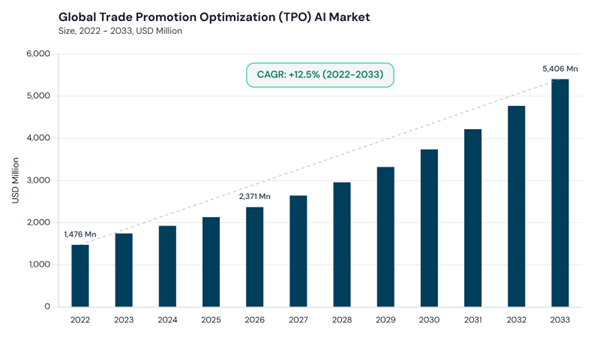
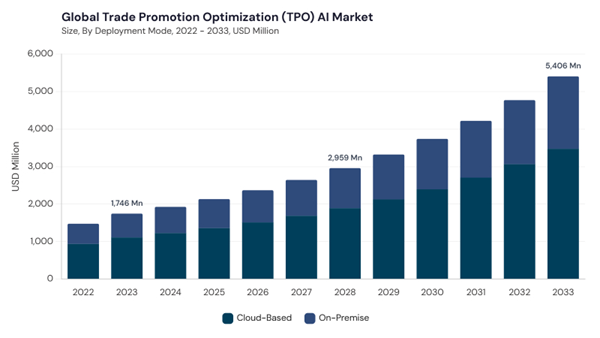
The Global Trade Promotion Optimization (TPO) AI Market size is expected to reach USD 5.40 billion by 2033, rising at a market growth of 12.5% CAGR during the forecast period.


Growth in the market is driven by increasing adoption of artificial intelligence, predictive analytics, and machine learning technologies across retail and consumer packaged goods (CPG) industries. Organizations are increasingly leveraging AI-powered trade promotion optimization platforms to improve promotional efficiency, optimize pricing strategies, enhance demand forecasting accuracy, and maximize return on promotional spending. Rapid expansion of omnichannel retailing, cloud-based enterprise ecosystems, and real-time analytics capabilities is further accelerating market expansion globally.

Key Market Trends & Insights:

  • The North America Trade Promotion Optimization (TPO) AI market dominated the Global Market in 2025, accounting for a 41.90% revenue share in 2025.
  • The US Trade Promotion Optimization (TPO) AI market is expected to continue its dominance in North America region thereby reaching a market size of USD 2.01 billion by 2033.
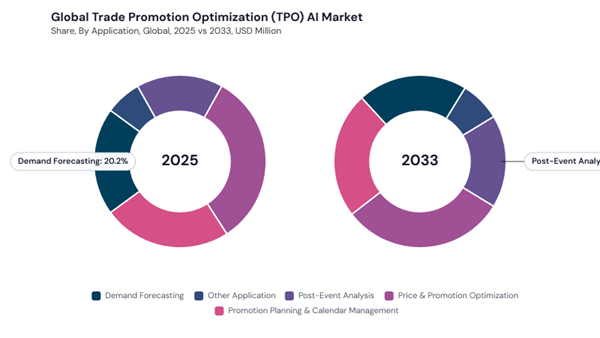
  • Among the various application segments, Price & Promotion Optimization dominated the global market contributing a revenue share of 32.7% in 2025.
  • In terms of the Deployment segmentation, the Cloud-Based segment captured a 63.7% revenue share in 2025.
  • Solutions led the Component segments in 2025, capturing a 60.4% revenue share and is projected to continue its dominance during projected period.
The Global Trade Promotion Optimization (TPO) AI Market has evolved significantly from traditional spreadsheet-based promotional planning systems into a highly intelligent AI-driven revenue optimization ecosystem. Earlier trade promotion activities primarily relied on manual forecasting, historical sales analysis, and disconnected promotional workflows, often resulting in inaccurate demand projections, inefficient trade spending, and reduced profitability. As retail environments became increasingly competitive and omnichannel commerce expanded rapidly, organizations began adopting advanced analytics and AI-powered solutions to improve pricing strategies, promotional planning, and demand forecasting capabilities. Over time, machine learning, predictive analytics, and cloud-native enterprise technologies transformed trade promotion optimization into a critical component of revenue growth management strategies across consumer packaged goods and retail industries.

Today, artificial intelligence, predictive analytics, cloud computing, and automation technologies are at the core of market expansion. Organizations increasingly leverage AI-powered TPO platforms to automate pricing decisions, simulate promotional scenarios, forecast demand fluctuations, and optimize trade spending effectiveness in real time. Integration of TPO platforms with ERP, CRM, supply chain, and customer analytics ecosystems is further strengthening operational visibility and decision-making efficiency. In addition, increasing adoption of omnichannel retail strategies, personalized consumer engagement models, and real-time analytics capabilities is accelerating demand for intelligent trade promotion optimization solutions globally.


The major strategies followed by the market participants are Partnerships & Collaborations as the key developmental strategy to keep pace with the changing demands of enterprises. For instance, In February, 2025, SAP SE expanded its AI-powered revenue growth management capabilities by integrating advanced trade promotion optimization analytics into its enterprise retail ecosystem to improve forecasting accuracy and promotional effectiveness. Additionally, In September, 2024, Oracle Corporation enhanced its cloud-based retail optimization platform with AI-driven predictive analytics and automated pricing intelligence to strengthen promotional planning and revenue optimization capabilities for consumer goods companies.

COVID-19 Impact Analysis

The COVID-19 pandemic negatively impacted the Trade Promotion Optimization (TPO) AI Market due to widespread disruptions across retail operations, supply chains, and consumer purchasing patterns. Sudden shifts in buying behavior, stockpiling trends, and inventory shortages reduced the effectiveness of traditional promotional forecasting models and disrupted planned trade promotion campaigns. Many organizations delayed investments in AI-driven optimization platforms during the pandemic as businesses prioritized operational continuity and cost management initiatives. Reduced in-store retail activity and temporary closure of physical stores also negatively affected demand for promotion planning and pricing optimization solutions. However, the pandemic accelerated long-term adoption of digital retail ecosystems, cloud platforms, and real-time analytics solutions, creating strong recovery momentum for AI-driven trade promotion optimization technologies. Thus, the COVID-19 pandemic had a negative impact on the market.

Driving and Restraining Factors

Drivers
  • Increasing Complexity of Promotional Campaigns and Trade Spending Management
  • Rising Adoption of Artificial Intelligence and Predictive Analytics Across Retail Ecosystems
  • Growing Demand for Revenue Growth Optimization and Real-Time Decision Making
  • Expansion of Omnichannel Retailing and Digital Commerce Platforms
Restraints
  • Data Privacy and Regulatory Compliance Challenges
  • Integration Complexities Across Legacy Enterprise Infrastructure
  • High Initial Implementation Costs and Organizational Resistance
Opportunities
  • Expansion of AI-Driven Autonomous Promotion Planning Systems
  • Growing Integration of TPO Platforms with ERP and CRM Ecosystems
  • Increasing Demand for Hyper-Personalized Consumer Promotion Strategies
Challenges
  • Data Fragmentation and Inconsistent Retail Data Sources
  • Complexity in Measuring Promotional ROI and Incrementality
  • Limited Availability of Skilled AI and Retail Analytics Professionals

Market Share Analysis


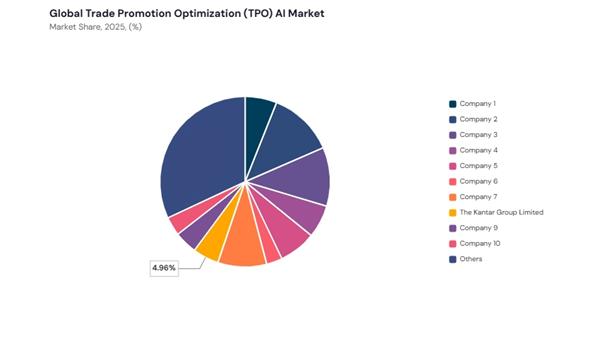
The leading players in the market are competing with diverse innovative offerings to remain competitive in the market. The above illustration shows the percentage of revenue shared by some of the leading companies in the market. The leading players of the market are adopting various strategies in order to cater demand coming from the different industries. The key developmental strategies in the market are Partnerships & Collaborations, Product Innovations, and AI Platform Expansion.

Deployment Outlook

On the basis of deployment, the Trade Promotion Optimization (TPO) AI market is classified into cloud-based and on-premise. The cloud-based segment recorded 63.73% revenue share in the Trade Promotion Optimization (TPO) AI market in 2025. Cloud-based deployment plays a critical role in market expansion owing to its scalability, flexibility, lower infrastructure costs, and ability to support real-time analytics across geographically distributed retail ecosystems. Organizations increasingly prefer cloud-native TPO platforms to improve promotional planning efficiency, automate workflows, and enhance enterprise-wide collaboration.

Component Outlook

Based on component, the Trade Promotion Optimization (TPO) AI market is classified into solutions and services. The solutions segment recorded 60.49% revenue share in the market in 2025. Organizations increasingly deploy AI-powered solutions to automate trade spending analysis, optimize pricing strategies, improve promotional effectiveness, and strengthen predictive demand forecasting capabilities across omnichannel retail environments.

Application Outlook

By application, the Trade Promotion Optimization (TPO) AI market is divided into price & promotion optimization, promotion planning & calendar management, demand forecasting, post-event analysis, and others. The price & promotion optimization segment recorded 32.77% revenue share in the market in 2025. AI-driven pricing optimization platforms are increasingly utilized to improve promotional effectiveness, maximize revenue generation, and optimize consumer engagement strategies through predictive analytics and real-time decision-making capabilities.

Organization Size Outlook

Based on organization size, the Trade Promotion Optimization (TPO) AI market is segmented into large enterprises and SMEs. The large enterprises segment recorded 60.93% revenue share in the market in 2025. Large organizations increasingly deploy AI-powered TPO systems to manage complex promotional operations, optimize global trade spending, and improve real-time forecasting accuracy across extensive retail networks.

Industry Vertical Outlook

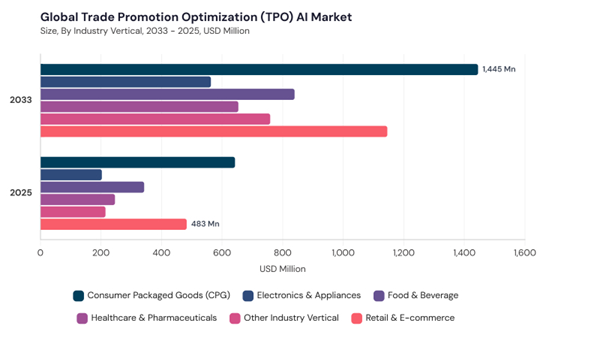
By industry vertical, the Trade Promotion Optimization (TPO) AI market is categorized into consumer packaged goods (CPG), retail & e-commerce, food & beverage, healthcare & pharmaceuticals, electronics & appliances, and others. The consumer packaged goods (CPG) segment recorded 30.13% revenue share in the market in 2025. Increasing competition among consumer goods manufacturers and growing demand for revenue optimization strategies are driving adoption of AI-powered trade promotion optimization platforms across the segment.

Regional Outlook

Region-wise, the Trade Promotion Optimization (TPO) AI Market is analyzed across North America, Europe, Asia Pacific, and LAMEA. The North America segment recorded 41.90% revenue share in the Trade Promotion Optimization (TPO) AI market in 2025. In North America and Europe, organizations are rapidly adopting AI-powered trade promotion optimization platforms to improve pricing intelligence, promotional forecasting, and consumer engagement strategies. Strong digital infrastructure, widespread cloud adoption, and increasing investments in enterprise AI technologies are accelerating regional market growth. Companies across retail and consumer packaged goods sectors increasingly rely on predictive analytics and real-time decision-making tools to optimize trade spending and improve profitability.

In Asia Pacific and LAMEA, the Trade Promotion Optimization (TPO) AI market is witnessing significant growth owing to rapid retail digitalization, expansion of e-commerce ecosystems, and increasing enterprise investments in cloud-based analytics platforms. Organizations across emerging economies are increasingly adopting AI-driven pricing optimization and promotional management solutions to strengthen operational efficiency and improve competitive positioning in rapidly evolving retail markets.
Market Competition and Attributes

The Trade Promotion Optimization (TPO) AI market is highly competitive and characterized by rapid technological innovation and increasing adoption of artificial intelligence, predictive analytics, and cloud-native enterprise platforms. Competition centers on the ability to deliver advanced pricing optimization, demand forecasting, real-time analytics, and promotional effectiveness measurement capabilities. Vendors differentiate themselves through AI-powered automation, integration with ERP and CRM ecosystems, scalability, and omnichannel analytics capabilities. Strategic partnerships with retail enterprises, cloud infrastructure providers, and consumer analytics companies further shape competitive positioning across the market.

Recent Strategies Deployed in the Market

  • Feb-2025: SAP SE expanded its AI-driven revenue growth management portfolio with advanced predictive promotion optimization capabilities designed to improve retail pricing intelligence and promotional forecasting.
  • Sep-2024: Oracle Corporation enhanced its cloud-based retail analytics ecosystem by integrating AI-powered pricing optimization and trade promotion automation functionalities for consumer packaged goods companies.
  • Jun-2024: Accenture Plc. unveiled advanced AI-powered retail analytics services focused on improving trade spending visibility, omnichannel promotional planning, and demand forecasting capabilities.
  • Mar-2024: Wipro Ltd. introduced intelligent AI-based retail optimization solutions to support automated pricing analysis and promotional campaign performance management across digital retail ecosystems.
  • Jan-2024: o9 Solutions, Inc. strengthened its AI-enabled enterprise planning platform by integrating advanced trade promotion forecasting and real-time analytics capabilities for retail and CPG industries.

List of Key Companies Profiled

  • SAP SE
  • Oracle Corporation
  • Accenture Plc.
  • Wipro Ltd.
  • Nielsen Consumer LLC
  • The Kantar Group Limited
  • o9 Solutions, Inc.
  • Anaplan, Inc.
  • Aera Technology, Inc.
  • Innovative Routines International (IRI), Inc.

Market Report Segmentation

By Component
  • Solutions
  • Services
By Deployment
  • Cloud-Based
  • On-Premise
By Application
  • Price & Promotion Optimization
  • Promotion Planning & Calendar Management
  • Demand Forecasting
  • Post-Event Analysis
  • Other Applications
By Organization Size
  • Large Enterprises
  • SMEs
By Industry Vertical
  • Consumer Packaged Goods (CPG)
  • Retail & E-commerce
  • Food & Beverage
  • Healthcare & Pharmaceuticals
  • Electronics & Appliances
  • Other Industry Verticals
By Geography
  • North America
    • US
    • Canada
    • Mexico
    • Rest of North America

  • Europe
    • Germany
    • UK
    • France
    • Russia
    • Spain
    • Italy
    • Rest of Europe

  • Asia Pacific
    • China
    • Japan
    • India
    • South Korea
    • Singapore
    • Malaysia
    • Rest of Asia Pacific

  • LAMEA
    • Brazil
    • Argentina
    • UAE
    • Saudi Arabia
    • South Africa
    • Nigeria
    • Rest of LAMEA

Table of Contents

Chapter 1. Global Market Overview
1.1 COVID-19 Impact
1.2 Market Composition and Scenario
Chapter 2. Key Factors Impacting Market
2.1 Market Drivers
2.2 Market Restraints
2.3 Market Opportunities
2.4 Market Challenges
2.5 Market Trends
2.6 State of Competition
2.7 Market Consolidation
2.8 Key Customer Criteria
Chapter 3. Product Life CycleChapter 4. Value Chain Analysis of Trade Promotion Optimization (TPO) AI MarketChapter 5. Market Share Analysis
Chapter 6. Segmentation By Deployment Mode
6.1 Cloud-Based
6.2 On-Premise
Chapter 7. Segmentation By Component
7.1 Solutions
7.2 Services
Chapter 8. Segmentation By Industry Vertical
8.1 Consumer Packaged Goods (CPG)
8.2 Retail & E-commerce
8.3 Food & Beverage
8.4 Healthcare & Pharmaceuticals
8.5 Electronics & Appliances
8.6 Other Industry Vertical
Chapter 9. Segmentation By Application
9.1 Promotion Planning & Calendar Management
9.2 Demand Forecasting
9.3 Price & Promotion Optimization
9.4 Post-Event Analysis
9.5 Other Application
Chapter 10. Segmentation By Organization Size
10.1 Large Enterprises
10.2 Small & Medium Enterprises (SMEs)
Chapter 11. North America Market
11.1 Market Overview
11.2 Key Factors Impacting Market
11.2.1 Market Drivers
11.2.2 Market Restraints
11.2.3 Market Opportunities
11.2.4 Market Challenges
11.2.5 Market Trends
11.2.6 State of Competition
11.2.7 Market Consolidation
11.2.8 Key Customer Criteria
11.3 Product Life Cycle
11.4 Segmentation By Deployment Mode
11.4.1 Cloud-Based
11.4.2 On-Premise
11.5 Segmentation By Component
11.6 Solutions
11.7 Segmentation By Industry Vertical
11.7.1 Consumer Packaged Goods (CPG)
11.7.2 Retail & E-commerce
11.7.3 Food & Beverage
11.7.4 Healthcare & Pharmaceuticals
11.7.5 Electronics & Appliances
11.7.6 Other Industry Vertical
11.8 Segmentation By Application
11.8.1 Promotion Planning & Calendar Management
11.8.2 Demand Forecasting
11.8.3 Price & Promotion Optimization
11.8.4 Post-Event Analysis
11.8.5 Other Application
11.9 Segmentation By Organization Size
11.9.1 Large Enterprises
11.9.2 Small & Medium Enterprises (SMEs)
11.10 Segmentation By Country
11.10.1 United States
11.10.1.1 Segmentation By Component
11.10.1.1.1 Solutions
11.10.1.1.2 Services
11.10.1.2 Segmentation By Deployment Mode
11.10.1.2.1 Cloud-Based
11.10.1.2.2 On-Premise
11.10.1.3 Segmentation By Organization Size
11.10.1.3.1 Large Enterprises
11.10.1.3.2 Small & Medium Enterprises (SMEs)
11.10.1.4 Segmentation By Application
11.10.1.4.1 Price & Promotion Optimization
11.10.1.4.2 Promotion Planning & Calendar Management
11.10.1.4.3 Demand Forecasting
11.10.1.4.4 Post-Event Analysis
11.10.1.4.5 Other Application
11.10.1.5 Segmentation By Industry Vertical
11.10.1.5.1 Consumer Packaged Goods (CPG)
11.10.1.5.2 Retail & E-commerce
11.10.1.5.3 Food & Beverage
11.10.1.5.4 Healthcare & Pharmaceuticals
11.10.1.5.5 Electronics & Appliances
11.10.1.5.6 Other Industry Vertical
11.10.2 Canada
11.10.2.1 Segmentation By Component
11.10.2.1.1 Solutions
11.10.2.1.2 Services
11.10.2.2 Segmentation By Deployment Mode
11.10.2.2.1 Cloud-Based
11.10.2.2.2 On-Premise
11.10.2.3 Segmentation By Organization Size
11.10.2.3.1 Large Enterprises
11.10.2.3.2 Small & Medium Enterprises (SMEs)
11.10.2.4 Segmentation By Application
11.10.2.4.1 Price & Promotion Optimization
11.10.2.4.2 Promotion Planning & Calendar Management
11.10.2.4.3 Demand Forecasting
11.10.2.4.4 Post-Event Analysis
11.10.2.4.5 Other Application
11.10.2.5 Segmentation By Industry Vertical
11.10.2.5.1 Consumer Packaged Goods (CPG)
11.10.2.5.2 Retail & E-commerce
11.10.2.5.3 Food & Beverage
11.10.2.5.4 Healthcare & Pharmaceuticals
11.10.2.5.5 Electronics & Appliances
11.10.2.5.6 Other Industry Vertical
11.10.3 Mexico
11.10.3.1 Segmentation By Component
11.10.3.1.1 Solutions
11.10.3.1.2 Services
11.10.3.2 Segmentation By Deployment Mode
11.10.3.2.1 Cloud-Based
11.10.3.2.2 On-Premise
11.10.3.3 Segmentation By Organization Size
11.10.3.3.1 Large Enterprises
11.10.3.3.2 Small & Medium Enterprises (SMEs)
11.10.3.4 Segmentation By Application
11.10.3.4.1 Price & Promotion Optimization
11.10.3.4.2 Promotion Planning & Calendar Management
11.10.3.4.3 Demand Forecasting
11.10.3.4.4 Post-Event Analysis
11.10.3.4.5 Other Application
11.10.3.5 Segmentation By Industry Vertical
11.10.3.5.1 Consumer Packaged Goods (CPG)
11.10.3.5.2 Retail & E-commerce
11.10.3.5.3 Food & Beverage
11.10.3.5.4 Healthcare & Pharmaceuticals
11.10.3.5.5 Electronics & Appliances
11.10.3.5.6 Other Industry Vertical
11.10.4 Rest of North America
11.10.4.1 Segmentation By Component
11.10.4.1.1 Solutions
11.10.4.1.2 Services
11.10.4.2 Segmentation By Deployment Mode
11.10.4.2.1 Cloud-Based
11.10.4.2.2 On-Premise
11.10.4.3 Segmentation By Organization Size
11.10.4.3.1 Large Enterprises
11.10.4.3.2 Small & Medium Enterprises (SMEs)
11.10.4.4 Segmentation By Application
11.10.4.4.1 Price & Promotion Optimization
11.10.4.4.2 Promotion Planning & Calendar Management
11.10.4.4.3 Demand Forecasting
11.10.4.4.4 Post-Event Analysis
11.10.4.4.5 Other Application
11.10.4.5 Segmentation By Industry Vertical
11.10.4.5.1 Consumer Packaged Goods (CPG)
11.10.4.5.2 Retail & E-commerce
11.10.4.5.3 Food & Beverage
11.10.4.5.4 Healthcare & Pharmaceuticals
11.10.4.5.5 Electronics & Appliances
11.10.4.5.6 Other Industry Vertical
Chapter 12. Europe Market
12.1 Market Overview
12.2 Key Factors Impacting Market
12.2.1 Market Drivers
12.2.2 Market Restraints
12.2.3 Market Opportunities
12.2.4 Market Challenges
12.2.5 Market Trends
12.2.6 State of Competition
12.2.7 Market Consolidation
12.2.8 Key Customer Criteria
12.3 Product Life Cycle
12.4 Segmentation By Deployment Mode
12.4.1 Cloud-Based
12.4.2 On-Premise
12.5 Segmentation By Component
12.5.1 Solutions
12.5.2 Services
12.6 Segmentation By Industry Vertical
12.6.1 Consumer Packaged Goods (CPG)
12.6.2 Retail & E-commerce
12.6.3 Food & Beverage
12.6.4 Healthcare & Pharmaceuticals
12.6.5 Electronics & Appliances
12.6.6 Other Industry Vertical
12.7 Segmentation By Application
12.7.1 Promotion Planning & Calendar Management
12.7.2 Demand Forecasting
12.7.3 Price & Promotion Optimization
12.7.4 Post-Event Analysis
12.7.5 Other Application
12.8 Segmentation By Organization Size
12.8.1 Large Enterprises
12.8.2 Small & Medium Enterprises (SMEs)
12.9 Segmentation By Country
12.9.1 Germany
12.9.1.1 Segmentation By Component
12.9.1.1.1 Solutions
12.9.1.1.2 Services
12.9.1.2 Segmentation By Deployment Mode
12.9.1.2.1 Cloud-Based
12.9.1.2.2 On-Premise
12.9.1.3 Segmentation By Organization Size
12.9.1.3.1 Large Enterprises
12.9.1.3.2 Small & Medium Enterprises (SMEs)
12.9.1.4 Segmentation By Application
12.9.1.4.1 Price & Promotion Optimization
12.9.1.4.2 Promotion Planning & Calendar Management
12.9.1.4.3 Demand Forecasting
12.9.1.4.4 Post-Event Analysis
12.9.1.4.5 Other Application
12.9.1.5 Segmentation By Industry Vertical
12.9.1.5.1 Consumer Packaged Goods (CPG)
12.9.1.5.2 Retail & E-commerce
12.9.1.5.3 Food & Beverage
12.9.1.5.4 Healthcare & Pharmaceuticals
12.9.1.5.5 Electronics & Appliances
12.9.1.5.6 Other Industry Vertical
12.9.2 United Kingdom
12.9.2.1 Segmentation By Component
12.9.2.1.1 Solutions
12.9.2.1.2 Services
12.9.2.2 Segmentation By Deployment Mode
12.9.2.2.1 Cloud-Based
12.9.2.2.2 On-Premise
12.9.2.3 Segmentation By Organization Size
12.9.2.3.1 Large Enterprises
12.9.2.3.2 Small & Medium Enterprises (SMEs)
12.9.2.4 Segmentation By Application
12.9.2.4.1 Price & Promotion Optimization
12.9.2.4.2 Promotion Planning & Calendar Management
12.9.2.4.3 Demand Forecasting
12.9.2.4.4 Post-Event Analysis
12.9.2.4.5 Other Application
12.9.2.5 Segmentation By Industry Vertical
12.9.2.5.1 Consumer Packaged Goods (CPG)
12.9.2.5.2 Retail & E-commerce
12.9.2.5.3 Food & Beverage
12.9.2.5.4 Healthcare & Pharmaceuticals
12.9.2.5.5 Electronics & Appliances
12.9.2.5.6 Other Industry Vertical
12.9.3 France
12.9.3.1 Segmentation By Component
12.9.3.1.1 Solutions
12.9.3.1.2 Services
12.9.3.2 Segmentation By Deployment Mode
12.9.3.2.1 Cloud-Based
12.9.3.2.2 On-Premise
12.9.3.3 Segmentation By Organization Size
12.9.3.3.1 Large Enterprises
12.9.3.3.2 Small & Medium Enterprises (SMEs)
12.9.3.4 Segmentation By Application
12.9.3.4.1 Price & Promotion Optimization
12.9.3.4.2 Promotion Planning & Calendar Management
12.9.3.4.3 Demand Forecasting
12.9.3.4.4 Post-Event Analysis
12.9.3.4.5 Other Application
12.9.3.5 Segmentation By Industry Vertical
12.9.3.5.1 Consumer Packaged Goods (CPG)
12.9.3.5.2 Retail & E-commerce
12.9.3.5.3 Food & Beverage
12.9.3.5.4 Healthcare & Pharmaceuticals
12.9.3.5.5 Electronics & Appliances
12.9.3.5.6 Other Industry Vertical
12.9.4 Russia
12.9.4.1 Segmentation By Component
12.9.4.1.1 Solutions
12.9.4.1.2 Services
12.9.4.2 Segmentation By Deployment Mode
12.9.4.2.1 Cloud-Based
12.9.4.2.2 On-Premise
12.9.4.3 Segmentation By Organization Size
12.9.4.3.1 Large Enterprises
12.9.4.3.2 Small & Medium Enterprises (SMEs)
12.9.4.4 Segmentation By Application
12.9.4.4.1 Price & Promotion Optimization
12.9.4.4.2 Promotion Planning & Calendar Management
12.9.4.4.3 Demand Forecasting
12.9.4.4.4 Post-Event Analysis
12.9.4.4.5 Other Application
12.9.4.5 Segmentation By Industry Vertical
12.9.4.5.1 Consumer Packaged Goods (CPG)
12.9.4.5.2 Retail & E-commerce
12.9.4.5.3 Food & Beverage
12.9.4.5.4 Healthcare & Pharmaceuticals
12.9.4.5.5 Electronics & Appliances
12.9.4.5.6 Other Industry Vertical
12.9.5 Spain
12.9.5.1 Segmentation By Component
12.9.5.1.1 Solutions
12.9.5.1.2 Services
12.9.5.2 Segmentation By Deployment Mode
12.9.5.2.1 Cloud-Based
12.9.5.2.2 On-Premise
12.9.5.3 Segmentation By Organization Size
12.9.5.3.1 Large Enterprises
12.9.5.3.2 Small & Medium Enterprises (SMEs)
12.9.5.4 Segmentation By Application
12.9.5.4.1 Price & Promotion Optimization
12.9.5.4.2 Promotion Planning & Calendar Management
12.9.5.4.3 Demand Forecasting
12.9.5.4.4 Post-Event Analysis
12.9.5.4.5 Other Application
12.9.5.5 Segmentation By Industry Vertical
12.9.5.5.1 Consumer Packaged Goods (CPG)
12.9.5.5.2 Retail & E-commerce
12.9.5.5.3 Food & Beverage
12.9.5.5.4 Healthcare & Pharmaceuticals
12.9.5.5.5 Electronics & Appliances
12.9.5.5.6 Other Industry Vertical
12.9.6 Italy
12.9.6.1 Segmentation By Component
12.9.6.1.1 Solutions
12.9.6.1.2 Services
12.9.6.2 Segmentation By Deployment Mode
12.9.6.2.1 Cloud-Based
12.9.6.2.2 On-Premise
12.9.6.3 Segmentation By Organization Size
12.9.6.3.1 Large Enterprises
12.9.6.3.2 Small & Medium Enterprises (SMEs)
12.9.6.4 Segmentation By Application
12.9.6.4.1 Price & Promotion Optimization
12.9.6.4.2 Promotion Planning & Calendar Management
12.9.6.4.3 Demand Forecasting
12.9.6.4.4 Post-Event Analysis
12.9.6.4.5 Other Application
12.9.6.5 Segmentation By Industry Vertical
12.9.6.5.1 Consumer Packaged Goods (CPG)
12.9.6.5.2 Retail & E-commerce
12.9.6.5.3 Food & Beverage
12.9.6.5.4 Healthcare & Pharmaceuticals
12.9.6.5.5 Electronics & Appliances
12.9.6.5.6 Other Industry Vertical
12.9.7 Rest of Europe
12.9.7.1 Segmentation By Component
12.9.7.1.1 Solutions
12.9.7.1.2 Services
12.9.7.2 Segmentation By Deployment Mode
12.9.7.2.1 Cloud-Based
12.9.7.2.2 On-Premise
12.9.7.3 Segmentation By Organization Size
12.9.7.3.1 Large Enterprises
12.9.7.3.2 Small & Medium Enterprises (SMEs)
12.9.7.4 Segmentation By Application
12.9.7.4.1 Price & Promotion Optimization
12.9.7.4.2 Promotion Planning & Calendar Management
12.9.7.4.3 Demand Forecasting
12.9.7.4.4 Post-Event Analysis
12.9.7.4.5 Other Application
12.9.7.5 Segmentation By Industry Vertical
12.9.7.5.1 Consumer Packaged Goods (CPG)
12.9.7.5.2 Retail & E-commerce
12.9.7.5.3 Food & Beverage
12.9.7.5.4 Healthcare & Pharmaceuticals
12.9.7.5.5 Electronics & Appliances
12.9.7.5.6 Other Industry Vertical
Chapter 13. Asia Pacific Market
13.1 Market Overview
13.2 Key Factors Impacting Market
13.2.1 Market Drivers
13.2.2 Market Restraints
13.2.3 Market Opportunities
13.2.4 Market Challenges
13.2.5 Market Trends
13.2.6 State of Competition
13.2.7 Market Consolidation
13.2.8 Key Customer Criteria
13.3 Product Life Cycle
13.4 Segmentation By Deployment Mode
13.4.1 Cloud-Based
13.4.2 On-Premise
13.5 Segmentation By Component
13.5.1 Solutions
13.5.2 Services
13.6 Segmentation By Industry Vertical
13.6.1 Consumer Packaged Goods (CPG)
13.6.2 Retail & E-commerce
13.6.3 Food & Beverage
13.6.4 Healthcare & Pharmaceuticals
13.6.5 Electronics & Appliances
13.6.6 Other Industry Vertical
13.7 Segmentation By Application
13.7.1 Promotion Planning & Calendar Management
13.7.2 Demand Forecasting
13.7.3 Price & Promotion Optimization
13.7.4 Post-Event Analysis
13.7.5 Other Application
13.8 Segmentation By Organization Size
13.8.1 Large Enterprises
13.8.2 Small & Medium Enterprises (SMEs)
13.9 Segmentation By Country
13.9.1 China
13.9.1.1 Segmentation By Component
13.9.1.1.1 Solutions
13.9.1.1.2 Services
13.9.1.2 Segmentation By Deployment Mode
13.9.1.2.1 Cloud-Based
13.9.1.2.2 On-Premise
13.9.1.3 Segmentation By Organization Size
13.9.1.3.1 Large Enterprises
13.9.1.3.2 Small & Medium Enterprises (SMEs)
13.9.1.4 Segmentation By Application
13.9.1.4.1 Price & Promotion Optimization
13.9.1.4.2 Promotion Planning & Calendar Management
13.9.1.4.3 Demand Forecasting
13.9.1.4.4 Post-Event Analysis
13.9.1.4.5 Other Application
13.9.1.5 Segmentation By Industry Vertical
13.9.1.5.1 Consumer Packaged Goods (CPG)
13.9.1.5.2 Retail & E-commerce
13.9.1.5.3 Food & Beverage
13.9.1.5.4 Healthcare & Pharmaceuticals
13.9.1.5.5 Electronics & Appliances
13.9.1.5.6 Other Industry Vertical
13.9.2 Japan
13.9.2.1 Segmentation By Component
13.9.2.1.1 Solutions
13.9.2.1.2 Services
13.9.2.2 Segmentation By Deployment Mode
13.9.2.2.1 Cloud-Based
13.9.2.2.2 On-Premise
13.9.2.3 Segmentation By Organization Size
13.9.2.3.1 Large Enterprises
13.9.2.3.2 Small & Medium Enterprises (SMEs)
13.9.2.4 Segmentation By Application
13.9.2.4.1 Price & Promotion Optimization
13.9.2.4.2 Promotion Planning & Calendar Management
13.9.2.4.3 Demand Forecasting
13.9.2.4.4 Post-Event Analysis
13.9.2.4.5 Other Application
13.9.2.5 Segmentation By Industry Vertical
13.9.2.5.1 Consumer Packaged Goods (CPG)
13.9.2.5.2 Retail & E-commerce
13.9.2.5.3 Food & Beverage
13.9.2.5.4 Healthcare & Pharmaceuticals
13.9.2.5.5 Electronics & Appliances
13.9.2.5.6 Other Industry Vertical
13.9.3 India
13.9.3.1 Segmentation By Component
13.9.3.1.1 Solutions
13.9.3.1.2 Services
13.9.3.2 Segmentation By Deployment Mode
13.9.3.2.1 Cloud-Based
13.9.3.2.2 On-Premise
13.9.3.3 Segmentation By Organization Size
13.9.3.3.1 Large Enterprises
13.9.3.3.2 Small & Medium Enterprises (SMEs)
13.9.3.4 Segmentation By Application
13.9.3.4.1 Price & Promotion Optimization
13.9.3.4.2 Promotion Planning & Calendar Management
13.9.3.4.3 Demand Forecasting
13.9.3.4.4 Post-Event Analysis
13.9.3.4.5 Other Application
13.9.3.5 Segmentation By Industry Vertical
13.9.3.5.1 Consumer Packaged Goods (CPG)
13.9.3.5.2 Retail & E-commerce
13.9.3.5.3 Food & Beverage
13.9.3.5.4 Healthcare & Pharmaceuticals
13.9.3.5.5 Electronics & Appliances
13.9.3.5.6 Other Industry Vertical
13.9.4 South Korea
13.9.4.1 Segmentation By Component
13.9.4.1.1 Solutions
13.9.4.1.2 Services
13.9.4.2 Segmentation By Deployment Mode
13.9.4.2.1 Cloud-Based
13.9.4.2.2 On-Premise
13.9.4.3 Segmentation By Organization Size
13.9.4.3.1 Large Enterprises
13.9.4.3.2 Small & Medium Enterprises (SMEs)
13.9.4.4 Segmentation By Application
13.9.4.4.1 Price & Promotion Optimization
13.9.4.4.2 Promotion Planning & Calendar Management
13.9.4.4.3 Demand Forecasting
13.9.4.4.4 Post-Event Analysis
13.9.4.4.5 Other Application
13.9.4.5 Segmentation By Industry Vertical
13.9.4.5.1 Consumer Packaged Goods (CPG)
13.9.4.5.2 Retail & E-commerce
13.9.4.5.3 Food & Beverage
13.9.4.5.4 Healthcare & Pharmaceuticals
13.9.4.5.5 Electronics & Appliances
13.9.4.5.6 Other Industry Vertical
13.9.5 Singapore
13.9.5.1 Segmentation By Component
13.9.5.1.1 Solutions
13.9.5.1.2 Services
13.9.5.2 Segmentation By Deployment Mode
13.9.5.2.1 Cloud-Based
13.9.5.2.2 On-Premise
13.9.5.3 Segmentation By Organization Size
13.9.5.3.1 Large Enterprises
13.9.5.3.2 Small & Medium Enterprises (SMEs)
13.9.5.4 Segmentation By Application
13.9.5.4.1 Price & Promotion Optimization
13.9.5.4.2 Promotion Planning & Calendar Management
13.9.5.4.3 Demand Forecasting
13.9.5.4.4 Post-Event Analysis
13.9.5.4.5 Other Application
13.9.5.5 Segmentation By Industry Vertical
13.9.5.5.1 Consumer Packaged Goods (CPG)
13.9.5.5.2 Retail & E-commerce
13.9.5.5.3 Food & Beverage
13.9.5.5.4 Healthcare & Pharmaceuticals
13.9.5.5.5 Electronics & Appliances
13.9.5.5.6 Other Industry Vertical
13.9.6 Malaysia
13.9.6.1 Segmentation By Component
13.9.6.1.1 Solutions
13.9.6.1.2 Services
13.9.6.2 Segmentation By Deployment Mode
13.9.6.2.1 Cloud-Based
13.9.6.2.2 On-Premise
13.9.6.3 Segmentation By Organization Size
13.9.6.3.1 Large Enterprises
13.9.6.3.2 Small & Medium Enterprises (SMEs)
13.9.6.4 Segmentation By Application
13.9.6.4.1 Price & Promotion Optimization
13.9.6.4.2 Promotion Planning & Calendar Management
13.9.6.4.3 Demand Forecasting
13.9.6.4.4 Post-Event Analysis
13.9.6.4.5 Other Application
13.9.6.5 Segmentation By Industry Vertical
13.9.6.5.1 Consumer Packaged Goods (CPG)
13.9.6.5.2 Retail & E-commerce
13.9.6.5.3 Food & Beverage
13.9.6.5.4 Healthcare & Pharmaceuticals
13.9.6.5.5 Electronics & Appliances
13.9.6.5.6 Other Industry Vertical
13.9.7 Rest of Asia Pacific
13.9.7.1 Segmentation By Component
13.9.7.1.1 Solutions
13.9.7.1.2 Services
13.9.7.2 Segmentation By Deployment Mode
13.9.7.2.1 Cloud-Based
13.9.7.2.2 On-Premise
13.9.7.3 Segmentation By Organization Size
13.9.7.3.1 Large Enterprises
13.9.7.3.2 Small & Medium Enterprises (SMEs)
13.9.7.4 Segmentation By Application
13.9.7.4.1 Price & Promotion Optimization
13.9.7.4.2 Promotion Planning & Calendar Management
13.9.7.4.3 Demand Forecasting
13.9.7.4.4 Post-Event Analysis
13.9.7.4.5 Other Application
13.9.7.5 Segmentation By Industry Vertical
13.9.7.5.1 Consumer Packaged Goods (CPG)
13.9.7.5.2 Retail & E-commerce
13.9.7.5.3 Food & Beverage
13.9.7.5.4 Healthcare & Pharmaceuticals
13.9.7.5.5 Electronics & Appliances
13.9.7.5.6 Other Industry Vertical
Chapter 14. LAMEA Market
14.1 Market Overview
14.2 Key Factors Impacting Market
14.2.1 Market Drivers
14.2.2 Market Restraints
14.2.3 Market Opportunities
14.2.4 Market Challenges
14.2.5 Market Trends
14.2.6 State of Competition
14.2.7 Market Consolidation
14.2.8 Key Customer Criteria
14.3 Product Life Cycle
14.4 Segmentation By Deployment Mode
14.4.1 Cloud-Based
14.4.2 On-Premise
14.5 Segmentation By Component
14.5.1 Solutions
14.5.2 Services
14.6 Segmentation By Industry Vertical
14.6.1 Consumer Packaged Goods (CPG)
14.6.2 Retail & E-commerce
14.6.3 Food & Beverage
14.6.4 Healthcare & Pharmaceuticals
14.6.5 Electronics & Appliances
14.6.6 Other Industry Vertical
14.7 Segmentation By Application
14.7.1 Promotion Planning & Calendar Management
14.7.2 Demand Forecasting
14.7.3 Price & Promotion Optimization
14.7.4 Post-Event Analysis
14.7.5 Other Application
14.8 Segmentation By Organization Size
14.8.1 Large Enterprises
14.8.2 Small & Medium Enterprises (SMEs)
14.8.3 Segmentation By Country
14.8.4 Brazil
14.8.4.1 Segmentation By Component
14.8.4.1.1 Solutions
14.8.4.1.2 Services
14.8.4.2 Segmentation By Deployment Mode
14.8.4.2.1 Cloud-Based
14.8.4.2.2 On-Premise
14.8.4.3 Segmentation By Organization Size
14.8.4.3.1 Large Enterprises
14.8.4.3.2 Small & Medium Enterprises (SMEs)
14.8.4.4 Segmentation By Application
14.8.4.4.1 Price & Promotion Optimization
14.8.4.4.2 Promotion Planning & Calendar Management
14.8.4.4.3 Demand Forecasting
14.8.4.4.4 Post-Event Analysis
14.8.4.4.5 Other Application
14.8.4.5 Segmentation By Industry Vertical
14.8.4.5.1 Consumer Packaged Goods (CPG)
14.8.4.5.2 Retail & E-commerce
14.8.4.5.3 Food & Beverage
14.8.4.5.4 Healthcare & Pharmaceuticals
14.8.4.5.5 Electronics & Appliances
14.8.4.5.6 Other Industry Vertical
14.8.5 Argentina
14.8.5.1 Segmentation By Component
14.8.5.1.1 Solutions
14.8.5.1.2 Services
14.8.5.2 Segmentation By Deployment Mode
14.8.5.2.1 Cloud-Based
14.8.5.2.2 On-Premise
14.8.5.3 Segmentation By Organization Size
14.8.5.3.1 Large Enterprises
14.8.5.3.2 Small & Medium Enterprises (SMEs)
14.8.5.4 Segmentation By Application
14.8.5.4.1 Price & Promotion Optimization
14.8.5.4.2 Promotion Planning & Calendar Management
14.8.5.4.3 Demand Forecasting
14.8.5.4.4 Post-Event Analysis
14.8.5.4.5 Other Application
14.8.5.5 Segmentation By Industry Vertical
14.8.5.5.1 Consumer Packaged Goods (CPG)
14.8.5.5.2 Retail & E-commerce
14.8.5.5.3 Food & Beverage
14.8.5.5.4 Healthcare & Pharmaceuticals
14.8.5.5.5 Electronics & Appliances
14.8.5.5.6 Other Industry Vertical
14.8.6 UAE
14.8.6.1 Segmentation By Component
14.8.6.1.1 Solutions
14.8.6.1.2 Services
14.8.6.2 Segmentation By Deployment Mode
14.8.6.2.1 Cloud-Based
14.8.6.2.2 On-Premise
14.8.6.3 Segmentation By Organization Size
14.8.6.3.1 Large Enterprises
14.8.6.3.2 Small & Medium Enterprises (SMEs)
14.8.6.4 Segmentation By Application
14.8.6.4.1 Price & Promotion Optimization
14.8.6.4.2 Promotion Planning & Calendar Management
14.8.6.4.3 Demand Forecasting
14.8.6.4.4 Post-Event Analysis
14.8.6.4.5 Other Application
14.8.6.5 Segmentation By Industry Vertical
14.8.6.5.1 Consumer Packaged Goods (CPG)
14.8.6.5.2 Retail & E-commerce
14.8.6.5.3 Food & Beverage
14.8.6.5.4 Healthcare & Pharmaceuticals
14.8.6.5.5 Electronics & Appliances
14.8.6.5.6 Other Industry Vertical
14.8.7 Saudi Arabia
14.8.7.1 Segmentation By Component
14.8.7.1.1 Solutions
14.8.7.1.2 Services
14.8.7.2 Segmentation By Deployment Mode
14.8.7.2.1 Cloud-Based
14.8.7.2.2 On-Premise
14.8.7.3 Segmentation By Organization Size
14.8.7.3.1 Large Enterprises
14.8.7.3.2 Small & Medium Enterprises (SMEs)
14.8.7.4 Segmentation By Application
14.8.7.4.1 Price & Promotion Optimization
14.8.7.4.2 Promotion Planning & Calendar Management
14.8.7.4.3 Demand Forecasting
14.8.7.4.4 Post-Event Analysis
14.8.7.4.5 Other Application
14.8.7.5 Segmentation By Industry Vertical
14.8.7.5.1 Consumer Packaged Goods (CPG)
14.8.7.5.2 Retail & E-commerce
14.8.7.5.3 Food & Beverage
14.8.7.5.4 Healthcare & Pharmaceuticals
14.8.7.5.5 Electronics & Appliances
14.8.7.5.6 Other Industry Vertical
14.8.8 South Africa
14.8.8.1 Segmentation By Component
14.8.8.1.1 Solutions
14.8.8.1.2 Services
14.8.8.2 Segmentation By Deployment Mode
14.8.8.2.1 Cloud-Based
14.8.8.2.2 On-Premise
14.8.8.3 Segmentation By Organization Size
14.8.8.3.1 Large Enterprises
14.8.8.3.2 Small & Medium Enterprises (SMEs)
14.8.8.4 Segmentation By Application
14.8.8.4.1 Price & Promotion Optimization
14.8.8.4.2 Promotion Planning & Calendar Management
14.8.8.4.3 Demand Forecasting
14.8.8.4.4 Post-Event Analysis
14.8.8.4.5 Other Application
14.8.8.5 Segmentation By Industry Vertical
14.8.8.5.1 Consumer Packaged Goods (CPG)
14.8.8.5.2 Retail & E-commerce
14.8.8.5.3 Food & Beverage
14.8.8.5.4 Healthcare & Pharmaceuticals
14.8.8.5.5 Electronics & Appliances
14.8.8.5.6 Other Industry Vertical
14.8.9 Nigeria
14.8.9.1 Segmentation By Component
14.8.9.1.1 Solutions
14.8.9.1.2 Services
14.8.9.2 Segmentation By Deployment Mode
14.8.9.2.1 Cloud-Based
14.8.9.2.2 On-Premise
14.8.9.3 Segmentation By Organization Size
14.8.9.3.1 Large Enterprises
14.8.9.3.2 Small & Medium Enterprises (SMEs)
14.8.9.4 Segmentation By Application
14.8.9.4.1 Price & Promotion Optimization
14.8.9.4.2 Promotion Planning & Calendar Management
14.8.9.4.3 Demand Forecasting
14.8.9.4.4 Post-Event Analysis
14.8.9.4.5 Other Application
14.8.9.5 Segmentation By Industry Vertical
14.8.9.5.1 Consumer Packaged Goods (CPG)
14.8.9.5.2 Retail & E-commerce
14.8.9.5.3 Food & Beverage
14.8.9.5.4 Healthcare & Pharmaceuticals
14.8.9.5.5 Electronics & Appliances
14.8.9.5.6 Other Industry Vertical
14.8.10 Rest of LAMEA
14.8.10.1 Segmentation By Component
14.8.10.1.1 Solutions
14.8.10.1.2 Services
14.8.10.2 Segmentation By Deployment Mode
14.8.10.2.1 Cloud-Based
14.8.10.2.2 On-Premise
14.8.10.3 Segmentation By Organization Size
14.8.10.3.1 Large Enterprises
14.8.10.3.2 Small & Medium Enterprises (SMEs)
14.8.10.4 Segmentation By Application
14.8.10.4.1 Price & Promotion Optimization
14.8.10.4.2 Promotion Planning & Calendar Management
14.8.10.4.3 Demand Forecasting
14.8.10.4.4 Post-Event Analysis
14.8.10.4.5 Other Application
14.8.10.5 Segmentation By Industry Vertical
14.8.10.5.1 Consumer Packaged Goods (CPG)
14.8.10.5.2 Retail & E-commerce
14.8.10.5.3 Food & Beverage
14.8.10.5.4 Healthcare & Pharmaceuticals
14.8.10.5.5 Electronics & Appliances
14.8.10.5.6 Other Industry Vertical
Chapter 15. Company Snapshot
15.1 o9 Solutions, Inc.
15.1.1 Business Overview
15.1.2 Key Information
15.1.3 Company Focus on Trade Promotion Optimization (TPO) AI Market
15.1.4 Strategic Insights on Trade Promotion Optimization (TPO) AI Market
15.1.5 Strategy Deployed for Trade Promotion Optimization (TPO) AI Market
15.1.6 Product & Service Portfolio
15.1.7 Key Products / Services (Representative)
15.1.8 Capability Overview
15.1.9 Technology & Innovation Focus
15.1.10 SWOT Analysis (Trade Promotion Optimization (TPO) AI Market)
15.1.11 Customers / End Users
15.1.12 Competitive Positioning
15.1.13 Key Differentiators
15.1.14 Portfolio Matrix
15.1.15 Analyst View
15.1.16 Future Outlook for Trade Promotion Optimization (TPO) AI Market
15.2 Oracle Corporation
15.2.1 Business Overview
15.2.2 Key Information
15.2.3 Company Focus on Trade Promotion Optimization (TPO) AI Market
15.2.4 Strategic Insights on Trade Promotion Optimization (TPO) AI Market
15.2.5 Strategy Deployed for Trade Promotion Optimization (TPO) AI Market
15.2.6 Product & Service Portfolio
15.2.7 Key Products / Services (Representative)
15.2.8 Capability Overview
15.2.9 SWOT Analysis (Trade Promotion Optimization (TPO) AI Market)
15.2.10 Customers / End Users
15.2.11 Competitive Positioning
15.2.12 Key Differentiators
15.2.13 Portfolio Matrix
15.2.14 Analyst View
15.2.15 Future Outlook for Trade Promotion Optimization (TPO) AI Market
15.3 SAP SE
15.3.1 Business Overview
15.3.2 Key Information
15.3.3 Company Focus on Trade Promotion Optimization (TPO) AI Market
15.3.4 Strategic Insights on Trade Promotion Optimization (TPO) AI Market
15.3.5 Strategy Deployed for Trade Promotion Optimization (TPO) AI Market
15.3.6 Product & Service Portfolio
15.3.7 Key Products / Services (Representative)
15.3.8 Capability Overview
15.3.9 Technology & Innovation Focus
15.3.10 SWOT Analysis (Trade Promotion Optimization (TPO) AI Market)
15.3.11 Customers / End Users
15.3.12 Competitive Positioning
15.3.13 Key Differentiators
15.3.14 Portfolio Matrix
15.3.15 Analyst View
15.3.16 Future Outlook for Trade Promotion Optimization (TPO) AI Market
15.4 Anaplan, Inc.
15.4.1 Business Overview
15.4.2 Key Information
15.4.3 Company Focus on Trade Promotion Optimization (TPO) AI Market
15.4.4 Strategic Insights on Trade Promotion Optimization (TPO) AI Market
15.4.5 Strategy Deployed for Trade Promotion Optimization (TPO) AI Market
15.4.6 Product & Service Portfolio
15.4.7 Capability Overview
15.4.8 Technology & Innovation Focus
15.4.9 SWOT Analysis (Trade Promotion Optimization (TPO) AI Market)
15.4.10 Customers / End Users
15.4.11 Competitive Positioning
15.4.12 Key Differentiators
15.4.13 Portfolio Matrix
15.4.14 Analyst View
15.4.15 Future Outlook for Trade Promotion Optimization (TPO) AI Market
15.5 Accenture Plc.
15.5.1 Business Overview
15.5.2 Key Information
15.5.3 Company Focus on Trade Promotion Optimization (TPO) AI Market
15.5.4 Strategic Insights on Trade Promotion Optimization (TPO) AI Market
15.5.5 Strategy Deployed for Trade Promotion Optimization (TPO) AI Market
15.5.6 Product & Service Portfolio
15.5.7 Technology & Innovation Focus
15.5.8 SWOT Analysis (Trade Promotion Optimization (TPO) AI Market)
15.5.9 Customers / End Users
15.5.10 Competitive Positioning
15.5.11 Key Differentiators
15.5.12 Portfolio Matrix
15.5.13 Analyst View
15.5.14 Future Outlook for Trade Promotion Optimization (TPO) AI Market
15.6 Wipro Ltd.
15.6.1 Business Overview
15.6.2 Key Information
15.6.3 Company Focus on Trade Promotion Optimization (TPO) AI Market
15.6.4 Strategic Insights on Trade Promotion Optimization (TPO) AI Market
15.6.5 Strategy Deployed for Trade Promotion Optimization (TPO) AI Market
15.6.6 Product & Service Portfolio
15.6.7 Technology & Innovation Focus
15.6.8 SWOT Analysis (Trade Promotion Optimization (TPO) AI Market)
15.6.9 Customers / End Users
15.6.10 Competitive Positioning
15.6.11 Key Differentiators
15.6.12 Portfolio Matrix
15.6.13 Analyst View
15.6.14 Future Outlook for Trade Promotion Optimization (TPO) AI Market
15.7 Nielsen Consumer LLC
15.7.1 Business Overview
15.7.2 Key Information
15.7.3 Company Focus on Trade Promotion Optimization (TPO) AI Market
15.7.4 Strategic Insights on Trade Promotion Optimization (TPO) AI Market
15.7.5 Strategy Deployed for Trade Promotion Optimization (TPO) AI Market
15.7.6 Product & Service Portfolio
15.7.7 SWOT Analysis (Trade Promotion Optimization (TPO) AI Market)
15.7.8 Customers / End Users
15.7.9 Competitive Positioning
15.7.10 Key Differentiators
15.7.11 Portfolio Matrix
15.7.12 Analyst View
15.7.13 Future Outlook for Trade Promotion Optimization (TPO) AI Market
15.8 The Kantar Group Limited
15.8.1 Business Overview
15.8.2 Key Information
15.8.3 Company Focus on Trade Promotion Optimization (TPO) AI Market
15.8.4 Strategic Insights on Trade Promotion Optimization (TPO) AI Market
15.8.5 Strategy Deployed for Trade Promotion Optimization (TPO) AI Market
15.8.6 Product & Service Portfolio
15.8.7 Technology & Innovation Focus
15.8.8 SWOT Analysis (Trade Promotion Optimization (TPO) AI Market)
15.8.9 Customers / End Users
15.8.10 Competitive Positioning
15.8.11 Key Differentiators
15.8.12 Portfolio Matrix
15.8.13 Analyst View
15.8.14 Future Outlook for Trade Promotion Optimization (TPO) AI Market
15.9 Aera Technology, Inc.
15.9.1 Business Overview
15.9.2 Key Information
15.9.3 Company Focus on Trade Promotion Optimization (TPO) AI Market
15.9.4 Strategic Insights on Trade Promotion Optimization (TPO) AI Market
15.9.5 Strategy Deployed for Trade Promotion Optimization (TPO) AI Market
15.9.6 Product & Service Portfolio
15.9.7 SWOT Analysis (Trade Promotion Optimization (TPO) AI Market)
15.9.8 Customers / End Users
15.9.9 Competitive Positioning
15.9.10 Key Differentiators
15.9.11 Portfolio Matrix
15.9.12 Analyst View
15.9.13 Future Outlook for Trade Promotion Optimization (TPO) AI Market
15.10 Innovative Routines International (IRI), Inc.
15.10.1 Business Overview
15.10.2 Key Information
15.10.3 Company Focus on Trade Promotion Optimization (TPO) AI Market
15.10.4 Strategic Insights on Trade Promotion Optimization (TPO) AI Market
15.10.5 Strategy Deployed for Trade Promotion Optimization (TPO) AI Market
15.10.6 Product & Service Portfolio
15.10.7 SWOT Analysis (Trade Promotion Optimization (TPO) AI Market)
15.10.8 Customers / End Users
15.10.9 Competitive Positioning
15.10.10 Key Differentiators
15.10.11 Portfolio Matrix
15.10.12 Analyst View
15.10.13 Future Outlook for Trade Promotion Optimization (TPO) AI Market
Chapter 16. Winning Imperatives of Trade Promotion Optimization (TPO) AI Market

Companies Mentioned

  • SAP SE
  • Oracle Corporation
  • Accenture Plc.
  • Wipro Ltd.
  • Nielsen Consumer LLC
  • The Kantar Group Limited
  • o9 Solutions, Inc.
  • Anaplan, Inc.
  • Aera Technology, Inc.
  • Innovative Routines International (IRI), Inc.