+353-1-416-8900REST OF WORLD
+44-20-3973-8888REST OF WORLD
1-917-300-0470EAST COAST U.S
1-800-526-8630U.S. (TOLL FREE)

Global Next-generation Sequencing Data Analysis Market Size, Share & Industry Analysis Report by Deployment Mode, Component, Workflow Stage, Technology, End User, Regional Outlook and Forecast, 2026-2033

  • PDF Icon

    Report

  • 726 Pages
  • May 2026
  • Marqual IT Solutions Pvt. Ltd (KBV Research)
  • ID: 6276095
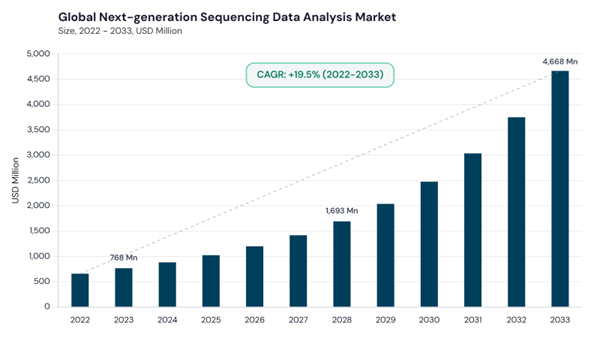
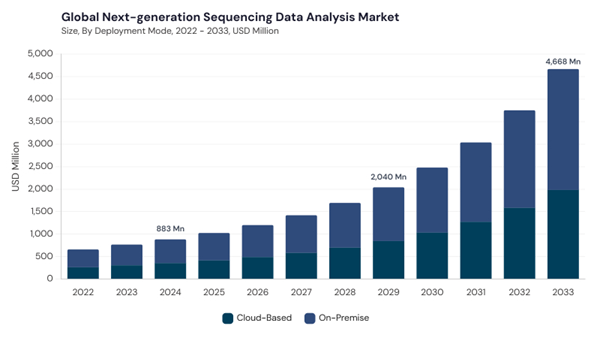
The Global Next-generation Sequencing Data Analysis Market size is expected to reach USD 4.66 billion by 2033, rising at a market growth of 21.4% CAGR during the forecast period.


Growth in the market is driven by increasing adoption of precision medicine, rising genomic research activities, and growing integration of artificial intelligence and cloud computing technologies into sequencing analytics workflows. Expanding applications of next-generation sequencing across oncology, rare disease diagnostics, infectious disease surveillance, and personalized therapeutics are accelerating demand for advanced genomic data interpretation platforms globally. Additionally, declining sequencing costs, rapid advancements in sequencing technologies, and increasing demand for high-throughput genomic analysis are further supporting market expansion.

Key Market Trends & Insights:

  • The North America Next-generation Sequencing Data Analysis market dominated the Global Market in 2025, accounting for a 48.90% revenue share in 2025.
  • The US Next-generation Sequencing Data Analysis market is expected to continue its dominance in North America region thereby reaching a market size of USD 1.73 billion by 2033.
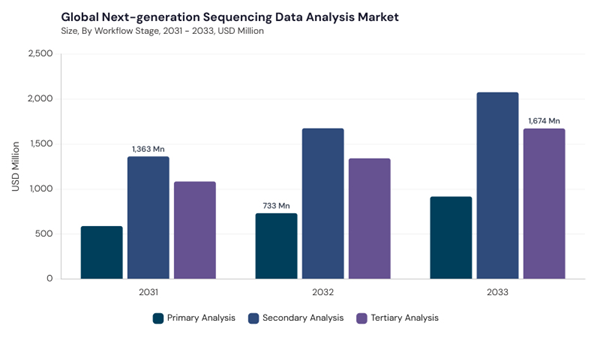
  • Among the various workflow stage segments, Secondary Analysis dominated the global market contributing a revenue share of 45.930% in 2025.
  • In terms of the Deployment Mode segmentation, the On-Premise segment captured a 59.51% revenue share in 2025.
  • Software led the Component segments in 2025, capturing a 57.39% revenue share and is projected to continue its dominance during projected period.
The Global Next-generation Sequencing Data Analysis Market has evolved significantly from conventional bioinformatics interpretation tools into highly sophisticated AI-driven genomic analytics ecosystems. Initially, genomic analysis workflows were largely dependent on manual sequence interpretation, expensive computational infrastructure, and fragmented bioinformatics pipelines, limiting adoption primarily to academic research institutions and specialized laboratories. However, rapid advancements in high-throughput sequencing technologies, automation platforms, and computational analytics have transformed genomic data analysis into a scalable and clinically actionable process. The increasing adoption of precision medicine, oncology profiling, and biomarker discovery applications has accelerated demand for advanced sequencing analytics solutions globally.


Today, artificial intelligence, machine learning, cloud computing, and multi-omics integration technologies are at the core of market expansion. Organizations increasingly deploy AI-powered genomic analytics platforms to automate variant calling, sequence alignment, gene expression analysis, and biomarker identification workflows. In addition, cloud-native infrastructures are improving collaborative research capabilities, data storage scalability, and real-time genomic interpretation efficiency across healthcare institutions, pharmaceutical companies, and research organizations. Increasing integration of sequencing data analysis with clinical diagnostics, drug discovery pipelines, and personalized therapeutics is further strengthening market growth globally.

The major strategies followed by the market participants are Partnerships & Collaborations as the key developmental strategy to keep pace with the changing demands of healthcare and genomic research organizations. For instance, In October, 2024, Illumina, Inc. unveiled the MiSeq i100 Series sequencing systems designed to provide faster and simplified genomic analysis workflows with enhanced operational efficiency. Additionally, In April, 2024, Bio-Rad Laboratories, Inc. collaborated with Oncocyte Corporation to commercialize transplant monitoring solutions utilizing Droplet Digital PCR technology for advanced genomic testing applications.

COVID-19 Impact Analysis

The COVID-19 pandemic negatively impacted the Next-generation Sequencing Data Analysis Market due to disruptions in laboratory operations, sequencing workflows, and genomic research activities across healthcare and academic institutions. Temporary shutdown of laboratories, workforce limitations, and shortages of sequencing reagents and consumables affected operational capacities and delayed ongoing genomic projects globally. In addition, disruptions in global supply chains negatively impacted sequencing platform deployment and bioinformatics infrastructure expansion. However, the pandemic accelerated long-term investments in pathogen genomics, epidemiological surveillance, cloud-based analytics platforms, and real-time genomic interpretation technologies. Increasing demand for SARS-CoV-2 sequencing and variant tracking significantly strengthened adoption of scalable sequencing data analysis infrastructures globally. Thus, the COVID-19 pandemic had a negative impact on the market.

Driving and Restraining Factors

Drivers
  • Decreasing Costs and Enhanced Accessibility of Genome Sequencing Technologies
  • Integration of Artificial Intelligence and Machine Learning in Data Interpretation
  • Expansion of Precision Medicine and Pharmaceutical R&D Applications
  • Increasing Adoption of Multi-Omics Approaches and Complex Data Integration
Restraints
  • High Initial Investment and Operational Costs
  • Complex Data Interpretation and Lack of Standardization
  • Data Privacy Concerns and Regulatory Compliance Challenges
Opportunities
  • Integration of Artificial Intelligence and Machine Learning in NGS Data Analysis
  • Expansion into Clinical and Diagnostic Applications with Regulatory-Grade Analytics
  • Development of Cloud-Based Solutions for Scalable and Collaborative NGS Data Analysis
Challenges
  • Data Integration and Management Complexity
  • High Computational Costs and Infrastructure Limitations
  • Data Privacy, Security, and Regulatory Compliance Concerns

Market Share Analysis


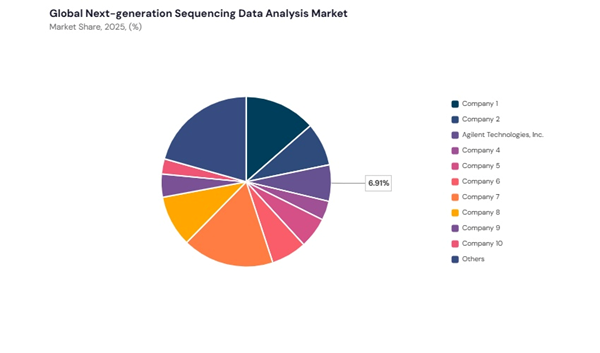
The leading players in the market are competing with diverse innovative offerings to remain competitive in the market. The above illustration shows the percentage of revenue shared by some of the leading companies in the market. The leading players of the market are adopting various strategies in order to cater demand coming from the different industries. The key developmental strategies in the market are Partnerships & Collaborations, Acquisitions, and Product Launches.

Deployment Mode Outlook

On the basis of deployment mode, the Next-generation Sequencing Data Analysis market is classified into On-Premise and Cloud-Based. The On-Premise segment recorded 59.51% revenue share in the market in 2025. Healthcare institutions, pharmaceutical companies, and research organizations increasingly prefer on-premise infrastructures due to enhanced data security, improved regulatory compliance, and greater control over sensitive genomic datasets. The growing importance of genomic privacy and regulatory-grade analytics is further supporting segment growth globally.

Component Outlook

Based on component, the Next-generation Sequencing Data Analysis market is classified into Software and Services. The Software segment recorded 57.39% revenue share in the market in 2025. Increasing deployment of AI-enabled bioinformatics platforms, automated genomic interpretation tools, and cloud-integrated analytics systems is supporting segment expansion across research and clinical environments globally.

Workflow Stage Outlook

By workflow stage, the Next-generation Sequencing Data Analysis market is divided into Primary Analysis, Secondary Analysis, and Tertiary Analysis. The Secondary Analysis segment recorded 45.93% revenue share in the market in 2025. Secondary analysis workflows play a critical role in sequence alignment, assembly, variant calling, and genomic data processing, making them essential across precision medicine and genomic research applications globally.

Technology Outlook

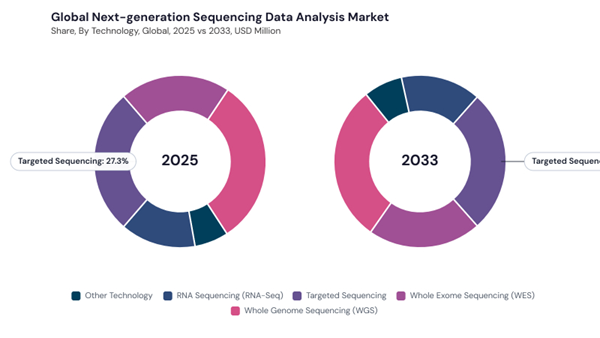
Based on technology, the Next-generation Sequencing Data Analysis market is segmented into Whole Genome Sequencing (WGS), Whole Exome Sequencing (WES), Targeted Sequencing, RNA Sequencing (RNA-Seq), and Others. The Whole Genome Sequencing (WGS) segment recorded 31.41% revenue share in the market in 2025 owing to increasing applications in oncology diagnostics, rare disease detection, and personalized medicine research.

End User Outlook

By end user, the Next-generation Sequencing Data Analysis market is categorized into Academic & Research Institutes, Hospitals & Clinics, Pharmaceutical & Biotechnology Companies, CROs, and Others. The Academic & Research Institutes segment recorded 36.72% revenue share in the market in 2025. Rising genomic research activities, increasing funding for precision medicine initiatives, and growing investments in sequencing infrastructure are accelerating adoption across academic and research institutions globally.

Regional Outlook


Region-wise, the Next-generation Sequencing Data Analysis Market is analyzed across North America, Europe, Asia Pacific, and LAMEA. The North America segment recorded 48.90% revenue share in the market in 2025. In North America and Europe, genomic research organizations, healthcare institutions, and pharmaceutical companies are increasingly deploying AI-driven sequencing analytics platforms to improve precision medicine capabilities, biomarker discovery, and genomic diagnostics. Strong healthcare infrastructure, advanced sequencing ecosystems, and increasing investments in genomics research are supporting regional market growth.

In Asia Pacific and LAMEA, the Next-generation Sequencing Data Analysis market is witnessing strong growth owing to improving healthcare infrastructure, rising biotechnology investments, and increasing adoption of sequencing technologies across emerging economies. Governments and healthcare organizations across these regions are increasingly investing in genomic research initiatives, precision medicine programs, and cloud-based bioinformatics infrastructures to strengthen healthcare outcomes and disease surveillance capabilities.
Market Competition and Attributes

The Next-generation Sequencing Data Analysis market is highly competitive and characterized by rapid technological innovation and increasing integration of artificial intelligence, machine learning, and cloud-native bioinformatics platforms. Competition centers on the ability to deliver scalable genomic analytics, automated variant interpretation, high-throughput sequencing workflows, and secure cloud-based genomic infrastructures. Vendors differentiate themselves through AI-enabled analytics capabilities, workflow automation, multi-omics integration, and advanced computational efficiency. Strategic collaborations between sequencing platform providers, pharmaceutical companies, healthcare institutions, and bioinformatics vendors continue to shape competitive positioning globally.

Recent Strategies Deployed in the Market

  • Oct-2024: Illumina, Inc. unveiled the MiSeq i100 Series sequencing systems designed to simplify genomic workflows and improve sequencing analysis efficiency across research and clinical environments.
  • Apr-2024: Bio-Rad Laboratories, Inc. collaborated with Oncocyte Corporation to commercialize transplant monitoring solutions utilizing Droplet Digital PCR technology for genomic analysis applications.
  • Mar-2024: Revvity, Inc. launched NGS-based newborn screening workflow solutions to support early genetic disorder detection and improve sequencing efficiency.
  • Oct-2023: QIAGEN N.V. partnered with Myriad Genetics to develop companion diagnostic tests using NGS and PCR technologies for precision oncology applications.
  • Oct-2023: Revvity, Inc. collaborated with Element Biosciences, Inc. to launch innovative sequencing workflows designed to simplify genomic analysis and improve operational efficiency.
  • May-2023: Thermo Fisher Scientific, Inc. partnered with Pfizer Inc. to expand access to NGS testing solutions for breast and lung cancer diagnostics globally.
  • Jan-2023: Agilent Technologies, Inc. acquired Avida Biomed to strengthen targeted methylation sequencing and liquid biopsy capabilities.
  • Jun-2020: Illumina, Inc. acquired BlueBee to strengthen cloud-based genomic analysis and sequencing workflow scalability.

List of Key Companies Profiled

  • Illumina, Inc.
  • Thermo Fisher Scientific, Inc.
  • QIAGEN N.V.
  • Agilent Technologies, Inc.
  • Hoffmann-La Roche Ltd.
  • Bio-Rad Laboratories, Inc.
  • Revvity, Inc.
  • Pacific Biosciences of California, Inc.
  • SOPHiA GENETICS
  • DNAnexus, Inc.

Market Report Segmentation

By Component
  • Software
  • Services
By Workflow Stage
  • Primary Analysis
  • Secondary Analysis
  • Tertiary Analysis
By Technology
  • Whole Genome Sequencing (WGS)
  • Whole Exome Sequencing (WES)
  • Targeted Sequencing
  • RNA Sequencing (RNA-Seq)
  • Others
By Deployment Mode
  • On-Premise
  • Cloud-Based
By End User
  • Academic & Research Institutes
  • Hospitals & Clinics
  • Pharmaceutical & Biotechnology Companies
  • CROs
  • Others
By Geography
  • North America
    • US
    • Canada
    • Mexico
    • Rest of North America

  • Europe
    • Germany
    • UK
    • France
    • Russia
    • Spain
    • Italy
    • Rest of Europe

  • Asia Pacific
    • China
    • Japan
    • India
    • South Korea
    • Singapore
    • Malaysia
    • Rest of Asia Pacific

  • LAMEA
    • Brazil
    • Argentina
    • UAE
    • Saudi Arabia
    • South Africa
    • Nigeria
    • Rest of LAMEA

Table of Contents

Chapter 1. Global Market Overview
1.1 COVID-19 Impact
1.2 Market Composition and Scenario
Chapter 2. Key Factors Impacting Market
2.1 Market Drivers
2.2 Market Restraints
2.3 Market Opportunities
2.4 Market Challenges
2.5 Market Trends
2.6 State of Competition
2.7 Market Consolidation
2.8 Key Customer Criteria
Chapter 3. Product Life CycleChapter 4. Value Chain Analysis
Chapter 5. Competition Analysis - Global
5.1 The Cardinal Matrix
5.2 Recent Industry Wide Strategic Developments
5.2.1 Partnerships, Collaborations and Agreements
5.2.2 Product Launches and Product Expansions
5.2.3 Acquisition and Mergers
5.3 Market Share Analysis, 2025
5.4 Top Winning Strategies
5.4.1 Key Leading Strategies: Percentage Distribution (2020-2024)
5.4.2 Key Strategic Move: (Partnerships, Collaborations & Agreements : 2021, Jun - 2024, Apr) Leading Players
Chapter 6. Segmentation By Component
6.1 Software
6.2 Services
Chapter 7. Segmentation By Workflow Stage
7.1 Primary Analysis
7.2 Secondary Analysis
7.3 Tertiary Analysis
Chapter 8. Segmentation By End User
8.1 Academic & Research Institutes
8.2 Hospitals & Clinics
8.3 Pharmaceutical & Biotechnology Companies
8.4 CROs
8.5 Other End User
Chapter 9. Segmentation By Deployment Mode
9.1 On-Premise
9.2 Cloud-Based
Chapter 10. Segmentation By Technology
10.1 Whole Genome Sequencing (WGS)
10.2 Whole Exome Sequencing (WES)
10.3 Targeted Sequencing
10.4 RNA Sequencing (RNA-Seq)
10.5 Other Technology
Chapter 11. North America
11.1 Market Overview
11.2 Key Factors Impacting Market
11.2.1 Market Drivers
11.2.2 Market Restraints
11.2.3 Market Opportunities
11.2.4 Market Challenges
11.2.5 Market Trends
11.2.6 State of Competition
11.2.7 Market Consolidation
11.2.8 Key Customer Criteria
11.3 Product Life Cycle
11.4 Segmentation By Component
11.4.1 Software
11.4.2 Services
11.5 Segmentation By Workflow Stage
11.5.1 Primary Analysis
11.5.2 Secondary Analysis
11.5.3 Tertiary Analysis
11.6 Segmentation By End User
11.6.1 Academic & Research Institutes
11.6.2 Hospitals & Clinics
11.6.3 Pharmaceutical & Biotechnology Companies
11.6.4 CROs
11.6.5 Other End User
11.7 Segmentation By Deployment Mode
11.7.1 On-Premise
11.7.2 Cloud-Based
11.8 Segmentation By Technology
11.8.1 Whole Genome Sequencing (WGS)
11.8.2 Whole Exome Sequencing (WES)
11.8.3 Targeted Sequencing
11.8.4 RNA Sequencing (RNA-Seq)
11.8.5 Other Technology
11.9 Segmentation By Country
11.9.1 United States
11.9.1.1 Segmentation By Component
11.9.1.1.1 Software
11.9.1.1.2 Services
11.9.1.2 Segmentation By Workflow Stage
11.9.1.2.1 Primary Analysis
11.9.1.2.2 Secondary Analysis Tertiary Analysis
11.9.1.3 Segmentation By End User
11.9.1.3.1 Academic & Research Institutes
11.9.1.3.2 Hospitals & Clinics
11.9.1.3.3 Pharmaceutical & Biotechnology Companies
11.9.1.3.4 CROs
11.9.1.3.5 Other End User
11.9.1.4 Segmentation By Deployment Mode
11.9.1.4.1 On-Premise
11.9.1.4.2 Cloud-Based
11.9.1.5 Segmentation By Technology
11.9.1.5.1 Whole Genome Sequencing (WGS)
11.9.1.5.2 Whole Exome Sequencing (WES)
11.9.1.5.3 Targeted Sequencing
11.9.1.5.4 RNA Sequencing (RNA-Seq)
11.9.1.5.5 Other Technology
11.9.2 Canada
11.9.2.1 Segmentation By Component
11.9.2.1.1 Software
11.9.2.1.2 Services
11.9.2.2 Segmentation By Workflow Stage
11.9.2.2.1 Primary Analysis
11.9.2.2.2 Secondary Analysis Tertiary Analysis
11.9.2.3 Segmentation By End User
11.9.2.3.1 Academic & Research Institutes
11.9.2.3.2 Hospitals & Clinics
11.9.2.3.3 Pharmaceutical & Biotechnology Companies
11.9.2.3.4 CROs
11.9.2.3.5 Other End User
11.9.2.4 Segmentation By Deployment Mode
11.9.2.4.1 On-Premise
11.9.2.4.2 Cloud-Based
11.9.2.5 Segmentation By Technology
11.9.2.5.1 Whole Genome Sequencing (WGS)
11.9.2.5.2 Whole Exome Sequencing (WES)
11.9.2.5.3 Targeted Sequencing
11.9.2.5.4 RNA Sequencing (RNA-Seq)
11.9.2.5.5 Other Technology
11.9.3 Mexico
11.9.3.1 Segmentation By Component
11.9.3.1.1 Software
11.9.3.1.2 Services
11.9.3.2 Segmentation By Workflow Stage
11.9.3.2.1 Primary Analysis
11.9.3.2.2 Secondary Analysis Tertiary Analysis
11.9.3.3 Segmentation By End User
11.9.3.3.1 Academic & Research Institutes
11.9.3.3.2 Hospitals & Clinics
11.9.3.3.3 Pharmaceutical & Biotechnology Companies
11.9.3.3.4 CROs
11.9.3.3.5 Other End User
11.9.3.4 Segmentation By Deployment Mode
11.9.3.4.1 On-Premise
11.9.3.4.2 Cloud-Based
11.9.3.5 Segmentation By Technology
11.9.3.5.1 Whole Genome Sequencing (WGS)
11.9.3.5.2 Whole Exome Sequencing (WES)
11.9.3.5.3 Targeted Sequencing
11.9.3.5.4 RNA Sequencing (RNA-Seq)
11.9.3.5.5 Other Technology
11.9.4 Rest of North America
11.9.4.1 Segmentation By Component
11.9.4.1.1 Software
11.9.4.1.2 Services
11.9.4.2 Segmentation By Workflow Stage
11.9.4.2.1 Primary Analysis
11.9.4.2.2 Secondary Analysis Tertiary Analysis
11.9.4.3 Segmentation By End User
11.9.4.3.1 Academic & Research Institutes
11.9.4.3.2 Hospitals & Clinics
11.9.4.3.3 Pharmaceutical & Biotechnology Companies
11.9.4.3.4 CROs
11.9.4.3.5 Other End User
11.9.4.4 Segmentation By Deployment Mode
11.9.4.4.1 On-Premise
11.9.4.4.2 Cloud-Based
11.9.4.5 Segmentation By Technology
11.9.4.5.1 Whole Genome Sequencing (WGS)
11.9.4.5.2 Whole Exome Sequencing (WES)
11.9.4.5.3 Targeted Sequencing
11.9.4.5.4 RNA Sequencing (RNA-Seq)
11.9.4.5.5 Other Technology
Chapter 12. Europe Market
12.1 Market Overview
12.2 Key Factors Impacting Market
12.2.1 Market Drivers
12.2.2 Market Restraints
12.2.3 Market Opportunities
12.2.4 Market Challenges
12.2.5 Market Trends
12.2.6 State of Competition
12.2.7 Market Consolidation
12.2.8 Key Customer Criteria
12.3 Product Life Cycle
12.4 Segmentation By Component
12.4.1 Software
12.4.2 Services
12.5 Segmentation By Workflow Stage
12.5.1 Primary Analysis
12.5.2 Secondary Analysis
12.5.3 Tertiary Analysis
12.6 Segmentation By End User
12.6.1 Academic & Research Institutes
12.6.2 Hospitals & Clinics
12.6.3 Pharmaceutical & Biotechnology Companies
12.6.4 CROs
12.6.5 Other End User
12.7 Segmentation By Deployment Mode
12.7.1 On-Premise
12.7.2 Cloud-Based
12.8 Segmentation By Technology
12.8.1 Whole Genome Sequencing (WGS)
12.8.2 Whole Exome Sequencing (WES)
12.8.3 Targeted Sequencing
12.8.4 RNA Sequencing (RNA-Seq)
12.8.5 Other Technology
12.9 Segmentation By Country
12.9.1 Germany
12.9.1.1 Segmentation By Component
12.9.1.1.1 Software
12.9.1.1.2 Services
12.9.1.2 Segmentation By Workflow Stage
12.9.1.2.1 Primary Analysis
12.9.1.2.2 Secondary Analysis Tertiary Analysis
12.9.1.3 Segmentation By End User
12.9.1.3.1 Academic & Research Institutes
12.9.1.3.2 Hospitals & Clinics
12.9.1.3.3 Pharmaceutical & Biotechnology Companies
12.9.1.3.4 CROs
12.9.1.3.5 Other End User
12.9.1.4 Segmentation By Deployment Mode
12.9.1.4.1 On-Premise
12.9.1.4.2 Cloud-Based
12.9.1.5 Segmentation By Technology
12.9.1.5.1 Whole Genome Sequencing (WGS)
12.9.1.5.2 Whole Exome Sequencing (WES)
12.9.1.5.3 Targeted Sequencing
12.9.1.5.4 RNA Sequencing (RNA-Seq)
12.9.1.5.5 Other Technology
12.9.2 United Kingdom
12.9.2.1 Segmentation By Component
12.9.2.1.1 Software
12.9.2.1.2 Services
12.9.2.2 Segmentation By Workflow Stage
12.9.2.2.1 Primary Analysis
12.9.2.2.2 Secondary Analysis Tertiary Analysis
12.9.2.3 Segmentation By End User
12.9.2.3.1 Academic & Research Institutes
12.9.2.3.2 Hospitals & Clinics
12.9.2.3.3 Pharmaceutical & Biotechnology Companies
12.9.2.3.4 CROs
12.9.2.3.5 Other End User
12.9.2.4 Segmentation By Deployment Mode
12.9.2.4.1 On-Premise
12.9.2.4.2 Cloud-Based
12.9.2.5 Segmentation By Technology
12.9.2.5.1 Whole Genome Sequencing (WGS)
12.9.2.5.2 Whole Exome Sequencing (WES)
12.9.2.5.3 Targeted Sequencing
12.9.2.5.4 RNA Sequencing (RNA-Seq)
12.9.2.5.5 Other Technology
12.9.3 France
12.9.3.1 Segmentation By Component
12.9.3.1.1 Software
12.9.3.1.2 Services
12.9.3.2 Segmentation By Workflow Stage
12.9.3.2.1 Primary Analysis
12.9.3.2.2 Secondary Analysis Tertiary Analysis
12.9.3.3 Segmentation By End User
12.9.3.3.1 Academic & Research Institutes
12.9.3.3.2 Hospitals & Clinics
12.9.3.3.3 Pharmaceutical & Biotechnology Companies
12.9.3.3.4 CROs
12.9.3.3.5 Other End User
12.9.3.4 Segmentation By Deployment Mode
12.9.3.4.1 On-Premise
12.9.3.4.2 Cloud-Based
12.9.3.5 Segmentation By Technology
12.9.3.5.1 Whole Genome Sequencing (WGS)
12.9.3.5.2 Whole Exome Sequencing (WES)
12.9.3.5.3 Targeted Sequencing
12.9.3.5.4 RNA Sequencing (RNA-Seq)
12.9.3.5.5 Other Technology
12.9.4 Russia
12.9.4.1 Segmentation By Component
12.9.4.1.1 Software
12.9.4.1.2 Services
12.9.4.2 Segmentation By Workflow Stage
12.9.4.2.1 Primary Analysis
12.9.4.2.2 Secondary Analysis Tertiary Analysis
12.9.4.3 Segmentation By End User
12.9.4.3.1 Academic & Research Institutes
12.9.4.3.2 Hospitals & Clinics
12.9.4.3.3 Pharmaceutical & Biotechnology Companies
12.9.4.3.4 CROs
12.9.4.3.5 Other End User
12.9.4.4 Segmentation By Deployment Mode
12.9.4.4.1 On-Premise
12.9.4.4.2 Cloud-Based
12.9.4.5 Segmentation By Technology
12.9.4.5.1 Whole Genome Sequencing (WGS)
12.9.4.5.2 Whole Exome Sequencing (WES)
12.9.4.5.3 Targeted Sequencing
12.9.4.5.4 RNA Sequencing (RNA-Seq)
12.9.4.5.5 Other Technology
12.9.5 Spain
12.9.5.1 Segmentation By Component
12.9.5.1.1 Software
12.9.5.1.2 Services
12.9.5.2 Segmentation By Workflow Stage
12.9.5.2.1 Primary Analysis
12.9.5.2.2 Secondary Analysis Tertiary Analysis
12.9.5.3 Segmentation By End User
12.9.5.3.1 Academic & Research Institutes
12.9.5.3.2 Hospitals & Clinics
12.9.5.3.3 Pharmaceutical & Biotechnology Companies
12.9.5.3.4 CROs
12.9.5.3.5 Other End User
12.9.5.4 Segmentation By Deployment Mode
12.9.5.4.1 On-Premise
12.9.5.4.2 Cloud-Based
12.9.5.5 Segmentation By Technology
12.9.5.5.1 Whole Genome Sequencing (WGS)
12.9.5.5.2 Whole Exome Sequencing (WES)
12.9.5.5.3 Targeted Sequencing
12.9.5.5.4 RNA Sequencing (RNA-Seq)
12.9.5.5.5 Other Technology
12.9.6 Italy
12.9.6.1 Segmentation By Component
12.9.6.1.1 Software
12.9.6.1.2 Services
12.9.6.2 Segmentation By Workflow Stage
12.9.6.2.1 Primary Analysis
12.9.6.2.2 Secondary Analysis Tertiary Analysis
12.9.6.3 Segmentation By End User
12.9.6.3.1 Academic & Research Institutes
12.9.6.3.2 Hospitals & Clinics
12.9.6.3.3 Pharmaceutical & Biotechnology Companies
12.9.6.3.4 CROs
12.9.6.3.5 Other End User
12.9.6.4 Segmentation By Deployment Mode
12.9.6.4.1 On-Premise
12.9.6.4.2 Cloud-Based
12.9.6.5 Segmentation By Technology
12.9.6.5.1 Whole Genome Sequencing (WGS)
12.9.6.5.2 Whole Exome Sequencing (WES)
12.9.6.5.3 Targeted Sequencing
12.9.6.5.4 RNA Sequencing (RNA-Seq)
12.9.6.5.5 Other Technology
12.9.7 Rest of Europe
12.9.7.1 Segmentation By Component
12.9.7.1.1 Software
12.9.7.1.2 Services
12.9.7.2 Segmentation By Workflow Stage
12.9.7.2.1 Primary Analysis
12.9.7.2.2 Secondary Analysis Tertiary Analysis
12.9.7.3 Segmentation By End User
12.9.7.3.1 Academic & Research Institutes
12.9.7.3.2 Hospitals & Clinics
12.9.7.3.3 Pharmaceutical & Biotechnology Companies
12.9.7.3.4 CROs
12.9.7.3.5 Other End User
12.9.7.4 Segmentation By Deployment Mode
12.9.7.4.1 On-Premise
12.9.7.4.2 Cloud-Based
12.9.7.5 Segmentation By Technology
12.9.7.5.1 Whole Genome Sequencing (WGS)
12.9.7.5.2 Whole Exome Sequencing (WES)
12.9.7.5.3 Targeted Sequencing
12.9.7.5.4 RNA Sequencing (RNA-Seq)
12.9.7.5.5 Other Technology
Chapter 13. Asia Pacific
13.1 Market Overview
13.2 Key Factors Impacting Market
13.2.1 Market Drivers
13.2.2 Market Restraints
13.2.3 Market Opportunities
13.2.4 Market Challenges
13.2.5 Market Trends
13.2.6 State of Competition
13.2.7 Market Consolidation
13.2.8 Key Customer Criteria
13.3 Product Life Cycle
13.4 Segmentation By Component
13.4.1 Software
13.4.2 Services
13.5 Segmentation By Workflow Stage
13.5.1 Primary Analysis
13.5.2 Secondary Analysis
13.5.3 Tertiary Analysis
13.6 Segmentation By End User
13.6.1 Academic & Research Institutes
13.6.2 Hospitals & Clinics
13.6.3 Pharmaceutical & Biotechnology Companies
13.6.4 CROs
13.6.5 Other End User
13.7 Segmentation By Deployment Mode
13.7.1 On-Premise
13.7.2 Cloud-Based
13.8 Segmentation By Technology
13.8.1 Whole Genome Sequencing (WGS)
13.8.2 Whole Exome Sequencing (WES)
13.8.3 Targeted Sequencing
13.8.4 RNA Sequencing (RNA-Seq)
13.8.5 Other Technology
13.9 Segmentation By Country
13.9.1 China
13.9.1.1 Segmentation By Component
13.9.1.1.1 Software
13.9.1.1.2 Services
13.9.1.2 Segmentation By Workflow Stage
13.9.1.2.1 Primary Analysis
13.9.1.2.2 Secondary Analysis Tertiary Analysis
13.9.1.3 Segmentation By End User
13.9.1.3.1 Academic & Research Institutes
13.9.1.3.2 Hospitals & Clinics
13.9.1.3.3 Pharmaceutical & Biotechnology Companies
13.9.1.3.4 CROs
13.9.1.3.5 Other End User
13.9.1.4 Segmentation By Deployment Mode
13.9.1.4.1 On-Premise
13.9.1.4.2 Cloud-Based
13.9.1.5 Segmentation By Technology
13.9.1.5.1 Whole Genome Sequencing (WGS)
13.9.1.5.2 Whole Exome Sequencing (WES)
13.9.1.5.3 Targeted Sequencing
13.9.1.5.4 RNA Sequencing (RNA-Seq)
13.9.1.5.5 Other Technology
13.9.2 Japan
13.9.2.1 Segmentation By Component
13.9.2.1.1 Software
13.9.2.1.2 Services
13.9.2.2 Segmentation By Workflow Stage
13.9.2.2.1 Primary Analysis
13.9.2.2.2 Secondary Analysis Tertiary Analysis
13.9.2.3 Segmentation By End User
13.9.2.3.1 Academic & Research Institutes
13.9.2.3.2 Hospitals & Clinics
13.9.2.3.3 Pharmaceutical & Biotechnology Companies
13.9.2.3.4 CROs
13.9.2.3.5 Other End User
13.9.2.4 Segmentation By Deployment Mode
13.9.2.4.1 On-Premise
13.9.2.4.2 Cloud-Based
13.9.2.5 Segmentation By Technology
13.9.2.5.1 Whole Genome Sequencing (WGS)
13.9.2.5.2 Whole Exome Sequencing (WES)
13.9.2.5.3 Targeted Sequencing
13.9.2.5.4 RNA Sequencing (RNA-Seq)
13.9.2.5.5 Other Technology
13.9.3 India
13.9.3.1 Segmentation By Component
13.9.3.1.1 Software
13.9.3.1.2 Services
13.9.3.2 Segmentation By Workflow Stage
13.9.3.2.1 Primary Analysis
13.9.3.2.2 Secondary Analysis Tertiary Analysis
13.9.3.3 Segmentation By End User
13.9.3.3.1 Academic & Research Institutes
13.9.3.3.2 Hospitals & Clinics
13.9.3.3.3 Pharmaceutical & Biotechnology Companies
13.9.3.3.4 CROs
13.9.3.3.5 Other End User
13.9.3.4 Segmentation By Deployment Mode
13.9.3.4.1 On-Premise
13.9.3.4.2 Cloud-Based
13.9.3.5 Segmentation By Technology
13.9.3.5.1 Whole Genome Sequencing (WGS)
13.9.3.5.2 Whole Exome Sequencing (WES)
13.9.3.5.3 Targeted Sequencing
13.9.3.5.4 RNA Sequencing (RNA-Seq)
13.9.3.5.5 Other Technology
13.9.4 South Korea
13.9.4.1 Segmentation By Component
13.9.4.1.1 Software
13.9.4.1.2 Services
13.9.4.2 Segmentation By Workflow Stage
13.9.4.2.1 Primary Analysis
13.9.4.2.2 Secondary Analysis Tertiary Analysis
13.9.4.3 Segmentation By End User
13.9.4.3.1 Academic & Research Institutes
13.9.4.3.2 Hospitals & Clinics
13.9.4.3.3 Pharmaceutical & Biotechnology Companies
13.9.4.3.4 CROs
13.9.4.3.5 Other End User
13.9.4.4 Segmentation By Deployment Mode
13.9.4.4.1 On-Premise
13.9.4.4.2 Cloud-Based
13.9.4.5 Segmentation By Technology
13.9.4.5.1 Whole Genome Sequencing (WGS)
13.9.4.5.2 Whole Exome Sequencing (WES)
13.9.4.5.3 Targeted Sequencing
13.9.4.5.4 RNA Sequencing (RNA-Seq)
13.9.4.5.5 Other Technology
13.9.5 Singapore
13.9.5.1 Segmentation By Component
13.9.5.1.1 Software
13.9.5.1.2 Services
13.9.5.2 Segmentation By Workflow Stage
13.9.5.2.1 Primary Analysis
13.9.5.2.2 Secondary Analysis Tertiary Analysis
13.9.5.3 Segmentation By End User
13.9.5.3.1 Academic & Research Institutes
13.9.5.3.2 Hospitals & Clinics
13.9.5.3.3 Pharmaceutical & Biotechnology Companies
13.9.5.3.4 CROs
13.9.5.3.5 Other End User
13.9.5.4 Segmentation By Deployment Mode
13.9.5.4.1 On-Premise
13.9.5.4.2 Cloud-Based
13.9.5.5 Segmentation By Technology
13.9.5.5.1 Whole Genome Sequencing (WGS)
13.9.5.5.2 Whole Exome Sequencing (WES)
13.9.5.5.3 Targeted Sequencing
13.9.5.5.4 RNA Sequencing (RNA-Seq)
13.9.5.5.5 Other Technology
13.9.6 Malaysia
13.9.6.1 Segmentation By Component
13.9.6.1.1 Software
13.9.6.1.2 Services
13.9.6.2 Segmentation By Workflow Stage
13.9.6.2.1 Primary Analysis
13.9.6.2.2 Secondary Analysis Tertiary Analysis
13.9.6.3 Segmentation By End User
13.9.6.3.1 Academic & Research Institutes
13.9.6.3.2 Hospitals & Clinics
13.9.6.3.3 Pharmaceutical & Biotechnology Companies
13.9.6.3.4 CROs
13.9.6.3.5 Other End User
13.9.6.4 Segmentation By Deployment Mode
13.9.6.4.1 On-Premise
13.9.6.4.2 Cloud-Based
13.9.6.5 Segmentation By Technology
13.9.6.5.1 Whole Genome Sequencing (WGS)
13.9.6.5.2 Whole Exome Sequencing (WES)
13.9.6.5.3 Targeted Sequencing
13.9.6.5.4 RNA Sequencing (RNA-Seq)
13.9.6.5.5 Other Technology
13.9.7 Rest of Asia Pacific
13.9.7.1 Segmentation By Component
13.9.7.1.1 Software
13.9.7.1.2 Services
13.9.7.2 Segmentation By Workflow Stage
13.9.7.2.1 Primary Analysis
13.9.7.2.2 Secondary Analysis Tertiary Analysis
13.9.7.3 Segmentation By End User
13.9.7.3.1 Academic & Research Institutes
13.9.7.3.2 Hospitals & Clinics
13.9.7.3.3 Pharmaceutical & Biotechnology Companies
13.9.7.3.4 CROs
13.9.7.3.5 Other End User
13.9.7.4 Segmentation By Deployment Mode
13.9.7.4.1 On-Premise
13.9.7.4.2 Cloud-Based
13.9.7.5 Segmentation By Technology
13.9.7.5.1 Whole Genome Sequencing (WGS)
13.9.7.5.2 Whole Exome Sequencing (WES)
13.9.7.5.3 Targeted Sequencing
13.9.7.5.4 RNA Sequencing (RNA-Seq)
13.9.7.5.5 Other Technology
Chapter 14. LAMEA Market
14.1 Market Overview
14.2 Key Factors Impacting Market
14.2.1 Market Drivers
14.2.2 Market Restraints
14.2.3 Market Opportunities
14.2.4 Market Challenges
14.2.5 Market Trends
14.2.5.1.1 Example
14.2.5.2 3. Expansion Of Cloud-Based And AI-Driven Analytical Platforms Enabling Scalability And Accessibility
14.2.6 State of Competition
14.2.7 Market Consolidation
14.2.8 Key Customer Criteria
14.3 Product Life Cycle
14.4 Segmentation By Component
14.4.1 Software
14.4.2 Services
14.5 Segmentation By Workflow Stage
14.5.1 Primary Analysis
14.5.2 Secondary Analysis
14.5.3 Tertiary Analysis
14.6 Segmentation By End User
14.6.1 Academic & Research Institutes
14.6.2 Hospitals & Clinics
14.6.3 Pharmaceutical & Biotechnology Companies
14.6.4 CROs
14.6.5 Other End User
14.7 Segmentation By Deployment Mode
14.7.1 On-Premise
14.7.2 Cloud-Based
14.8 Segmentation By Technology
14.8.1 Whole Genome Sequencing (WGS)
14.8.2 Whole Exome Sequencing (WES)
14.8.3 Targeted Sequencing
14.8.4 RNA Sequencing (RNA-Seq)
14.8.5 Other Technology
14.9 Segmentation By Country
14.9.1 Brazil
14.9.1.1 Segmentation By Component
14.9.1.1.1 Software
14.9.1.1.2 Services
14.9.1.2 Segmentation By Workflow Stage
14.9.1.2.1 Primary Analysis
14.9.1.2.2 Secondary Analysis Tertiary Analysis
14.9.1.3 Segmentation By End User
14.9.1.3.1 Academic & Research Institutes
14.9.1.3.2 Hospitals & Clinics
14.9.1.3.3 Pharmaceutical & Biotechnology Companies
14.9.1.3.4 CROs
14.9.1.3.5 Other End User
14.9.1.4 Segmentation By Deployment Mode
14.9.1.4.1 On-Premise
14.9.1.4.2 Cloud-Based
14.9.1.5 Segmentation By Technology
14.9.1.5.1 Whole Genome Sequencing (WGS)
14.9.1.5.2 Whole Exome Sequencing (WES)
14.9.1.5.3 Targeted Sequencing
14.9.1.5.4 RNA Sequencing (RNA-Seq)
14.9.1.5.5 Other Technology
14.9.2 Argentina
14.9.2.1 Segmentation By Component
14.9.2.1.1 Software
14.9.2.1.2 Services
14.9.2.2 Segmentation By Workflow Stage
14.9.2.2.1 Primary Analysis
14.9.2.2.2 Secondary Analysis Tertiary Analysis
14.9.2.3 Segmentation By End User
14.9.2.3.1 Academic & Research Institutes
14.9.2.3.2 Hospitals & Clinics
14.9.2.3.3 Pharmaceutical & Biotechnology Companies
14.9.2.3.4 CROs
14.9.2.3.5 Other End User
14.9.2.4 Segmentation By Deployment Mode
14.9.2.4.1 On-Premise
14.9.2.4.2 Cloud-Based
14.9.2.5 Segmentation By Technology
14.9.2.5.1 Whole Genome Sequencing (WGS)
14.9.2.5.2 Whole Exome Sequencing (WES)
14.9.2.5.3 Targeted Sequencing
14.9.2.5.4 RNA Sequencing (RNA-Seq)
14.9.2.5.5 Other Technology
14.9.3 UAE
14.9.3.1 Segmentation By Component
14.9.3.1.1 Software
14.9.3.1.2 Services
14.9.3.2 Segmentation By Workflow Stage
14.9.3.2.1 Primary Analysis
14.9.3.2.2 Secondary Analysis Tertiary Analysis
14.9.3.3 Segmentation By End User
14.9.3.3.1 Academic & Research Institutes
14.9.3.3.2 Hospitals & Clinics
14.9.3.3.3 Pharmaceutical & Biotechnology Companies
14.9.3.3.4 CROs
14.9.3.3.5 Other End User
14.9.3.4 Segmentation By Deployment Mode
14.9.3.4.1 On-Premise
14.9.3.4.2 Cloud-Based
14.9.3.5 Segmentation By Technology
14.9.3.5.1 Whole Genome Sequencing (WGS)
14.9.3.5.2 Whole Exome Sequencing (WES)
14.9.3.5.3 Targeted Sequencing
14.9.3.5.4 RNA Sequencing (RNA-Seq)
14.9.3.5.5 Other Technology
14.9.4 Saudi Arabia
14.9.4.1 Segmentation By Component
14.9.4.1.1 Software
14.9.4.1.2 Services
14.9.4.2 Segmentation By Workflow Stage
14.9.4.2.1 Primary Analysis
14.9.4.2.2 Secondary Analysis Tertiary Analysis
14.9.4.3 Segmentation By End User
14.9.4.3.1 Academic & Research Institutes
14.9.4.3.2 Hospitals & Clinics
14.9.4.3.3 Pharmaceutical & Biotechnology Companies
14.9.4.3.4 CROs
14.9.4.3.5 Other End User
14.9.4.4 Segmentation By Deployment Mode
14.9.4.4.1 On-Premise
14.9.4.4.2 Cloud-Based
14.9.4.5 Segmentation By Technology
14.9.4.5.1 Whole Genome Sequencing (WGS)
14.9.4.5.2 Whole Exome Sequencing (WES)
14.9.4.5.3 Targeted Sequencing
14.9.4.5.4 RNA Sequencing (RNA-Seq)
14.9.4.5.5 Other Technology
14.9.5 South Africa
14.9.5.1 Segmentation By Component
14.9.5.1.1 Software
14.9.5.1.2 Services
14.9.5.2 Segmentation By Workflow Stage
14.9.5.2.1 Primary Analysis
14.9.5.2.2 Secondary Analysis Tertiary Analysis
14.9.5.3 Segmentation By End User
14.9.5.3.1 Academic & Research Institutes
14.9.5.3.2 Hospitals & Clinics
14.9.5.3.3 Pharmaceutical & Biotechnology Companies
14.9.5.3.4 CROs
14.9.5.3.5 Other End User
14.9.5.4 Segmentation By Deployment Mode
14.9.5.4.1 On-Premise
14.9.5.4.2 Cloud-Based
14.9.5.5 Segmentation By Technology
14.9.5.5.1 Whole Genome Sequencing (WGS)
14.9.5.5.2 Whole Exome Sequencing (WES)
14.9.5.5.3 Targeted Sequencing
14.9.5.5.4 RNA Sequencing (RNA-Seq)
14.9.5.5.5 Other Technology
14.9.6 Nigeria
14.9.6.1 Segmentation By Component
14.9.6.1.1 Software
14.9.6.1.2 Services
14.9.6.2 Segmentation By Workflow Stage
14.9.6.2.1 Primary Analysis
14.9.6.2.2 Secondary Analysis Tertiary Analysis
14.9.6.3 Segmentation By End User
14.9.6.3.1 Academic & Research Institutes
14.9.6.3.2 Hospitals & Clinics
14.9.6.3.3 Pharmaceutical & Biotechnology Companies
14.9.6.3.4 CROs
14.9.6.3.5 Other End User
14.9.6.4 Segmentation By Deployment Mode
14.9.6.4.1 On-Premise
14.9.6.4.2 Cloud-Based
14.9.6.5 Segmentation By Technology
14.9.6.5.1 Whole Genome Sequencing (WGS)
14.9.6.5.2 Whole Exome Sequencing (WES)
14.9.6.5.3 Targeted Sequencing
14.9.6.5.4 RNA Sequencing (RNA-Seq)
14.9.6.5.5 Other Technology
14.9.7 Rest of LAMEA
14.9.7.1 Segmentation By Component
14.9.7.1.1 Software
14.9.7.1.2 Services
14.9.7.2 Segmentation By Workflow Stage
14.9.7.2.1 Primary Analysis
14.9.7.2.2 Secondary Analysis Tertiary Analysis
14.9.7.3 Segmentation By End User
14.9.7.3.1 Academic & Research Institutes
14.9.7.3.2 Hospitals & Clinics
14.9.7.3.3 Pharmaceutical & Biotechnology Companies
14.9.7.3.4 CROs
14.9.7.3.5 Other End User
14.9.7.4 Segmentation By Deployment Mode
14.9.7.4.1 On-Premise
14.9.7.4.2 Cloud-Based
14.9.7.5 Segmentation By Technology
14.9.7.5.1 Whole Genome Sequencing (WGS)
14.9.7.5.2 Whole Exome Sequencing (WES)
14.9.7.5.3 Targeted Sequencing
14.9.7.5.4 RNA Sequencing (RNA-Seq)
14.9.7.5.5 Other Technology
Chapter 15. Company Profiles
15.1 ABB Ltd.
15.1.1 Company Overview
15.1.2 Recent Strategies and Developments
15.1.2.1 Product Launches and Product Expansions
15.1.3 Company Focus
15.1.15 Strategic Insights
15.1.5 Strategy Deployed
15.1.6 SWOT Analysis
15.1.7 Future Outlook
15.2 Schneider Electric SE
15.2.1 Company Overview
15.2.2 Financial Analysis
15.2.3 Segmental and Regional Analysis
15.2.15 Research & Development Expense
15.2.5 Recent Strategies and Developments
15.2.5.1 Product Launches and Product Expansions
15.2.5.2 Geographical Expansions
15.2.6 Company Focus
15.2.7 Strategic Insights
15.2.8 Strategy Deployed
15.2.9 SWOT Analysis
15.2.10 Future Outlook
15.3 Siemens AG
15.3.1 Company Overview
15.3.2 Financial Analysis
15.3.3 Segmental and Regional Analysis
15.3.15 Research & Development Expense
15.3.5 Recent Strategies and Developments
15.3.5.1 Partnerships, Collaborations, and Agreements
15.3.6 Company Focus
15.3.7 Strategic Insights
15.3.8 Strategy Deployed
15.3.9 SWOT Analysis
15.3.10 Future Outlook
15.15 Eaton Corporation PLC
15.15.1 Company Overview
15.15.2 Financial Analysis
15.15.3 Segmental and Regional Analysis
15.15.15 Research & Development Expense
15.15.5 Company Focus
15.15.6 Strategic Insights
15.15.7 Strategy Deployed
15.15.8 SWOT Analysis
15.15.9 Future Outlook
15.5 Mitsubishi Electric Corporation
15.5.1 Company Overview
15.5.2 Financial Analysis
15.5.3 Segmental and Regional Analysis
15.5.15 Research & Development Expense
15.5.5 Recent Strategies and Developments
15.5.5.1 Partnerships, Collaborations, and Agreements
15.5.5.2 Product Launches and Product Expansions
15.5.6 Company Focus
15.5.7 Strategic Insights
15.5.8 Strategy Deployed
15.5.9 SWOT Analysis
15.5.10 Future Outlook
15.6 Legrand S.A. (Legrand Group)
15.6.1 Company Overview
15.6.2 Financial Analysis
15.6.3 Regional Analysis
15.6.15 Research & Development Expense
15.6.5 Recent Strategies and Developments
15.6.5.1 Product Launches and Product Expansions
15.6.6 Company Focus
15.6.7 Strategic Insights
15.6.8 Strategy Deployed
15.6.9 SWOT Analysis
15.6.10 Future Outlook
15.7 General Electric Company
15.7.1 Company Overview
15.7.2 Company Focus
15.7.3 Strategic Insights
15.7.15 Strategy Deployed
15.7.5 SWOT Analysis
15.7.6 Future Outlook
15.8 Hager Group
15.8.1 Company Overview
15.8.2 Company Focus
15.8.3 Strategic Insights
15.8.15 Strategy Deployed
15.8.5 SWOT Analysis
15.8.6 Future Outlook
15.9 Fuji Electric Co. Ltd.
15.9.1 Company Overview
15.9.2 Financial Analysis
15.9.3 Segmental and Regional Analysis
15.9.15 Research & Development Expense
15.9.5 Company Focus
15.9.6 Strategic Insights
15.9.7 Strategy Deployed
15.9.8 SWOT Analysis
15.9.9 Future Outlook
15.1 CHINT Group Co., Ltd.
15.10.1 Company Overview
15.10.2 Recent Strategies and Developments
15.10.2.1 Partnerships, Collaborations, and Agreements
15.10.2.2 Geographical Expansions
15.10.3 Company Focus
15.10.15 Strategic Insights
15.10.5 Strategy Deployed
15.10.6 SWOT Analysis
15.10.7 Future Outlook
Chapter 16. Winning Imperatives

Companies Mentioned

  • Illumina, Inc.
  • Thermo Fisher Scientific, Inc.
  • F. Hoffmann-La Roche Ltd.
  • QIAGEN N.V.
  • Agilent Technologies, Inc.
  • Bio-Rad Laboratories, Inc.
  • Revvity, Inc.
  • Pacific Biosciences of California, Inc.
  • Eurofins Genomics
  • SOPHiA GENETICS