



The Asia Pacific Facility Management Market is predicted to reach USD 571.9 million by 2031, growing at a CAGR of 8.8% during 2026-2033.
The Asia Pacific Facility Management Market has experienced significant growth due to rapid urbanization, expanding commercial infrastructure, and increasing investments in smart building technologies across emerging and developed economies. Organizations throughout the region are increasingly adopting integrated facility management solutions to improve operational efficiency, optimize energy consumption, and enhance workplace productivity.
Countries such as China, Japan, India, and South Korea are witnessing strong demand for digital facility management systems driven by the expansion of commercial real estate, industrial facilities, healthcare institutions, and smart city initiatives. The growing adoption of IoT-enabled building automation systems, predictive maintenance technologies, and cloud-based facility management platforms is further accelerating market development across the region.
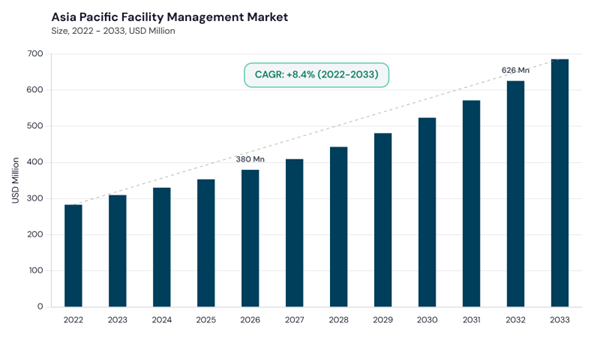
The Asia Pacific Facility Management Market has experienced significant growth due to rapid urbanization, expanding commercial infrastructure, and increasing investments in smart building technologies across emerging and developed economies. Organizations throughout the region are increasingly adopting integrated facility management solutions to improve operational efficiency, optimize energy consumption, and enhance workplace productivity.
Countries such as China, Japan, India, and South Korea are witnessing strong demand for digital facility management systems driven by the expansion of commercial real estate, industrial facilities, healthcare institutions, and smart city initiatives. The growing adoption of IoT-enabled building automation systems, predictive maintenance technologies, and cloud-based facility management platforms is further accelerating market development across the region.
Offering Outlook
Based on Offering, the market is segmented into Outsourced and In-House. The Outsourced segment acquired the largest revenue share in the Asia Pacific Facility Management Market in 2025 and is expected to continue to be a dominant segment till 2031; thereby, achieving a market value of USD 316.6 million by 2031. The In-House segment is expected to witness a CAGR of 9.9% during 2026-2033.Outsourced Outlook
Based on Outsourced, the market is segmented into Bundled and Single. The Bundled segment acquired the largest revenue share in the Asia Pacific Facility Management Market in 2025 and is expected to continue to be a dominant segment till 2031; thereby, achieving a market value of USD 190.0 million by 2031. The Single segment is expected to witness a CAGR of 8.2% during 2026-2033.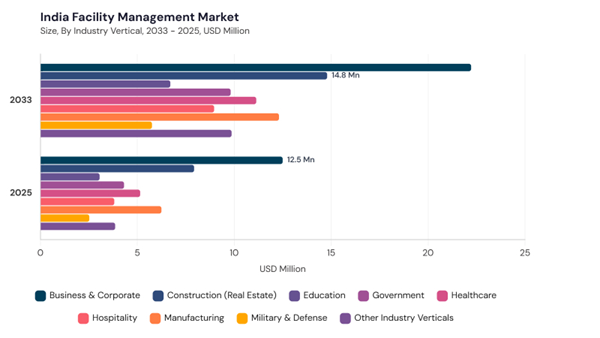
Service Type Outlook
Based on Service Type, the market is segmented into Soft Services and Hard Services. The Soft Services segment garnered the largest revenue share in the Asia Pacific Facility Management Market in 2025 and is expected to continue to be a dominant segment till 2031; thereby, achieving a market value of USD 303.9 million by 2031. The Hard Services segment is expected to witness a CAGR of 9.2% during 2026-2033.Industry Vertical Outlook
Based on Industry Vertical, the market is segmented into Business & Corporate, Construction (Real Estate), Manufacturing, Healthcare, Government, Hospitality, Education, Military & Defense, and Other Industry Verticals. The Business & Corporate segment acquired the highest revenue share in the Asia Pacific Facility Management Market in 2025 and is expected to continue to be a dominant segment till 2031; thereby, achieving a market value of USD 129.7 million by 2031. The Construction (Real Estate) segment is expected to witness a CAGR of 7.5% during 2026-2033.Country Outlook
List of Key Companies Profiled
- CBRE Group, Inc.
- Jones Lang LaSalle Incorporated (JLL)
- Sodexo
- ISS A/S
- Compass Group PLC
- Cushman & Wakefield plc
- Aramark Corporation
- Johnson Controls International plc
- Siemens AG
- Honeywell International Inc.
Market Report Segmentation
By Offering- Outsourced
- In-House
- Bundled
- Single
- Soft Services
- Hard Services
- Business & Corporate
- Construction (Real Estate)
- Manufacturing
- Healthcare
- Government
- Hospitality
- Education
- Military & Defense
- Other Industry Verticals
- China
- Japan
- India
- South Korea
- Singapore
- Malaysia
- Rest of Asia Pacific
Table of Contents
Chapter 1. Asia Pacific Market1.1 Market Overview
1.2 Key Factors Impacting Market
1.2.1 Market Drivers
1.2.2 Market Restraints
1.2.3 Market Opportunities
1.2.4 Market Challenges
1.2.5 Market Trends
1.2.6 State of Competition
1.2.7 Market Consolidation
1.2.8 Key Customer Criteria
1.3 Product Life Cycle
1.4 Segmentation By Offering
1.4.1 In-House
1.4.2 Outsourced
1.4.2.1 Single
1.4.2.2 Bundled
1.5 Segmentation By Service Type
1.5.1 Soft Services
1.5.2 Hard Services
1.6 Segmentation By Industry Vertical
1.6.1 Business & Corporate
1.6.2 Construction (Real Estate)
1.6.3 Manufacturing
1.6.4 Healthcare
1.6.5 Government
1.6.6 Hospitality
1.6.7 Education
1.6.8 Military & Defense
1.6.9 Other Industry Verticals
1.7 Segmentation By Country
1.7.1 China
1.7.1.1 Segmentation By Offering
1.7.1.1.1 In-House
1.7.1.1.2 Outsourced
1.7.1.1.2.1 Single
1.7.1.1.2.2 Bundled
1.7.1.2 Segmentation By Service Type
1.7.1.2.1 Hard Services
1.7.1.2.2 Soft Services
1.7.1.3 Segmentation By Industry Vertical
1.7.1.3.1 Healthcare
1.7.1.3.2 Business & Corporate
1.7.1.3.3 Manufacturing
1.7.1.3.4 Government
1.7.1.3.5 Education
1.7.1.3.6 Military & Defense
1.7.1.3.7 Construction (Real Estate)
1.7.1.3.8 Hospitality
1.7.1.3.9 Other Industry Verticals
1.7.2 Japan
1.7.2.1 Segmentation By Offering
1.7.2.1.1 In-House
1.7.2.1.2 Outsourced
1.7.2.1.2.1 Single
1.7.2.1.2.2 Bundled
1.7.2.2 Segmentation By Service Type
1.7.2.2.1 Hard Services
1.7.2.2.2 Soft Services
1.7.2.3 Segmentation By Industry Vertical
1.7.2.3.1 Healthcare
1.7.2.3.2 Business & Corporate
1.7.2.3.3 Manufacturing
1.7.2.3.4 Government
1.7.2.3.5 Education
1.7.2.3.6 Military & Defense
1.7.2.3.7 Construction (Real Estate)
1.7.2.3.8 Hospitality
1.7.2.3.9 Other Industry Verticals
1.7.3 India
1.7.3.1 Segmentation By Offering
1.7.3.1.1 In-House
1.7.3.1.2 Outsourced
1.7.3.1.2.1 Single
1.7.3.1.2.2 Bundled
1.7.3.2 Segmentation By Service Type
1.7.3.2.1 Hard Services
1.7.3.2.2 Soft Services
1.7.3.3 Segmentation By Industry Vertical
1.7.3.3.1 Healthcare
1.7.3.3.2 Business & Corporate
1.7.3.3.3 Manufacturing
1.7.3.3.4 Government
1.7.3.3.5 Education
1.7.3.3.6 Military & Defense
1.7.3.3.7 Construction (Real Estate)
1.7.3.3.8 Hospitality
1.7.3.3.9 Other Industry Verticals
1.7.4 South Korea
1.7.4.1 Segmentation By Offering
1.7.4.1.1 In-House
1.7.4.1.2 Outsourced
1.7.4.1.2.1 Single
1.7.4.1.2.2 Bundled
1.7.4.2 Segmentation By Service Type
1.7.4.2.1 Hard Services
1.7.4.2.2 Soft Services
1.7.4.3 Segmentation By Industry Vertical
1.7.4.3.1 Healthcare
1.7.4.3.2 Business & Corporate
1.7.4.3.3 Manufacturing
1.7.4.3.4 Government
1.7.4.3.5 Education
1.7.4.3.6 Military & Defense
1.7.4.3.7 Construction (Real Estate)
1.7.4.3.8 Hospitality
1.7.4.3.9 Other Industry Verticals
1.7.5 Singapore
1.7.5.1 Segmentation By Offering
1.7.5.1.1 In-House
1.7.5.1.2 Outsourced
1.7.5.1.2.1 Single
1.7.5.1.2.2 Bundled
1.7.5.2 Segmentation By Service Type
1.7.5.2.1 Hard Services
1.7.5.2.2 Soft Services
1.7.5.3 Segmentation By Industry Vertical
1.7.5.3.1 Healthcare
1.7.5.3.2 Business & Corporate
1.7.5.3.3 Manufacturing
1.7.5.3.4 Government
1.7.5.3.5 Education
1.7.5.3.6 Military & Defense
1.7.5.3.7 Construction (Real Estate)
1.7.5.3.8 Hospitality
1.7.5.3.9 Other Industry Verticals
1.7.6 Malaysia
1.7.6.1 Segmentation By Offering
1.7.6.1.1 In-House
1.7.6.1.2 Outsourced
1.7.6.1.2.1 Single
1.7.6.1.2.2 Bundled
1.7.6.2 Segmentation By Service Type
1.7.6.2.1 Hard Services
1.7.6.2.2 Soft Services
1.7.6.3 Segmentation By Industry Vertical
1.7.6.3.1 Healthcare
1.7.6.3.2 Business & Corporate
1.7.6.3.3 Manufacturing
1.7.6.3.4 Government
1.7.6.3.5 Education
1.7.6.3.6 Military & Defense
1.7.6.3.7 Construction (Real Estate)
1.7.6.3.8 Hospitality
1.7.6.3.9 Other Industry Verticals
1.7.7 Rest of Asia Pacific
1.7.7.1 Segmentation By Offering
1.7.7.1.1 In-House
1.7.7.1.2 Outsourced
1.7.7.1.2.1 Single
1.7.7.1.2.2 Bundled
1.7.7.2 Segmentation By Service Type
1.7.7.2.1 Hard Services
1.7.7.2.2 Soft Services
1.7.7.3 Segmentation By Industry Vertical
1.7.7.3.1 Healthcare
1.7.7.3.2 Business & Corporate
1.7.7.3.3 Manufacturing
1.7.7.3.4 Government
1.7.7.3.5 Education
1.7.7.3.6 Military & Defense
1.7.7.3.7 Construction (Real Estate)
1.7.7.3.8 Hospitality
1.7.7.3.9 Other Industry Verticals
Chapter 2. Company Profiles
2.1 Sodexo S.A.
2.1.1 Company Overview
2.1.2 Financial Analysis
2.1.3 Regional Analysis
2.1.2 Recent Strategies and Developments
2.1.2.1 Partnerships, Collaborations, and Agreements
2.2 ISS A/S
2.2.1 Company Overview
2.2.2 Financial Analysis
2.2.3 Regional Analysis
2.2.2 Recent Strategies and Developments
2.2.2.1 Partnerships, Collaborations, and Agreements
2.3 Aramark Corporation
2.3.1 Company Overview
2.3.2 Financial Analysis
2.3.3 Regional & Segmental Analysis
2.3.2 Recent Strategies and Developments
2.3.2.1 Acquisition and Mergers
2.2 Johnson Controls International PLC
2.2.1 Company Overview
2.2.2 Financial Analysis
2.2.3 Segmental & Regional Analysis
2.2.2 Research & Development Expenses
2.2.5 Recent Strategies and Developments
2.2.5.1 Acquisition and Mergers
2.2.6 SWOT Analysis
2.5 Fortive Corporation
2.5.1 Company Overview
2.5.2 Financial Analysis
2.5.3 Segmental and Regional Analysis
2.5.2 Research & Development Expense
2.5.5 SWOT Analysis
2.6 Broadcom, Inc.
2.6.1 Company Overview
2.6.2 Financial Analysis
2.6.3 Segmental and Regional Analysis
2.6.2 Research & Development Expense
2.6.5 SWOT Analysis
2.7 IBM Corporation
2.7.1 Company Overview
2.7.2 Financial Analysis
2.7.3 Regional & Segmental Analysis
2.7.2 Research & Development Expenses
2.7.5 SWOT Analysis
2.8 Oracle Corporation
2.8.1 Company Overview
2.8.2 Financial Analysis
2.8.3 Segmental and Regional Analysis
2.8.2 Research & Development Expense
2.8.5 SWOT Analysis
2.9 SAP SE
2.9.1 Company Overview
2.9.2 Financial Analysis
2.9.3 Regional Analysis
2.9.2 Research & Development Expense
2.9.5 Recent Strategies and Developments
2.9.5.1 Partnerships, Collaborations, and Agreements
2.9.6 SWOT Analysis
2.1 Trimble, Inc.
2.10.1 Company Overview
2.10.2 Financial Analysis
2.10.3 Segmental and Regional Analysis
2.10.2 Research & Development Expenses
2.10.5 Recent Strategies and Developments
2.10.5.1 Acquisition and Mergers
2.10.6 SWOT Analysis
Companies Mentioned
- CBRE Group, Inc.
- Jones Lang LaSalle Incorporated (JLL)
- Sodexo
- ISS A/S
- Compass Group PLC
- Cushman & Wakefield plc
- Aramark Corporation
- Johnson Controls International plc
- Siemens AG
- Honeywell International Inc.


