



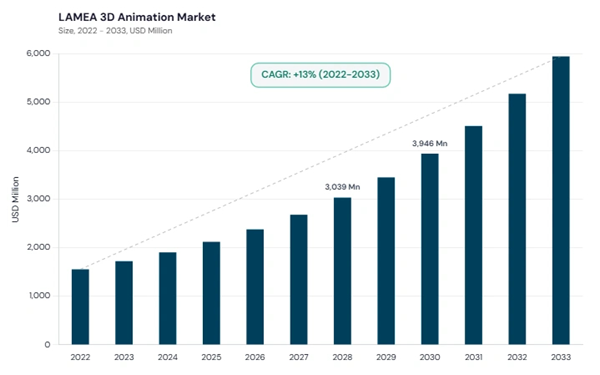
The LAMEA 3D Animation Market is expected to witness market growth of 14.0% CAGR during the forecast period (2026-2033) and is projected to reach USD 5.9 Billion by 2033.
The Brazil market dominated the LAMEA 3D Animation Market by country in 2025, and is expected to continue to be a dominant market till 2033; thereby, achieving a market value of USD 1.2 Billion by 2033. The Argentina market is expected to witness a CAGR of 14.5% during 2026-2033. Additionally, the UAE market is expected to witness a CAGR of 12.7% during 2026-2033. The Brazil and UAE led the LAMEA 3D Animation Market by Country with a market share of 22.8% and 12.3% in 2025. The South Africa market is expected to witness a CAGR of 15.1% during the forecast period.
The market for 3D animation in LAMEA developed more gradually than in mature regions, with early adoption shaped by limited infrastructure, dependence on imported tools, and relatively small local production ecosystems. Over time, better access to rendering software, improved computing power, and broader digital content demand helped studios across Latin America, the Middle East, and Africa raise production quality and expand into new formats. The market has since evolved beyond experimental or outsourced work into a more capable regional ecosystem serving entertainment, advertising, education, and virtual experiences. Growing in-house talent and better access to modern production workflows have supported this transition. As a result, LAMEA is becoming a more competitive and creatively distinctive market within the wider animation industry.
AI-enabled workflows, cloud collaboration, and localized storytelling are now central to LAMEA’s market direction. Studios are increasingly adopting automation tools for rigging, rendering, and environment detailing to improve productivity and manage costs more effectively. There is also rising emphasis on culturally specific storytelling, with content tailored to local languages, identities, and viewing habits across a highly diverse regional audience base. Cloud-based production platforms are improving cross-border teamwork and enabling more scalable project execution for geographically dispersed studios. At the same time, stronger use of digital platforms and streaming-led distribution is widening the path to audience reach and monetization. These trends are helping LAMEA move toward a more connected, efficient, and regionally differentiated animation market.
Based on Component, the market is segmented into Solution, and Service. The Solution segment dominated the LAMEA 3D Animation Market by Component in 2025 and is expected to continue to be a dominant segment till 2033; thereby, achieving a market value of USD 2.0 Billion by 2030. The Service segment is expected to witness a CAGR of 14.4% during 2026-2033. This indicates that while software and core production tools remain foundational, services are gaining strength as studios seek support for execution, scale, and technical specialization.
Brazil also stands out for its ability to produce culturally resonant content that aligns with local audience preferences while still supporting export opportunities. Strategic partnerships with technology providers, educators, and distributors have further strengthened the country’s production ecosystem. As demand rises for immersive and regionally relevant content, Brazil is likely to remain central to LAMEA’s growth, innovation, and long-term market positioning.
The Brazil market dominated the LAMEA 3D Animation Market by country in 2025, and is expected to continue to be a dominant market till 2033; thereby, achieving a market value of USD 1.2 Billion by 2033. The Argentina market is expected to witness a CAGR of 14.5% during 2026-2033. Additionally, the UAE market is expected to witness a CAGR of 12.7% during 2026-2033. The Brazil and UAE led the LAMEA 3D Animation Market by Country with a market share of 22.8% and 12.3% in 2025. The South Africa market is expected to witness a CAGR of 15.1% during the forecast period.
The market for 3D animation in LAMEA developed more gradually than in mature regions, with early adoption shaped by limited infrastructure, dependence on imported tools, and relatively small local production ecosystems. Over time, better access to rendering software, improved computing power, and broader digital content demand helped studios across Latin America, the Middle East, and Africa raise production quality and expand into new formats. The market has since evolved beyond experimental or outsourced work into a more capable regional ecosystem serving entertainment, advertising, education, and virtual experiences. Growing in-house talent and better access to modern production workflows have supported this transition. As a result, LAMEA is becoming a more competitive and creatively distinctive market within the wider animation industry.
AI-enabled workflows, cloud collaboration, and localized storytelling are now central to LAMEA’s market direction. Studios are increasingly adopting automation tools for rigging, rendering, and environment detailing to improve productivity and manage costs more effectively. There is also rising emphasis on culturally specific storytelling, with content tailored to local languages, identities, and viewing habits across a highly diverse regional audience base. Cloud-based production platforms are improving cross-border teamwork and enabling more scalable project execution for geographically dispersed studios. At the same time, stronger use of digital platforms and streaming-led distribution is widening the path to audience reach and monetization. These trends are helping LAMEA move toward a more connected, efficient, and regionally differentiated animation market.
Component Outlook
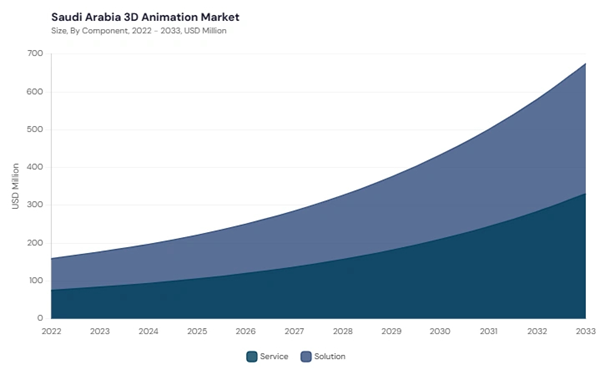
Based on Component, the market is segmented into Solution, and Service. The Solution segment dominated the LAMEA 3D Animation Market by Component in 2025 and is expected to continue to be a dominant segment till 2033; thereby, achieving a market value of USD 2.0 Billion by 2030. The Service segment is expected to witness a CAGR of 14.4% during 2026-2033. This indicates that while software and core production tools remain foundational, services are gaining strength as studios seek support for execution, scale, and technical specialization.
Deployment Mode Outlook
Based on Deployment Mode, the market is segmented into On-Premise, and Cloud. The On-Premise segment dominated the LAMEA 3D Animation Market by Deployment Mode in 2025 and is expected to continue to be a dominant segment till 2033; thereby, achieving a market value of USD 3.4 Billion by 2033. The Cloud segment is expected to witness a CAGR of 14.7% during 2026-2033. Cloud momentum reflects the region’s need for flexible infrastructure, remote collaboration, and lower upfront investment across expanding studio networks.Technology Outlook
Based on Technology, the market is segmented into 3D Modeling, 3D Rendering, Visual Effects (VFX), and Motion Graphics. The 3D Modeling segment dominated the LAMEA 3D Animation Market by Technology in 2025 and is expected to continue to be a dominant segment till 2033; thereby, achieving a market value of USD1.6 million by 2033. The Visual Effects (VFX) segment is expected to witness the highest CAGR of 14.6% during 2026-2033. This points to rising demand for more advanced visual quality, immersive formats, and cinematic production standards across regional content ecosystems.End-User Outlook
Based on End-User, the market is segmented into Media & Entertainment, Manufacturing & Construction, Government & Defense, Education, Healthcare, and Other End-User. The Media & Entertainment segment dominated the LAMEA 3D Animation Market by End-User in 2025 and is expected to continue to be a dominant segment till 2033; thereby, achieving a market value of USD 2.1 million by 2033. The Education segment is expected to witness a CAGR of 15.1% during 2026-2033. This shows how the market is expanding from entertainment-led demand into digital learning, training, and other communication-heavy use cases.Country Outlook
The Brazil 3D animation market is the strongest country market in LAMEA and serves as a major creative anchor for the wider region. Its growth has been supported by the expansion of Brazil’s multimedia industry, stronger domestic talent development, and broader adoption of 3D animation in television, advertising, and gaming. The market has benefited from increasing use of real-time engines, AI-assisted workflows, and cloud-based collaboration tools that allow studios to improve output quality while working more efficiently.Brazil also stands out for its ability to produce culturally resonant content that aligns with local audience preferences while still supporting export opportunities. Strategic partnerships with technology providers, educators, and distributors have further strengthened the country’s production ecosystem. As demand rises for immersive and regionally relevant content, Brazil is likely to remain central to LAMEA’s growth, innovation, and long-term market positioning.
List of Key Companies Profiled
- Autodesk, Inc.
- Adobe, Inc.
- NVIDIA Corporation
- Maxon Computer GmbH
- Side Effects Software
- Corel
- Vizrt
- DeepMotion, Inc.
- Zco Corporation
- Corus Entertainment
Market Report Segmentation
By Component- Solution
- Service
- On-Premise
- Cloud
- 3D Modeling
- 3D Rendering
- Visual Effects (VFX)
- Motion Graphics
- Media & Entertainment
- Manufacturing & Construction
- Government & Defense
- Education
- Healthcare
- Other End-User
- Brazil
- Argentina
- UAE
- Saudi Arabia
- South Africa
- Nigeria
- Rest of LAMEA
Table of Contents
Chapter 1. LAMEA Market1.1 Market Overview
1.2 Key Factors Impacting Market
1.2.1 Market Drivers
1.2.2 Market Restraints
1.2.3 Market Opportunities
1.2.4 Market Challenges
1.2.5 Market Trends
1.2.6 State of Competition
1.2.7 Market Consolidation
1.2.8 Key Customer Criteria
1.3 Product Life Cycle
1.4 Segmentation By Component
1.4.1 Solution
1.4.2 Services
1.5 Segmentation By Deployment Mode
1.5.1 On-Premise
1.5.2 Cloud
1.6 Segmentation By Technology
1.6.1 3D Modeling
1.6.2 3D Rendering
1.6.3 Visual Effects (VFX)
1.6.4 Motion Graphics
1.7 Segmentation By End-User
1.7.1 Media & Entertainment
1.7.2 Manufacturing & Construction
1.7.3 Government & Defense
1.7.4 Education
1.7.5 Healthcare
1.7.6 Other End-User
1.8 Segmentation By Country
1.8.1 Brazil
1.8.1.1 Segmentation By Component
1.8.1.1.1 Solution
1.8.1.1.2 Services
1.8.1.2 Segmentation By Deployment Mode
1.8.1.2.1 On-Premise
1.8.1.2.2 Cloud
1.8.1.3 Segmentation By Technology
1.8.1.3.1 3D Modeling
1.8.1.3.2 3D Rendering
1.8.1.3.3 Visual Effects (VFX)
1.8.1.3.4 Motion Graphics
1.8.1.4 Segmentation By End-User
1.8.1.4.1 Media & Entertainment
1.8.1.4.2 Manufacturing & Construction
1.8.1.4.3 Government & Defense
1.8.1.4.4 Education
1.8.1.4.5 Healthcare
1.8.1.4.6 Other End-User
1.8.2 Argentina
1.8.2.1 Segmentation By Component
1.8.2.1.1 Solution
1.8.2.1.2 Services
1.8.2.2 Segmentation By Deployment Mode
1.8.2.2.1 On-Premise
1.8.2.2.2 Cloud
1.8.2.3 Segmentation By Technology
1.8.2.3.1 3D Modeling
1.8.2.3.2 3D Rendering
1.8.2.3.3 Visual Effects (VFX)
1.8.2.3.4 Motion Graphics
1.8.2.4 Segmentation By End-User
1.8.2.4.1 Media & Entertainment
1.8.2.4.2 Manufacturing & Construction
1.8.2.4.3 Government & Defense
1.8.2.4.4 Education
1.8.2.4.5 Healthcare
1.8.2.4.6 Other End-User
1.8.3 UAE
1.8.3.1 Segmentation By Component
1.8.3.1.1 Solution
1.8.3.1.2 Services
1.8.3.2 Segmentation By Deployment Mode
1.8.3.2.1 On-Premise
1.8.3.2.2 Cloud
1.8.3.3 Segmentation By Technology
1.8.3.3.1 3D Modeling
1.8.3.3.2 3D Rendering
1.8.3.3.3 Visual Effects (VFX)
1.8.3.3.4 Motion Graphics
1.8.3.4 Segmentation By End-User
1.8.3.4.1 Media & Entertainment
1.8.3.4.2 Manufacturing & Construction
1.8.3.4.3 Government & Defense
1.8.3.4.4 Education
1.8.3.4.5 Healthcare
1.8.3.4.6 Other End-User
1.8.4 Saudi Arabia
1.8.4.1 Segmentation By Component
1.8.4.1.1 Solution
1.8.4.1.2 Services
1.8.4.2 Segmentation By Deployment Mode
1.8.4.2.1 On-Premise
1.8.4.2.2 Cloud
1.8.4.3 Segmentation By Technology
1.8.4.3.1 3D Modeling
1.8.4.3.2 3D Rendering
1.8.4.3.3 Visual Effects (VFX)
1.8.4.3.4 Motion Graphics
1.8.4.4 Segmentation By End-User
1.8.4.4.1 Media & Entertainment
1.8.4.4.2 Manufacturing & Construction
1.8.4.4.3 Government & Defense
1.8.4.4.4 Education
1.8.4.4.5 Healthcare
1.8.4.4.6 Other End-User
1.8.5 South Africa
1.8.5.1 Segmentation By Component
1.8.5.1.1 Solution
1.8.5.1.2 Services
1.8.5.2 Segmentation By Deployment Mode
1.8.5.2.1 On-Premise
1.8.5.2.2 Cloud
1.8.5.3 Segmentation By Technology
1.8.5.3.1 3D Modeling
1.8.5.3.2 3D Rendering
1.8.5.3.3 Visual Effects (VFX)
1.8.5.3.4 Motion Graphics
1.8.5.4 Segmentation By End-User
1.8.5.4.1 Media & Entertainment
1.8.5.4.2 Manufacturing & Construction
1.8.5.4.3 Government & Defense
1.8.5.4.4 Education
1.8.5.4.5 Healthcare
1.8.5.4.6 Other End-User
1.8.6 Nigeria
1.8.6.1 Segmentation By Component
1.8.6.1.1 Solution
1.8.6.1.2 Services
1.8.6.2 Segmentation By Deployment Mode
1.8.6.2.1 On-Premise
1.8.6.2.2 Cloud
1.8.6.3 Segmentation By Technology
1.8.6.3.1 3D Modeling
1.8.6.3.2 3D Rendering
1.8.6.3.3 Visual Effects (VFX)
1.8.6.3.4 Motion Graphics
1.8.6.4 Segmentation By End-User
1.8.6.4.1 Media & Entertainment
1.8.6.4.2 Manufacturing & Construction
1.8.6.4.3 Government & Defense
1.8.6.4.4 Education
1.8.6.4.5 Healthcare
1.8.6.4.6 Other End-User
1.8.7 Rest of LAMEA
1.8.7.1 Segmentation By Component
1.8.7.1.1 Solution
1.8.7.1.2 Services
1.8.7.2 Segmentation By Deployment Mode
1.8.7.2.1 On-Premise
1.8.7.2.2 Cloud
1.8.7.3 Segmentation By Technology
1.8.7.3.1 3D Modeling
1.8.7.3.2 3D Rendering
1.8.7.3.3 Visual Effects (VFX)
1.8.7.3.4 Motion Graphics
1.8.7.4 Segmentation By End-User
1.8.7.4.1 Media & Entertainment
1.8.7.4.2 Manufacturing & Construction
1.8.7.4.3 Government & Defense
1.8.7.4.4 Education
1.8.7.4.5 Healthcare
1.8.7.4.6 Other End-User
Chapter 2. Company Profiles
2.1 Adobe, Inc.
2.1.1 Company Overview
2.1.2 Financial Analysis
2.1.3 Segmental and Regional Analysis
2.1.2 Research & Development Expense
2.1.5 Recent Strategies and Developments
2.1.5.1 Product Launches and Product Expansions
2.1.6 SWOT Analysis
2.2 Autodesk, Inc.
2.2.1 Company Overview
2.2.2 Financial Analysis
2.2.3 Regional Analysis
2.2.2 Research & Development Expenses
2.2.5 Recent Strategies and Developments
2.2.5.1 Product Launches and Product Expansions
2.2.6 SWOT Analysis
2.3 Corel Corporation (KKR & Co., Inc.)
2.3.1 Company Overview
2.3.2 Financial Analysis
2.3.3 Regional & Segmental Analysis
2.2 NVIDIA Corporation
2.2.1 Company Overview
2.2.2 Financial Analysis
2.2.3 Segmental and Regional Analysis
2.2.2 Research & Development Expenses
2.2.5 Recent Strategies and Developments
2.2.5.1 Product Launches and Product Expansions
2.2.6 SWOT Analysis
2.5 DeepMotion, Inc.
2.5.1 Company Overview
2.5.2 Recent Strategies and Developments
2.5.2.1 Product Launches and Product Expansions
2.6 Maxon Computer GmbH
2.6.1 Company Overview
2.6.2 Recent Strategies and Developments
2.6.2.1 Acquisition and Mergers
2.7 Side Effects Software Inc.
2.7.1 Company Overview
2.8 Corus Entertainment Inc.
2.8.1 Company Overview
2.8.2 Financial Analysis
2.8.3 Segmental and Regional Analysis
2.9 Vizrt Group AS
2.9.1 Company Overview
2.1 Zco Corporation
2.10.1 Company Overview
Companies Mentioned
- Autodesk, Inc.
- Adobe, Inc.
- NVIDIA Corporation
- Maxon Computer GmbH
- Side Effects Software
- Corel
- Vizrt
- DeepMotion, Inc.
- Zco Corporation
- Corus Entertainment


