



The Asia Pacific Automotive Metal Stamping Market size is projected to reach USD 40.57 billion by 2030, growing at a CAGR of 5.1% during the forecast period 2026-2033.
The Asia Pacific Automotive Metal Stamping Market is witnessing strong expansion driven by rising automotive production, rapid electric vehicle adoption, and increasing demand for lightweight vehicle structures across the region. Countries such as China, Japan, South Korea, and India are continuously investing in advanced automotive manufacturing capabilities, boosting the requirement for precision-engineered stamped components for chassis systems, body structures, and battery enclosures. Additionally, stringent fuel-efficiency and emission regulations are encouraging automakers to utilize advanced high-strength steel and aluminum stamped parts to reduce vehicle weight while maintaining structural durability and crash performance.
The market is further supported by increasing integration of Industry 4.0 technologies, automation systems, and smart manufacturing solutions within stamping facilities. Automotive manufacturers across Asia Pacific are increasingly deploying robotic stamping lines, predictive maintenance systems, and AI-enabled quality inspection technologies to improve productivity, reduce waste, and enhance manufacturing precision. Furthermore, the rapid growth of electric vehicle production is generating substantial demand for specialized stamped components, including lightweight structural assemblies and battery housing systems, thereby accelerating technological advancements across the regional automotive metal stamping ecosystem.
China continues to lead the regional market owing to its massive automotive production capacity, rapid EV manufacturing expansion, and growing investments in advanced metal forming technologies. Japan and South Korea remain key contributors due to their technologically advanced automotive industries and increasing adoption of lightweight materials in vehicle production. India is witnessing strong growth supported by rising passenger vehicle demand, infrastructure development, and increasing localization of automotive component manufacturing. Meanwhile, Southeast Asian economies including Malaysia and Singapore are strengthening their automotive supply chains through investments in automation and precision manufacturing technologies.
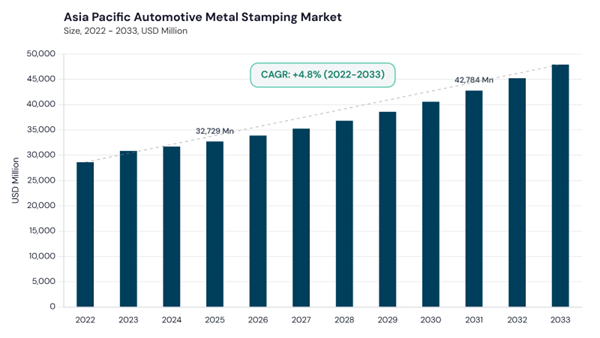
The Asia Pacific Automotive Metal Stamping Market is witnessing strong expansion driven by rising automotive production, rapid electric vehicle adoption, and increasing demand for lightweight vehicle structures across the region. Countries such as China, Japan, South Korea, and India are continuously investing in advanced automotive manufacturing capabilities, boosting the requirement for precision-engineered stamped components for chassis systems, body structures, and battery enclosures. Additionally, stringent fuel-efficiency and emission regulations are encouraging automakers to utilize advanced high-strength steel and aluminum stamped parts to reduce vehicle weight while maintaining structural durability and crash performance.
The market is further supported by increasing integration of Industry 4.0 technologies, automation systems, and smart manufacturing solutions within stamping facilities. Automotive manufacturers across Asia Pacific are increasingly deploying robotic stamping lines, predictive maintenance systems, and AI-enabled quality inspection technologies to improve productivity, reduce waste, and enhance manufacturing precision. Furthermore, the rapid growth of electric vehicle production is generating substantial demand for specialized stamped components, including lightweight structural assemblies and battery housing systems, thereby accelerating technological advancements across the regional automotive metal stamping ecosystem.
By Process Outlook
Based on Process, the market is segmented into Blanking, Bending, Embossing, Flanging, Coining, and Other Process. The Blanking segment dominated the Asia Pacific Automotive Metal Stamping Market in 2025 and is expected to continue to be a dominant segment till 2030; thereby, achieving a market value of USD 14.71 billion by 2030. The Bending segment is expected to witness a CAGR of 4.4% during 2026-2033. Additionally, the Blanking segment accounted for a market share of 37.5% in 2025.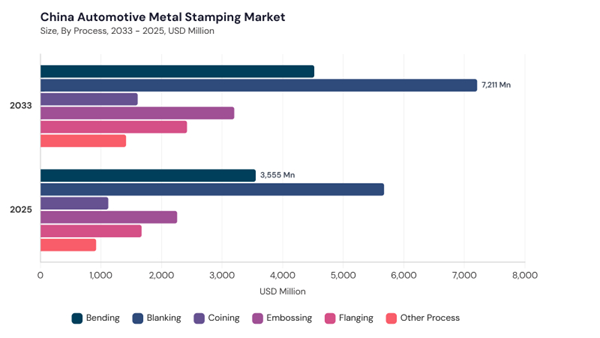
By Application Outlook
Based on Application, the market is segmented into Passenger Cars, Light Commercial Vehicles, Heavy Commercial Vehicles, and Recreational Vehicles. The Passenger Cars segment dominated the Asia Pacific Automotive Metal Stamping Market in 2025 and is expected to continue to be a dominant segment till 2030; thereby, achieving a market value of USD 23.30 billion by 2030. The Heavy Commercial Vehicles segment is expected to witness a CAGR of 6.0% during 2026-2033. Additionally, the Passenger Cars segment accounted for a market share of 58.6% in 2025.By Country Outlook
Based on Country, the market is segmented into China, Japan, India, South Korea, Singapore, Malaysia, and Rest of Asia Pacific. China dominated the Asia Pacific Automotive Metal Stamping Market by country in 2025 and is expected to continue to be a dominant market till 2030; thereby, achieving a market value of USD 17.86 billion by 2030. The Rest of Asia Pacific market is expected to witness a CAGR of 5.8% during 2026-2033. Additionally, China accounted for a market share of 46.5% in 2025.China continues to lead the regional market owing to its massive automotive production capacity, rapid EV manufacturing expansion, and growing investments in advanced metal forming technologies. Japan and South Korea remain key contributors due to their technologically advanced automotive industries and increasing adoption of lightweight materials in vehicle production. India is witnessing strong growth supported by rising passenger vehicle demand, infrastructure development, and increasing localization of automotive component manufacturing. Meanwhile, Southeast Asian economies including Malaysia and Singapore are strengthening their automotive supply chains through investments in automation and precision manufacturing technologies.
List of Key Companies Profiled
- Gestamp Automoción S.A.
- Magna International Inc.
- Martinrea International Inc.
- Schuler Group GmbH
- Tower International
- voestalpine AG
- thyssenkrupp AG
- Böllhoff Group
- KUKA AG
- GEDIA Automotive Group
Market Report Segmentation
By Process- Blanking
- Bending
- Embossing
- Flanging
- Coining
- Other Process
- Passenger Cars
- Light Commercial Vehicles
- Heavy Commercial Vehicles
- Recreational Vehicles
- China
- Japan
- India
- South Korea
- Singapore
- Malaysia
- Rest of Asia Pacific
Table of Contents
Chapter 1. Asia Pacific Market1.1 Market Overview
1.2 Key Factors Impacting Market
1.2.1 Market Drivers
1.2.2 Market Restraints
1.2.3 Market Opportunities
1.2.4 Market Challenges
1.2.5 Market Trends
1.2.6 State of Competition
1.2.7 Market Consolidation
1.2.8 Key Customer Criteria
1.3 Product Life Cycle
1.4 Segmentation By Process
1.4.1 Blanking
1.4.2 Embossing
1.4.3 Bending
1.4.4 Coining
1.4.5 Flanging
1.4.6 Other Process
1.5 Segmentation By Application
1.5.1 Passenger Cars
1.5.2 Light Commercial Vehicles
1.5.3 Heavy Commercial Vehicles
1.5.4 Recreational Vehicles
1.6 Segmentation By Country
1.6.1 China
1.6.1.1 Segmentation By Process
1.6.1.1.1 Blanking
1.6.1.1.2 Embossing
1.6.1.1.3 Bending
1.6.1.1.4 Coining
1.6.1.1.5 Flanging
1.6.1.1.6 Other Process
1.6.1.2 Segmentation By Application
1.6.1.2.1 Passenger Cars
1.6.1.2.2 Light Commercial Vehicles
1.6.1.2.3 Heavy Commercial Vehicles
1.6.1.2.4 Recreational Vehicles
1.6.2 Japan
1.6.2.1 Segmentation By Process
1.6.2.1.1 Blanking
1.6.2.1.2 Embossing
1.6.2.1.3 Bending
1.6.2.1.4 Coining
1.6.2.1.5 Flanging
1.6.2.1.6 Other Process
1.6.2.2 Segmentation By Application
1.6.2.2.1 Passenger Cars
1.6.2.2.2 Light Commercial Vehicles
1.6.2.2.3 Heavy Commercial Vehicles
1.6.2.2.4 Recreational Vehicles
1.6.3 India
1.6.3.1 Segmentation By Process
1.6.3.1.1 Blanking
1.6.3.1.2 Embossing
1.6.3.1.3 Bending
1.6.3.1.4 Coining
1.6.3.1.5 Flanging
1.6.3.1.6 Other Process
1.6.3.2 Segmentation By Application
1.6.3.2.1 Passenger Cars
1.6.3.2.2 Light Commercial Vehicles
1.6.3.2.3 Heavy Commercial Vehicles
1.6.3.2.4 Recreational Vehicles
1.6.4 South Korea
1.6.4.1 Segmentation By Process
1.6.4.1.1 Blanking
1.6.4.1.2 Embossing
1.6.4.1.3 Bending
1.6.4.1.4 Coining
1.6.4.1.5 Flanging
1.6.4.1.6 Other Process
1.6.4.2 Segmentation By Application
1.6.4.2.1 Passenger Cars
1.6.4.2.2 Light Commercial Vehicles
1.6.4.2.3 Heavy Commercial Vehicles
1.6.4.2.4 Recreational Vehicles
1.6.5 Singapore
1.6.5.1 Segmentation By Process
1.6.5.1.1 Blanking
1.6.5.1.2 Embossing
1.6.5.1.3 Bending
1.6.5.1.4 Coining
1.6.5.1.5 Flanging
1.6.5.1.6 Other Process
1.6.5.2 Segmentation By Application
1.6.5.2.1 Passenger Cars
1.6.5.2.2 Light Commercial Vehicles
1.6.5.2.3 Heavy Commercial Vehicles
1.6.5.2.4 Recreational Vehicles
1.6.6 Malaysia
1.6.6.1 Segmentation By Process
1.6.6.1.1 Blanking
1.6.6.1.2 Embossing
1.6.6.1.3 Bending
1.6.6.1.4 Coining
1.6.6.1.5 Flanging
1.6.6.1.6 Other Process
1.6.6.2 Segmentation By Application
1.6.6.2.1 Passenger Cars
1.6.6.2.2 Light Commercial Vehicles
1.6.6.2.3 Heavy Commercial Vehicles
1.6.6.2.4 Recreational Vehicles
1.6.7 Rest of Asia Pacific
1.6.7.1 Segmentation By Process
1.6.7.1.1 Blanking
1.6.7.1.2 Embossing
1.6.7.1.3 Bending
1.6.7.1.4 Coining
1.6.7.1.5 Flanging
1.6.7.1.6 Other Process
1.6.7.2 Segmentation By Application
1.6.7.2.1 Passenger Cars
1.6.7.2.2 Light Commercial Vehicles
1.6.7.2.3 Heavy Commercial Vehicles
1.6.7.2.4 Recreational Vehicless
Chapter 2. Company Snapshot
2.1 Magna International Inc.
2.1.1 Business Overview
2.1.2 Key Information
2.1.3 Company Focus
2.1.4 Strategic Insights
2.1.5 Strategy Deployed
2.1.6 Product & Service Portfolio
2.1.7 Capability Overview
2.1.8 Technology & Innovation Focus
2.1.9 Customers / End Users
2.1.10 Competitive Positioning
2.1.11 Key Differentiators
2.1.12 Portfolio Matrix
2.1.13 SWOT Analysis
2.1.14 Future Outlook
2.2 Gestamp Servicios, S.A.
2.2.1 Business Overview
2.2.2 Key Information
2.2.3 Company Focus
2.2.4 Strategic Insights
2.2.5 Strategy Deployed
2.2.6 Product & Service Portfolio
2.2.7 Capability Overview
2.2.8 Technology & Innovation Focus
2.2.9 Customers / End Users
2.2.10 Competitive Positioning
2.2.11 Key Differentiators
2.2.12 Portfolio Matrix
2.2.13 SWOT Analysis
2.2.14 Future Outlook
2.3 Martinrea International Inc.
2.3.1 Business Overview
2.3.2 Key Information
2.3.3 Company Focus
2.3.4 Strategic Insights
2.3.5 Strategy Deployed
2.3.6 Product & Service Portfolio
2.3.7 Capability Overview
2.3.8 Technology & Innovation Focus
2.3.9 Customers / End Users
2.3.10 Competitive Positioning
2.3.11 Key Differentiators
2.3.12 Portfolio Matrix
2.3.13 SWOT Analysis
2.3.14 Future Outlook
2.4 Autokiniton Global Group, LP
2.4.1 Business Overview
2.4.2 Key Information
2.4.3 Company Focus
2.4.4 Strategic Insights
2.4.5 Strategy Deployed
2.4.6 Product & Service Portfolio
2.4.7 Capability Overview
2.4.8 Technology & Innovation Focus
2.4.9 Customers / End Users
2.4.10 Competitive Positioning
2.4.11 Key Differentiators
2.4.12 Portfolio Matrix
2.4.13 SWOT Analysis
2.4.14 Future Outlook
2.5 BENTELER Group
2.5.1 Business Overview
2.5.2 Key Information
2.5.3 Company Focus
2.5.4 Strategic Insights
2.5.5 Strategy Deployed
2.5.6 Product & Service Portfolio
2.5.7 Capability Overview
2.5.8 Technology & Innovation Focus
2.5.9 Customers / End Users
2.5.10 Competitive Positioning
2.5.11 Key Differentiators
2.5.12 Portfolio Matrix
2.5.13 SWOT Analysis
2.5.14 Future Outlook
2.6 AISIN CORPORATION
2.6.1 Business Overview
2.6.2 Key Information
2.6.3 Company Focus
2.6.4 Strategic Insights
2.6.5 Strategy Deployed
2.6.6 Product & Service Portfolio
2.6.7 Capability Overview
2.6.8 Technology & Innovation Focus
2.6.9 Customers / End Users
2.6.10 Competitive Positioning
2.6.11 Key Differentiators
2.6.12 Portfolio Matrix
2.6.13 SWOT Analysis
2.6.14 Future Outlook
2.7 HIROTEC Corporation
2.7.1 Business Overview
2.7.2 Key Information
2.7.3 Company Focus
2.7.4 Strategic Insights
2.7.5 Strategy Deployed
2.7.6 Product & Service Portfolio
2.7.7 Capability Overview
2.7.8 Technology & Innovation Focus
2.7.9 Customers / End Users
2.7.10 Competitive Positioning
2.7.11 Key Differentiators
2.7.12 Portfolio Matrix
2.7.13 SWOT Analysis
2.7.14 Future Outlook
2.8 Thyssenkrupp AG
2.8.1 Business Overview
2.8.2 Key Information
2.8.3 Company Focus
2.8.4 Strategic Insights
2.8.5 Strategy Deployed
2.8.6 Product & Service Portfolio
2.8.7 Capability Overview
2.8.8 Technology & Innovation Focus
2.8.9 Customers / End Users
2.8.10 Competitive Positioning
2.8.11 Key Differentiators
2.8.12 Portfolio Matrix
2.8.13 SWOT Analysis
2.8.14 Future Outlook
2.9 Voestalpine AG
2.9.1 Business Overview
2.9.2 Key Information
2.9.3 Company Focus
2.9.4 Strategic Insights
2.9.5 Strategy Deployed
2.9.6 Product & Service Portfolio
2.9.7 Capability Overview
2.9.8 Technology & Innovation Focus
2.9.9 Customers / End Users
2.9.10 Competitive Positioning
2.9.11 Key Differentiators
2.9.12 Portfolio Matrix
2.9.13 SWOT Analysis
2.9.14 Future Outlook
2.10 Minth Group Limited
2.10.1 Business Overview
2.10.2 Key Information
2.10.3 Company Focus
2.10.4 Strategic Insights
2.10.5 Strategy Deployed
2.10.6 Product & Service Portfolio
2.10.7 Capability Overview
2.10.8 Technology & Innovation Focus
2.10.9 Customers / End Users
2.10.10 Competitive Positioning
2.10.11 Key Differentiators
2.10.12 Portfolio Matrix
2.10.13 SWOT Analysis
2.10.14 Future Outlook
Companies Mentioned
- Gestamp Automoción S.A.
- Magna International Inc.
- Martinrea International Inc.
- Schuler Group GmbH
- Tower International
- voestalpine AG
- thyssenkrupp AG
- Böllhoff Group
- KUKA AG
- GEDIA Automotive Group


