



The Asia Pacific Low Voltage Circuit Breaker Market is forecasted to reach USD 7.22 billion by 2031, growing at a CAGR of 8.6% during the forecast period (2026-2033).
The China market dominated the Asia Pacific Low Voltage Circuit Breaker Market by country in 2025, and is expected to continue to be a dominant market till 2033; thereby, achieving a market value of USD 3.35 billion by 2033. The Japan market is expected to witness a CAGR of 7.3% during 2026-2033. Additionally, the India market is expected to witness a CAGR of 9.5% during 2026-2033. The China and India led the Asia Pacific Low Voltage Circuit Breaker Market by Country with a market share of 42.4% and 12.4% in 2025. The Singapore market is expected to witness a CAGR of 11.7% throughout the forecast period.
Growing investments in renewable energy infrastructure, smart grids, electric vehicle charging networks, manufacturing facilities, and commercial construction projects are significantly contributing to market expansion throughout Asia Pacific. Countries such as China, India, Japan, South Korea, Singapore, and Malaysia are increasingly adopting advanced electrical distribution systems to support industrial automation, sustainable infrastructure development, and modernization of aging power networks. Rising adoption of smart buildings and energy-efficient electrical systems is also fueling demand for miniature circuit breakers (MCBs), molded case circuit breakers (MCCBs), and air circuit breakers (ACBs).
Competition within the Asia Pacific low voltage circuit breaker market is characterized by technological innovation, large-scale manufacturing capabilities, localized production expansion, and strategic collaborations with utilities and industrial infrastructure developers. Leading companies are investing heavily in smart energy management technologies, digital monitoring systems, and sustainable manufacturing practices to strengthen their market presence. Additionally, the increasing focus on grid reliability, uninterrupted power supply, and industrial energy optimization continues to support long-term market expansion across the region.
Japan’s market is witnessing stable growth driven by modernization of electrical infrastructure, adoption of energy-efficient technologies, and increasing investments in smart buildings and industrial automation systems. The country’s emphasis on operational reliability, advanced manufacturing technologies, and sustainable energy systems is encouraging adoption of technologically advanced low voltage circuit breakers across industrial and commercial sectors.
India is emerging as one of the fastest-growing markets in Asia Pacific due to rapid urbanization, industrial expansion, smart city projects, and increasing investments in renewable energy infrastructure. Government electrification initiatives, expansion of commercial construction activities, and modernization of power distribution systems are significantly increasing demand for advanced circuit protection technologies. The country’s growing manufacturing sector and rising deployment of electric vehicle charging infrastructure are also supporting strong market expansion.
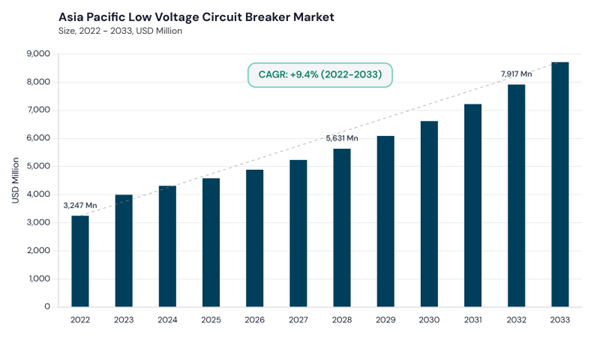
The China market dominated the Asia Pacific Low Voltage Circuit Breaker Market by country in 2025, and is expected to continue to be a dominant market till 2033; thereby, achieving a market value of USD 3.35 billion by 2033. The Japan market is expected to witness a CAGR of 7.3% during 2026-2033. Additionally, the India market is expected to witness a CAGR of 9.5% during 2026-2033. The China and India led the Asia Pacific Low Voltage Circuit Breaker Market by Country with a market share of 42.4% and 12.4% in 2025. The Singapore market is expected to witness a CAGR of 11.7% throughout the forecast period.
Growing investments in renewable energy infrastructure, smart grids, electric vehicle charging networks, manufacturing facilities, and commercial construction projects are significantly contributing to market expansion throughout Asia Pacific. Countries such as China, India, Japan, South Korea, Singapore, and Malaysia are increasingly adopting advanced electrical distribution systems to support industrial automation, sustainable infrastructure development, and modernization of aging power networks. Rising adoption of smart buildings and energy-efficient electrical systems is also fueling demand for miniature circuit breakers (MCBs), molded case circuit breakers (MCCBs), and air circuit breakers (ACBs).
Competition within the Asia Pacific low voltage circuit breaker market is characterized by technological innovation, large-scale manufacturing capabilities, localized production expansion, and strategic collaborations with utilities and industrial infrastructure developers. Leading companies are investing heavily in smart energy management technologies, digital monitoring systems, and sustainable manufacturing practices to strengthen their market presence. Additionally, the increasing focus on grid reliability, uninterrupted power supply, and industrial energy optimization continues to support long-term market expansion across the region.
Type Outlook
Based on Type, the market is segmented into Miniature Circuit Breaker, Molded Case Circuit Breaker, and Air Circuit Breaker. The Miniature Circuit Breaker market dominated the Asia Pacific Low Voltage Circuit Breaker Market by Type in 2025, and is expected to continue to be a dominant market till 2033; thereby, achieving a market value of USD 3.94 billion by 2033. The Molded Case Circuit Breaker market is expected to witness a CAGR of 9.0% during 2026-2033. Additionally, the Air Circuit Breaker market is expected to witness a CAGR of 9.3% during the forecast period.End-User Outlook
Based on End-User, the market is segmented into Commercial, Residential, and Other End-User. The Commercial segment dominated the Asia Pacific Low Voltage Circuit Breaker Market by End-User in 2025, and is expected to continue to be a dominant market till 2033; thereby, achieving a market value of USD 3.53 billion by 2033. The Residential market is expected to witness a CAGR of 8.8% during 2026-2033. The Other End-User market is expected to witness a CAGR of 9.1% during the forecast period.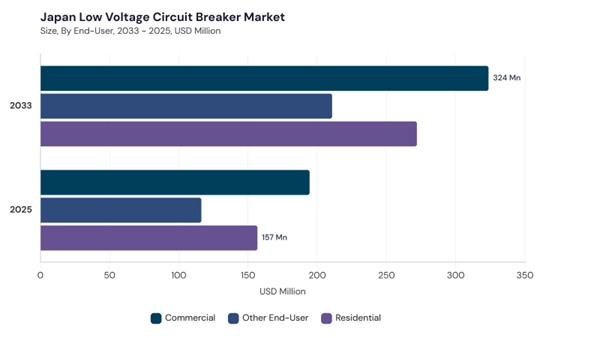
Application Outlook
Based on Application, the market is segmented into Shut-off Circuit, Energy Allocation, and Other Application. The Shut-off Circuit market dominated the Asia Pacific Low Voltage Circuit Breaker Market by Application in 2025, and is expected to continue to be a dominant market till 2033; thereby, achieving a market value of USD 4.44 billion by 2033. The Energy Allocation market is expected to witness a CAGR of 9.3% during 2026-2033. Additionally, the Other Application market is expected to witness a CAGR of 8.9% during the forecast period.Country Outlook
China dominates the Asia Pacific low voltage circuit breaker market due to its extensive manufacturing sector, rapid industrialization, large-scale infrastructure projects, and significant investments in renewable energy and smart grid deployment. The country’s strong focus on industrial automation, electric vehicle infrastructure, and modernization of electrical distribution networks is accelerating demand for intelligent circuit protection systems integrated with IoT and predictive maintenance technologies. Expanding commercial construction and urban infrastructure development further support market growth throughout China.Japan’s market is witnessing stable growth driven by modernization of electrical infrastructure, adoption of energy-efficient technologies, and increasing investments in smart buildings and industrial automation systems. The country’s emphasis on operational reliability, advanced manufacturing technologies, and sustainable energy systems is encouraging adoption of technologically advanced low voltage circuit breakers across industrial and commercial sectors.
India is emerging as one of the fastest-growing markets in Asia Pacific due to rapid urbanization, industrial expansion, smart city projects, and increasing investments in renewable energy infrastructure. Government electrification initiatives, expansion of commercial construction activities, and modernization of power distribution systems are significantly increasing demand for advanced circuit protection technologies. The country’s growing manufacturing sector and rising deployment of electric vehicle charging infrastructure are also supporting strong market expansion.
List of Key Companies Profiled
- ABB Ltd.
- Siemens AG
- Schneider Electric SE
- Eaton Corporation plc
- Mitsubishi Electric Corporation
- General Electric Company
- Legrand SA
- Rockwell Automation, Inc.
- Fuji Electric Co., Ltd.
- Larsen & Toubro Limited
Market Report Segmentation
By Type- Miniature Circuit Breaker
- Molded Case Circuit Breaker
- Air Circuit Breaker
- Commercial
- Residential
- Other End-User
- Shut-off Circuit
- Energy Allocation
- Other Application
- China
- Japan
- India
- South Korea
- Singapore
- Malaysia
- Rest of Asia Pacific
Table of Contents
Chapter 1. Asia Pacific Market1.1 Market Overview
1.2 Key Factors Impacting Market
1.2.1 Market Drivers
1.2.2 Market Restraints
1.2.3 Market Opportunities
1.2.4 Market Challenges
1.2.5 Market Trends
1.2.6 State of Competition
1.2.7 Market Consolidation
1.2.8 Key Customer Criteria
1.3 Product Life Cycle
1.4 Segmentation By Type
1.4.1 Miniature Circuit Breaker
1.4.2 Molded Case Circuit Breaker
1.4.3 Air Circuit Breaker
1.5 Segmentation By End User
1.5.1 Commercial
1.5.2 Residential
1.5.3 Other End-User
1.6 Segmentation By Application Analysis
1.6.1 Shut-off Circuit
1.6.2 Energy Allocation
1.6.2.1.1.1 Other Application
1.7 Segmentation By Country
1.7.1 China
1.7.1.1 Segmentation By Type
1.7.1.1.1 Miniature Circuit Breaker
1.7.1.1.2 Molded Case Circuit Breaker
1.7.1.1.3 Air Circuit Breaker
1.7.1.2 Segmentation By End User
1.7.1.2.1 Commercial
1.7.1.2.2 Residential
1.7.1.2.3 Other End-User
1.7.1.3 Segmentation by Application
1.7.1.3.1 Shut-off Circuit
1.7.1.3.2 Energy Allocation
1.7.1.3.3 Other Application
1.7.2 Japan
1.7.2.1 Segmentation By Type
1.7.2.1.1 Miniature Circuit Breaker
1.7.2.1.2 Molded Case Circuit Breaker
1.7.2.1.3 Air Circuit Breaker
1.7.2.2 Segmentation By End User
1.7.2.2.1 Commercial
1.7.2.2.2 Residential
1.7.2.2.3 Other End-User
1.7.2.3 Segmentation by Application
1.7.2.3.1 Shut-off Circuit
1.7.2.3.2 Energy Allocation
1.7.2.3.3 Other Application
1.7.3 India
1.7.3.1 Segmentation By Type
1.7.3.1.1 Miniature Circuit Breaker
1.7.3.1.2 Molded Case Circuit Breaker
1.7.3.1.3 Air Circuit Breaker
1.7.3.2 Segmentation By End User
1.7.3.2.1 Commercial
1.7.3.2.2 Residential
1.7.3.2.3 Other End-User
1.7.3.3 Segmentation by Application
1.7.3.3.1 Shut-off Circuit
1.7.3.3.2 Energy Allocation
1.7.3.3.3 Other Application
1.7.4 South Korea
1.7.4.1 Segmentation By Type
1.7.4.1.1 Miniature Circuit Breaker
1.7.4.1.2 Molded Case Circuit Breaker
1.7.4.1.3 Air Circuit Breaker
1.7.4.2 Segmentation By End User
1.7.4.2.1 Commercial
1.7.4.2.2 Residential
1.7.4.2.3 Other End-User
1.7.4.3 Segmentation by Application
1.7.4.3.1 Shut-off Circuit
1.7.4.3.2 Energy Allocation
1.7.4.3.3 Other Application
1.7.5 Singapore
1.7.5.1 Segmentation By Type
1.7.5.1.1 Miniature Circuit Breaker
1.7.5.1.2 Molded Case Circuit Breaker
1.7.5.1.3 Air Circuit Breaker
1.7.5.2 Segmentation By End User
1.7.5.2.1 Commercial
1.7.5.2.2 Residential
1.7.5.2.3 Other End-User
1.7.5.3 Segmentation by Application
1.7.5.3.1 Shut-off Circuit
1.7.5.3.2 Energy Allocation
1.7.5.3.3 Other Application
1.7.6 Malaysia
1.7.6.1 Segmentation By Type
1.7.6.1.1 Miniature Circuit Breaker
1.7.6.1.2 Molded Case Circuit Breaker
1.7.6.1.3 Air Circuit Breaker
1.7.6.2 Segmentation By End User
1.7.6.2.1 Commercial
1.7.6.2.2 Residential
1.7.6.2.3 Other End-User
1.7.6.3 Segmentation by Application
1.7.6.3.1 Shut-off Circuit
1.7.6.3.2 Energy Allocation
1.7.6.3.3 Other Application
1.7.7 Rest of Asia Pacific
1.7.7.1 Segmentation By Type
1.7.7.1.1 Miniature Circuit Breaker
1.7.7.1.2 Molded Case Circuit Breaker
1.7.7.1.3 Air Circuit Breaker
1.7.7.2 Segmentation By End User
1.7.7.2.1 Commercial
1.7.7.2.2 Residential
1.7.7.2.3 Other End-User
1.7.7.3 Segmentation by Application
1.7.7.3.1 Shut-off Circuit
1.7.7.3.2 Energy Allocation
1.7.7.3.3 Other Application
Chapter 2. Company Profiles
2.1 ABB Ltd.
2.1.1 Company Overview
2.1.2 Recent Strategies and Developments
2.1.2.1 Product Launches and Product Expansions
2.1.3 Company Focus
2.1.4 Strategic Insights
2.1.5 Strategy Deployed
2.1.6 SWOT Analysis
2.1.7 Future Outlook
2.2 Schneider Electric SE
2.2.1 Company Overview
2.2.2 Financial Analysis
2.2.3 Segmental and Regional Analysis
2.2.4 Research & Development Expense
2.2.5 Recent Strategies and Developments
2.2.5.1 Product Launches and Product Expansions
2.2.5.2 Geographical Expansions
2.2.6 Company Focus
2.2.7 Strategic Insights
2.2.8 Strategy Deployed
2.2.9 SWOT Analysis
2.2.10 Future Outlook
2.3 Siemens AG
2.3.1 Company Overview
2.3.2 Financial Analysis
2.3.3 Segmental and Regional Analysis
2.3.4 Research & Development Expense
2.3.5 Recent Strategies and Developments
2.3.5.1 Partnerships, Collaborations, and Agreements
2.3.6 Company Focus
2.3.7 Strategic Insights
2.3.8 Strategy Deployed
2.3.9 SWOT Analysis
2.3.10 Future Outlook
2.4 Eaton Corporation PLC
2.4.1 Company Overview
2.4.2 Financial Analysis
2.4.3 Segmental and Regional Analysis
2.4.4 Research & Development Expense
2.4.5 Company Focus
2.4.6 Strategic Insights
2.4.7 Strategy Deployed
2.4.8 SWOT Analysis
2.4.9 Future Outlook
2.5 Mitsubishi Electric Corporation
2.5.1 Company Overview
2.5.2 Financial Analysis
2.5.3 Segmental and Regional Analysis
2.5.4 Research & Development Expense
2.5.5 Recent Strategies and Developments
2.5.5.1 Partnerships, Collaborations, and Agreements
2.5.5.2 Product Launches and Product Expansions
2.5.6 Company Focus
2.5.7 Strategic Insights
2.5.8 Strategy Deployed
2.5.9 SWOT Analysis
2.5.10 Future Outlook
2.6 Legrand S.A. (Legrand Group)
2.6.1 Company Overview
2.6.2 Financial Analysis
2.6.3 Regional Analysis
2.6.4 Research & Development Expense
2.6.5 Recent Strategies and Developments
2.6.5.1 Product Launches and Product Expansions
2.6.6 Company Focus
2.6.7 Strategic Insights
2.6.8 Strategy Deployed
2.6.9 SWOT Analysis
2.6.10 Future Outlook
2.7 General Electric Company
2.7.1 Company Overview
2.7.2 Company Focus
2.7.3 Strategic Insights
2.7.4 Strategy Deployed
2.7.5 SWOT Analysis
2.7.6 Future Outlook
2.8 Hager Group
2.8.1 Company Overview
2.8.2 Company Focus
2.8.3 Strategic Insights
2.8.4 Strategy Deployed
2.8.5 SWOT Analysis
2.8.6 Future Outlook
2.9 Fuji Electric Co. Ltd.
2.9.1 Company Overview
2.9.2 Financial Analysis
2.9.3 Segmental and Regional Analysis
2.9.4 Research & Development Expense
2.9.5 Company Focus
2.9.6 Strategic Insights
2.9.7 Strategy Deployed
2.9.8 SWOT Analysis
2.9.9 Future Outlook
2.1 CHINT Group Co., Ltd.
2.10.1 Company Overview
2.10.2 Recent Strategies and Developments
2.10.2.1 Partnerships, Collaborations, and Agreements
2.10.2.2 Geographical Expansions
2.10.3 Company Focus
2.10.4 Strategic Insights
2.10.5 Strategy Deployed
2.10.6 SWOT Analysis
2.10.7 Future Outlook
Companies Mentioned
- ABB Ltd.
- Siemens AG
- Schneider Electric SE
- Eaton Corporation plc
- Mitsubishi Electric Corporation
- General Electric Company
- Legrand SA
- Rockwell Automation, Inc.
- Fuji Electric Co., Ltd.
- Larsen & Toubro Limited


