



The North America LED Driver Market size is projected to reach USD 26.29 billion by 2032, growing at a CAGR of 8.9% during the forecast period (2026 to 2033).
The North America LED driver market originated alongside the initial commercialization of LED lighting technologies in the late 20th century, fundamentally propelled by the need for efficient, reliable power supplies tailored to the unique electrical characteristics of LED modules. Early development focused on basic constant current or constant voltage drivers designed to replace conventional transformers and ballasts for incandescent and fluorescent lighting, marking a key transition from analog to more sophisticated electronics.
As LED adoption surged due to superior energy efficiency and longer lifespan relative to traditional lighting, the LED driver technologies evolved from simple components to integrated systems featuring dimming capabilities, thermal management, and power factor correction. Key turning points include the integration of smart controls and the demand for compatibility with emerging lighting protocols, enabling networking and automation in commercial and industrial settings.
Among the critical trends shaping the North America LED driver market is the acceleration in smart lighting integration driven by both energy efficiency mandates and the convergence of lighting with building automation systems. The cause of this trend lies in growing consumer and regulatory pressures for reduced energy consumption and smarter infrastructure, prompting a shift toward LED drivers capable of seamless communication with building management systems via protocols like DALI or Zigbee. Another significant trend is the shift towards enhanced thermal management and miniaturization of driver components, necessitated by the increasing luminance and compactness of LED modules.
Meanwhile, the Constant Voltage segment is expected to witness a CAGR of 8.4% during the forecast period due to rising demand for decorative lighting, LED strips, signage systems, and smart residential lighting applications. Increasing investments in smart city infrastructure and intelligent building systems continue to accelerate the adoption of programmable and dimmable LED driver technologies across North America.
Meanwhile, the LED Luminaires segment is expected to register a CAGR of 7.9% during the forecast period owing to increasing deployment across commercial buildings, industrial facilities, smart city projects, and outdoor infrastructure applications. Demand for integrated lighting systems with advanced thermal management and smart control compatibility continues to strengthen market growth.
In contrast, the External LED Drivers segment is projected to witness a CAGR of 9.1% during the forecast period due to growing deployment in industrial lighting, infrastructure projects, and high-power outdoor applications requiring superior thermal management and easier maintenance accessibility. Increasing adoption of connected lighting systems is further driving innovation in external driver technologies.
Meanwhile, the Commercial Lighting segment is expected to witness a CAGR of 8.8% during the forecast period due to rapid deployment across offices, retail stores, hospitality facilities, and institutional buildings focused on reducing operational energy costs and improving illumination quality. Industrial automation, warehouse modernization, and the increasing adoption of electric vehicles are also supporting demand across industrial and automotive lighting applications.
Canada is witnessing increasing deployment of LED driver technologies due to rising energy-efficiency initiatives, smart building modernization, and expansion of intelligent public infrastructure projects. Government sustainability programs and investments in green construction continue to support market expansion.
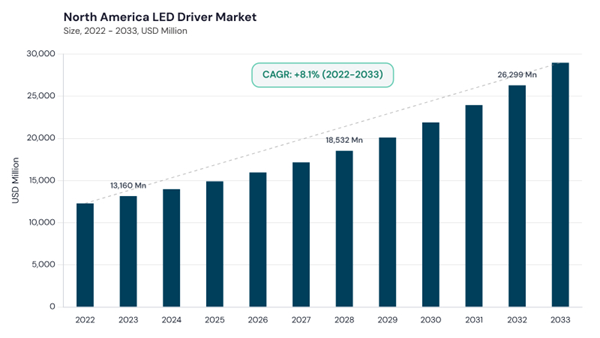
The North America LED driver market originated alongside the initial commercialization of LED lighting technologies in the late 20th century, fundamentally propelled by the need for efficient, reliable power supplies tailored to the unique electrical characteristics of LED modules. Early development focused on basic constant current or constant voltage drivers designed to replace conventional transformers and ballasts for incandescent and fluorescent lighting, marking a key transition from analog to more sophisticated electronics.
As LED adoption surged due to superior energy efficiency and longer lifespan relative to traditional lighting, the LED driver technologies evolved from simple components to integrated systems featuring dimming capabilities, thermal management, and power factor correction. Key turning points include the integration of smart controls and the demand for compatibility with emerging lighting protocols, enabling networking and automation in commercial and industrial settings.
Among the critical trends shaping the North America LED driver market is the acceleration in smart lighting integration driven by both energy efficiency mandates and the convergence of lighting with building automation systems. The cause of this trend lies in growing consumer and regulatory pressures for reduced energy consumption and smarter infrastructure, prompting a shift toward LED drivers capable of seamless communication with building management systems via protocols like DALI or Zigbee. Another significant trend is the shift towards enhanced thermal management and miniaturization of driver components, necessitated by the increasing luminance and compactness of LED modules.
Deployment Outlook
Based on Deployment Type, the market is segmented into Constant Current and Constant Voltage. The Constant Current segment dominated the North America LED Driver Market with a market value of USD 9.83 billion in 2025 owing to increasing deployment across commercial, industrial, and municipal lighting applications requiring stable current delivery and higher operational efficiency.Meanwhile, the Constant Voltage segment is expected to witness a CAGR of 8.4% during the forecast period due to rising demand for decorative lighting, LED strips, signage systems, and smart residential lighting applications. Increasing investments in smart city infrastructure and intelligent building systems continue to accelerate the adoption of programmable and dimmable LED driver technologies across North America.
Component Outlook
Based on Component, the market is segmented into Driver IC, Discrete Components, and Other Components. The Driver IC segment attained a market value of USD 6.52 billion in 2025 due to rising demand for advanced semiconductor-based power management technologies supporting dimming control, thermal regulation, and IoT-enabled lighting systems. On the other hand, the Discrete Components segment is projected to witness a CAGR of 8.9% during the forecast period owing to growing utilization in industrial lighting, horticulture lighting, and customized retrofit applications requiring flexible circuit architectures. Increasing semiconductor integration and advancements in programmable driver technologies are supporting innovation across the component ecosystem.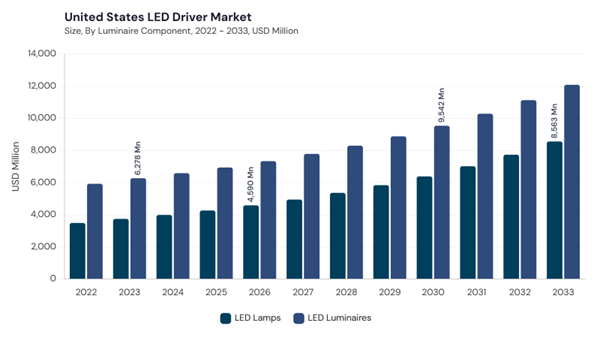
Luminaire Component Outlook
Based on Luminaire Component, the market is segmented into LED Lamps and LED Luminaires. The LED Lamps segment recorded a market size of USD 5.65 billion in 2025 due to increasing residential adoption of energy-efficient lighting systems and growing replacement of conventional incandescent and fluorescent bulbs.Meanwhile, the LED Luminaires segment is expected to register a CAGR of 7.9% during the forecast period owing to increasing deployment across commercial buildings, industrial facilities, smart city projects, and outdoor infrastructure applications. Demand for integrated lighting systems with advanced thermal management and smart control compatibility continues to strengthen market growth.
Installation Type Outlook
Based on Installation Type, the market is segmented into Internal LED Drivers and External LED Drivers. The Internal LED Drivers segment achieved a market size of USD 8.44 billion in 2025 owing to increasing demand for compact and aesthetically integrated lighting systems across residential and commercial environments.In contrast, the External LED Drivers segment is projected to witness a CAGR of 9.1% during the forecast period due to growing deployment in industrial lighting, infrastructure projects, and high-power outdoor applications requiring superior thermal management and easier maintenance accessibility. Increasing adoption of connected lighting systems is further driving innovation in external driver technologies.
Application Outlook
Based on Application, the market is segmented into Residential Lighting, Commercial Lighting, Industrial Lighting, Automotive, and Consumer Electronics. The Residential Lighting segment accounted for the largest revenue share with a market value of USD 4.23 billion in 2025 owing to growing smart home adoption and increasing consumer preference for energy-efficient lighting solutions.Meanwhile, the Commercial Lighting segment is expected to witness a CAGR of 8.8% during the forecast period due to rapid deployment across offices, retail stores, hospitality facilities, and institutional buildings focused on reducing operational energy costs and improving illumination quality. Industrial automation, warehouse modernization, and the increasing adoption of electric vehicles are also supporting demand across industrial and automotive lighting applications.
Country Outlook
The United States dominated the North America LED Driver Market owing to increasing investments in smart city infrastructure, commercial construction, industrial automation, and connected lighting technologies. Strong regulatory support for energy-efficient lighting systems and growing adoption of IoT-enabled lighting infrastructure continue to accelerate market growth across the country.Canada is witnessing increasing deployment of LED driver technologies due to rising energy-efficiency initiatives, smart building modernization, and expansion of intelligent public infrastructure projects. Government sustainability programs and investments in green construction continue to support market expansion.
List of Key Companies Profiled
- Texas Instruments
- Analog Devices
- Signify
- Inventronics
- Mean Well
- Acuity Brands
- Lutron Electronics
- Universal Lighting Technologies
- Cree (Wolfspeed)
- Philips Lighting North America
Market Report Segmentation
By Luminaire Component- LED Lamps
- LED Luminaires
- Driver IC
- Discrete Components
- Other Components
- Constant Current
- Constant Voltage
- Internal LED Drivers
- External LED Drivers
- Residential Lighting
- Commercial Lighting
- Industrial Lighting
- Automotive
- Consumer Electronics
- US
- Canada
- Mexico
- Rest of North America
Table of Contents
Chapter 1. North America Market1.1 Market Overview
1.2 Key Factors Impacting Market
1.2.1 Market Restraints
1.2.2 Market Opportunities
1.2.3 Market Challenges
1.2.4 Market Trends
1.2.5 State of Competition
1.2.6 Market Consolidation
1.2.7 Key Customer Criteria
1.3 Product Life Cycle
1.4 Segmentation By Luminaire Component
1.4.1 LED Lamps
1.4.2 LED Luminaires
1.5 Segmentation By Component
1.5.1 Driver IC
1.5.2 Discrete Components
1.5.3 Other Component
1.6 Segmentation By Supply Type
1.6.1 Constant Current
1.6.2 Constant Voltage
1.7 Segmentation By Installation Type
1.7.1 Internal LED Drivers
1.7.2 External LED Drivers
1.8 Segmentation By Application
1.8.1 Residential Lighting
1.8.2 Commercial Lighting
1.8.3 Industrial Lighting
1.8.4 Automotive
1.8.5 Consumer Electronics
1.8.6 Other Application
1.9 Segmentation By Country
1.9.1 US
1.9.1.1 Segmentation By Luminaire Component
1.9.1.1.1 LED Lamps
1.9.1.1.2 LED Luminaires
1.9.1.2 Segmentation By Supply Type
1.9.1.2.1 Constant Current
1.9.1.2.2 Constant Voltage
1.9.1.3 Segmentation By Component
1.9.1.3.1 Driver IC
1.9.1.3.2 Discrete Components
1.9.1.3.3 Other Component
1.9.1.4 Segmentation By Installation Type
1.9.1.4.1 Internal LED Drivers
1.9.1.4.2 External LED Drivers
1.9.1.5 Segmentation By Application
1.9.1.5.1 Residential Lighting
1.9.1.5.2 Commercial Lighting
1.9.1.5.3 Industrial Lighting
1.9.1.5.4 Automotive
1.9.1.5.5 Consumer Electronics
1.9.1.5.6 Other Application
1.9.2 Canada
1.9.2.1 Segmentation By Luminaire Component
1.9.2.1.1 LED Lamps
1.9.2.1.2 LED Luminaires
1.9.2.2 Segmentation By Supply Type
1.9.2.2.1 Constant Current
1.9.2.2.2 Constant Voltage
1.9.2.3 Segmentation By Component
1.9.2.3.1 Driver IC
1.9.2.3.2 Discrete Components
1.9.2.3.3 Other Component
1.9.2.4 Segmentation By Installation Type
1.9.2.4.1 Internal LED Drivers
1.9.2.4.2 External LED Drivers
1.9.2.5 Segmentation By Application
1.9.2.5.1 Residential Lighting
1.9.2.5.2 Commercial Lighting
1.9.2.5.3 Industrial Lighting
1.9.2.5.4 Automotive
1.9.2.5.5 Consumer Electronics
1.9.2.5.6 Other Application
1.9.3 Mexico
1.9.3.1 Segmentation By Luminaire Component
1.9.3.1.1 LED Lamps
1.9.3.1.2 LED Luminaires
1.9.3.2 Segmentation By Supply Type
1.9.3.2.1 Constant Current
1.9.3.2.2 Constant Voltage
1.9.3.3 Segmentation By Component
1.9.3.3.1 Driver IC
1.9.3.3.2 Discrete Components
1.9.3.3.3 Other Component
1.9.3.4 Segmentation By Installation Type
1.9.3.4.1 Internal LED Drivers
1.9.3.4.2 External LED Drivers
1.9.3.5 Segmentation By Application
1.9.3.5.1 Residential Lighting
1.9.3.5.2 Commercial Lighting
1.9.3.5.3 Industrial Lighting
1.9.3.5.4 Automotive
1.9.3.5.5 Consumer Electronics
1.9.3.5.6 Other Application
1.9.4 Rest of North America
1.9.4.1 Segmentation By Luminaire Component
1.9.4.1.1 LED Lamps
1.9.4.1.2 LED Luminaires
1.9.4.2 Segmentation By Supply Type
1.9.4.2.1 Constant Current
1.9.4.2.2 Constant Voltage
1.9.4.3 Segmentation By Component
1.9.4.3.1 Driver IC
1.9.4.3.2 Discrete Components
1.9.4.3.3 Other Component
1.9.4.4 Segmentation By Installation Type
1.9.4.4.1 Internal LED Drivers
1.9.4.4.2 External LED Drivers
1.9.4.5 Segmentation By Application
1.9.4.5.1 Residential Lighting
1.9.4.5.2 Commercial Lighting
1.9.4.5.3 Industrial Lighting
1.9.4.5.4 Automotive
1.9.4.5.5 Consumer Electronics
1.9.4.5.6 Other Application
Chapter 2. Company Snapshot
2.1 Signify N.V.
2.1.1 Business Overview
2.1.2 Key Information
2.1.3 Company Focus
2.1.4 Strategic Insights
2.1.5 Strategy Deployed
2.1.6 Product & Service Portfolio
2.1.7 Capability Overview
2.1.8 Technology & Innovation Focus
2.1.9 Customers / End Users
2.1.10 Competitive Positioning
2.1.11 Key Differentiators
2.1.12 Portfolio Matrix
2.1.13 SWOT Analysis
2.1.14 Future Outlook
2.2 ams-OSRAM AG
2.2.1 Business Overview
2.2.2 Key Information
2.2.3 Company Focus
2.2.4 Strategic Insights
2.2.5 Strategy Deployed
2.2.6 Product & Service Portfolio
2.2.7 Capability Overview
2.2.8 Technology & Innovation Focus
2.2.9 Customers / End Users
2.2.10 Competitive Positioning
2.2.11 Key Differentiators
2.2.12 Portfolio Matrix
2.2.13 SWOT Analysis
2.2.14 Future Outlook
2.3 Acuity Brands, Inc.
2.3.1 Business Overview
2.3.2 Key Information
2.3.3 Company Focus
2.3.4 Strategic Insights
2.3.5 Strategy Deployed
2.3.6 Product & Service Portfolio
2.3.7 Capability Overview
2.3.8 Technology & Innovation Focus
2.3.9 Customers / End Users
2.3.10 Competitive Positioning
2.3.11 Key Differentiators
2.3.12 Portfolio Matrix
2.3.13 SWOT Analysis
2.3.14 Future Outlook
2.4 Hubbell Incorporated
2.4.1 Business Overview
2.4.2 Key Information
2.4.3 Company Focus
2.4.4 Strategic Insights
2.4.5 Strategy Deployed
2.4.6 Product & Service Portfolio
2.4.7 Capability Overview
2.4.8 Technology & Innovation Focus
2.4.9 Customers / End Users
2.4.10 Competitive Positioning
2.4.11 Key Differentiators
2.4.12 Portfolio Matrix
2.4.13 SWOT Analysis
2.4.14 Future Outlook
2.5 Eaton Corporation plc
2.5.1 Business Overview
2.5.2 Key Information
2.5.3 Company Focus
2.5.4 Strategic Insights
2.5.5 Strategy Deployed
2.5.6 Product & Service Portfolio
2.5.7 Capability Overview
2.5.8 Technology & Innovation Focus
2.5.9 Customers / End Users
2.5.10 Competitive Positioning
2.5.11 Key Differentiators
2.5.12 Portfolio Matrix
2.5.13 SWOT Analysis
2.5.14 Future Outlook
2.6 Lutronic GmbH
2.6.1 Business Overview
2.6.2 Key Information
2.6.3 Company Focus
2.6.4 Strategic Insights
2.6.5 Strategy Deployed
2.6.6 Product & Service Portfolio
2.6.7 Capability Overview
2.6.8 Technology & Innovation Focus
2.6.9 Customers / End Users
2.6.10 Competitive Positioning
2.6.11 Key Differentiators
2.6.12 Portfolio Matrix
2.6.13 SWOT Analysis
2.6.14 Future Outlook
2.7 Penguin Solutions, Inc. (Cree LED)
2.7.1 Business Overview
2.7.2 Key Information
2.7.3 Company Focus
2.7.4 Strategic Insights
2.7.5 Strategy Deployed
2.7.6 Product & Service Portfolio
2.7.7 Capability Overview
2.7.8 Technology & Innovation Focus
2.7.9 Customers / End Users
2.7.10 Competitive Positioning
2.7.11 Key Differentiators
2.7.12 Portfolio Matrix
2.7.13 SWOT Analysis
2.7.14 Future Outlook
2.8 MEAN WELL Enterprises Co., Ltd.
2.8.1 Business Overview
2.8.2 Key Information
2.8.3 Company Focus
2.8.4 Strategic Insights
2.8.5 Strategy Deployed
2.8.6 Product & Service Portfolio
2.8.7 Capability Overview
2.8.8 Technology & Innovation Focus
2.8.9 Customers / End Users
2.8.10 Competitive Positioning
2.8.11 Key Differentiators
2.8.12 Portfolio Matrix
2.8.13 SWOT Analysis
2.8.14 Future Outlook
2.9 Inventronics
2.9.1 Business Overview
2.9.2 Key Information
2.9.3 Company Focus
2.9.4 Strategic Insights
2.9.5 Strategy Deployed
2.9.6 Product & Service Portfolio
2.9.7 Capability Overview
2.9.8 Technology & Innovation Focus
2.9.9 Customers / End Users
2.9.10 Competitive Positioning
2.9.11 Key Differentiators
2.9.12 Portfolio Matrix
2.9.13 SWOT Analysis
2.9.14 Future Outlook
2.10 Tridonic GmbH & Co KG
2.10.1 Business Overview
2.10.2 Key Information
2.10.3 Company Focus
2.10.4 Strategic Insights
2.10.5 Strategy Deployed
2.10.6 Product & Service Portfolio
2.10.7 Capability Overview
2.10.8 Technology & Innovation Focus
2.10.9 Customers / End Users
2.10.10 Competitive Positioning
2.10.11 Key Differentiators
2.10.12 Portfolio Matrix
2.10.13 SWOT Analysis
2.10.14 Future Outlook
Companies Mentioned
- Texas Instruments
- Analog Devices
- Signify
- Inventronics
- Mean Well
- Acuity Brands
- Lutron Electronics
- Universal Lighting Technologies
- Cree (Wolfspeed)
- Philips Lighting North America


