



The LAMEA Network Operations Center as a Service (NOCaaS) Market is expected to reach USD 360.7 million by 2029, growing at a CAGR of 12.4% during the forecast period of 2026-2033.
The market growth is driven by increasing cloud migration, rising demand for remote infrastructure monitoring, growing investments in cybersecurity frameworks, and expansion of digital transformation initiatives across Latin America, the Middle East, and Africa. Enterprises across the region are increasingly outsourcing network management operations to improve operational efficiency, reduce downtime, and support scalable hybrid IT environments.
The region is witnessing rising adoption of AI-enabled monitoring platforms, predictive maintenance tools, automated incident management systems, and software-defined networking solutions. Countries such as Brazil, UAE, Saudi Arabia, South Africa, and Nigeria are significantly investing in telecom modernization, smart city infrastructure, hyperscale data centers, and managed IT services, thereby creating strong growth opportunities for NOCaaS providers.
The market growth is driven by increasing cloud migration, rising demand for remote infrastructure monitoring, growing investments in cybersecurity frameworks, and expansion of digital transformation initiatives across Latin America, the Middle East, and Africa. Enterprises across the region are increasingly outsourcing network management operations to improve operational efficiency, reduce downtime, and support scalable hybrid IT environments.
The region is witnessing rising adoption of AI-enabled monitoring platforms, predictive maintenance tools, automated incident management systems, and software-defined networking solutions. Countries such as Brazil, UAE, Saudi Arabia, South Africa, and Nigeria are significantly investing in telecom modernization, smart city infrastructure, hyperscale data centers, and managed IT services, thereby creating strong growth opportunities for NOCaaS providers.
Enterprise Size Outlook
Based on Enterprise Size, the market is segmented into Large Enterprise and Small & Medium Enterprise (SMEs). The Large Enterprise segment dominated the LAMEA Network Operations Center as a Service Market in 2025 and accounted for a 64.6% share of the regional market. The segment is expected to continue to remain dominant until 2029; thereby, reaching a market value of USD 230.4 million by 2029, growing at a CAGR of 12.0% during the forecast period. The dominance of the segment is attributed to increasing deployment of hybrid cloud environments, rising cybersecurity spending, and strong adoption of AI-driven network automation platforms among large organizations. Meanwhile, the SMEs segment is expected to witness a CAGR of 13.0% during 2026-2033, supported by increasing affordability of subscription-based managed services and rising cloud adoption across SMEs.Support Model Outlook
Based on Support Model, the market is segmented into Offsite, Hybrid, and Onsite. The Offsite segment dominated the LAMEA Network Operations Center as a Service Market in 2025 and held a 53.8% share of the regional market. The segment is expected to continue to remain dominant until 2029; thereby, attaining a market value of USD 193.9 million by 2029, growing at a CAGR of 11.9% during the forecast period. The growth of the segment is supported by increasing enterprise preference for centralized remote monitoring, operational flexibility, and reduced infrastructure management costs. Additionally, the Hybrid segment is expected to witness a CAGR of 12.8% during 2026-2033 owing to increasing demand for combined onsite visibility and remote management capabilities across mission-critical environments.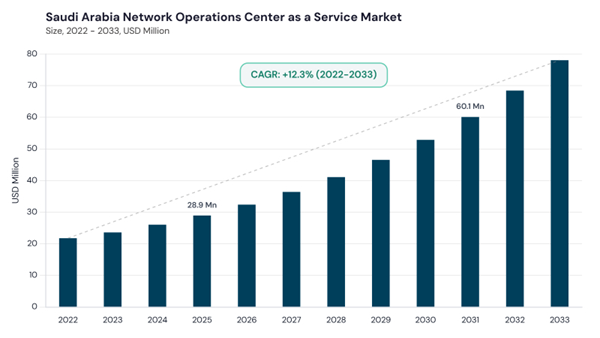
Service Type Outlook
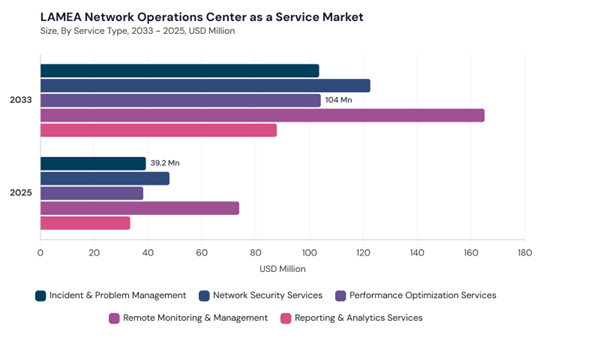
Based on Service Type, the market is segmented into Remote Monitoring & Management, Network Security Services, Incident & Problem Management, Performance Optimization Services, and Reporting & Analytics Services. The Remote Monitoring & Management segment dominated the LAMEA Network Operations Center as a Service Market in 2025 and accounted for a 31.7% share of the regional market. The segment is expected to continue to remain dominant until 2029; thereby, reaching a market value of USD 108.6 million by 2029, growing at a CAGR of 10.7% during the forecast period. The segment growth is driven by rising enterprise demand for proactive fault detection, predictive maintenance, real-time infrastructure visibility, and uninterrupted network performance management. Furthermore, the Performance Optimization Services segment is expected to witness the highest CAGR of 13.5% during 2026-2033 due to increasing adoption of AI-powered analytics, latency optimization, and workload balancing solutions across digital enterprises.End Use Outlook
Based on End Use, the market is segmented into IT & Telecom, BFSI, Healthcare, Retail & E-commerce, Manufacturing, Government & Public Sector, Energy & Utilities, and Other End Use. The IT & Telecom segment dominated the LAMEA Network Operations Center as a Service Market in 2025 owing to increasing deployment of telecom infrastructure modernization projects, expansion of 5G networks, and rising demand for low-latency connectivity services. The segment is expected to continue to remain dominant until 2029; thereby, reaching a market value of USD 93.6 million by 2029, growing at a CAGR of 10.4% during the forecast period. Additionally, the BFSI segment is expected to witness a CAGR of 12.7% during 2026-2033, while the Government & Public Sector segment is anticipated to register one of the fastest growth rates at 14.3% during the forecast period due to increasing smart city projects and public-sector digitalization initiatives across the region.Country Outlook
Brazil dominated the LAMEA Network Operations Center as a Service Market by country in 2025 and accounted for a 21.8% share of the regional market. The country is expected to continue to remain dominant until 2029; thereby, achieving a market value of USD 74.3 million by 2029, growing at a CAGR of 10.7% during the forecast period. The dominance of Brazil is attributed to increasing enterprise cloud adoption, expansion of managed IT services, and rising investments in telecom infrastructure modernization. The UAE market is expected to witness a CAGR of 11.2% during 2026-2033 driven by smart city developments and increasing adoption of AI-driven network management platforms. Additionally, the Saudi Arabia market is expected to witness a CAGR of 13.4% during the forecast period owing to large-scale digital transformation programs, rising hyperscale data center investments, and expanding cybersecurity initiatives under national digitalization strategies.List of Key Companies Profiled
- Cisco Systems, Inc.
- IBM Corporation
- AT&T Inc.
- Verizon Communications Inc.
- Lumen Technologies, Inc.
- Orange Business Services
- Hewlett Packard Enterprise Company
- Tata Communications Ltd.
- Broadcom, Inc.
- NEC Corporation
Market Report Segmentation
By Enterprise Size- Large Enterprise
- Small & Medium Enterprise (SMEs)
- Offsite
- Hybrid
- Onsite
- Remote Monitoring & Management
- Network Security Services
- Incident & Problem Management
- Performance Optimization Services
- Reporting & Analytics Services
- IT & Telecom
- BFSI
- Healthcare
- Retail & E-commerce
- Manufacturing
- Government & Public Sector
- Energy & Utilities
- Other End Use
- Brazil
- Argentina
- UAE
- Saudi Arabia
- South Africa
- Nigeria
- Rest of LAMEA
Table of Contents
Chapter 1. LAMEA Market1.1 Market Overview
1.2 Key Factors Impacting Market
1.2.1 Market Drivers
1.2.2 Market Restraints
1.2.3 Market Opportunities
1.2.4 Market Challenges
1.2.5 Market Trends
1.2.6 State of Competition
1.2.7 Market Consolidation
1.2.8 Key Customer Criteria
1.3 Product Life Cycle
1.4 Segmentation By Service Type
1.4.1 Remote Monitoring & Management
1.4.2 Network Security Services
1.4.3 Incident & Problem Management
1.4.4 Performance Optimization Services
1.4.5 Reporting & Analytics Services
1.5 Segmentation By Support Model
1.5.1 Onsite
1.5.2 Offsite
1.5.3 Hybrid
1.6 Segmentation By Enterprise Size
1.6.1 Large Enterprise
1.6.2 Small & Medium Enterprise (SMEs)
1.7 Segmentation By End Use
1.7.1 IT & Telecom
1.7.2 BFSI
1.7.3 Healthcare
1.7.4 Retail & E-commerce
1.7.5 Manufacturing
1.7.6 Government & Public Sector
1.7.7 Energy & Utilities
1.7.8 Other End use
1.8 Segmentation By Country
1.8.1 Brazil
1.8.1.1 Segmentation By Service Type
1.8.1.1.1 Remote Monitoring & Management
1.8.1.1.2 Network Security Services
1.8.1.1.3 Incident & Problem Management
1.8.1.1.4 Performance Optimization Services
1.8.1.1.5 Reporting & Analytics Services
1.8.1.2 Segmentation By Support Model
1.8.1.2.1 Onsite
1.8.1.2.2 Offsite
1.8.1.2.3 Hybrid
1.8.1.3 Segmentation By Enterprise Size
1.8.1.3.1 Large Enterprise
1.8.1.3.2 Small & Medium Enterprise (SMEs)
1.8.1.4 Segmentation By End Use
1.8.1.4.1 IT & Telecom
1.8.1.4.2 BFSI
1.8.1.4.3 Healthcare
1.8.1.4.4 Retail & E-commerce
1.8.1.4.5 Manufacturing
1.8.1.4.6 Government & Public Sector
1.8.1.4.7 Energy & Utilities
1.8.1.4.8 Others End use
1.8.2 Argentina
1.8.2.1 Segmentation By Service Type
1.8.2.1.1 Remote Monitoring & Management
1.8.2.1.2 Network Security Services
1.8.2.1.3 Incident & Problem Management
1.8.2.1.4 Performance Optimization Services
1.8.2.1.5 Reporting & Analytics Services
1.8.2.2 Segmentation By Support Model
1.8.2.2.1 Onsite
1.8.2.2.2 Offsite
1.8.2.2.3 Hybrid
1.8.2.3 Segmentation By Enterprise Size
1.8.2.3.1 Large Enterprise
1.8.2.3.2 Small & Medium Enterprise (SMEs)
1.8.2.4 Segmentation By End Use
1.8.2.4.1 IT & Telecom
1.8.2.4.2 BFSI
1.8.2.4.3 Healthcare
1.8.2.4.4 Retail & E-commerce
1.8.2.4.5 Manufacturing
1.8.2.4.6 Government & Public Sector
1.8.2.4.7 Energy & Utilities
1.8.2.4.8 Others End use
1.8.3 UAE
1.8.3.1 Segmentation By Service Type
1.8.3.1.1 Remote Monitoring & Management
1.8.3.1.2 Network Security Services
1.8.3.1.3 Incident & Problem Management
1.8.3.1.4 Performance Optimization Services
1.8.3.1.5 Reporting & Analytics Services
1.8.3.2 Segmentation By Support Model
1.8.3.2.1 Onsite
1.8.3.2.2 Offsite
1.8.3.2.3 Hybrid
1.8.3.3 Segmentation By Enterprise Size
1.8.3.3.1 Large Enterprise
1.8.3.3.2 Small & Medium Enterprise (SMEs)
1.8.3.4 Segmentation By End Use
1.8.3.4.1 IT & Telecom
1.8.3.4.2 BFSI
1.8.3.4.3 Healthcare
1.8.3.4.4 Retail & E-commerce
1.8.3.4.5 Manufacturing
1.8.3.4.6 Government & Public Sector
1.8.3.4.7 Energy & Utilities
1.8.3.4.8 Others End use
1.8.4 Saudi Arabia
1.8.4.1 Segmentation By Service Type
1.8.4.1.1 Remote Monitoring & Management
1.8.4.1.2 Network Security Services
1.8.4.1.3 Incident & Problem Management
1.8.4.1.4 Performance Optimization Services
1.8.4.1.5 Reporting & Analytics Services
1.8.4.2 Segmentation By Support Model
1.8.4.2.1 Onsite
1.8.4.2.2 Offsite
1.8.4.2.3 Hybrid
1.8.4.3 Segmentation By Enterprise Size
1.8.4.3.1 Large Enterprise
1.8.4.3.2 Small & Medium Enterprise (SMEs)
1.8.4.4 Segmentation By End Use
1.8.4.4.1 IT & Telecom
1.8.4.4.2 BFSI
1.8.4.4.3 Healthcare
1.8.4.4.4 Retail & E-commerce
1.8.4.4.5 Manufacturing
1.8.4.4.6 Government & Public Sector
1.8.4.4.7 Energy & Utilities
1.8.4.4.8 Others End use
1.8.5 South Africa
1.8.5.1 Segmentation By Service Type
1.8.5.1.1 Remote Monitoring & Management
1.8.5.1.2 Network Security Services
1.8.5.1.3 Incident & Problem Management
1.8.5.1.4 Performance Optimization Services
1.8.5.1.5 Reporting & Analytics Services
1.8.5.2 Segmentation By Support Model
1.8.5.2.1 Onsite
1.8.5.2.2 Offsite
1.8.5.2.3 Hybrid
1.8.5.3 Segmentation By Enterprise Size
1.8.5.3.1 Large Enterprise
1.8.5.3.2 Small & Medium Enterprise (SMEs)
1.8.5.4 Segmentation By End Use
1.8.5.4.1 IT & Telecom
1.8.5.4.2 BFSI
1.8.5.4.3 Healthcare
1.8.5.4.4 Retail & E-commerce
1.8.5.4.5 Manufacturing
1.8.5.4.6 Government & Public Sector
1.8.5.4.7 Energy & Utilities
1.8.5.4.8 Others End use
1.8.6 Nigeria
1.8.6.1 Segmentation By Service Type
1.8.6.1.1 Remote Monitoring & Management
1.8.6.1.2 Network Security Services
1.8.6.1.3 Incident & Problem Management
1.8.6.1.4 Performance Optimization Services
1.8.6.1.5 Reporting & Analytics Services
1.8.6.2 Segmentation By Support Model
1.8.6.2.1 Onsite
1.8.6.2.2 Offsite
1.8.6.2.3 Hybrid
1.8.6.3 Segmentation By Enterprise Size
1.8.6.3.1 Large Enterprise
1.8.6.3.2 Small & Medium Enterprise (SMEs)
1.8.6.4 Segmentation By End Use
1.8.6.4.1 IT & Telecom
1.8.6.4.2 BFSI
1.8.6.4.3 Healthcare
1.8.6.4.4 Retail & E-commerce
1.8.6.4.5 Manufacturing
1.8.6.4.6 Government & Public Sector
1.8.6.4.7 Energy & Utilities
1.8.6.4.8 Others End use
1.8.7 Rest of LAMEA
1.8.7.1 Segmentation By Service Type
1.8.7.1.1 Remote Monitoring & Management
1.8.7.1.2 Network Security Services
1.8.7.1.3 Incident & Problem Management
1.8.7.1.4 Performance Optimization Services
1.8.7.1.5 Reporting & Analytics Services
1.8.7.2 Segmentation By Support Model
1.8.7.2.1 Onsite
1.8.7.2.2 Offsite
1.8.7.2.3 Hybrid
1.8.7.3 Segmentation By Enterprise Size
1.8.7.3.1 Large Enterprise
1.8.7.3.2 Small & Medium Enterprise (SMEs)
1.8.7.4 Segmentation By End Use
1.8.7.4.1 IT & Telecom
1.8.7.4.2 BFSI
1.8.7.4.3 Healthcare
1.8.7.4.4 Retail & E-commerce
1.8.7.4.5 Manufacturing
1.8.7.4.6 Government & Public Sector
1.8.7.4.7 Energy & Utilities
1.8.7.4.8 Others End use
Chapter 2. Company Snapshot
2.1 ConnectWise, LLC
2.1.1 Business Overview
2.1.2 Key Information
2.1.3 Company Focus
2.1.4 Strategic Insights
2.1.5 Strategy Deployed
2.1.6 Product & Service Portfolio
2.1.7 Capability Overview
2.1.8 Technology & Innovation Focus
2.1.9 Customers / End Users
2.1.10 Competitive Positioning
2.1.11 Key Differentiators
2.1.12 Portfolio Matrix
2.1.13 SWOT Analysis
2.1.14 Future Outlook
2.2 ExterNetworks Inc.
2.2.1 Business Overview
2.2.2 Key Information
2.2.3 Company Focus
2.2.4 Strategic Insights
2.2.5 Strategy Deployed
2.2.6 Product & Service Portfolio
2.2.7 Capability Overview
2.2.8 Technology & Innovation Focus
2.2.9 Customers / End Users
2.2.10 Competitive Positioning
2.2.11 Key Differentiators
2.2.12 Portfolio Matrix
2.2.13 SWOT Analysis
2.2.14 Future Outlook
2.3 Fujitsu Limited
2.3.1 Business Overview
2.3.2 Key Information
2.3.3 Company Focus
2.3.4 Strategic Insights
2.3.5 Strategy Deployed
2.3.6 Product & Service Portfolio
2.3.7 Capability Overview
2.3.8 Technology & Innovation Focus
2.3.9 Customers / End Users
2.3.10 Competitive Positioning
2.3.11 Key Differentiators
2.3.12 Portfolio Matrix
2.3.13 SWOT Analysis
2.3.14 Future Outlook
2.4 iGLASS Networks
2.4.1 Business Overview
2.4.2 Key Information
2.4.3 Company Focus
2.4.4 Strategic Insights
2.4.5 Strategy Deployed
2.4.6 Product & Service Portfolio
2.4.7 Capability Overview
2.4.8 Technology & Innovation Focus
2.4.9 Customers / End Users
2.4.10 Competitive Positioning
2.4.11 Key Differentiators
2.4.12 Portfolio Matrix
2.4.13 SWOT Analysis
2.4.14 Future Outlook
2.5 INOC
2.5.1 Business Overview
2.5.2 Key Information
2.5.3 Company Focus
2.5.4 Strategic Insights
2.5.5 Strategy Deployed
2.5.6 Product & Service Portfolio
2.5.7 Capability Overview
2.5.8 Technology & Innovation Focus
2.5.9 Customers / End Users
2.5.10 Competitive Positioning
2.5.11 Key Differentiators
2.5.12 Portfolio Matrix
2.5.13 SWOT Analysis
2.5.14 Future Outlook
2.6 Infrassist Technologies Pvt. Ltd.
2.6.1 Business Overview
2.6.2 Key Information
2.6.3 Company Focus
2.6.4 Strategic Insights
2.6.5 Strategy Deployed
2.6.6 Product & Service Portfolio
2.6.7 Capability Overview
2.6.8 Technology & Innovation Focus
2.6.9 Customers / End Users
2.6.10 Competitive Positioning
2.6.11 Key Differentiators
2.6.12 Portfolio Matrix
2.6.13 SWOT Analysis
2.6.14 Future Outlook
2.7 Netrio, LLC
2.7.1 Business Overview
2.7.2 Key Information
2.7.3 Company Focus
2.7.4 Strategic Insights
2.7.5 Strategy Deployed
2.7.6 Product & Service Portfolio
2.7.7 Capability Overview
2.7.8 Technology & Innovation Focus
2.7.9 Customers / End Users
2.7.10 Competitive Positioning
2.7.11 Key Differentiators
2.7.12 Portfolio Matrix
2.7.13 SWOT Analysis
2.7.14 Future Outlook
2.8 Park Place Technologies, LLC
2.8.1 Business Overview
2.8.2 Key Information
2.8.3 Company Focus
2.8.4 Strategic Insights
2.8.5 Strategy Deployed
2.8.6 Product & Service Portfolio
2.8.7 Capability Overview
2.8.8 Technology & Innovation Focus
2.8.9 Customers / End Users
2.8.10 Competitive Positioning
2.8.11 Key Differentiators
2.8.12 Portfolio Matrix
2.8.13 SWOT Analysis
2.8.14 Future Outlook
2.9 Mission Control NOC
2.9.1 Business Overview
2.9.2 Key Information
2.9.3 Company Focus
2.9.4 Strategic Insights
2.9.5 Strategy Deployed
2.9.6 Product & Service Portfolio
2.9.7 Capability Overview
2.9.8 Technology & Innovation Focus
2.9.9 Customers / End Users
2.9.10 Competitive Positioning
2.9.11 Key Differentiators
2.9.12 Portfolio Matrix
2.9.13 SWOT Analysis
2.9.14 Future Outlook
2.10 Netenrich
2.10.1 Business Overview
2.10.2 Key Information
2.10.3 Company Focus
2.10.4 Strategic Insights
2.10.5 Strategy Deployed
2.10.6 Product & Service Portfolio
2.10.7 Capability Overview
2.10.8 Technology & Innovation Focus
2.10.9 Customers / End Users
2.10.10 Competitive Positioning
2.10.11 Key Differentiators
2.10.12 Portfolio Matrix
2.10.13 SWOT Analysis
2.10.14 Future Outlook
Companies Mentioned
- Cisco Systems, Inc.
- IBM Corporation
- AT&T Inc.
- Verizon Communications Inc.
- Lumen Technologies, Inc.
- Orange Business Services
- Hewlett Packard Enterprise Company
- Tata Communications Ltd.
- Broadcom, Inc.
- NEC Corporation


