



The Europe Procurement Software Market is expected to reach USD 5.93 billion by 2032, growing at a CAGR of 9.7% during 2026-2033.
Germany dominated the Europe Procurement Software Market by country in 2025 and is expected to continue to be a dominant market till 2032; thereby, achieving a market value of USD 1.21 billion by 2032. The UK market is expected to witness a CAGR of 8.6% during 2026-2033. Additionally, the France market would register a CAGR of 10.5% during 2026-2033.
Cloud computing, automation technologies, and enterprise resource planning (ERP) integration transformed procurement software into a strategic business tool capable of managing spend analysis, supplier relationships, contract compliance, and sourcing optimization. The increasing adoption of AI-driven analytics, workflow automation, and predictive procurement intelligence has further strengthened market growth across Europe. In addition, regulatory frameworks related to data privacy, sustainability reporting, and supplier transparency continue to encourage enterprises to modernize procurement operations across multiple industries.
Several major trends are currently influencing the Europe Procurement Software Market. Enterprises are increasingly investing in AI-enabled procurement systems to automate sourcing, supplier evaluation, and contract lifecycle management processes. Organizations are also prioritizing cloud-native procurement ecosystems that provide real-time visibility, remote accessibility, and seamless supplier collaboration. Sustainability-focused procurement strategies and ESG compliance requirements are driving demand for software platforms capable of tracking ethical sourcing practices and carbon footprint metrics.
The growing focus on Industry 4.0 and supply chain resilience is further accelerating the adoption of cloud-based procurement solutions. Additionally, strict European Union compliance regulations, including GDPR and sustainability reporting requirements, are encouraging enterprises to deploy procurement software with advanced compliance and analytics capabilities. Procurement modernization initiatives across automotive, manufacturing, BFSI, and retail sectors are expected to continue driving the market growth in Germany through 2032.
Germany dominated the Europe Procurement Software Market by country in 2025 and is expected to continue to be a dominant market till 2032; thereby, achieving a market value of USD 1.21 billion by 2032. The UK market is expected to witness a CAGR of 8.6% during 2026-2033. Additionally, the France market would register a CAGR of 10.5% during 2026-2033.
Cloud computing, automation technologies, and enterprise resource planning (ERP) integration transformed procurement software into a strategic business tool capable of managing spend analysis, supplier relationships, contract compliance, and sourcing optimization. The increasing adoption of AI-driven analytics, workflow automation, and predictive procurement intelligence has further strengthened market growth across Europe. In addition, regulatory frameworks related to data privacy, sustainability reporting, and supplier transparency continue to encourage enterprises to modernize procurement operations across multiple industries.
Several major trends are currently influencing the Europe Procurement Software Market. Enterprises are increasingly investing in AI-enabled procurement systems to automate sourcing, supplier evaluation, and contract lifecycle management processes. Organizations are also prioritizing cloud-native procurement ecosystems that provide real-time visibility, remote accessibility, and seamless supplier collaboration. Sustainability-focused procurement strategies and ESG compliance requirements are driving demand for software platforms capable of tracking ethical sourcing practices and carbon footprint metrics.
Deployment Outlook
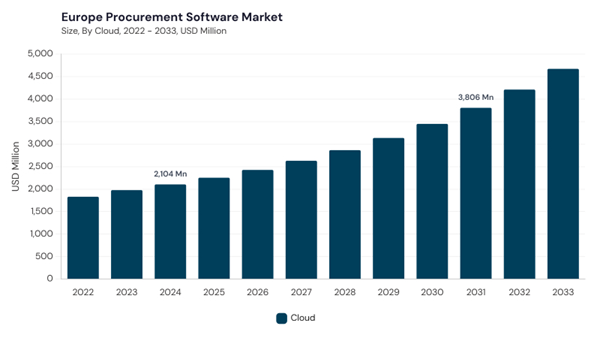
Based on Deployment, the market is segmented into Cloud and On-Premise. The Cloud market dominated the Europe Procurement Software Market by Deployment in 2025 and is expected to continue to be a dominant segment till 2032; thereby, achieving a market value of USD 4.21 billion by 2032. The On-Premise market is expected to witness a CAGR of 9.5% during 2026-2033.Enterprise Size Outlook
Based on Enterprise Size, the market is segmented into Large Enterprise and Small and Medium Enterprises (SMEs). The Large Enterprise market dominated the Europe Procurement Software Market by Enterprise Size in 2025 and is expected to continue to be a dominant segment till 2032; thereby, achieving a market value of USD 3.87 billion by 2032. The Small and Medium Enterprises (SMEs) market is anticipated to witness a CAGR of 10.4% during 2026-2033.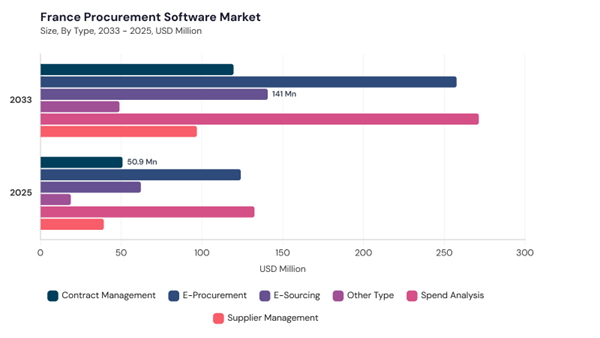
Type Outlook
Based on Type, the market is segmented into Spend Analysis, E-Procurement, E-Sourcing, Contract Management, Supplier Management, and Other Type. The Spend Analysis market dominated the Europe Procurement Software Market by Type in 2025 and is expected to continue to be a dominant segment till 2032; thereby, achieving a market value of USD 1.72 billion by 2032. The E-Procurement market is expected to witness a CAGR of 9.0% during 2026-2033. Additionally, the E-Sourcing market is expected to witness a CAGR of 10.2% during 2026-2033.End Use Outlook
Based on End Use, the market is segmented into Manufacturing & Automotive, Retail & E-commerce, BFSI, IT & Telecom, Healthcare & Pharmaceuticals, Energy & Utilities, and Other End Use. The Manufacturing & Automotive market dominated the Europe Procurement Software Market by End Use in 2025 and is expected to continue to be a dominant segment till 2032; thereby, achieving a market value of USD 1.33 billion by 2032. The Retail & E-commerce market is expected to witness a CAGR of 8.3% during 2026-2033. Additionally, the BFSI market is expected to witness a CAGR of 10.4% during 2026-2033.Country Outlook
Germany represents the largest market for procurement software in Europe due to its strong industrial base, extensive manufacturing ecosystem, and early adoption of digital transformation initiatives across enterprises. Organizations in Germany are increasingly investing in AI-enabled procurement platforms to optimize supplier management, automate sourcing workflows, and improve spend visibility.The growing focus on Industry 4.0 and supply chain resilience is further accelerating the adoption of cloud-based procurement solutions. Additionally, strict European Union compliance regulations, including GDPR and sustainability reporting requirements, are encouraging enterprises to deploy procurement software with advanced compliance and analytics capabilities. Procurement modernization initiatives across automotive, manufacturing, BFSI, and retail sectors are expected to continue driving the market growth in Germany through 2032.
List of Key Companies Profiled
- SAP SE
- Oracle Corporation
- Coupa Software Inc.
- IBM Corporation
- GEP Worldwide
- Jaggaer
- Ivalua Inc.
- Procurify Technologies Inc.
- Zycus Inc.
- Basware Corporation
Market Report Segmentation
By Deployment- Cloud
- On-Premise
- Large Enterprise
- Small and Medium Enterprises (SMEs)
- Spend Analysis
- E-Procurement
- E-Sourcing
- Contract Management
- Supplier Management
- Other Type
- Manufacturing & Automotive
- Retail & E-commerce
- BFSI
- IT & Telecom
- Healthcare & Pharmaceuticals
- Energy & Utilities
- Other End Use
- Germany
- UK
- France
- Russia
- Spain
- Italy
- Rest of Europe
Table of Contents
Chapter 1. Europe Market1.1 Market Overview
1.2 Key Factors Impacting Market
1.2.1 Market Drivers
1.2.2 Market Restraints
1.2.3 Market Opportunities
1.2.4 Market Challenges
1.2.5 Market Trends
1.2.6 State of Competition
1.2.7 Market Consolidation
1.2.8 Key Customer Criteria
1.3 Product Life Cycle
1.4 Segmentation By Type
1.4.1 Spend Analysis
1.4.2 E-Sourcing
1.4.3 E-Procurement
1.4.4 Contract Management
1.4.5 Supplier Management
1.4.6 Other Type
1.5 Segmentation By Deployment
1.5.1 Cloud
1.5.2 On-Premise
1.6 Segmentation By Enterprise Size
1.6.1 Large Enterprise
1.6.2 Small and Medium Enterprises (SMEs)
1.7 Segmentation By End Use
1.7.1 Energy & Utilities
1.7.2 BFSI
1.7.3 IT & Telecom
1.7.4 Manufacturing & Automotive
1.7.5 Healthcare & Pharmaceuticals
1.7.6 Retail & E-commerce
1.7.7 Other End Use
1.8 Segmentation By Country
1.8.1 Germany
1.8.1.1 Segmentation By Type
1.8.1.1.1 Spend Analysis
1.8.1.1.2 E-Sourcing
1.8.1.1.3 E-Procurement
1.8.1.1.4 Contract Management
1.8.1.1.5 Supplier Management
1.8.1.1.6 Other Type
1.8.1.2 Segmentation By Deployment
1.8.1.2.1 Cloud
1.8.1.2.2 On-Premise
1.8.1.3 Segmentation By Enterprise Size
1.8.1.3.1 Large Enterprise
1.8.1.3.2 Small and Medium Enterprises (SMEs)
1.8.1.4 Segmentation By End Use
1.8.1.4.1 Energy & Utilities
1.8.1.4.2 BFSI
1.8.1.4.3 IT & Telecom
1.8.1.4.4 Manufacturing & Automotive
1.8.1.4.5 Healthcare & Pharmaceuticals
1.8.1.4.6 Retail & E-commerce
1.8.1.4.7 Other End Use
1.8.2 United Kingdom
1.8.2.1 Segmentation By Type
1.8.2.1.1 Spend Analysis
1.8.2.1.2 E-Sourcing
1.8.2.1.3 E-Procurement
1.8.2.1.4 Contract Management
1.8.2.1.5 Supplier Management
1.8.2.1.6 Other Type
1.8.2.2 Segmentation By Deployment
1.8.2.2.1 Cloud
1.8.2.2.2 On-Premise
1.8.2.3 Segmentation By Enterprise Size
1.8.2.3.1 Large Enterprise
1.8.2.3.2 Small and Medium Enterprises (SMEs)
1.8.2.4 Segmentation By End Use
1.8.2.4.1 Energy & Utilities
1.8.2.4.2 BFSI
1.8.2.4.3 IT & Telecom
1.8.2.4.4 Manufacturing & Automotive
1.8.2.4.5 Healthcare & Pharmaceuticals
1.8.2.4.6 Retail & E-commerce
1.8.2.4.7 Other End Use
1.8.3 France
1.8.3.1 Segmentation By Type
1.8.3.1.1 Spend Analysis
1.8.3.1.2 E-Sourcing
1.8.3.1.3 E-Procurement
1.8.3.1.4 Contract Management
1.8.3.1.5 Supplier Management
1.8.3.1.6 Other Type
1.8.3.2 Segmentation By Deployment
1.8.3.2.1 Cloud
1.8.3.2.2 On-Premise
1.8.3.3 Segmentation By Enterprise Size
1.8.3.3.1 Large Enterprise
1.8.3.3.2 Small and Medium Enterprises (SMEs)
1.8.3.4 Segmentation By End Use
1.8.3.4.1 Energy & Utilities
1.8.3.4.2 BFSI
1.8.3.4.3 IT & Telecom
1.8.3.4.4 Manufacturing & Automotive
1.8.3.4.5 Healthcare & Pharmaceuticals
1.8.3.4.6 Retail & E-commerce
1.8.3.4.7 Other End Use
1.8.4 Russia
1.8.4.1 Segmentation By Type
1.8.4.1.1 Spend Analysis
1.8.4.1.2 E-Sourcing
1.8.4.1.3 E-Procurement
1.8.4.1.4 Contract Management
1.8.4.1.5 Supplier Management
1.8.4.1.6 Other Type
1.8.4.2 Segmentation By Deployment
1.8.4.2.1 Cloud
1.8.4.2.2 On-Premise
1.8.4.3 Segmentation By Enterprise Size
1.8.4.3.1 Large Enterprise
1.8.4.3.2 Small and Medium Enterprises (SMEs)
1.8.4.4 Segmentation By End Use
1.8.4.4.1 Energy & Utilities
1.8.4.4.2 BFSI
1.8.4.4.3 IT & Telecom
1.8.4.4.4 Manufacturing & Automotive
1.8.4.4.5 Healthcare & Pharmaceuticals
1.8.4.4.6 Retail & E-commerce
1.8.4.4.7 Other End Use
1.8.5 Spain
1.8.5.1 Segmentation By Type
1.8.5.1.1 Spend Analysis
1.8.5.1.2 E-Sourcing
1.8.5.1.3 E-Procurement
1.8.5.1.4 Contract Management
1.8.5.1.5 Supplier Management
1.8.5.1.6 Other Type
1.8.5.2 Segmentation By Deployment
1.8.5.2.1 Cloud
1.8.5.2.2 On-Premise
1.8.5.3 Segmentation By Enterprise Size
1.8.5.3.1 Large Enterprise
1.8.5.3.2 Small and Medium Enterprises (SMEs)
1.8.5.4 Segmentation By End Use
1.8.5.4.1 Energy & Utilities
1.8.5.4.2 BFSI
1.8.5.4.3 IT & Telecom
1.8.5.4.4 Manufacturing & Automotive
1.8.5.4.5 Healthcare & Pharmaceuticals
1.8.5.4.6 Retail & E-commerce
1.8.5.4.7 Other End Use
1.8.6 Italy
1.8.6.1 Segmentation By Type
1.8.6.1.1 Spend Analysis
1.8.6.1.2 E-Sourcing
1.8.6.1.3 E-Procurement
1.8.6.1.4 Contract Management
1.8.6.1.5 Supplier Management
1.8.6.1.6 Other Type
1.8.6.2 Segmentation By Deployment
1.8.6.2.1 Cloud
1.8.6.2.2 On-Premise
1.8.6.3 Segmentation By Enterprise Size
1.8.6.3.1 Large Enterprise
1.8.6.3.2 Small and Medium Enterprises (SMEs)
1.8.6.4 Segmentation By End Use
1.8.6.4.1 Energy & Utilities
1.8.6.4.2 BFSI
1.8.6.4.3 IT & Telecom
1.8.6.4.4 Manufacturing & Automotive
1.8.6.4.5 Healthcare & Pharmaceuticals
1.8.6.4.6 Retail & E-commerce
1.8.6.4.7 Other End Use
1.8.7 Rest of Europe
1.8.7.1 Segmentation By Type
1.8.7.1.1 Spend Analysis
1.8.7.1.2 E-Sourcing
1.8.7.1.3 E-Procurement
1.8.7.1.4 Contract Management
1.8.7.1.5 Supplier Management
1.8.7.1.6 Other Type
1.8.7.2 Segmentation By Deployment
1.8.7.2.1 Cloud
1.8.7.2.2 On-Premise
1.8.7.3 Segmentation By Enterprise Size
1.8.7.3.1 Large Enterprise
1.8.7.3.2 Small and Medium Enterprises (SMEs)
1.8.7.4 Segmentation By End Use
1.8.7.4.1 Energy & Utilities
1.8.7.4.2 BFSI
1.8.7.4.3 IT & Telecom
1.8.7.4.4 Manufacturing & Automotive
1.8.7.4.5 Healthcare & Pharmaceuticals
1.8.7.4.6 Retail & E-commerce
1.8.7.4.7 Other End Use
Chapter 2. Company Profiles
2.1 SAP SE
2.1.1 Company Overview
2.1.2 Financial Analysis
2.1.3 Segmental and Regional Analysis
2.1.2 Research & Development Expense
2.2 Coupa Software, Inc.
2.2.1 Company Overview
2.3 Oracle Corporation
2.3.1 Company Overview
2.3.2 Financial Analysis
2.3.3 Segmental and Regional Analysis
2.3.2 Research & Development Expense
2.3.5 Recent Strategies and Developments
2.3.5.1 Product Launches and Product Expansions
2.3.6 SWOT Analysis
2.2 NB Ventures, Inc. (GEP)
2.2.1 Company Overview
2.2.2 Recent Strategies and Developments
2.2.2.1 Product Launches and Product Expansions
2.5 Ivalua Inc.
2.5.1 Company Overview
2.5.2 Recent Strategies and Developments
2.5.2.1 Partnerships, Collaborations, and Agreements
2.5.2.2 Geographical Expansions
2.6 JAGGAER, LLC
2.6.1 Company Overview
2.7 Zycus, Inc.
2.7.1 Company Overview
2.8 Basware Corporation
2.8.1 Company Overview
2.9 Infor, Inc. (Koch Industries)
2.9.1 Company Overview
2.9.2 SWOT Analysis
2.1 Workday, Inc.
2.10.1 Company Overview
2.10.2 Financial Analysis
2.10.3 Regional Analysis
2.10.2 Recent Strategies and Developments
2.10.2.1 Product Launches and Product Expansions
2.10.2.2 Acquisition and Mergers
2.10.5 SWOT Analysis
Companies Mentioned
- SAP SE
- Oracle Corporation
- Coupa Software Inc.
- IBM Corporation
- GEP Worldwide
- Jaggaer
- Ivalua Inc.
- Procurify Technologies Inc.
- Zycus Inc.
- Basware Corporation


