



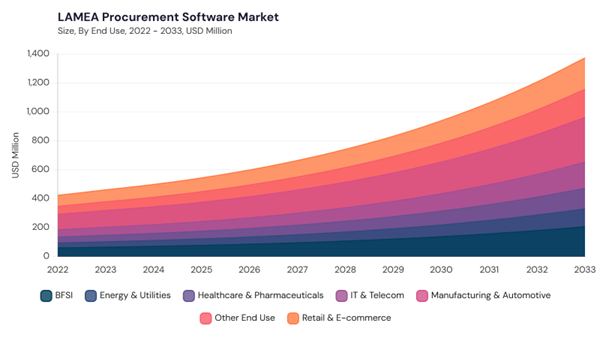
The LAMEA Procurement Software Market to reach USD 938.8 million by 2030, growing at a CAGR of 12.6% during 2026-2033.
Brazil dominated the LAMEA Procurement Software Market by country in 2025 and is expected to continue to be a dominant market till 2030; thereby, achieving a market value of USD 183.5 million by 2030. The UAE market is expected to witness a CAGR of 11.4% during 2026-2033. Additionally, the South Africa market would register a CAGR of 13.7% during 2026-2033.
The LAMEA Procurement Software Market emerged as organizations across Latin America, the Middle East, and Africa increasingly shifted toward digital procurement solutions to improve operational efficiency, supplier management, and procurement transparency. Initially, procurement activities in many countries across the region relied heavily on manual processes and fragmented legacy systems, limiting procurement visibility and increasing operational inefficiencies.
Several major trends are shaping the LAMEA Procurement Software Market. Organizations are increasingly investing in cloud-based procurement solutions to improve scalability, remote accessibility, and cost efficiency. AI-powered procurement analytics, supplier risk management, and automated sourcing capabilities are gaining traction as enterprises seek to optimize procurement decisions and reduce operational costs.
Businesses are also focusing on ESG-focused procurement strategies and supplier transparency, driving demand for procurement platforms that support sustainability tracking and regulatory compliance. Additionally, integration of predictive analytics, machine learning, and automation technologies is enhancing procurement visibility, supplier collaboration, and operational resilience. These developments are transforming procurement software from a transactional procurement tool into a strategic enterprise management platform supporting long-term supply chain optimization across the LAMEA region.
Brazil dominated the LAMEA Procurement Software Market by country in 2025 and is expected to continue to be a dominant market till 2030; thereby, achieving a market value of USD 183.5 million by 2030. The UAE market is expected to witness a CAGR of 11.4% during 2026-2033. Additionally, the South Africa market would register a CAGR of 13.7% during 2026-2033.
The LAMEA Procurement Software Market emerged as organizations across Latin America, the Middle East, and Africa increasingly shifted toward digital procurement solutions to improve operational efficiency, supplier management, and procurement transparency. Initially, procurement activities in many countries across the region relied heavily on manual processes and fragmented legacy systems, limiting procurement visibility and increasing operational inefficiencies.
Several major trends are shaping the LAMEA Procurement Software Market. Organizations are increasingly investing in cloud-based procurement solutions to improve scalability, remote accessibility, and cost efficiency. AI-powered procurement analytics, supplier risk management, and automated sourcing capabilities are gaining traction as enterprises seek to optimize procurement decisions and reduce operational costs.
Businesses are also focusing on ESG-focused procurement strategies and supplier transparency, driving demand for procurement platforms that support sustainability tracking and regulatory compliance. Additionally, integration of predictive analytics, machine learning, and automation technologies is enhancing procurement visibility, supplier collaboration, and operational resilience. These developments are transforming procurement software from a transactional procurement tool into a strategic enterprise management platform supporting long-term supply chain optimization across the LAMEA region.
Deployment Outlook
Based on Deployment, the market is segmented into Cloud and On-Premise. The Cloud market dominated the LAMEA Procurement Software Market by Deployment in 2025 and is expected to continue to be a dominant segment till 2030; thereby, achieving a market value of USD 672.5 million by 2030. The On-Premise market is expected to witness a CAGR of 12.4% during 2026-2033.Enterprise Size Outlook
Based on Enterprise Size, the market is segmented into Large Enterprise and Small and Medium Enterprises (SMEs). The Large Enterprise market dominated the LAMEA Procurement Software Market by Enterprise Size in 2025 and is expected to continue to be a dominant segment till 2030; thereby, achieving a market value of USD 624.6 million by 2030. The Small and Medium Enterprises (SMEs) market is anticipated to witness a CAGR of 13.4% during 2026-2033.Type Outlook
Based on Type, the market is segmented into Spend Analysis, E-Procurement, E-Sourcing, Contract Management, Supplier Management, and Other Type. The Spend Analysis market dominated the LAMEA Procurement Software Market by Type in 2025 and is expected to continue to be a dominant segment till 2030; thereby, achieving a market value of USD 281.0 million by 2030. The E-Procurement market is expected to witness a CAGR of 11.8% during 2026-2033. Additionally, the E-Sourcing market is expected to witness a CAGR of 13.2% during 2026-2033.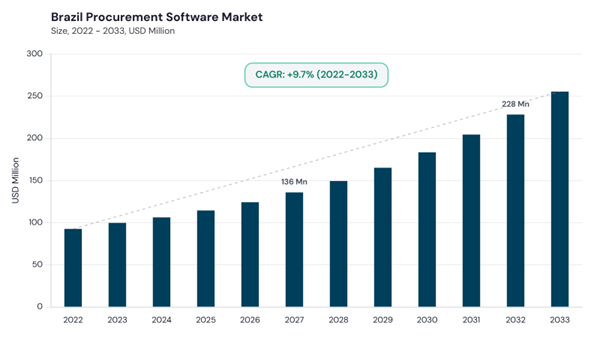
End Use Outlook
Based on End Use, the market is segmented into Manufacturing & Automotive, Retail & E-commerce, BFSI, IT & Telecom, Healthcare & Pharmaceuticals, Energy & Utilities, and Other End Use. The Manufacturing & Automotive market dominated the LAMEA Procurement Software Market by End Use in 2025 and is expected to continue to be a dominant segment till 2030; thereby, achieving a market value of USD 218.7 million by 2030. The Retail & E-commerce market is expected to witness a CAGR of 11.1% during 2026-2033. Additionally, the BFSI market is expected to witness a CAGR of 13.4% during 2026-2033.Country Outlook
Brazil represents the leading market for procurement software in the LAMEA region due to increasing enterprise digitalization, expanding industrial operations, and rising investments in cloud-based enterprise software solutions. Organizations across manufacturing, retail, BFSI, and public sectors are increasingly adopting procurement platforms to optimize sourcing operations, improve supplier management, and strengthen procurement transparency. The country is also witnessing growing demand for AI-enabled procurement analytics and automated spend management solutions to improve operational efficiency and cost optimization. Furthermore, increasing government initiatives supporting digital transformation and procurement modernization are expected to continue driving procurement software adoption across Brazil through 2030.List of Key Companies Profiled
- SAP SE
- Oracle Corporation
- Coupa Software Inc.
- IBM Corporation
- GEP Worldwide
- Jaggaer
- Ivalua Inc.
- Procurify Technologies Inc.
- Zycus Inc.
- Basware Corporation
Market Report Segmentation
By Deployment- Cloud
- On-Premise
- Large Enterprise
- Small and Medium Enterprises (SMEs)
- Spend Analysis
- E-Procurement
- E-Sourcing
- Contract Management
- Supplier Management
- Other Type
- Manufacturing & Automotive
- Retail & E-commerce
- BFSI
- IT & Telecom
- Healthcare & Pharmaceuticals
- Energy & Utilities
- Other End Use
- Brazil
- Argentina
- UAE
- Saudi Arabia
- South Africa
- Nigeria
- Rest of LAMEA
Table of Contents
Chapter 1. LAMEA Market1.1 Market Overview
1.2 Key Factors Impacting Market
1.2.1 Market Drivers
1.2.2 Market Restraints
1.2.3 Market Opportunities
1.2.4 Market Challenges
1.2.5 Market Trends
1.2.6 State of Competition
1.2.7 Market Consolidation
1.2.8 Key Customer Criteria
1.3 Product Life Cycle
1.4 Segmentation By Type
1.4.1 Spend Analysis
1.4.2 E-Sourcing
1.4.3 E-Procurement
1.4.4 Contract Management
1.4.5 Supplier Management
1.4.6 Other Type
1.5 Segmentation By Deployment
1.5.1 Cloud
1.5.2 On-Premise
1.6 Segmentation By Enterprise Size
1.6.1 Large Enterprise
1.6.2 Small and Medium Enterprises (SMEs)
1.7 Segmentation By End Use
1.7.1 Energy & Utilities
1.7.2 BFSI
1.7.3 IT & Telecom
1.7.4 Manufacturing & Automotive
1.7.5 Healthcare & Pharmaceuticals
1.7.6 Retail & E-commerce
1.7.7 Other End Use
1.8 Segmentation By Country
1.8.1 Brazil
1.8.1.1 Segmentation By Type
1.8.1.1.1 Spend Analysis
1.8.1.1.2 E-Sourcing
1.8.1.1.3 E-Procurement
1.8.1.1.4 Contract Management
1.8.1.1.5 Supplier Management
1.8.1.1.6 Other Type
1.8.1.2 Segmentation By Deployment
1.8.1.2.1 Cloud
1.8.1.2.2 On-Premise
1.8.1.3 Segmentation By Enterprise Size
1.8.1.3.1 Large Enterprise
1.8.1.3.2 Small and Medium Enterprises (SMEs)
1.8.1.4 Segmentation By End Use
1.8.1.4.1 Energy & Utilities
1.8.1.4.2 BFSI
1.8.1.4.3 IT & Telecom
1.8.1.4.4 Manufacturing & Automotive
1.8.1.4.5 Healthcare & Pharmaceuticals
1.8.1.4.6 Retail & E-commerce
1.8.1.4.7 Other End Use
1.8.2 Argentina
1.8.2.1 Segmentation By Type
1.8.2.1.1 Spend Analysis
1.8.2.1.2 E-Sourcing
1.8.2.1.3 E-Procurement
1.8.2.1.4 Contract Management
1.8.2.1.5 Supplier Management
1.8.2.1.6 Other Type
1.8.2.2 Segmentation By Deployment
1.8.2.2.1 Cloud
1.8.2.2.2 On-Premise
1.8.2.3 Segmentation By Enterprise Size
1.8.2.3.1 Large Enterprise
1.8.2.3.2 Small and Medium Enterprises (SMEs)
1.8.2.4 Segmentation By End Use
1.8.2.4.1 Energy & Utilities
1.8.2.4.2 BFSI
1.8.2.4.3 IT & Telecom
1.8.2.4.4 Manufacturing & Automotive
1.8.2.4.5 Healthcare & Pharmaceuticals
1.8.2.4.6 Retail & E-commerce
1.8.2.4.7 Other End Use
1.8.3 UAE
1.8.3.1 Segmentation By Type
1.8.3.1.1 Spend Analysis
1.8.3.1.2 E-Sourcing
1.8.3.1.3 E-Procurement
1.8.3.1.4 Contract Management
1.8.3.1.5 Supplier Management
1.8.3.1.6 Other Type
1.8.3.2 Segmentation By Deployment
1.8.3.2.1 Cloud
1.8.3.2.2 On-Premise
1.8.3.3 Segmentation By Enterprise Size
1.8.3.3.1 Large Enterprise
1.8.3.3.2 Small and Medium Enterprises (SMEs)
1.8.3.4 Segmentation By End Use
1.8.3.4.1 Energy & Utilities
1.8.3.4.2 BFSI
1.8.3.4.3 IT & Telecom
1.8.3.4.4 Manufacturing & Automotive
1.8.3.4.5 Healthcare & Pharmaceuticals
1.8.3.4.6 Retail & E-commerce
1.8.3.4.7 Other End Use
1.8.4 Saudi Arabia
1.8.4.1 Segmentation By Type
1.8.4.1.1 Spend Analysis
1.8.4.1.2 E-Sourcing
1.8.4.1.3 E-Procurement
1.8.4.1.4 Contract Management
1.8.4.1.5 Supplier Management
1.8.4.1.6 Other Type
1.8.4.2 Segmentation By Deployment
1.8.4.2.1 Cloud
1.8.4.2.2 On-Premise
1.8.4.3 Segmentation By Enterprise Size
1.8.4.3.1 Large Enterprise
1.8.4.3.2 Small and Medium Enterprises (SMEs)
1.8.4.4 Segmentation By End Use
1.8.4.4.1 Energy & Utilities
1.8.4.4.2 BFSI
1.8.4.4.3 IT & Telecom
1.8.4.4.4 Manufacturing & Automotive
1.8.4.4.5 Healthcare & Pharmaceuticals
1.8.4.4.6 Retail & E-commerce
1.8.4.4.7 Other End Use
1.8.5 South Africa
1.8.5.1 Segmentation By Type
1.8.5.1.1 Spend Analysis
1.8.5.1.2 E-Sourcing
1.8.5.1.3 E-Procurement
1.8.5.1.4 Contract Management
1.8.5.1.5 Supplier Management
1.8.5.1.6 Other Type
1.8.5.2 Segmentation By Deployment
1.8.5.2.1 Cloud
1.8.5.2.2 On-Premise
1.8.5.3 Segmentation By Enterprise Size
1.8.5.3.1 Large Enterprise
1.8.5.3.2 Small and Medium Enterprises (SMEs)
1.8.5.4 Segmentation By End Use
1.8.5.4.1 Energy & Utilities
1.8.5.4.2 BFSI
1.8.5.4.3 IT & Telecom
1.8.5.4.4 Manufacturing & Automotive
1.8.5.4.5 Healthcare & Pharmaceuticals
1.8.5.4.6 Retail & E-commerce
1.8.5.4.7 Other End Use
1.8.6 Nigeria
1.8.6.1 Segmentation By Type
1.8.6.1.1 Spend Analysis
1.8.6.1.2 E-Sourcing
1.8.6.1.3 E-Procurement
1.8.6.1.4 Contract Management
1.8.6.1.5 Supplier Management
1.8.6.1.6 Other Type
1.8.6.2 Segmentation By Deployment
1.8.6.2.1 Cloud
1.8.6.2.2 On-Premise
1.8.6.3 Segmentation By Enterprise Size
1.8.6.3.1 Large Enterprise
1.8.6.3.2 Small and Medium Enterprises (SMEs)
1.8.6.4 Segmentation By End Use
1.8.6.4.1 Energy & Utilities
1.8.6.4.2 BFSI
1.8.6.4.3 IT & Telecom
1.8.6.4.4 Manufacturing & Automotive
1.8.6.4.5 Healthcare & Pharmaceuticals
1.8.6.4.6 Retail & E-commerce
1.8.6.4.7 Other End Use
1.8.7 Rest of LAMEA
1.8.7.1 Segmentation By Type
1.8.7.1.1 Spend Analysis
1.8.7.1.2 E-Sourcing
1.8.7.1.3 E-Procurement
1.8.7.1.4 Contract Management
1.8.7.1.5 Supplier Management
1.8.7.1.6 Other Type
1.8.7.2 Segmentation By Deployment
1.8.7.2.1 Cloud
1.8.7.2.2 On-Premise
1.8.7.3 Segmentation By Enterprise Size
1.8.7.3.1 Large Enterprise
1.8.7.3.2 Small and Medium Enterprises (SMEs)
1.8.7.4 Segmentation By End Use
1.8.7.4.1 Energy & Utilities
1.8.7.4.2 BFSI
1.8.7.4.3 IT & Telecom
1.8.7.4.4 Manufacturing & Automotive
1.8.7.4.5 Healthcare & Pharmaceuticals
1.8.7.4.6 Retail & E-commerce
1.8.7.4.7 Other End Use
Chapter 2. Company Profiles
2.1 SAP SE
2.1.1 Company Overview
2.1.2 Financial Analysis
2.1.3 Segmental and Regional Analysis
2.1.2 Research & Development Expense
2.2 Coupa Software, Inc.
2.2.1 Company Overview
2.3 Oracle Corporation
2.3.1 Company Overview
2.3.2 Financial Analysis
2.3.3 Segmental and Regional Analysis
2.3.2 Research & Development Expense
2.3.5 Recent Strategies and Developments
2.3.5.1 Product Launches and Product Expansions
2.3.6 SWOT Analysis
2.2 NB Ventures, Inc. (GEP)
2.2.1 Company Overview
2.2.2 Recent Strategies and Developments
2.2.2.1 Product Launches and Product Expansions
2.5 Ivalua Inc.
2.5.1 Company Overview
2.5.2 Recent Strategies and Developments
2.5.2.1 Partnerships, Collaborations, and Agreements
2.5.2.2 Geographical Expansions
2.6 JAGGAER, LLC
2.6.1 Company Overview
2.7 Zycus, Inc.
2.7.1 Company Overview
2.8 Basware Corporation
2.8.1 Company Overview
2.9 Infor, Inc. (Koch Industries)
2.9.1 Company Overview
2.9.2 SWOT Analysis
2.1 Workday, Inc.
2.10.1 Company Overview
2.10.2 Financial Analysis
2.10.3 Regional Analysis
2.10.2 Recent Strategies and Developments
2.10.2.1 Product Launches and Product Expansions
2.10.2.2 Acquisition and Mergers
2.10.5 SWOT Analysis
Companies Mentioned
- SAP SE
- Oracle Corporation
- Coupa Software Inc.
- IBM Corporation
- GEP Worldwide
- Jaggaer
- Ivalua Inc.
- Procurify Technologies Inc.
- Zycus Inc.
- Basware Corporation


