



The North America Ultra-Low Latency Connectivity Market size is expected to reach approximately USD 3.50 billion by 2032, growing at a CAGR of around 17.4% during the forecast period (2026-2033).
The U.S. market dominated the North America Ultra-Low Latency Connectivity Market by country in 2025, and is expected to continue to be a dominant market till 2033; thereby, achieving a market value of approximately USD 2.9 billion by 2033. The Canada market is expected to witness a CAGR of 20.1% during 2026-2033. Additionally, the Mexico market is expected to witness a CAGR of 18.8% during 2026-2033. The U.S. and Canada led the North America Ultra-Low Latency Connectivity Market by Country with a market share of approximately 76.2% and 10.4% in 2025. The Mexico market is expected to witness strong growth throughout the forecast period. North America accounted for nearly 36.66% revenue share of the global Ultra-Low Latency Connectivity Market in 2025, supported by strong investments in 5G infrastructure, hyperscale data centers, and edge computing ecosystems.
The North America Ultra-Low Latency Connectivity Market evolved rapidly alongside advancements in high-speed networking infrastructure, cloud computing expansion, and increasing enterprise demand for real-time communication systems. Initially driven by financial trading networks and telecom modernization projects, the market transitioned toward broader adoption across industrial automation, healthcare, cloud gaming, and smart transportation applications. The emergence of edge computing, AI-powered network orchestration, and software-defined networking significantly enhanced low-latency communication capabilities across enterprise environments. Furthermore, large-scale deployment of fiber-optic infrastructure and private 5G networks accelerated commercialization of ultra-responsive connectivity frameworks across the region.
The market is witnessing increasing adoption of edge-native networking architectures, AI-enabled traffic optimization, and distributed cloud infrastructure to support mission-critical applications requiring near real-time responsiveness. Enterprises are deploying ultra-low latency connectivity solutions across autonomous systems, immersive AR/VR environments, remote healthcare applications, and industrial IoT ecosystems. Rising investments in hyperscale cloud infrastructure, AI workloads, and intelligent data center interconnectivity are strengthening demand for advanced networking hardware and latency optimization software. Competitive dynamics remain highly innovation-driven, with telecom operators, networking vendors, semiconductor manufacturers, and cloud providers focusing on scalable ultra-low latency communication ecosystems optimized for next-generation digital services.
The segment is expected to register a CAGR of approximately 16.1% during 2026-2033. The AR/VR & Metaverse Streaming segment is anticipated to witness one of the fastest growth rates with a CAGR of around 18.4% during the forecast period due to increasing demand for immersive digital experiences and real-time interactive applications. Analysis & Future Outlook: Rising adoption of autonomous systems, industrial AI platforms, cloud gaming, and intelligent healthcare applications is expected to accelerate long-term deployment of ultra-low latency communication infrastructure.
The Manufacturing segment is expected to grow at a CAGR of around 17.1% during the forecast period supported by rising adoption of industrial IoT, predictive maintenance systems, and automated production environments. Analysis & Future Outlook: Expansion of smart infrastructure, enterprise digital transformation, and increasing deployment of AI-enabled networking platforms are expected to strengthen long-term demand across major end-user industries.
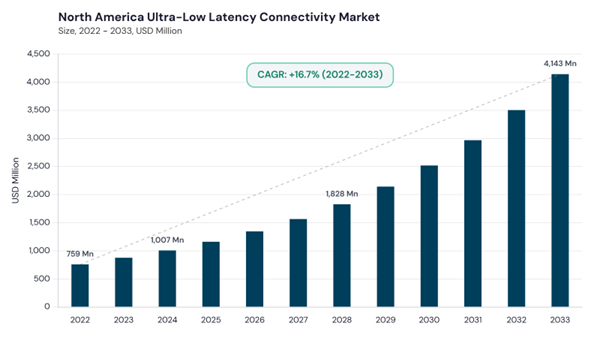
The U.S. market dominated the North America Ultra-Low Latency Connectivity Market by country in 2025, and is expected to continue to be a dominant market till 2033; thereby, achieving a market value of approximately USD 2.9 billion by 2033. The Canada market is expected to witness a CAGR of 20.1% during 2026-2033. Additionally, the Mexico market is expected to witness a CAGR of 18.8% during 2026-2033. The U.S. and Canada led the North America Ultra-Low Latency Connectivity Market by Country with a market share of approximately 76.2% and 10.4% in 2025. The Mexico market is expected to witness strong growth throughout the forecast period. North America accounted for nearly 36.66% revenue share of the global Ultra-Low Latency Connectivity Market in 2025, supported by strong investments in 5G infrastructure, hyperscale data centers, and edge computing ecosystems.
The North America Ultra-Low Latency Connectivity Market evolved rapidly alongside advancements in high-speed networking infrastructure, cloud computing expansion, and increasing enterprise demand for real-time communication systems. Initially driven by financial trading networks and telecom modernization projects, the market transitioned toward broader adoption across industrial automation, healthcare, cloud gaming, and smart transportation applications. The emergence of edge computing, AI-powered network orchestration, and software-defined networking significantly enhanced low-latency communication capabilities across enterprise environments. Furthermore, large-scale deployment of fiber-optic infrastructure and private 5G networks accelerated commercialization of ultra-responsive connectivity frameworks across the region.
The market is witnessing increasing adoption of edge-native networking architectures, AI-enabled traffic optimization, and distributed cloud infrastructure to support mission-critical applications requiring near real-time responsiveness. Enterprises are deploying ultra-low latency connectivity solutions across autonomous systems, immersive AR/VR environments, remote healthcare applications, and industrial IoT ecosystems. Rising investments in hyperscale cloud infrastructure, AI workloads, and intelligent data center interconnectivity are strengthening demand for advanced networking hardware and latency optimization software. Competitive dynamics remain highly innovation-driven, with telecom operators, networking vendors, semiconductor manufacturers, and cloud providers focusing on scalable ultra-low latency communication ecosystems optimized for next-generation digital services.
Component Outlook
Based on Component, the market is segmented into Hardware, Services, and Software. The Hardware segment dominated the North America Ultra-Low Latency Connectivity Market in 2025 with the largest revenue share owing to increasing investments in routers, switches, edge devices, and high-performance networking equipment required for ultra-fast data transmission and real-time processing. The segment is expected to continue its dominance while witnessing a CAGR of approximately 29.4% during 2026-2033. The Software segment is anticipated to witness one of the fastest growth rates with a CAGR of around 18.1% during the forecast period driven by rising adoption of software-defined networking, AI-driven traffic management, and latency optimization platforms. Analysis & Future Outlook: Expansion of edge computing infrastructure and increasing deployment of intelligent networking ecosystems are expected to accelerate long-term demand across hardware and software deployment environments.Network Technology Outlook
Based on Network Technology, the market is segmented into 5G & 6G, Fiber-Optic Networks, Ethernet & InfiniBand, and Microwave & mmWave. The 5G & 6G segment dominated the North America Ultra-Low Latency Connectivity Market in 2025 and held the largest share supported by rapid deployment of next-generation wireless infrastructure and growing investments in ultra-fast communication technologies. The segment is projected to grow at a CAGR of approximately 30.8% during 2026-2033. The Fiber-Optic Networks segment is expected to witness robust expansion with a CAGR of around 17.6% owing to increasing broadband modernization and data center interconnectivity investments. Analysis & Future Outlook: Ongoing 6G innovation, expansion of edge-native architectures, and increasing demand for high-capacity low-latency communication systems are expected to strengthen market expansion across advanced networking technologies.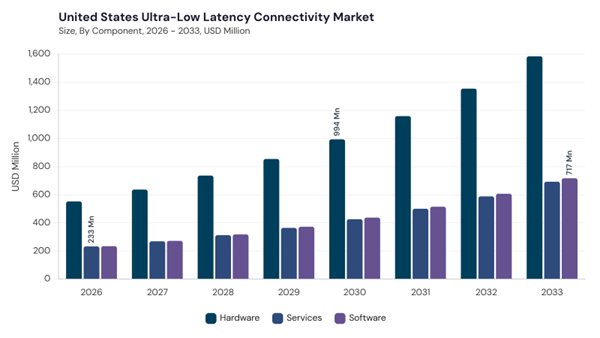
Application Outlook
Based on Application, the market is segmented into Smart Manufacturing & Industrial IoT, High-Frequency & Algorithmic Trading, Online Gaming & Esports, AR/VR & Metaverse Streaming, Autonomous Vehicles & V2X, and Remote Healthcare & Telesurgery. The Smart Manufacturing & Industrial IoT segment dominated the North America Ultra-Low Latency Connectivity Market in 2025 owing to increasing Industry 4.0 deployment, industrial automation initiatives, and rising demand for real-time machine communication systems.The segment is expected to register a CAGR of approximately 16.1% during 2026-2033. The AR/VR & Metaverse Streaming segment is anticipated to witness one of the fastest growth rates with a CAGR of around 18.4% during the forecast period due to increasing demand for immersive digital experiences and real-time interactive applications. Analysis & Future Outlook: Rising adoption of autonomous systems, industrial AI platforms, cloud gaming, and intelligent healthcare applications is expected to accelerate long-term deployment of ultra-low latency communication infrastructure.
End User Outlook
Based on End User, the market is segmented into IT & Telecommunications, Manufacturing, BFSI, Media & Entertainment, Transportation & Logistics, Healthcare, and Other End User. The IT & Telecommunications segment dominated the North America Ultra-Low Latency Connectivity Market in 2025 and held the largest share driven by increasing investments in cloud networking, telecom modernization, and next-generation communication infrastructure. The segment is projected to witness a CAGR of approximately 15.3% during 2026-2033.The Manufacturing segment is expected to grow at a CAGR of around 17.1% during the forecast period supported by rising adoption of industrial IoT, predictive maintenance systems, and automated production environments. Analysis & Future Outlook: Expansion of smart infrastructure, enterprise digital transformation, and increasing deployment of AI-enabled networking platforms are expected to strengthen long-term demand across major end-user industries.
Country Outlook
The United States continues to lead the North America Ultra-Low Latency Connectivity Market due to its advanced telecom ecosystem, strong hyperscale cloud infrastructure, and large-scale investments in AI-driven networking technologies. Enterprises across financial services, manufacturing, healthcare, and media industries are rapidly deploying low-latency communication systems to support mission-critical operations requiring ultra-fast responsiveness and real-time analytics. The country’s leadership in 5G commercialization, semiconductor innovation, and edge computing deployment continues to accelerate market expansion. Increasing investments in autonomous mobility, cloud gaming, industrial AI systems, and immersive digital applications are strengthening demand for scalable ultra-low latency infrastructure. Strategic collaborations among telecom providers, cloud vendors, networking companies, and semiconductor firms are expected to enhance commercialization of next-generation connectivity platforms across the U.S. market.List of Key Companies Profiled
- Cisco Systems, Inc.
- Intel Corporation
- Qualcomm Incorporated
- Broadcom Inc.
- Arista Networks, Inc.
- Juniper Networks, Inc.
- Verizon Communications Inc.
- NTT DOCOMO, INC.
- Telefónica S.A.
- Colt Technology Services Group Limited
Market Report Segmentation
By Component- Hardware
- Services
- Software
- 5G & 6G
- Fiber-Optic Networks
- Ethernet & InfiniBand
- Microwave & mmWave
- Smart Manufacturing & Industrial IoT
- High-Frequency & Algorithmic Trading
- Online Gaming & Esports
- AR/VR & Metaverse Streaming
- Autonomous Vehicles & V2X
- Remote Healthcare & Telesurgery
- IT & Telecommunications
- Manufacturing
- BFSI
- Media & Entertainment
- Transportation & Logistics
- Healthcare
- Other End User
- United States
- Canada
- Mexico
- Rest of North America
Table of Contents
Chapter 1. North America Market1.1 Market Overview
1.2 Key Factors Impacting Market
1.2.1 Market Drivers
1.2.2 Market Restraints
1.2.3 Market Opportunities
1.2.4 Market Challenges
1.2.5 Market Trends
1.2.6 State of Competition
1.2.7 Market Consolidation
1.2.8 Key Customer Criteria
1.3 Product Life Cycle
1.4 Segmentation By Component
1.4.1 Hardware
1.4.2 Software
1.4.3 Services
1.5 Segmentation By Network Technology
1.5.1 5G & 6G
1.5.2 Fiber-Optic Networks
1.5.3 Ethernet & InfiniBand
1.5.4 Microwave & mmWave
1.6 Segmentation By Application
1.6.1 High-Frequency & Algorithmic Trading
1.6.2 Online Gaming & Esports
1.6.3 AR/VR & Metaverse Streaming
1.6.4 Smart Manufacturing & Industrial IoT
1.6.5 Remote Healthcare & Telesurgery
1.7 Segmentation By End User
1.7.1 BFSI
1.7.2 Media & Entertainment
1.7.3 Manufacturing
1.7.4 Healthcare
1.7.5 Transportation & Logistics
1.7.6 IT & Telecommunications
1.7.7 Other End User
1.8 Segmentation By Country
1.8.1 United States
1.8.1.1 Segmentation By Component
1.8.1.1.1 Hardware
1.8.1.1.2 Services
1.8.1.1.3 Software
1.8.1.2 Segmentation By Network Technology
1.8.1.2.1 5G & 6G
1.8.1.2.2 Fiber-Optic Networks
1.8.1.2.3 Ethernet & InfiniBand
1.8.1.2.4 Microwave & mmWave
1.8.1.3 Segmentation By Application
1.8.1.3.1 High-Frequency & Algorithmic Trading
1.8.1.3.2 Online Gaming & Esports
1.8.1.3.3 AR/VR & Metaverse Streaming
1.8.1.3.4 Smart Manufacturing & Industrial IoT
1.8.1.3.5 Remote Healthcare & Telesurgery
1.8.1.3.6 Autonomous Vehicles & V2X
1.8.1.4 Segmentation By End User
1.8.1.4.1 BFSI
1.8.1.4.2 Media & Entertainment
1.8.1.4.3 Manufacturing
1.8.1.4.4 Healthcare
1.8.1.4.5 Transportation & Logistics
1.8.1.4.6 IT & Telecommunications
1.8.1.4.7 Other End User
1.8.2 Canada
1.8.2.1 Segmentation By Component
1.8.2.1.1 Hardware
1.8.2.1.2 Services
1.8.2.1.3 Software
1.8.2.2 Segmentation By Network Technology
1.8.2.2.1 5G & 6G
1.8.2.2.2 Fiber-Optic Networks
1.8.2.2.3 Ethernet & InfiniBand
1.8.2.2.4 Microwave & mmWave
1.8.2.3 Segmentation By Application
1.8.2.3.1 High-Frequency & Algorithmic Trading
1.8.2.3.2 Online Gaming & Esports
1.8.2.3.3 AR/VR & Metaverse Streaming
1.8.2.3.4 Smart Manufacturing & Industrial IoT
1.8.2.3.5 Remote Healthcare & Telesurgery
1.8.2.3.6 Autonomous Vehicles & V2X
1.8.2.4 Segmentation By End User
1.8.2.4.1 BFSI
1.8.2.4.2 Media & Entertainment
1.8.2.4.3 Manufacturing
1.8.2.4.4 Healthcare
1.8.2.4.5 Transportation & Logistics
1.8.2.4.6 IT & Telecommunications
1.8.2.4.7 Other End User
1.8.3 Mexico
1.8.3.1 Segmentation By Component
1.8.3.1.1 Hardware
1.8.3.1.2 Services
1.8.3.1.3 Software
1.8.3.2 Segmentation By Network Technology
1.8.3.2.1 5G & 6G
1.8.3.2.2 Fiber-Optic Networks
1.8.3.2.3 Ethernet & InfiniBand
1.8.3.2.4 Microwave & mmWave
1.8.3.3 Segmentation By Application
1.8.3.3.1 High-Frequency & Algorithmic Trading
1.8.3.3.2 Online Gaming & Esports
1.8.3.3.3 AR/VR & Metaverse Streaming
1.8.3.3.4 Smart Manufacturing & Industrial IoT
1.8.3.3.5 Remote Healthcare & Telesurgery
1.8.3.3.6 Autonomous Vehicles & V2X
1.8.3.4 Segmentation By End User
1.8.3.4.1 BFSI
1.8.3.4.2 Media & Entertainment
1.8.3.4.3 Manufacturing
1.8.3.4.4 Healthcare
1.8.3.4.5 Transportation & Logistics
1.8.3.4.6 IT & Telecommunications
1.8.3.4.7 Other End User
1.8.4 Rest of North America
1.8.4.1 Segmentation By Component
1.8.4.1.1 Hardware
1.8.4.1.2 Services
1.8.4.1.3 Software
1.8.4.2 Segmentation By Network Technology
1.8.4.2.1 5G & 6G
1.8.4.2.2 Fiber-Optic Networks
1.8.4.2.3 Ethernet & InfiniBand
1.8.4.2.4 Microwave & mmWave
1.8.4.3 Segmentation By Application
1.8.4.3.1 High-Frequency & Algorithmic Trading
1.8.4.3.2 Online Gaming & Esports
1.8.4.3.3 AR/VR & Metaverse Streaming
1.8.4.3.4 Smart Manufacturing & Industrial IoT
1.8.4.3.5 Remote Healthcare & Telesurgery
1.8.4.3.6 Autonomous Vehicles & V2X
1.8.4.4 Segmentation By End User
1.8.4.4.1 BFSI
1.8.4.4.2 Media & Entertainment
1.8.4.4.3 Manufacturing
1.8.4.4.4 Healthcare
1.8.4.4.5 Transportation & Logistics
1.8.4.4.6 IT & Telecommunications
1.8.4.4.7 Other End User
Chapter 2. Company Snapshot
2.1 Cisco Systems, Inc.
2.1.1 Business Overview
2.1.2 Key Information
2.1.3 Company Focus
2.1.4 Strategic Insights
2.1.5 Strategy Deployed
2.1.6 Product & Service Portfolio
2.1.7 Capability Overview
2.1.8 Technology & Innovation Focus
2.1.9 Customers / End Users
2.1.10 Competitive Positioning
2.1.11 Key Differentiators
2.1.12 Portfolio Matrix
2.1.13 SWOT Analysis
2.1.14 Future Outlook
2.2 Juniper Networks, Inc.
2.2.1 Business Overview
2.2.2 Key Information
2.2.3 Company Focus
2.2.4 Strategic Insights
2.2.5 Strategy Deployed
2.2.6 Product & Service Portfolio
2.2.7 Capability Overview
2.2.8 Technology & Innovation Focus
2.2.9 Customers / End Users
2.2.10 Competitive Positioning
2.2.11 Key Differentiators
2.2.12 Portfolio Matrix
2.2.13 SWOT Analysis
2.2.14 Future Outlook
2.3 Arista Networks, Inc.
2.3.1 Business Overview
2.3.2 Key Information
2.3.3 Company Focus
2.3.4 Strategic Insights
2.3.5 Strategy Deployed
2.3.6 Product & Service Portfolio
2.3.7 Capability Overview
2.3.8 Technology & Innovation Focus
2.3.9 Customers / End Users
2.3.10 Competitive Positioning
2.3.11 Key Differentiators
2.3.12 Portfolio Matrix
2.3.13 SWOT Analysis
2.3.14 Future Outlook
2.4 Broadcom Inc.
2.4.1 Business Overview
2.4.2 Key Information
2.4.3 Company Focus
2.4.4 Strategic Insights
2.4.5 Strategy Deployed
2.4.6 Product & Service Portfolio
2.4.7 Capability Overview
2.4.8 Technology & Innovation Focus
2.4.9 Customers / End Users
2.4.10 Competitive Positioning
2.4.11 Key Differentiators
2.4.12 Portfolio Matrix
2.4.13 SWOT Analysis
2.4.14 Future Outlook
2.5 Intel Corporation
2.5.1 Business Overview
2.5.2 Key Information
2.5.3 Company Focus
2.5.4 Strategic Insights
2.5.5 Strategy Deployed
2.5.6 Product & Service Portfolio
2.5.7 Capability Overview
2.5.8 Technology & Innovation Focus
2.5.9 Customers / End Users
2.5.10 Competitive Positioning
2.5.11 Key Differentiators
2.5.12 Portfolio Matrix
2.5.13 SWOT Analysis
2.5.14 Future Outlook
2.6 Qualcomm Incorporated (Qualcomm Technologies, Inc.)
2.6.1 Business Overview
2.6.2 Key Information
2.6.3 Company Focus
2.6.4 Strategic Insights
2.6.5 Strategy Deployed
2.6.6 Product & Service Portfolio
2.6.7 Capability Overview
2.6.8 Technology & Innovation Focus
2.6.9 Customers / End Users
2.6.10 Competitive Positioning
2.6.11 Key Differentiators
2.6.12 Portfolio Matrix
2.6.13 SWOT Analysis
2.6.14 Future Outlook
2.7 Verizon Communications, Inc.
2.7.1 Business Overview
2.7.2 Key Information
2.7.3 Company Focus
2.7.4 Strategic Insights
2.7.5 Strategy Deployed
2.7.6 Product & Service Portfolio
2.7.7 Capability Overview
2.7.8 Technology & Innovation Focus
2.7.9 Customers / End Users
2.7.10 Competitive Positioning
2.7.11 Key Differentiators
2.7.12 Portfolio Matrix
2.7.13 SWOT Analysis
2.7.14 Future Outlook
2.8 NTT DOCOMO, INC.
2.8.1 Business Overview
2.8.2 Key Information
2.8.3 Company Focus
2.8.4 Strategic Insights
2.8.5 Strategy Deployed
2.8.6 Product & Service Portfolio
2.8.7 Capability Overview
2.8.8 Technology & Innovation Focus
2.8.9 Customers / End Users
2.8.10 Competitive Positioning
2.8.11 Key Differentiators
2.8.12 Portfolio Matrix
2.8.13 SWOT Analysis
2.8.14 Future Outlook
2.9 Telefónica S.A.
2.9.1 Business Overview
2.9.2 Key Information
2.9.3 Company Focus
2.9.4 Strategic Insights
2.9.5 Strategy Deployed
2.9.6 Product & Service Portfolio
2.9.7 Capability Overview
2.9.8 Technology & Innovation Focus
2.9.9 Customers / End Users
2.9.10 Competitive Positioning
2.9.11 Key Differentiators
2.9.12 Portfolio Matrix
2.9.13 SWOT Analysis
2.9.14 Future Outlook
2.10 Colt Technology Services Group Limited
2.10.1 Business Overview
2.10.2 Key Information
2.10.3 Company Focus
2.10.4 Strategic Insights
2.10.5 Strategy Deployed
2.10.6 Product & Service Portfolio
2.10.7 Capability Overview
2.10.8 Technology & Innovation Focus
2.10.9 Customers / End Users
2.10.10 Competitive Positioning
2.10.11 Key Differentiators
2.10.12 Portfolio Matrix
2.10.13 SWOT Analysis
2.10.14 Future Outlook
Companies Mentioned
- Cisco Systems, Inc.
- Intel Corporation
- Qualcomm Incorporated
- Broadcom Inc.
- Arista Networks, Inc.
- Juniper Networks, Inc.
- Verizon Communications Inc.
- NTT DOCOMO, INC.
- Telefónica S.A.
- Colt Technology Services Group Limited


