



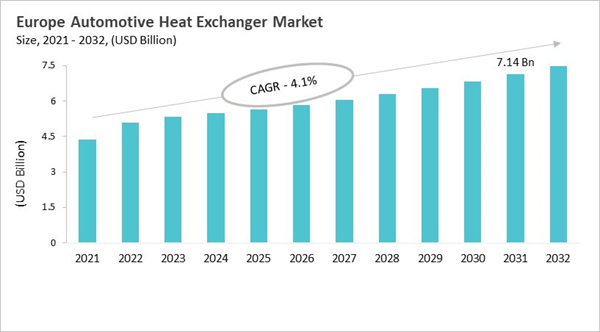
The Europe Automotive Heat Exchanger Market is expected to reach $7.14 billion by 2031 and is expected to witness market growth of 4.1% CAGR during the forecast period (2025-2032).
The Germany market dominated the Europe Automotive Heat Exchanger Market by country in 2024, and is expected to continue to be a dominant market till 2032; thereby, achieving a market value of $1.85 billion by 2032. The UK market is exhibiting a CAGR of 2.5% during 2025-2032. Additionally, the France market is expected to experience a CAGR of 5.1% during 2025-2032. The Germany and UK led the Europe Automotive Heat Exchanger Market by Country with a market share of 27% and 11.7% in 2024. The Spain market is expected to witness a CAGR of 5.8% during throughout the forecast period.
The European Automotive Heat Exchanger Market has changed a lot. It has gone from using traditional radiator-based cooling systems to highly integrated thermal management solutions. This is because of new developments in automotive engineering and government rules. At first, the market focused on keeping the engine temperature stable in internal combustion vehicles. Over time, it has adopted more advanced materials, smaller designs, and better manufacturing methods to make vehicles more efficient and long-lasting. The introduction of strict emissions standards across Europe sped up innovation even more. This led to the creation of heat exchangers that make engines smaller, turbocharge them, and use less fuel. More recently, the market has changed because electric and hybrid vehicles are becoming more popular. This has shifted the focus to more advanced systems that control battery temperature, power electronics, and cabin climate. As a result, thermal management has become an important part of modern vehicle performance and sustainability.
Three key trends are shaping the market: vehicle electrification, advanced manufacturing, and strict environmental regulations. Electrification has driven demand for specialized heat exchangers that precisely control electric vehicle temperatures. Simultaneously, methods like 3D printing enable lighter, more efficient new designs. Regulatory pressures promote lightweight, corrosion-resistant materials and improved designs, further boosting efficiency. Leading companies focus on innovation, strategic partnerships, and expansion to strengthen their market position. Competition remains intense: global firms leverage advanced R&D while regional firms emphasize customization and cost. This drives the market toward more advanced, eco-friendly, performance-oriented solutions.
The Germany market dominated the Europe Automotive Heat Exchanger Market by country in 2024, and is expected to continue to be a dominant market till 2032; thereby, achieving a market value of $1.85 billion by 2032. The UK market is exhibiting a CAGR of 2.5% during 2025-2032. Additionally, the France market is expected to experience a CAGR of 5.1% during 2025-2032. The Germany and UK led the Europe Automotive Heat Exchanger Market by Country with a market share of 27% and 11.7% in 2024. The Spain market is expected to witness a CAGR of 5.8% during throughout the forecast period.
The European Automotive Heat Exchanger Market has changed a lot. It has gone from using traditional radiator-based cooling systems to highly integrated thermal management solutions. This is because of new developments in automotive engineering and government rules. At first, the market focused on keeping the engine temperature stable in internal combustion vehicles. Over time, it has adopted more advanced materials, smaller designs, and better manufacturing methods to make vehicles more efficient and long-lasting. The introduction of strict emissions standards across Europe sped up innovation even more. This led to the creation of heat exchangers that make engines smaller, turbocharge them, and use less fuel. More recently, the market has changed because electric and hybrid vehicles are becoming more popular. This has shifted the focus to more advanced systems that control battery temperature, power electronics, and cabin climate. As a result, thermal management has become an important part of modern vehicle performance and sustainability.
Three key trends are shaping the market: vehicle electrification, advanced manufacturing, and strict environmental regulations. Electrification has driven demand for specialized heat exchangers that precisely control electric vehicle temperatures. Simultaneously, methods like 3D printing enable lighter, more efficient new designs. Regulatory pressures promote lightweight, corrosion-resistant materials and improved designs, further boosting efficiency. Leading companies focus on innovation, strategic partnerships, and expansion to strengthen their market position. Competition remains intense: global firms leverage advanced R&D while regional firms emphasize customization and cost. This drives the market toward more advanced, eco-friendly, performance-oriented solutions.
Type Outlook
Based on Type, the market is segmented into Liquid-to-Air, and Air-to-Air. The Liquid-to-Air market segment dominated the Germany Automotive Heat Exchanger Market by Type is expected to grow at a CAGR of 2.5 % during the forecast period thereby continuing its dominance until 2032. Also, The Air-to-Air market is anticipated to grow as a CAGR of 3.6 % during the forecast period during 2025-2032.Propulsion Outlook
Based on Propulsion, the market is segmented into ICE, and Electric. With a compound annual growth rate (CAGR) of 4.8% over the projection period, the ICE Market, dominate the France Automotive Heat Exchanger Market by Propulsion in 2024 and would be a prominent market until 2032. The Electric market is expected to witness a CAGR of 6.2% during 2025-2032.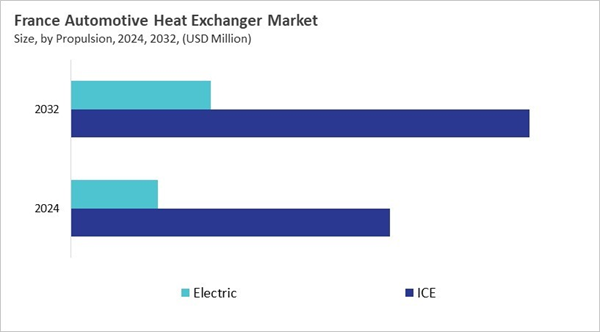
Country Outlook
The market for automotive heat exchangers in Germany has changed from traditional radiator-based systems to more advanced, lightweight thermal management solutions. This is because Germany has a strong history of automotive engineering. Regulatory pressures on emissions and the quick move toward electrification have sped up the use of new technologies, especially for electric and hybrid vehicles that need efficient cooling for their batteries and power electronics. Some important trends in the market are the merging of EV platforms, the need for hybrid systems that use less energy, and the growing importance of lightweight materials like aluminum. To make high-performance, multi-functional heat exchangers, top companies are focusing on research and development, strategic partnerships, and manufacturing in specific locations. Innovation, cost-effectiveness, and the ability to customize are all factors that affect competition. Both regional and global companies are working to meet changing thermal needs. In general, the market shows that Germany is moving toward more environmentally friendly and efficient automotive solutions.List of Key Companies Profiled
- Denso Corporation
- Valeo SA
- Marelli Holdings Co., Ltd.
- Mahle GmbH (Mahle Stiftung GmbH)
- Hanon Systems (Hahn & Co. Auto Holdings Co., Ltd.)
- T.RAD Co., Ltd.
- hejiang Yinlun Machinery Co., Ltd.
- Weifang Hengan Radiator Group Co., Ltd.
- Modine Manufacturing Company
- Banco Products (India) Ltd.
Market Report Segmentation
By Type- Liquid-to-Air
- Air-to-Air
- ICE
- Electric
- Passenger Cars
- Commercial Vehicles
- Germany
- UK
- France
- Russia
- Spain
- Italy
- Rest of Europe
Table of Contents
Chapter 1. Market Scope & Methodology
Chapter 2. Market at a Glance
Chapter 3. Market Overview
Chapter 4. Market Trends - Europe Automotive Heat Exchanger Market
Chapter 5. State of Competition - Europe Automotive Heat Exchanger Market
Chapter 6. Market Consolidation - Europe Automotive Heat Exchanger Market
Chapter 7. Key Customer Criteria - Europe Automotive Heat Exchanger Market
Chapter 8. Product Life Cycle - Europe Automotive Heat Exchanger Market
Chapter 10. Competition Analysis - Global
Chapter 11. Europe Automotive Heat Exchanger Market by Type
Chapter 12. Europe Automotive Heat Exchanger Market by Propulsion
Chapter 13. Europe Automotive Heat Exchanger Market by Vehicle Type
Chapter 14. Europe Automotive Heat Exchanger Market by Country
Chapter 15. Company Profiles
Companies Mentioned
- Denso Corporation
- Valeo SA
- Marelli Holdings Co., Ltd.
- Mahle GmbH (Mahle Stiftung GmbH)
- Hanon Systems (Hahn & Co. Auto Holdings Co., Ltd.)
- T.RAD Co., Ltd.
- hejiang Yinlun Machinery Co., Ltd.
- Weifang Hengan Radiator Group Co., Ltd.
- Modine Manufacturing Company
- Banco Products (India) Ltd.


