



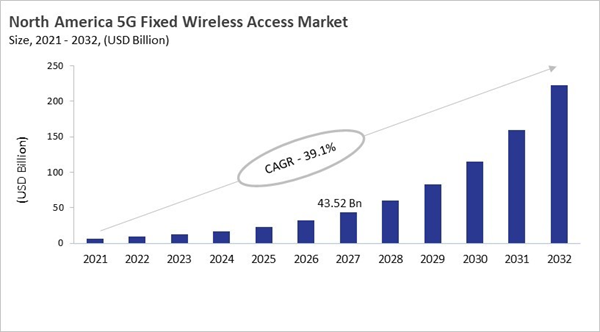
The North America 5G Fixed Wireless Access Market is expected to reach $43.52 billion by 2027 and is expected to witness market growth of 38.1% CAGR during the forecast period (2025-2032).
The US market dominated the North America 5G Fixed Wireless Access Market by country in 2024, and is expected to continue to be a dominant market till 2032; thereby, achieving a market value of $160.70 billion by 2032. The Canada market is experiencing a CAGR of 40.7% during 2025-2032. Additionally, the Mexico market is expected to exhibit a of 40.1% during 2025-2032. The US and Canada led the North America 5G Fixed Wireless Access Market by Country with a market share of 76% and 13.2% in 2024.
The North American 5G Fixed Wireless Access (FWA) Market has become a strategic broadband solution to fill connectivity gaps in cities, suburbs, and rural areas by minimizing the reliance on traditional wired infrastructure. Government policies, spectrum initiatives, and regulatory frameworks in the United States and Canada have all contributed to its growth, evolving from early 3G and LTE-based fixed wireless services to advanced 5G-enabled deployments. The introduction of 5G technologies - utilizing low-, mid-, and millimeter-wave spectrum, along with massive MIMO and beamforming - has significantly enhanced capacity, latency, and reliability. This has enabled FWA to transition from being an additional option to a primary broadband strategy that aligns with national goals for digital inclusion.
Operator strategies that focus on reusing infrastructure, optimizing spectrum, and collaborating with public sector stakeholders are also contributing to market growth. At the same time, OEMs are making progress in customer premises equipment and network virtualization. Some of the most important trends include aligning with programs to expand broadband, utilizing more mid-band and millimeter-wave spectrum, and employing FWA devices that are easy to install and use, which reduces deployment costs and enhances the customer experience. Competition is still driven by innovation, with telecom companies and equipment makers setting themselves apart by offering better service, expanding coverage, and improving technology. This makes 5G FWA a scalable and long-term broadband option in North America that can compete with fiber.
The US market dominated the North America 5G Fixed Wireless Access Market by country in 2024, and is expected to continue to be a dominant market till 2032; thereby, achieving a market value of $160.70 billion by 2032. The Canada market is experiencing a CAGR of 40.7% during 2025-2032. Additionally, the Mexico market is expected to exhibit a of 40.1% during 2025-2032. The US and Canada led the North America 5G Fixed Wireless Access Market by Country with a market share of 76% and 13.2% in 2024.
The North American 5G Fixed Wireless Access (FWA) Market has become a strategic broadband solution to fill connectivity gaps in cities, suburbs, and rural areas by minimizing the reliance on traditional wired infrastructure. Government policies, spectrum initiatives, and regulatory frameworks in the United States and Canada have all contributed to its growth, evolving from early 3G and LTE-based fixed wireless services to advanced 5G-enabled deployments. The introduction of 5G technologies - utilizing low-, mid-, and millimeter-wave spectrum, along with massive MIMO and beamforming - has significantly enhanced capacity, latency, and reliability. This has enabled FWA to transition from being an additional option to a primary broadband strategy that aligns with national goals for digital inclusion.
Operator strategies that focus on reusing infrastructure, optimizing spectrum, and collaborating with public sector stakeholders are also contributing to market growth. At the same time, OEMs are making progress in customer premises equipment and network virtualization. Some of the most important trends include aligning with programs to expand broadband, utilizing more mid-band and millimeter-wave spectrum, and employing FWA devices that are easy to install and use, which reduces deployment costs and enhances the customer experience. Competition is still driven by innovation, with telecom companies and equipment makers setting themselves apart by offering better service, expanding coverage, and improving technology. This makes 5G FWA a scalable and long-term broadband option in North America that can compete with fiber.
Offering Outlook
Based on Offering, the market is segmented into Hardware, and Services. With a compound annual growth rate (CAGR) of 40.5% over the projection period, the Hardware Market, dominate the Canada 5G Fixed Wireless Access Market by Offering in 2024 and would be a prominent market until 2032. The Services market is expected to witness a CAGR of 41.2% during 2025-2032.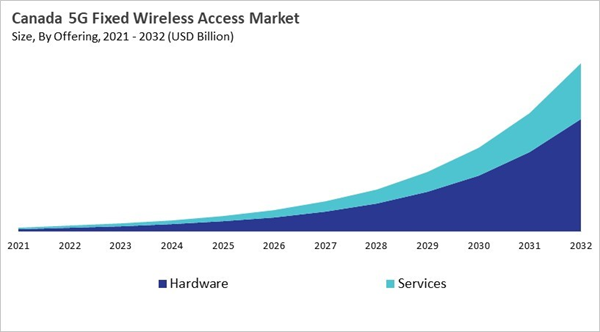
Demography Outlook
Based on Demography, the market is segmented into Urban, Semi-urban, and Rural. The Urban market segment dominated the US 5G Fixed Wireless Access Market by Demography is expected to grow at a CAGR of 36.6 % during the forecast period thereby continuing its dominance until 2032. Also, The Rural market is anticipated to grow as a CAGR of 38 % during the forecast period during 2025-2032.Country Outlook
The United States has become one of the most advanced markets for 5G Fixed Wireless Access (FWA). This is because nationwide 5G networks make it possible to get high-speed home broadband without having to use traditional wired infrastructure. As more people want cheap, flexible broadband and the ability to quickly serve rural and underserved areas, 5G FWA is becoming a more viable option to cable and fiber. Verizon, T-Mobile, and AT&T are using mid-band and ultra-wideband spectrum, government-supported spectrum policies, and plug-and-play customer equipment to improve performance and coverage. Streaming, gaming, working from home, and going to school are all becoming more popular, and mobile and home internet plans are being aggressively bundled together. This is speeding up adoption in cities, suburbs, and rural areas. FWA is taking about 6-7% of the U.S. broadband market. Its competitive pricing, ongoing network upgrades, and pressure from cable and fiber incumbents are all making it a disruptive force in the changing broadband landscape.List of Key Companies Profiled
- Huawei Technologies Co., Ltd. (Huawei Investment & Holding Co., Ltd.)
- Ericsson AB
- Nokia Corporation
- Samsung Electronics Co., Ltd. (Samsung Group)
- Inseego Corp.
- Qualcomm Incorporated (Qualcomm Technologies, Inc.)
- Intel Corporation
- MediaTek, Inc.
- CommScope Holding Company, Inc.
- Verizon Communications Inc.
Market Report Segmentation
By Offering- Hardware
- Services
- Urban
- Semi-urban
- Rural
- Residential
- Commercial
- Industrial
- Government
- Sub-6 GHz
- 24-39 GHz
- Above 39 GHz
- US
- Canada
- Mexico
- Rest of North America
Table of Contents
Chapter 1. Market Scope & Methodology
Chapter 2. Market at a Glance
Chapter 3. Market Overview
Chapter 10. Competition Analysis - Global
Chapter 11. North America 5G Fixed Wireless Access Market by Offering
Chapter 12. North America 5G Fixed Wireless Access Market by Demography
Chapter 13. North America 5G Fixed Wireless Access Market by Application
Chapter 14. North America 5G Fixed Wireless Access Market by Operating Frequency
Chapter 15. North America 5G Fixed Wireless Access Market by Country
Chapter 16. Company Profiles
Companies Mentioned
- Huawei Technologies Co., Ltd. (Huawei Investment & Holding Co., Ltd.)
- Ericsson AB
- Nokia Corporation
- Samsung Electronics Co., Ltd. (Samsung Group)
- Inseego Corp.
- Qualcomm Incorporated (Qualcomm Technologies, Inc.)
- Intel Corporation
- MediaTek, Inc.
- CommScope Holding Company, Inc.
- Verizon Communications Inc.


