



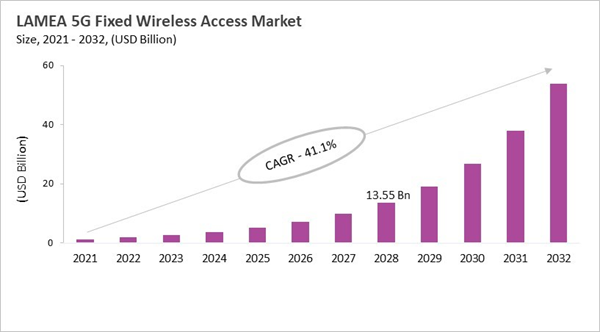
The Latin America, Middle East and Africa 5G Fixed Wireless Access Market is expected to reach $13.55 billion by 2028 and is expected to witness market growth of 40.3% CAGR during the forecast period (2025-2032).
The Brazil market dominated the LAMEA 5G Fixed Wireless Access Market by country in 2024, and is expected to continue to be a dominant market till 2032; thereby, achieving a market value of $10.95 billion by 2032. The Argentina market is showcasing a CAGR of 41.9% during 2025-2032. Additionally, the UAE market would register a CAGR of 39.1% during 2025-2032. The Brazil and UAE led the LAMEA 5G Fixed Wireless Access Market by Country with a market share of 22.8% and 9.7% in 2024. The South Africa market is expected to witness a CAGR of 41.7% during throughout the forecast period.
The LAMEA 5G Fixed Wireless Access (FWA) Market has become a smart way to bring broadband to areas with different geography and limited infrastructure. Because of high deployment costs, spread-out populations, and the need for quick digital inclusion, governments and telecom stakeholders are seeing 5G FWA as a viable alternative to fiber more and more. The switch to 5G has greatly improved capacity, reliability, and scalability, building on earlier LTE-based deployments. Regulatory support through spectrum allocation and telecom reforms, along with the growing need for digital services like e-government, education, and remote work, has made 5G FWA a key part of national connectivity plans in Latin America, the Middle East, and Africa.
Strong policy alignment, better use of spectrum, and constant technological innovation all help the market grow. Governments push for 5G FWA as part of their national digital agendas. Operators, on the other hand, prefer mid-band spectrum to balance coverage and performance, with millimeter-wave added in areas with a lot of people. OEMs are very important because they make advanced radio technologies and customer premises equipment that is easy to install and cheap. To keep costs down, make networks more scalable, and improve operational efficiency, top companies use flexible, multi-band, and software-driven network architectures. Competition is still driven by innovation and in line with public connectivity goals, which will help the 5G FWA ecosystem grow in a way that lasts across the LAMEA region.
The Brazil market dominated the LAMEA 5G Fixed Wireless Access Market by country in 2024, and is expected to continue to be a dominant market till 2032; thereby, achieving a market value of $10.95 billion by 2032. The Argentina market is showcasing a CAGR of 41.9% during 2025-2032. Additionally, the UAE market would register a CAGR of 39.1% during 2025-2032. The Brazil and UAE led the LAMEA 5G Fixed Wireless Access Market by Country with a market share of 22.8% and 9.7% in 2024. The South Africa market is expected to witness a CAGR of 41.7% during throughout the forecast period.
The LAMEA 5G Fixed Wireless Access (FWA) Market has become a smart way to bring broadband to areas with different geography and limited infrastructure. Because of high deployment costs, spread-out populations, and the need for quick digital inclusion, governments and telecom stakeholders are seeing 5G FWA as a viable alternative to fiber more and more. The switch to 5G has greatly improved capacity, reliability, and scalability, building on earlier LTE-based deployments. Regulatory support through spectrum allocation and telecom reforms, along with the growing need for digital services like e-government, education, and remote work, has made 5G FWA a key part of national connectivity plans in Latin America, the Middle East, and Africa.
Strong policy alignment, better use of spectrum, and constant technological innovation all help the market grow. Governments push for 5G FWA as part of their national digital agendas. Operators, on the other hand, prefer mid-band spectrum to balance coverage and performance, with millimeter-wave added in areas with a lot of people. OEMs are very important because they make advanced radio technologies and customer premises equipment that is easy to install and cheap. To keep costs down, make networks more scalable, and improve operational efficiency, top companies use flexible, multi-band, and software-driven network architectures. Competition is still driven by innovation and in line with public connectivity goals, which will help the 5G FWA ecosystem grow in a way that lasts across the LAMEA region.
Offering Outlook
Based on Offering, the market is segmented into Hardware, and Services. With a compound annual growth rate (CAGR) of 38% over the projection period, the Hardware Market, dominate the Brazil 5G Fixed Wireless Access Market by Offering in 2024 and would be a prominent market until 2032. From 2025 to 2032 The Services market is expected to witness a CAGR of 38.7% during 2025-2032.Application Outlook
Based on Application, the market is segmented into Residential, Commercial, Industrial, and Government. Among various South Africa 5G Fixed Wireless Access Market by Application; The Residential market achieved a market size of USD $3.05 billion in 2024 and is expected to grow at a CAGR of 40.9 % during the forecast period. The Industrial market is predicted to experience a CAGR of 43.1% throughout the forecast period from (2025-2032).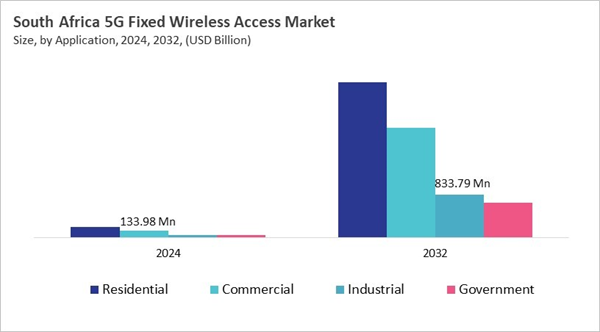
Country Outlook
Brazil's 5G Fixed Wireless Access market is becoming an important part of broadband growth in the LAMEA region because of uneven fiber penetration, a large area, and a strong need for fast internet. 5G FWA is a cost-effective and quickly deployable alternative to fiber, especially in suburban, secondary, and rural areas, thanks to good spectrum allocation and regulatory initiatives. Telecom companies are using advanced CPE, Massive MIMO, and cloud-native network architectures to speed up the rollout and make sure the service is good. The market is very competitive, with major operators working with global OEMs. Competition is focused on coverage, performance, and scalability. In general, 5G FWA is expected to work well with fiber infrastructure and become more important in helping Brazil reach its goals of digital inclusion and modernizing its networks.List of Key Companies Profiled
- Huawei Technologies Co., Ltd. (Huawei Investment & Holding Co., Ltd.)
- Ericsson AB
- Nokia Corporation
- Samsung Electronics Co., Ltd. (Samsung Group)
- Inseego Corp.
- Qualcomm Incorporated (Qualcomm Technologies, Inc.)
- Intel Corporation
- MediaTek, Inc.
- CommScope Holding Company, Inc.
- Verizon Communications Inc.
Market Report Segmentation
By Offering- Hardware
- Services
- Urban
- Semi-urban
- Rural
- Residential
- Commercial
- Industrial
- Government
- Sub-6 GHz
- 24-39 GHz
- Above 39 GHz
- Brazil
- Argentina
- UAE
- Saudi Arabia
- South Africa
- Nigeria
- Rest of LAMEA
Table of Contents
Chapter 1. Market Scope & Methodology
Chapter 2. Market at a Glance
Chapter 3. Market Overview
Chapter 10. Competition Analysis - Global
Chapter 11. LAMEA 5G Fixed Wireless Access Market by Offering
Chapter 12. LAMEA 5G Fixed Wireless Access Market by Demography
Chapter 13. LAMEA 5G Fixed Wireless Access Market by Application
Chapter 14. LAMEA 5G Fixed Wireless Access Market by Operating Frequency
Chapter 15. LAMEA 5G Fixed Wireless Access Market by Country
Chapter 16. Company Profiles
Companies Mentioned
- Huawei Technologies Co., Ltd. (Huawei Investment & Holding Co., Ltd.)
- Ericsson AB
- Nokia Corporation
- Samsung Electronics Co., Ltd. (Samsung Group)
- Inseego Corp.
- Qualcomm Incorporated (Qualcomm Technologies, Inc.)
- Intel Corporation
- MediaTek, Inc.
- CommScope Holding Company, Inc.
- Verizon Communications Inc.


