



The North America Cloud Radio Access Network (C-RAN) Market is expected to witness market growth of 16.5% CAGR during the forecast period (2025-2032).
The US market dominated the North America Cloud Radio Access Network (C-RAN) Market by country in 2024, and is expected to continue to be a dominant market till 2032; thereby, achieving a market value of $11.55 billion by 2032. Canada market is experiencing a CAGR of 18.8% during 2025-2032. Additionally, the Mexico market is expected to exhibit a CAGR of 18.1% during 2025-2032. The US and Canada led the North America Cloud Radio Access Network (C-RAN) Market by Country with a market share of 77.2% and 11.9% in 2024.
As North America has moved toward more advanced digital infrastructure and next-generation wireless connectivity, the C-RAN market has changed as well. The growing need for mobile data showed the flaws in traditional RAN architectures, which led to interest in centralized and cloud-based models. Early research projects and government-backed programs helped prove C-RAN ideas, especially during the growth of LTE. The switch to 5G sped up adoption even more because virtualization, software-defined networking, and cloud-native principles became necessary for the core network. National digital strategies that focus on resilience, efficiency, and scalability are still helping the market grow.
Adoption of cloud-native and virtualized RAN, open interfaces, and more automation and AI are some of the most important trends in the market. Open C-RAN frameworks make it easier for different systems to work together and make it harder for vendors to lock in customers, which leads to a bigger ecosystem. Automation and AI make networks work better, use less energy, and run more smoothly. The market is still moderately competitive, but this is because of new technology, not prices. The competitive landscape is always changing and growing because vendors, operators, and public institutions work together.
The US market dominated the North America Cloud Radio Access Network (C-RAN) Market by country in 2024, and is expected to continue to be a dominant market till 2032; thereby, achieving a market value of $11.55 billion by 2032. Canada market is experiencing a CAGR of 18.8% during 2025-2032. Additionally, the Mexico market is expected to exhibit a CAGR of 18.1% during 2025-2032. The US and Canada led the North America Cloud Radio Access Network (C-RAN) Market by Country with a market share of 77.2% and 11.9% in 2024.
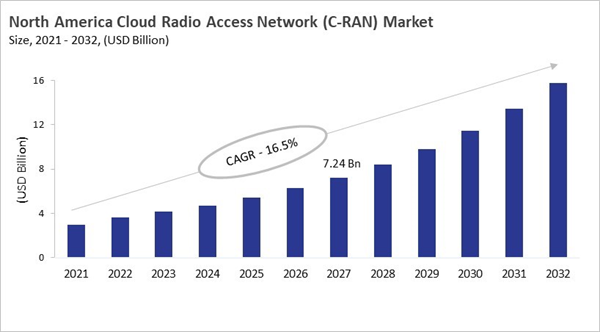
As North America has moved toward more advanced digital infrastructure and next-generation wireless connectivity, the C-RAN market has changed as well. The growing need for mobile data showed the flaws in traditional RAN architectures, which led to interest in centralized and cloud-based models. Early research projects and government-backed programs helped prove C-RAN ideas, especially during the growth of LTE. The switch to 5G sped up adoption even more because virtualization, software-defined networking, and cloud-native principles became necessary for the core network. National digital strategies that focus on resilience, efficiency, and scalability are still helping the market grow.
Adoption of cloud-native and virtualized RAN, open interfaces, and more automation and AI are some of the most important trends in the market. Open C-RAN frameworks make it easier for different systems to work together and make it harder for vendors to lock in customers, which leads to a bigger ecosystem. Automation and AI make networks work better, use less energy, and run more smoothly. The market is still moderately competitive, but this is because of new technology, not prices. The competitive landscape is always changing and growing because vendors, operators, and public institutions work together.
Deployment Model Outlook
Based on Deployment Model, the market is segmented into Centralised RAN (C-RAN), Virtualised RAN (vRAN), Open RAN (O-RAN) and Hybrid Cloud RAN. The Centralised RAN (C-RAN) market segment dominated the US Cloud Radio Access Network (C-RAN) Market by Deployment Model is expected to grow at a CAGR of 15.1 % during the forecast period thereby continuing its dominance until 2032. Also, The Hybrid Cloud RAN market is anticipated to grow as a CAGR of 16.1 % during the forecast period during 2025-2032.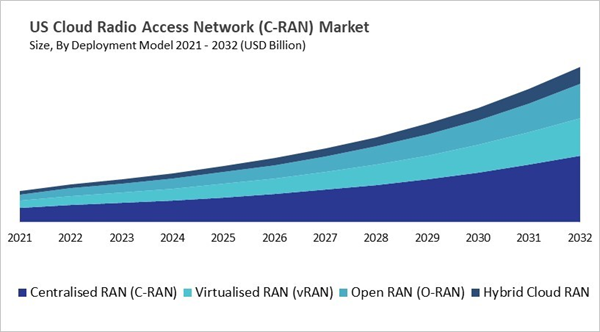
Network Type Outlook
Based on Network Type, the market is segmented into 5G, 4G, LTE and 3G (EDGE). Among various Mexico Cloud Radio Access Network (C-RAN) Market by Network Type; The 5G market achieved a market size of USD $179.2 Million in 2024 and is expected to grow at a CAGR of 17.6 % during the forecast period. The 3G (EDGE) market is predicted to experience a CAGR of 19.2% throughout the forecast period from (2025-2032).Country Outlook
Because of its advanced telecom infrastructure, large-scale 5G rollouts, and aggressive network modernization by major operators, the United States is the leader in C-RAN adoption in North America. People think that C-RAN is necessary to make networks more flexible, scalable, and cost-effective by using cloud-native and virtualized architectures. U.S. operators have started commercial deployments and pilots of cloud-based RAN technologies that can handle live 5G traffic. The growing demand for mobile data and the rapid densification of networks are two main reasons why operators are moving away from traditional hardware-based RAN models. The Open RAN movement helps C-RAN adoption even more by encouraging open interfaces and ecosystems with multiple vendors. In general, the U.S. is a central hub for C-RAN evolution because of strong operator initiatives and mature technology ecosystems.List of Key Companies Profiled
- Nokia Corporation
- Huawei Technologies Co., Ltd. (Huawei Investment & Holding Co., Ltd.)
- Intel Corporation
- ZTE Corporation
- Samsung Electronics Co., Ltd. (Samsung Group)
- Ericsson AB
- NEC Corporation
- Cisco Systems, Inc.
- Fujitsu Limited
- Qualcomm Incorporated (Qualcomm Technologies, Inc.)
Market Report Segmentation
By Component- Solutions
- Services
- Professional Services
- Managed Services
- 5G
- 4G
- LTE
- 3G (EDGE)
- Centralised RAN (C-RAN)
- Virtualised RAN (vRAN)
- Open RAN (O-RAN)
- Hybrid Cloud RAN
- Mobile Network Operators (MNOs)
- Enterprises
- Government & Public Safety
- Neutral Host / Tower Companies
- US
- Canada
- Mexico
- Rest of North America
Table of Contents
Chapter 1. Market Scope & Methodology
Chapter 2. Market at a Glance
Chapter 3. Market Overview
Chapter 9. Competition Analysis - Global
Chapter 11. North America Cloud Radio Access Network (C-RAN) Market by Component
Chapter 12. North America Cloud Radio Access Network (C-RAN) Market by Network Type
Chapter 13. North America Cloud Radio Access Network (C-RAN) Market by Deployment Model
Chapter 14. North America Cloud Radio Access Network (C-RAN) Market by End User
Chapter 15. North America Cloud Radio Access Network (C-RAN) Market by Country
Chapter 16. Company Profiles
Companies Mentioned
- Nokia Corporation
- Huawei Technologies Co., Ltd. (Huawei Investment & Holding Co., Ltd.)
- Intel Corporation
- ZTE Corporation
- Samsung Electronics Co., Ltd. (Samsung Group)
- Ericsson AB
- NEC Corporation
- Cisco Systems, Inc.
- Fujitsu Limited
- Qualcomm Incorporated (Qualcomm Technologies, Inc.)


