



The Asia Pacific Cloud Radio Access Network (C-RAN) Market is expected to witness market growth of 17.6% CAGR during the forecast period (2025-2032).
The China market dominated the Asia Pacific Cloud Radio Access Network (C-RAN) Market by country in 2024, and is expected to continue to be a dominant market till 2032; thereby, achieving a market value of $4.77 billion by 2032. The Japan market is registering a CAGR of 16.7% during 2025-2032. Additionally, the India market is expected to showcase a CAGR of 18.4% during 2025-2032. The China and Japan led the Asia Pacific Cloud Radio Access Network (C-RAN) Market by Country with a market share of 34.9% and 16.5% in 2024.The Malaysia market is expected to witness a CAGR of 20.5% during throughout the forecast period.
The Asia Pacific C-RAN market has grown rapidly due to large populations, rising mobile data demand, and strong government support for digital infrastructure. Early adoption was driven by national broadband and innovation programs, especially in high-density countries, to improve spectrum efficiency and reduce costs. LTE expansion validated centralized RAN benefits, while smart city initiatives encouraged cloud-based deployments. The rollout of 5G significantly accelerated C-RAN adoption, aligning with virtualization and cloud-native network principles. Focus on energy efficiency, resilience, and technological leadership continues to shape market development.
Key trends include widespread adoption of cloud-native and virtualized RAN, support for open interfaces, and increased use of automation and AI. Governments promote interoperability and standardized frameworks to strengthen supply chains and local innovation. Automation and centralized optimization improve operational efficiency and sustainability. Market leaders emphasize R&D investment, ecosystem collaboration, and alignment with public policy. Overall, the Asia Pacific C-RAN market is highly competitive, driven by innovation, scale, and collaborative deployment models.
The China market dominated the Asia Pacific Cloud Radio Access Network (C-RAN) Market by country in 2024, and is expected to continue to be a dominant market till 2032; thereby, achieving a market value of $4.77 billion by 2032. The Japan market is registering a CAGR of 16.7% during 2025-2032. Additionally, the India market is expected to showcase a CAGR of 18.4% during 2025-2032. The China and Japan led the Asia Pacific Cloud Radio Access Network (C-RAN) Market by Country with a market share of 34.9% and 16.5% in 2024.The Malaysia market is expected to witness a CAGR of 20.5% during throughout the forecast period.
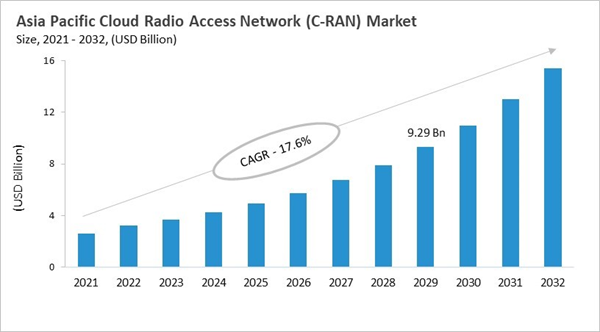
The Asia Pacific C-RAN market has grown rapidly due to large populations, rising mobile data demand, and strong government support for digital infrastructure. Early adoption was driven by national broadband and innovation programs, especially in high-density countries, to improve spectrum efficiency and reduce costs. LTE expansion validated centralized RAN benefits, while smart city initiatives encouraged cloud-based deployments. The rollout of 5G significantly accelerated C-RAN adoption, aligning with virtualization and cloud-native network principles. Focus on energy efficiency, resilience, and technological leadership continues to shape market development.
Key trends include widespread adoption of cloud-native and virtualized RAN, support for open interfaces, and increased use of automation and AI. Governments promote interoperability and standardized frameworks to strengthen supply chains and local innovation. Automation and centralized optimization improve operational efficiency and sustainability. Market leaders emphasize R&D investment, ecosystem collaboration, and alignment with public policy. Overall, the Asia Pacific C-RAN market is highly competitive, driven by innovation, scale, and collaborative deployment models.
Component Outlook
Based on Component, the market is segmented into Solutions and Services. With a compound annual growth rate (CAGR) of 18% over the projection period, the Solutions Market, dominate the India Cloud Radio Access Network (C-RAN) Market by Component in 2024 and would be a prominent market until 2032. The Services market is expected to witness a CAGR of 19.4% during 2025-2032.End User Outlook
Based on End User, the market is segmented into Mobile Network Operators (MNOs), Enterprises, Government & Public Safety and Neutral Host / Tower Companies. Among various Singapore Cloud Radio Access Network (C-RAN) Market by End User; The Mobile Network Operators (MNOs) market achieved a market size of USD $138.9 Million in 2024 and is expected to grow at a CAGR of 19.4 % during the forecast period. The Neutral Host / Tower Companies market is predicted to experience a CAGR of 20.7% throughout the forecast period from (2025-2032).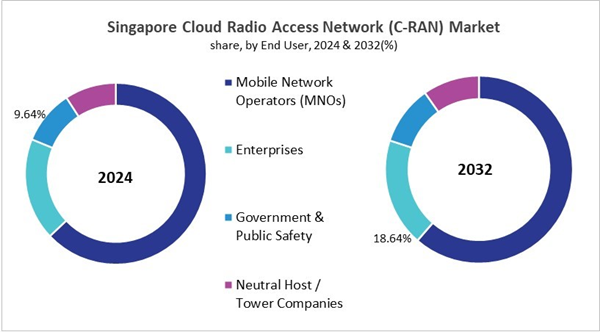
Country Outlook
China is one of the largest and most advanced markets for Cloud Radio Access Network deployment in the Asia Pacific region, driven by aggressive 5G rollouts and dense urban networks. C-RAN is widely adopted to improve network efficiency, scalability, and centralized resource management. Strong growth in cloud computing and the need to reduce energy consumption further accelerate adoption. Market trends highlight cloud-native, software-defined RAN integrated with edge computing and AI-based network management. Virtualization enables rapid scaling and faster feature deployment. Competition is dominated by domestic OEMs supporting national digital and security objectives.List of Key Companies Profiled
- Nokia Corporation
- Huawei Technologies Co., Ltd. (Huawei Investment & Holding Co., Ltd.)
- Intel Corporation
- ZTE Corporation
- Samsung Electronics Co., Ltd. (Samsung Group)
- Ericsson AB
- NEC Corporation
- Cisco Systems, Inc.
- Fujitsu Limited
- Qualcomm Incorporated (Qualcomm Technologies, Inc.)
Market Report Segmentation
By Component- Solutions
- Services
- Professional Services
- Managed Services
- 5G
- 4G
- LTE
- 3G (EDGE)
- Centralised RAN (C-RAN)
- Virtualised RAN (vRAN)
- Open RAN (O-RAN)
- Hybrid Cloud RAN
- Mobile Network Operators (MNOs)
- Enterprises
- Government & Public Safety
- Neutral Host / Tower Companies
- China
- Japan
- India
- South Korea
- Singapore
- Malaysia
- Rest of Asia Pacific
Table of Contents
Chapter 1. Market Scope & Methodology
Chapter 2. Market at a Glance
Chapter 3. Market Overview
Chapter 9. Competition Analysis - Global
Chapter 11. Asia Pacific Cloud Radio Access Network (C-RAN) Market by Component
Chapter 12. Asia Pacific Cloud Radio Access Network (C-RAN) Market by Network Type
Chapter 13. Asia Pacific Cloud Radio Access Network (C-RAN) Market by Deployment Model
Chapter 14. Asia Pacific Cloud Radio Access Network (C-RAN) Market by End User
Chapter 15. Asia Pacific Cloud Radio Access Network (C-RAN) Market by Country
Chapter 16. Company Profiles
Companies Mentioned
- Nokia Corporation
- Huawei Technologies Co., Ltd. (Huawei Investment & Holding Co., Ltd.)
- Intel Corporation
- ZTE Corporation
- Samsung Electronics Co., Ltd. (Samsung Group)
- Ericsson AB
- NEC Corporation
- Cisco Systems, Inc.
- Fujitsu Limited
- Qualcomm Incorporated (Qualcomm Technologies, Inc.)


