



The North America Industrial Data Management Market is expected to reach $60.06 billion by 2028 and is expected to witness market growth of 13.7% CAGR during the forecast period (2025-2032).
The US market dominated the North America Industrial Data Management Market by country in 2024, and is expected to continue to be a dominant market till 2032; thereby, achieving a market value of $73.96 billion by 2032. Canada market is experiencing a CAGR of 16% during 2025-2032. Additionally, the Mexico market is expected to exhibit a CAGR of 15.1% during 2025-2032. The US and Canada led the North America Industrial Data Management Market by Country with a market share of 76.2% and 12% in 2024.
As the industrial sector has quickly gone digital, the North America Industrial Data Management Market has grown as well. Before, industrial data was kept in separate systems and manual records, which made it hard to access and analyze. As IoT devices, sensors, and advanced computing became more common, industries started to produce huge amounts of complicated data. This made it necessary to have strong data management platforms. These systems can now store, process, manage, and protect data in real time. The region's strong manufacturing base, helpful government programs, and rules about cybersecurity and data integrity have all helped speed up the use of advanced data management technologies.
AI and machine learning are being used more for predictive analytics, automated data governance, and operational optimization. Sustainability efforts are also influencing how data is managed; for example, industries are adding energy use and carbon monitoring to their data systems. Another big trend is making industrial data available to more people by using easy-to-use platforms and visualization tools. Innovation, strategic partnerships, and the creation of scalable, secure platforms that provide advanced analytics and easy integration with industrial systems are what keep the competition going.
The US market dominated the North America Industrial Data Management Market by country in 2024, and is expected to continue to be a dominant market till 2032; thereby, achieving a market value of $73.96 billion by 2032. Canada market is experiencing a CAGR of 16% during 2025-2032. Additionally, the Mexico market is expected to exhibit a CAGR of 15.1% during 2025-2032. The US and Canada led the North America Industrial Data Management Market by Country with a market share of 76.2% and 12% in 2024.
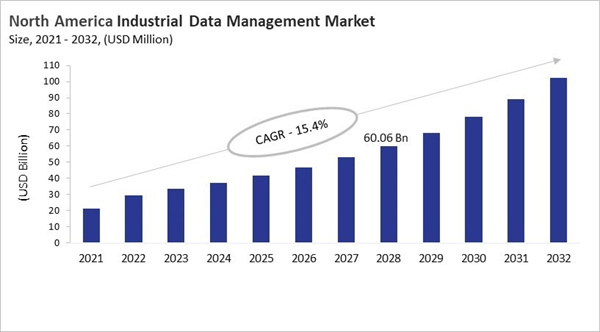
As the industrial sector has quickly gone digital, the North America Industrial Data Management Market has grown as well. Before, industrial data was kept in separate systems and manual records, which made it hard to access and analyze. As IoT devices, sensors, and advanced computing became more common, industries started to produce huge amounts of complicated data. This made it necessary to have strong data management platforms. These systems can now store, process, manage, and protect data in real time. The region's strong manufacturing base, helpful government programs, and rules about cybersecurity and data integrity have all helped speed up the use of advanced data management technologies.
AI and machine learning are being used more for predictive analytics, automated data governance, and operational optimization. Sustainability efforts are also influencing how data is managed; for example, industries are adding energy use and carbon monitoring to their data systems. Another big trend is making industrial data available to more people by using easy-to-use platforms and visualization tools. Innovation, strategic partnerships, and the creation of scalable, secure platforms that provide advanced analytics and easy integration with industrial systems are what keep the competition going.
End Use Outlook
Based on End Use, the market is segmented into Manufacturing & Processing, Energy & Utilities, Logistics & Supply Chain, BFSI, and Healthcare & Others. The Manufacturing & Processing market segment dominated the US Industrial Data Management Market by End Use is expected to grow at a CAGR of 12.1 % during the forecast period thereby continuing its dominance until 2032. Also, The BFSI market is anticipated to grow as a CAGR of 14.2 % during the forecast period during 2025-2032.Data Type Outlook
Based on Data Type, the market is segmented into Structured Data, Unstructured Data, and Semi-Structured Data. With a compound annual growth rate (CAGR) of 15.4% over the projection period, the Structured Data Market, dominate the Canada Industrial Data Management Market by Data Type in 2024 and would be a prominent market until 2032. The Semi-Structured Data market is expected to witness a CAGR of 16.4% during 2025-2032.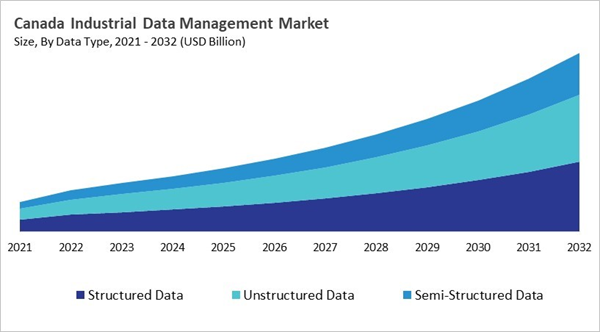
Country Outlook
The US Industrial Data Management Market has grown a lot because more industrial processes are going digital and more advanced technologies are being used in fields like logistics and manufacturing. At first, the market was only for collecting basic data from systems like SCADA, PLCs, and RTUs. Now, it has grown into advanced platforms that can combine and analyze huge amounts of industrial data. The growth of Industry 4.0, IIoT devices, cloud and edge computing, and AI-driven analytics has made it easier to monitor things in real time, do maintenance before problems happen, and run businesses more efficiently. Data governance, cybersecurity, and following the rules have also become very important. Some important trends are the use of AI and machine learning together, better data governance frameworks, and the growth of edge computing to speed up data processing. Top companies are putting money into research and development, partnerships, and flexible deployment models like cloud and hybrid systems. There are both well-known industrial automation companies and new startups in the competitive landscape. This leads to ongoing technological progress and data-driven decision-making in industrial operations.List of Key Companies Profiled
- Microsoft Corporation
- Amazon Web Services, Inc. (Amazon.com, Inc.)
- IBM Corporation
- SAP SE
- Oracle Corporation
- Informatica Inc.
- Google LLC
- Snowflake Inc.
- Siemens AG
- Honeywell International, Inc.
Market Report Segmentation
By Data Type- Structured Data
- Unstructured Data
- Semi-Structured Data
- Manufacturing & Processing
- Energy & Utilities
- Logistics & Supply Chain
- BFSI
- Healthcare & Others
- Data Storage & Integration
- Data Orchestration & Analytics
- Data Visualization
- Data Security
- Data Governance & Compliance
- Data Sharing
- Predictive Maintenance
- Asset Monitoring & Optimization
- Manufacturing Process Optimization
- Real-Time Operational Analytics
- Supply Chain & Inventory Management
- Regulatory Reporting & Compliance
- Other Application
- US
- Canada
- Mexico
- Rest of North America
Table of Contents
Chapter 1. Market Scope & Methodology
Chapter 2. Market at a Glance
Chapter 3. Market Overview
Chapter 4. Market Trends - North America Intrinsically Safe Equipment Market
Chapter 5. State of Competition - North America Intrinsically Safe Equipment Market
Chapter 6. Market Consolidation - North America Intrinsically Safe Equipment Market
Chapter 7. Key Customer Criteria - North America Intrinsically Safe Equipment Market
Chapter 8. Product Life Cycle - North America Intrinsically Safe Equipment Market
Chapter 9. Value Chain Analysis of Intrinsically Safe Equipment Market
Chapter 10. Competition Analysis - Global
Chapter 11. North America Intrinsically Safe Equipment Market by Class Type
Chapter 12. North America Intrinsically Safe Equipment Market by End Use
Chapter 13. North America Intrinsically Safe Equipment Market by Zone
Chapter 14. North America Intrinsically Safe Equipment Market by Product
Chapter 15. North America Intrinsically Safe Equipment Market by Country
Chapter 16. Company Profiles
Companies Mentioned
- Banner Engineering Corporation
- Honeywell International Inc.
- Eaton Corporation plc
- Emerson Electric Co.
- Rockwell Automation, Inc.
- Schneider Electric SE
- Siemens AG
- Fluke Corporation (Fortive Corporation)
- Pepperl+Fuchs SE
- R. STAHL AG


