



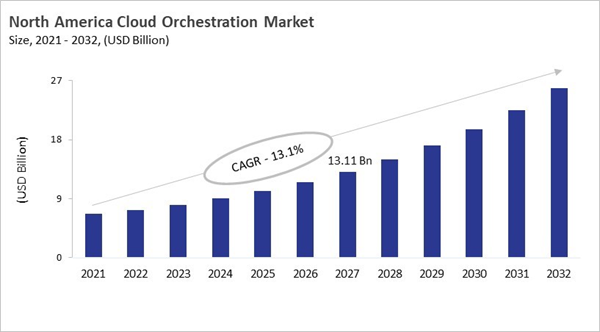
The North America Cloud Orchestration Market is expected to reach $13.11 billion by 2027 and is expected to witness market growth of 14.2% CAGR during the forecast period (2025-2032).
The US market dominated the North America Cloud Orchestration Market by country in 2024, and is expected to continue to be a dominant market till 2032; thereby, achieving a market value of $19.72 billion by 2032. The Canada market is experiencing a CAGR of 17% during 2025-2032. Additionally, the Mexico market is expected to exhibit a CAGR of 16% during 2025-2032. The US and Canada led the North America Cloud Orchestration Market by Country with a market share of 80.2% and 9.7% in 2024.
In North America, cloud orchestration has gone from being a simple way to automate infrastructure to being an important tool for managing complex, distributed cloud environments. Orchestration was first made possible by the early use of cloud services in the 2010s, such as AWS, Microsoft Azure, and Google Cloud. It allowed resources to be automatically provisioned, deployed, and scaled using infrastructure-as-code and workflow-based models. As businesses started using hybrid and multi-cloud strategies, orchestration grew to include services in public, private, and on-premises environments. This was helped by government programs like the U.S. "Cloud Smart" strategy. Orchestration is what makes modern cloud operations possible. It allows for consistency, scalability, and governance in fields like finance, healthcare, government, and enterprise IT.
Orchestration is becoming more and more connected to DevOps, container platforms like Kubernetes, and AI-driven automation. Hybrid and multi-cloud management tools, deep DevOps and IaC integration, and new intelligent orchestration that uses AI/ML for predictive scaling, cost optimization, and resilience are some of the things that set the best providers apart. Policy-driven governance, security enforcement, and compliance automation are now built into orchestration frameworks. This is because businesses want both flexibility and control. As competition among hyperscalers heats up, cloud orchestration has become a key technology for making digital infrastructure across North America more flexible, smart, and safe.
The US market dominated the North America Cloud Orchestration Market by country in 2024, and is expected to continue to be a dominant market till 2032; thereby, achieving a market value of $19.72 billion by 2032. The Canada market is experiencing a CAGR of 17% during 2025-2032. Additionally, the Mexico market is expected to exhibit a CAGR of 16% during 2025-2032. The US and Canada led the North America Cloud Orchestration Market by Country with a market share of 80.2% and 9.7% in 2024.
In North America, cloud orchestration has gone from being a simple way to automate infrastructure to being an important tool for managing complex, distributed cloud environments. Orchestration was first made possible by the early use of cloud services in the 2010s, such as AWS, Microsoft Azure, and Google Cloud. It allowed resources to be automatically provisioned, deployed, and scaled using infrastructure-as-code and workflow-based models. As businesses started using hybrid and multi-cloud strategies, orchestration grew to include services in public, private, and on-premises environments. This was helped by government programs like the U.S. "Cloud Smart" strategy. Orchestration is what makes modern cloud operations possible. It allows for consistency, scalability, and governance in fields like finance, healthcare, government, and enterprise IT.
Orchestration is becoming more and more connected to DevOps, container platforms like Kubernetes, and AI-driven automation. Hybrid and multi-cloud management tools, deep DevOps and IaC integration, and new intelligent orchestration that uses AI/ML for predictive scaling, cost optimization, and resilience are some of the things that set the best providers apart. Policy-driven governance, security enforcement, and compliance automation are now built into orchestration frameworks. This is because businesses want both flexibility and control. As competition among hyperscalers heats up, cloud orchestration has become a key technology for making digital infrastructure across North America more flexible, smart, and safe.
User Type Outlook
Based on User Type, the market is segmented into Large Enterprises and Small & Medium Enterprises (SMEs). The Large Enterprises market segment dominated the Canada Cloud Orchestration Market by User Type is expected to grow at a CAGR of 16.6 % during the forecast period thereby continuing its dominance until 2032. Also, The Small & Medium Enterprises (SMEs) market is anticipated to grow as a CAGR of 17.8 % during the forecast period during 2025-2032.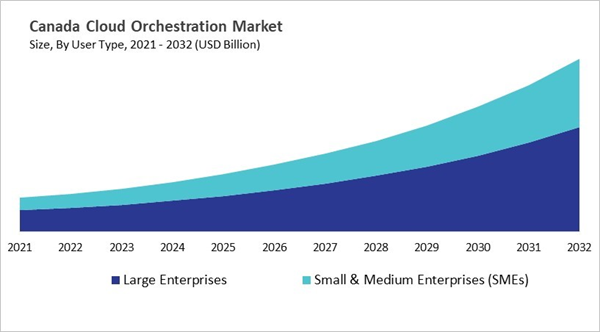
Industry Vertical Outlook
Based on Industry Vertical, the market is segmented into IT and Telecom, BFSI, Healthcare, Government & Education, Retail, Manufacturing, Media & Entertainment and Other Industry Verticals. Among various US Cloud Orchestration Market by Industry Vertical; The IT and Telecom market achieved a market size of USD $1.88 billion in 2024 and is expected to grow at a CAGR of 11.5 % during the forecast period. The Media & Entertainment market is predicted to experience a CAGR of 14.3% throughout the forecast period from (2025-2032).Country Outlook
The United States is a key player in the North America Cloud Orchestration Market because it was one of the first countries to adopt cloud technology, has a strong digital infrastructure, and is home to many global cloud technology providers. Orchestration is now a must-have for automating workloads, managing resources, and keeping things consistent because many industries, including finance, healthcare, retail, and government, use multi-cloud and hybrid environments. Companies put orchestration at the top of their list of priorities in order to improve operational efficiency, resilience, security, and compliance with regulations in architectures that are becoming more complex andList of Key Companies Profiled
- Cisco Systems, Inc.
- IBM Corporation
- Microsoft Corporation
- Google LLC (Alphabet Inc.)
- Oracle Corporation
- Amazon Web Services, Inc. (Amazon.com, Inc.)
- Hewlett Packard Enterprise Company
- VMware, Inc. (Broadcom Inc.)
- Huawei Technologies Co., Ltd. (Huawei Investment & Holding Co., Ltd.)
- DXC Technology Company
Market Report Segmentation
By User Type- Large Enterprises
- Small & Medium Enterprises (SMEs)
- Hybrid Cloud
- Public Cloud
- Private Cloud
- Configuration
- Managed Support
- Portable Service
- Other Solution
- IT and Telecom
- BFSI
- Healthcare
- Government & Education
- Retail
- Manufacturing
- Media & Entertainment
- Other Industry Verticals
- US
- Canada
- Mexico
- Rest of North America
Table of Contents
Chapter 1. Market Scope & Methodology
Chapter 2. Market at a Glance
Chapter 3. Market Overview
Chapter 10. Competition Analysis - Global
Chapter 11. North America Cloud Orchestration Market by User Type
Chapter 12. North America Cloud Orchestration Market by Deployment Model
Chapter 13. North America Cloud Orchestration Market by Solution
Chapter 14. North America Cloud Orchestration Market by Industry Vertical
Chapter 15. North America Cloud Orchestration Market by Country
Chapter 16. Company Profiles
Companies Mentioned
- Cisco Systems, Inc.
- IBM Corporation
- Microsoft Corporation
- Google LLC (Alphabet Inc.)
- Oracle Corporation
- Amazon Web Services, Inc. (Amazon.com, Inc.)
- Hewlett Packard Enterprise Company
- VMware, Inc. (Broadcom Inc.)
- Huawei Technologies Co., Ltd. (Huawei Investment & Holding Co., Ltd.)
- DXC Technology Company


