



The Europe Container Handling Equipment Market is expected to reach $2.53 billion by 2031 and is expected to witness market growth of 3.8% CAGR during the forecast period (2025-2032).
The Germany market dominated the Europe Container Handling Equipment Market by country in 2024, and is expected to continue to be a dominant market till 2032; thereby, achieving a market value of $479.1 million by 2032. The UK market is exhibiting a CAGR of 2.7% during 2025-2032. Additionally, the France market is expected to experience a CAGR of 4.6% during 2025-2032. The Germany and UK led the Europe Container Handling Equipment Market by Country with a market share of 20.3% and 16.8% in 2024.The Italy market is expected to witness a CAGR of 4.3% during throughout the forecast period.
The Europe container handling equipment market is an important part of the region's maritime trade system. It helps some of the busiest and most advanced ports in the world. It has ship-to-shore cranes, gantry cranes, straddle carriers, reach stackers, and terminal tractors that are used in ports and intermodal hubs. With the rise of containerization, the market changed from manual handling to mechanized systems. Ports like Rotterdam, Hamburg, and Antwerp needed high-capacity and efficient equipment to meet their needs. In the late 1900s, Europe became the leader in port engineering and new ideas. Automation and digitalization changed how terminals work in the twenty-first century. Strong EU environmental policies pushed the market even more toward energy-efficient solutions.
The main trends in Europe's market for container handling equipment are automation and sustainability. To make things safer and more productive, ports are using more automated stacking cranes, remote-controlled quay cranes, and smart control systems. Strict rules about the environment are speeding up the use of electric and low-emission tools. As container ships get bigger, there is more need for cranes that can reach farther and lift more weight. Konecranes, Kalmar, and Liebherr are some of the biggest OEMs that focus on research and development, modular solutions, and lifecycle services. Localization and strong service networks help meet customer needs and follow the rules. The market is moderately consolidated, and competition is based on things like automation expertise, environmental performance, reliability, and long-term support, not just price.
The Germany market dominated the Europe Container Handling Equipment Market by country in 2024, and is expected to continue to be a dominant market till 2032; thereby, achieving a market value of $479.1 million by 2032. The UK market is exhibiting a CAGR of 2.7% during 2025-2032. Additionally, the France market is expected to experience a CAGR of 4.6% during 2025-2032. The Germany and UK led the Europe Container Handling Equipment Market by Country with a market share of 20.3% and 16.8% in 2024.The Italy market is expected to witness a CAGR of 4.3% during throughout the forecast period.
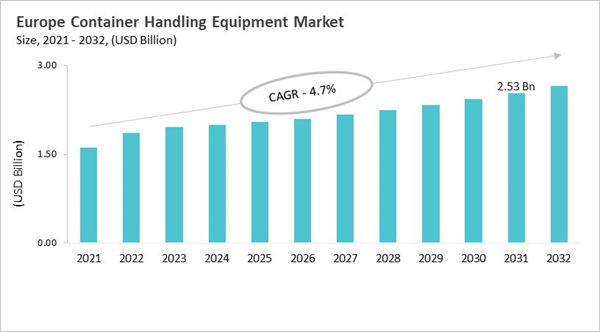
The Europe container handling equipment market is an important part of the region's maritime trade system. It helps some of the busiest and most advanced ports in the world. It has ship-to-shore cranes, gantry cranes, straddle carriers, reach stackers, and terminal tractors that are used in ports and intermodal hubs. With the rise of containerization, the market changed from manual handling to mechanized systems. Ports like Rotterdam, Hamburg, and Antwerp needed high-capacity and efficient equipment to meet their needs. In the late 1900s, Europe became the leader in port engineering and new ideas. Automation and digitalization changed how terminals work in the twenty-first century. Strong EU environmental policies pushed the market even more toward energy-efficient solutions.
The main trends in Europe's market for container handling equipment are automation and sustainability. To make things safer and more productive, ports are using more automated stacking cranes, remote-controlled quay cranes, and smart control systems. Strict rules about the environment are speeding up the use of electric and low-emission tools. As container ships get bigger, there is more need for cranes that can reach farther and lift more weight. Konecranes, Kalmar, and Liebherr are some of the biggest OEMs that focus on research and development, modular solutions, and lifecycle services. Localization and strong service networks help meet customer needs and follow the rules. The market is moderately consolidated, and competition is based on things like automation expertise, environmental performance, reliability, and long-term support, not just price.
Automation Level Outlook
Based on Automation Level, the market is segmented into Manual, Semi-Automated, and Fully Automated. Among various UK Container Handling Equipment Market by Automation Level; The Manual market achieved a market size of USD $167.4 Million in 2024 and is expected to grow at a CAGR of 2.2 % during the forecast period. The Fully Automated market is predicted to experience a CAGR of 3.5% throughout the forecast period from (2025-2032).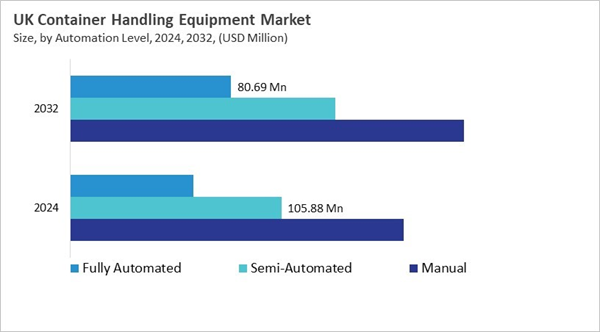
End-User Outlook
Based on End User, the market is segmented into Seaport & River Terminals, Inland Container Depots / Rail Yards, and Container Freight Stations & Warehouses. The Seaport & River Terminals market segment dominated the France Container Handling Equipment Market by End-User is expected to grow at a CAGR of 4.2 % during the forecast period thereby continuing its dominance until 2032. Also, The Container Freight Stations & Warehouses market is anticipated to grow as a CAGR of 5.9 % during the forecast period during 2025-2032.Country Outlook
Germany’s container handling equipment market is closely linked to its major ports such as Hamburg and Bremerhaven and its strong logistics and industrial base. Equipment such as reach stackers, container handlers, straddle carriers, and terminal tractors is widely used across ports, intermodal terminals, and logistics hubs. The market emphasizes high operational efficiency supported by extensive dealer and service networks. Sustainability is a key driver, with growing demand for electric and low-emission equipment to meet EU regulations. Trends show increasing adoption of electrification, automation, and digital tools like telematics and fleet management systems. Competition involves global and European OEMs such as Kalmar and Hyster offering tailored solutions. Future growth will be driven by decarbonization goals and continued investment in automated and energy-efficient container handling technologies.List of Key Companies Profiled
- Cosco Shipping Lines Co. Ltd.
- A.P. Moller - Maersk A/S
- CMA CGM Group
- MSC Mediterranean Shipping Company S.A.
- Ocean Network Express Pte. Ltd.
- Evergreen Marine Corp. (Taiwan) Ltd. (Evergreen Group)
- Hapag-Lloyd AG
- ZIM Integrated Shipping Services Ltd. (KENON HOLDINGS LTD.)
- DP World Logistics FZE (SeaRates)
- SANY Group
Market Report Segmentation
By Automation Level- Manual
- Semi-Automated
- Fully Automated
- Seaport & River Terminals
- Inland Container Depots / Rail Yards
- Container Freight Stations & Warehouses
- Diesel
- Hybrid
- Battery Electric
- Hydrogen Fuel Cell
- Other Propulsion Type
- Forklift Truck
- Reach Stacker
- Rubber Tired Gantry (RTG) Crane
- Ship-to-Shore (STS) Crane
- Straddle Carrier
- Automated Guided Vehicle (AGV)
- Other Equipment Type
- Germany
- UK
- France
- Russia
- Spain
- Italy
- Rest of Europe
Table of Contents
Chapter 1. Market Scope & Methodology
Chapter 2. Market at a Glance
Chapter 3. Market Overview
Chapter 10. Europe Container Handling Equipment Market by Automation Level
Chapter 11. Europe Container Handling Equipment Market by End-User
Chapter 12. Europe Container Handling Equipment Market by Propulsion Type
Chapter 13. Europe Container Handling Equipment Market by Equipment Type
Chapter 14. Europe Container Handling Equipment Market by Country
Chapter 15. Company Profiles
Companies Mentioned
- Cosco Shipping Lines Co. Ltd.
- A.P. Moller - Maersk A/S
- CMA CGM Group
- MSC Mediterranean Shipping Company S.A.
- Ocean Network Express Pte. Ltd.
- Evergreen Marine Corp. (Taiwan) Ltd. (Evergreen Group)
- Hapag-Lloyd AG
- ZIM Integrated Shipping Services Ltd. (KENON HOLDINGS LTD.)
- DP World Logistics FZE (SeaRates)
- SANY Group


