



The Latin America, Middle East and Africa Container Handling Equipment Market is expected to reach $808.61 Million by 2032 and is expected to witness market growth of 5.5% CAGR during the forecast period (2025-2032).
The UAE market dominated the LAMEA Container Handling Equipment Market by country in 2024, and is expected to continue to be a dominant market till 2032; thereby, achieving a market value of $176.8 million by 2032. The Argentina market is showcasing a CAGR of 6.1% during 2025-2032. Additionally, the Brazil market would register a CAGR of 4.6% during 2025-2032. The UAE and Brazil led the LAMEA Container Handling Equipment Market by Country with a market share of 19.8% and 17.6% in 2024. The Nigeria market is expected to witness a CAGR of 6.7% during throughout the forecast period.
As Latin America, the Middle East, and Africa build up their ports and logistics networks, the LAMEA container handling equipment market is becoming more important. It includes cranes that lift things from ships to the shore, gantry cranes, reach stackers, straddle carriers, and terminal tractors used in ports and intermodal terminals. The gradual shift from traditional cargo handling to containerized systems has pushed the market to change. To help exports grow and trade diversify, big ports in Latin America and the Middle East bought new cranes and yard equipment. Government-led programs to modernize ports, especially in the Middle East, sped up the use of high-capacity equipment. International development funding helped fix up ports and buy basic machinery in Africa. The market is still changing today as companies add more capacity and use new technologies.
A big trend in LAMEA is expanding port capacity by building new terminals and buying modern equipment to handle bigger ships and more trade. Global terminal operators like DP World and APM Terminals create demand by using standardized and efficient systems for handling goods. Environmental concerns are growing, which is leading to the gradual use of electric and low-emission tools. OEM strategies include strong designs, making products available in different places, and working with port authorities and operators. Setting up regional service hubs and training programs helps equipment work well over time. Competition is fragmented and project-driven, led mainly by global OEMs and terminal operators. Market competition is based on more than just automation; it's also based on reliability, service capability, and execution strength.
The UAE market dominated the LAMEA Container Handling Equipment Market by country in 2024, and is expected to continue to be a dominant market till 2032; thereby, achieving a market value of $176.8 million by 2032. The Argentina market is showcasing a CAGR of 6.1% during 2025-2032. Additionally, the Brazil market would register a CAGR of 4.6% during 2025-2032. The UAE and Brazil led the LAMEA Container Handling Equipment Market by Country with a market share of 19.8% and 17.6% in 2024. The Nigeria market is expected to witness a CAGR of 6.7% during throughout the forecast period.
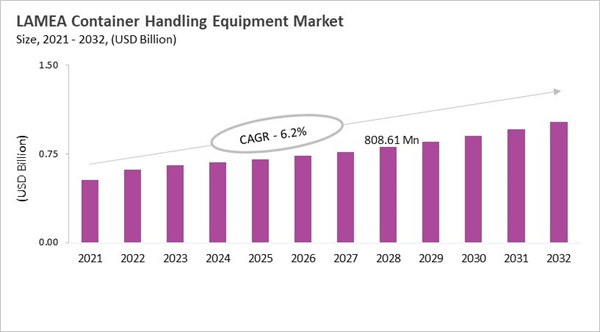
As Latin America, the Middle East, and Africa build up their ports and logistics networks, the LAMEA container handling equipment market is becoming more important. It includes cranes that lift things from ships to the shore, gantry cranes, reach stackers, straddle carriers, and terminal tractors used in ports and intermodal terminals. The gradual shift from traditional cargo handling to containerized systems has pushed the market to change. To help exports grow and trade diversify, big ports in Latin America and the Middle East bought new cranes and yard equipment. Government-led programs to modernize ports, especially in the Middle East, sped up the use of high-capacity equipment. International development funding helped fix up ports and buy basic machinery in Africa. The market is still changing today as companies add more capacity and use new technologies.
A big trend in LAMEA is expanding port capacity by building new terminals and buying modern equipment to handle bigger ships and more trade. Global terminal operators like DP World and APM Terminals create demand by using standardized and efficient systems for handling goods. Environmental concerns are growing, which is leading to the gradual use of electric and low-emission tools. OEM strategies include strong designs, making products available in different places, and working with port authorities and operators. Setting up regional service hubs and training programs helps equipment work well over time. Competition is fragmented and project-driven, led mainly by global OEMs and terminal operators. Market competition is based on more than just automation; it's also based on reliability, service capability, and execution strength.
Propulsion Type Outlook
Based on Propulsion Type, the market is segmented into Diesel, Hybrid, Battery Electric, Hydrogen Fuel Cell, and Other Propulsion Type. Among various UAE Container Handling Equipment Market by Propulsion Type; The Diesel market achieved a market size of USD $80.5 Million in 2024 and is expected to grow at a CAGR of 3.2 % during the forecast period. The Battery Electric market is predicted to experience a CAGR of 4.7% throughout the forecast period from (2025-2032).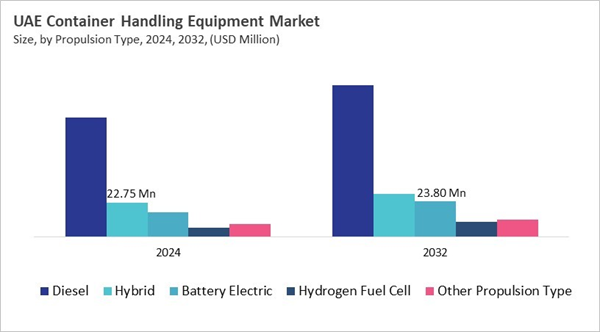
Automation Level Outlook
Based on Automation Level, the market is segmented into Manual, Semi-Automated, and Fully Automated. The Manual market segment dominated the South Africa Container Handling Equipment Market by Automation Level is expected to grow at a CAGR of 5.9 % during the forecast period thereby continuing its dominance until 2032. Also, The Fully Automated market is anticipated to grow as a CAGR of 7.3 % during the forecast period during 2025-2032.Country Outlook
As a major logistics and transshipment hub that connects Asia, Europe, and Africa through ports like Jebel Ali and Khalifa Port, the UAE container handling equipment market is growing. Heavy-duty equipment like reach stackers, terminal tractors, gantry cranes, and ship-to-shore cranes is needed when there are a lot of containers. OEMs like Konecranes provide advanced and integrated handling solutions that are made to fit the needs of UAE terminals. Many people use automation and digital workflow integration to make things safer and more efficient. Sustainability goals are pushing people to use telematics and remote monitoring to make their electric and eco-friendly equipment. Global OEMs that offer customization and strong after-sales support are the ones who lead the competition. Continued capacity growth, electrification, and next-generation automation technologies will help the company grow in the future.List of Key Companies Profiled
- Cosco Shipping Lines Co. Ltd.
- A.P. Moller - Maersk A/S
- CMA CGM Group
- MSC Mediterranean Shipping Company S.A.
- Ocean Network Express Pte. Ltd.
- Evergreen Marine Corp. (Taiwan) Ltd. (Evergreen Group)
- Hapag-Lloyd AG
- ZIM Integrated Shipping Services Ltd. (KENON HOLDINGS LTD.)
- DP World Logistics FZE (SeaRates)
- SANY Group
Market Report Segmentation
By Automation Level- Manual
- Semi-Automated
- Fully Automated
- Seaport & River Terminals
- Inland Container Depots / Rail Yards
- Container Freight Stations & Warehouses
- Diesel
- Hybrid
- Battery Electric
- Hydrogen Fuel Cell
- Other Propulsion Type
- Forklift Truck
- Reach Stacker
- Rubber Tired Gantry (RTG) Crane
- Ship-to-Shore (STS) Crane
- Straddle Carrier
- Automated Guided Vehicle (AGV)
- Other Equipment Type
- Brazil
- Argentina
- UAE
- Saudi Arabia
- South Africa
- Nigeria
- Rest of LAMEA
Table of Contents
Chapter 1. Market Scope & Methodology
Chapter 2. Market at a Glance
Chapter 3. Market Overview
Chapter 10. LAMEA Container Handling Equipment Market by Automation Level
Chapter 11. LAMEA Container Handling Equipment Market by End-User
Chapter 12. LAMEA Container Handling Equipment Market by Propulsion Type
Chapter 13. LAMEA Container Handling Equipment Market by Equipment Type
Chapter 14. LAMEA Container Handling Equipment Market by Country
Chapter 15. Company Profiles
Companies Mentioned
- Cosco Shipping Lines Co. Ltd.
- A.P. Moller - Maersk A/S
- CMA CGM Group
- MSC Mediterranean Shipping Company S.A.
- Ocean Network Express Pte. Ltd.
- Evergreen Marine Corp. (Taiwan) Ltd. (Evergreen Group)
- Hapag-Lloyd AG
- ZIM Integrated Shipping Services Ltd. (KENON HOLDINGS LTD.)
- DP World Logistics FZE (SeaRates)
- SANY Group


