



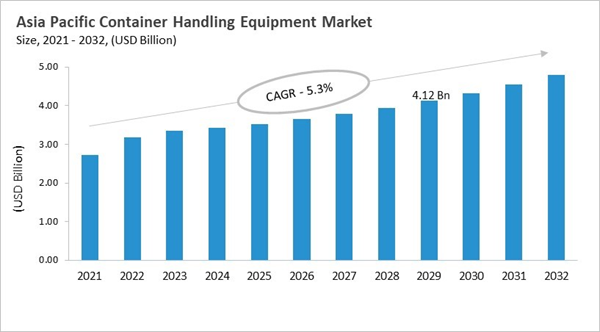
The Asia Pacific Container Handling Equipment Market is expected to reach $4.12 billion by 2029 and is expected to witness market growth of 4.5% CAGR during the forecast period (2025-2032).
The China market dominated the Asia Pacific Container Handling Equipment Market by country in 2024, and is expected to continue to be a dominant market till 2032; thereby, achieving a market value of $1.37 billion by 2032. The Japan market is registering a CAGR of 3.2% during 2025-2032. Additionally, the India market is expected to showcase a CAGR of 5.2% during 2025-2032. The China and India led the Asia Pacific Container Handling Equipment Market by Country with a market share of 32.5% and 13.6% in 2024. The Malaysia market is expected to witness a CAGR of 6.5% during throughout the forecast period.
The Asia Pacific handling equipment market is very important for global maritime trade because it has some of the biggest container ports in the world. There are ship-to-shore cranes, gantry cranes, straddle carriers, reach stackers, and terminal tractors that are used in ports and intermodal hubs. The market changed as containerized shipping grew quickly in places like China, Japan, and South Korea. Ports like Shanghai, Singapore, and Busan spent a lot of money on high-capacity equipment to handle more trade and bigger ships. As part of their national industrial strategies, governments pushed for the growth of ports. OEMs like ZPMC, Konecranes, and Kalmar provided heavy-duty systems for operations with a lot of cycles. Automation, digitalization, and sustainability efforts have all played a role in recent growth.
Automation is a big trend, and the best ports are using automated stacking cranes, remote-controlled quay cranes, and smart port technologies to make things safer and more productive. The rise of ultra-large container ships makes people want cranes that can reach farther and hold more. Environmental sustainability is becoming increasingly important, which is why people are using electric and hybrid equipment to cut down on emissions. OEMs focus on new ideas, big businesses, and networks of manufacturing and service centers in the area. Ports at different stages of development can use the right solutions thanks to a wide range of equipment. Key strategies include lifecycle services like maintenance, retrofitting, and digital upgrades. There is a lot of competition in the market. Chinese companies compete on size and price, while global OEMs set themselves apart by offering automation, engineering, and long-term service support.
The China market dominated the Asia Pacific Container Handling Equipment Market by country in 2024, and is expected to continue to be a dominant market till 2032; thereby, achieving a market value of $1.37 billion by 2032. The Japan market is registering a CAGR of 3.2% during 2025-2032. Additionally, the India market is expected to showcase a CAGR of 5.2% during 2025-2032. The China and India led the Asia Pacific Container Handling Equipment Market by Country with a market share of 32.5% and 13.6% in 2024. The Malaysia market is expected to witness a CAGR of 6.5% during throughout the forecast period.
The Asia Pacific handling equipment market is very important for global maritime trade because it has some of the biggest container ports in the world. There are ship-to-shore cranes, gantry cranes, straddle carriers, reach stackers, and terminal tractors that are used in ports and intermodal hubs. The market changed as containerized shipping grew quickly in places like China, Japan, and South Korea. Ports like Shanghai, Singapore, and Busan spent a lot of money on high-capacity equipment to handle more trade and bigger ships. As part of their national industrial strategies, governments pushed for the growth of ports. OEMs like ZPMC, Konecranes, and Kalmar provided heavy-duty systems for operations with a lot of cycles. Automation, digitalization, and sustainability efforts have all played a role in recent growth.
Automation is a big trend, and the best ports are using automated stacking cranes, remote-controlled quay cranes, and smart port technologies to make things safer and more productive. The rise of ultra-large container ships makes people want cranes that can reach farther and hold more. Environmental sustainability is becoming increasingly important, which is why people are using electric and hybrid equipment to cut down on emissions. OEMs focus on new ideas, big businesses, and networks of manufacturing and service centers in the area. Ports at different stages of development can use the right solutions thanks to a wide range of equipment. Key strategies include lifecycle services like maintenance, retrofitting, and digital upgrades. There is a lot of competition in the market. Chinese companies compete on size and price, while global OEMs set themselves apart by offering automation, engineering, and long-term service support.
Automation Level Outlook
Based on Automation Level, the market is segmented into Manual, Semi-Automated, and Fully Automated. With a compound annual growth rate (CAGR) of 2.3% over the projection period, the Manual Market, dominate the China Container Handling Equipment Market by Automation Level in 2024 and would be a prominent market until 2032. The Fully Automated market is expected to witness a CAGR of 3.6% during 2025-2032.End-User Outlook
Based on End User, the market is segmented into Seaport & River Terminals, Inland Container Depots / Rail Yards, and Container Freight Stations & Warehouses. The Seaport & River Terminals market segment dominated the Singapore Container Handling Equipment Market by End-User is expected to grow at a CAGR of 5.1 % during the forecast period thereby continuing its dominance until 2032. Also, The Container Freight Stations & Warehouses market is anticipated to grow as a CAGR of 6.9 % during the forecast period during 2025-2032.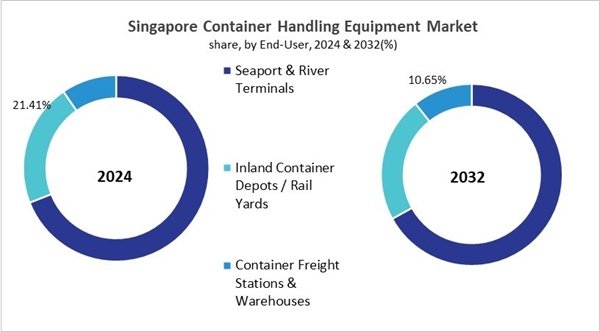
Country Outlook
China's container handling equipment market is the backbone of the world's busiest port network, which includes major hubs like Shanghai, Shenzhen, and Ningbo-Zhoushan. High trade volumes make people want reach stackers, container handlers, gantry cranes, and terminal tractors from both global and domestic OEMs. For continuous operations, high-capacity and reliable equipment is needed because manufacturing exports and intermodal logistics are growing quickly. Policies that promote electrification are making it easier for people to use electric and hybrid machines to meet national emissions standards. Telematics, fleet management systems, and automation are all examples of how digitalization is becoming more important in the market. These technologies help companies make better use of their resources and cut down on the amount of work they have to do. Competition combines the strength of international OEMs with the focus of local manufacturers on smart and specialized terminal solutions. Modernization, sustainability goals, and investments in advanced, digitally integrated handling equipment will all help the company grow in the future.List of Key Companies Profiled
- Cosco Shipping Lines Co. Ltd.
- A.P. Moller - Maersk A/S
- CMA CGM Group
- MSC Mediterranean Shipping Company S.A.
- Ocean Network Express Pte. Ltd.
- Evergreen Marine Corp. (Taiwan) Ltd. (Evergreen Group)
- Hapag-Lloyd AG
- ZIM Integrated Shipping Services Ltd. (KENON HOLDINGS LTD.)
- DP World Logistics FZE (SeaRates)
- SANY Group
Market Report Segmentation
By Automation Level- Manual
- Semi-Automated
- Fully Automated
- Seaport & River Terminals
- Inland Container Depots / Rail Yards
- Container Freight Stations & Warehouses
- Diesel
- Hybrid
- Battery Electric
- Hydrogen Fuel Cell
- Other Propulsion Type
- Forklift Truck
- Reach Stacker
- Rubber Tired Gantry (RTG) Crane
- Ship-to-Shore (STS) Crane
- Straddle Carrier
- Automated Guided Vehicle (AGV)
- Other Equipment Type
- China
- Japan
- India
- South Korea
- Singapore
- Malaysia
- Rest of Asia Pacific
Table of Contents
Chapter 1. Market Scope & Methodology
Chapter 2. Market at a Glance
Chapter 3. Market Overview
Chapter 10. Asia Pacific Container Handling Equipment Market by Automation Level
Chapter 11. Asia Pacific Container Handling Equipment Market by End-User
Chapter 12. Asia Pacific Container Handling Equipment Market by Propulsion Type
Chapter 13. Asia Pacific Container Handling Equipment Market by Equipment Type
Chapter 14. Asia Pacific Container Handling Equipment Market by Country
Chapter 15. Company Profiles
Companies Mentioned
- Cosco Shipping Lines Co. Ltd.
- A.P. Moller - Maersk A/S
- CMA CGM Group
- MSC Mediterranean Shipping Company S.A.
- Ocean Network Express Pte. Ltd.
- Evergreen Marine Corp. (Taiwan) Ltd. (Evergreen Group)
- Hapag-Lloyd AG
- ZIM Integrated Shipping Services Ltd. (KENON HOLDINGS LTD.)
- DP World Logistics FZE (SeaRates)
- SANY Group


