



The North America Data Science Platform Market is projected to reach USD 253.19 billion by 2032, growing at a CAGR of 24.7% during the forecast period.
The US market dominated the North America Data Science Platform Market by country in 2025 and is expected to continue to be a dominant market till 2033; thereby, achieving a market value of USD 195.56 billion by 2032, growing at a CAGR of 24.3% during the forecast period. The Canada market is expected to witness a CAGR of 26.4% during 2026-2033. Additionally, the Mexico market is expected to witness a CAGR of 25.9% during 2026-2033.
The increasing adoption of artificial intelligence, machine learning, and predictive analytics solutions across enterprises is significantly driving the growth of the North America Data Science Platform Market. Organizations across industries are increasingly leveraging advanced analytics platforms to improve operational efficiency, automate workflows, optimize customer experiences, and enable real-time decision-making. The rapid expansion of cloud computing infrastructure and enterprise digital transformation initiatives has further accelerated the deployment of scalable data science platforms across the region. Additionally, the growing volume of structured and unstructured data generated through IoT devices, connected systems, e-commerce platforms, and enterprise applications continues to create strong demand for advanced analytics and intelligent automation technologies.
The region is witnessing substantial investments from technology companies, cloud providers, and analytics vendors to strengthen AI-enabled data science ecosystems. Businesses are increasingly integrating generative AI, natural language processing, automated machine learning (AutoML), and real-time analytics capabilities within enterprise data science environments. Increasing focus on explainable AI, data governance, and cybersecurity frameworks is also encouraging organizations to deploy more advanced and secure analytics platforms. Furthermore, industries such as BFSI, healthcare, manufacturing, retail, telecommunications, and government are accelerating investments in analytics-driven operational strategies to improve competitiveness and business agility.
The Services segment is expected to witness a CAGR of 25.8% during the forecast period. Growing enterprise reliance on consulting, deployment, training, managed analytics, and AI integration services is supporting segment expansion across North America.
The Marketing & Sales Analytics segment dominated the North America Data Science Platform Market by Application in 2025 and is expected to continue to be a dominant market till 2033; thereby, achieving a market value of USD 54.26 billion by 2032, growing at a CAGR of 23.3% during the forecast period. The Financial Analytics (Risk & Fraud) segment is expected to witness a CAGR of 24.0% during the forecast period due to rising cybersecurity threats, digital transactions, and fraud prevention requirements across financial institutions.
The BFSI segment dominated the North America Data Science Platform Market by Vertical in 2025 and is expected to continue to be a dominant market till 2033; thereby, achieving a market value of USD 54.29 billion by 2032, growing at a CAGR of 23.3% during the forecast period. The segment is poised to high growth due to increasing adoption of fraud detection systems, predictive risk analytics, regulatory compliance tools, and AI-driven financial intelligence solutions.
The IT & Telecommunications segment is expected to witness a CAGR of 23.3% during the forecast period due to increasing implementation of network analytics, customer intelligence, and AI-powered automation technologies.
The Canada Data Science Platform Market is predicted to reach USD 28.04 billion by 2032, growing at a CAGR of 26.4% during the forecast period. Rising government support for AI innovation, increasing enterprise cloud adoption, and expanding investments in advanced analytics infrastructure are supporting market growth across the country.
The US market dominated the North America Data Science Platform Market by country in 2025 and is expected to continue to be a dominant market till 2033; thereby, achieving a market value of USD 195.56 billion by 2032, growing at a CAGR of 24.3% during the forecast period. The Canada market is expected to witness a CAGR of 26.4% during 2026-2033. Additionally, the Mexico market is expected to witness a CAGR of 25.9% during 2026-2033.
The increasing adoption of artificial intelligence, machine learning, and predictive analytics solutions across enterprises is significantly driving the growth of the North America Data Science Platform Market. Organizations across industries are increasingly leveraging advanced analytics platforms to improve operational efficiency, automate workflows, optimize customer experiences, and enable real-time decision-making. The rapid expansion of cloud computing infrastructure and enterprise digital transformation initiatives has further accelerated the deployment of scalable data science platforms across the region. Additionally, the growing volume of structured and unstructured data generated through IoT devices, connected systems, e-commerce platforms, and enterprise applications continues to create strong demand for advanced analytics and intelligent automation technologies.
The region is witnessing substantial investments from technology companies, cloud providers, and analytics vendors to strengthen AI-enabled data science ecosystems. Businesses are increasingly integrating generative AI, natural language processing, automated machine learning (AutoML), and real-time analytics capabilities within enterprise data science environments. Increasing focus on explainable AI, data governance, and cybersecurity frameworks is also encouraging organizations to deploy more advanced and secure analytics platforms. Furthermore, industries such as BFSI, healthcare, manufacturing, retail, telecommunications, and government are accelerating investments in analytics-driven operational strategies to improve competitiveness and business agility.
Component Outlook
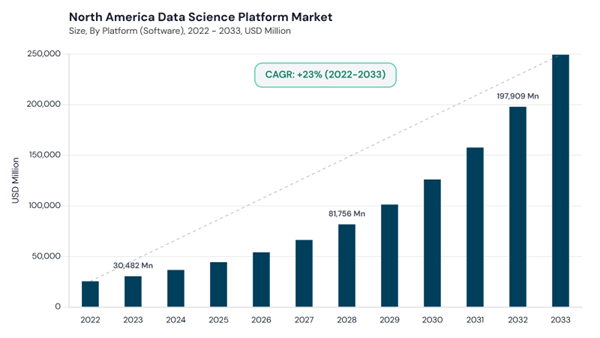
Based on Component, the market is segmented into Platform (Software) and Services. The Platform (Software) segment dominated the North America Data Science Platform Market by Component in 2025 and is expected to continue to be a dominant market till 2033; thereby, achieving a market value of USD 197.91 billion by 2032, growing at a CAGR of 24.4% during the forecast period. The segment generated USD 44.38 billion in 2025 due to increasing enterprise demand for scalable AI-powered analytics software, cloud-native machine learning platforms, and advanced automation solutions.The Services segment is expected to witness a CAGR of 25.8% during the forecast period. Growing enterprise reliance on consulting, deployment, training, managed analytics, and AI integration services is supporting segment expansion across North America.
Application Outlook
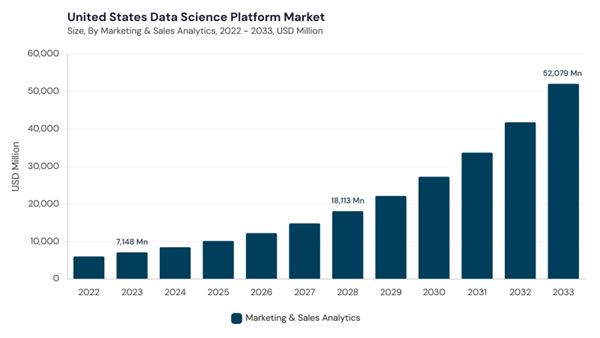
Based on Application, the market is segmented into Marketing & Sales Analytics, Financial Analytics (Risk & Fraud), Supply Chain & Operations Analytics, Customer Analytics & Support, Predictive Maintenance, and Other Application.The Marketing & Sales Analytics segment dominated the North America Data Science Platform Market by Application in 2025 and is expected to continue to be a dominant market till 2033; thereby, achieving a market value of USD 54.26 billion by 2032, growing at a CAGR of 23.3% during the forecast period. The Financial Analytics (Risk & Fraud) segment is expected to witness a CAGR of 24.0% during the forecast period due to rising cybersecurity threats, digital transactions, and fraud prevention requirements across financial institutions.
Vertical Outlook
Based on Vertical, the market is segmented into BFSI, IT & Telecommunications, Healthcare, Retail & E-commerce, Manufacturing, Government & Public Sector, Energy & Utilities, Automotive, and Other Vertical.The BFSI segment dominated the North America Data Science Platform Market by Vertical in 2025 and is expected to continue to be a dominant market till 2033; thereby, achieving a market value of USD 54.29 billion by 2032, growing at a CAGR of 23.3% during the forecast period. The segment is poised to high growth due to increasing adoption of fraud detection systems, predictive risk analytics, regulatory compliance tools, and AI-driven financial intelligence solutions.
The IT & Telecommunications segment is expected to witness a CAGR of 23.3% during the forecast period due to increasing implementation of network analytics, customer intelligence, and AI-powered automation technologies.
Country Outlook
The US Data Science Platform Market and is expected to reach USD 195.56 billion by 2032, growing at a CAGR of 24.3% during the forecast period. The country continues to dominate the regional market due to strong cloud infrastructure, early adoption of AI technologies, and increasing investments in enterprise analytics platforms. Large-scale deployment of predictive analytics, generative AI, and intelligent automation across BFSI, healthcare, retail, and manufacturing sectors continues to strengthen market growth.The Canada Data Science Platform Market is predicted to reach USD 28.04 billion by 2032, growing at a CAGR of 26.4% during the forecast period. Rising government support for AI innovation, increasing enterprise cloud adoption, and expanding investments in advanced analytics infrastructure are supporting market growth across the country.
List of Key Companies Profiled
- IBM Corporation
- Microsoft Corporation
- Oracle Corporation
- SAP SE
- SAS Institute Inc.
- Alteryx, Inc.
- Databricks, Inc.
- TIBCO Software Inc.
- Snowflake Inc.
- RapidMiner, Inc.
Market Report Segmentation
By Component- Platform (Software)
- Services
- Marketing & Sales Analytics
- Financial Analytics (Risk & Fraud)
- Supply Chain & Operations Analytics
- Customer Analytics & Support
- Predictive Maintenance
- Other Application
- BFSI
- IT & Telecommunications
- Healthcare
- Retail & E-commerce
- Manufacturing
- Government & Public Sector
- Energy & Utilities
- Automotive
- Other Vertical
- US
- Canada
- Mexico
- Rest of North America
Table of Contents
Chapter 1. North America Market1.1 Market Overview
1.2 Key Factors Impacting Market
1.2.1 Market Drivers
1.2.2 Market Restraints
1.2.3 Market Opportunities
1.2.4 Market Challenges
1.2.5 Market Trends
1.2.6 State of Competition
1.2.7 Market Consolidation
1.2.8 Key Customer Criteria
1.3 Product Life Cycle
1.4 Segmentation By Component
1.4.1 Platform (Software)
1.4.2 Services
1.5 Segmentation By Application
1.5.1 Marketing & Sales Analytics
1.5.2 Financial Analytics (Risk & Fraud)
1.5.3 Supply Chain & Operations Analytics
1.5.4 Customer Analytics & Support
1.5.5 Predictive Maintenance
1.5.6 Other Application
1.6 Segmentation By Vertical
1.6.1 IT & Telecommunications
1.6.2 Healthcare
1.6.3 BFSI
1.6.4 Manufacturing
1.6.5 Retail & E-commerce
1.6.6 Energy & Utilities
1.6.7 Government & Public Sector
1.6.8 Automotive
1.6.9 Other Vertical
1.7 Segmentation By Country
1.7.1 United States
1.7.1.1.1 Platform (Software)
1.7.1.1.2 Services
1.7.1.1.3 Marketing & Sales Analytics
1.7.1.1.4 Financial Analytics (Risk & Fraud)
1.7.1.1.5 Supply Chain & Operations Analytics
1.7.1.1.6 Customer Analytics & Support
1.7.1.1.7 Predictive Maintenance
1.7.1.1.8 Other Application
1.7.1.1.9 Segmentation By Vertical
1.7.1.1.10 BFSI
1.7.1.1.11 IT & Telecommunications
1.7.1.1.12 Healthcare
1.7.1.1.13 Retail & E-commerce
1.7.1.1.14 Manufacturing
1.7.1.1.15 Government & Public Sector
1.7.1.1.16 Energy & Utilities
1.7.1.1.17 Automotive
1.7.1.1.18 Other Vertical
1.7.2 Canada
1.7.2.1.1 Platform (Software)
1.7.2.1.2 Services
1.7.2.1.3 Marketing & Sales Analytics
1.7.2.1.4 Financial Analytics (Risk & Fraud)
1.7.2.1.5 Supply Chain & Operations Analytics
1.7.2.1.6 Customer Analytics & Support
1.7.2.1.7 Predictive Maintenance
1.7.2.1.8 Other Application
1.7.2.1.9 Segmentation By Vertical
1.7.2.1.10 BFSI
1.7.2.1.11 IT & Telecommunications
1.7.2.1.12 Healthcare
1.7.2.1.13 Retail & E-commerce
1.7.2.1.14 Manufacturing
1.7.2.1.15 Government & Public Sector
1.7.2.1.16 Energy & Utilities
1.7.2.1.17 Automotive
1.7.2.1.18 Other Vertical
1.7.3 Mexico
1.7.3.1.1 Platform (Software)
1.7.3.1.2 Services
1.7.3.1.3 Marketing & Sales Analytics
1.7.3.1.4 Financial Analytics (Risk & Fraud)
1.7.3.1.5 Supply Chain & Operations Analytics
1.7.3.1.6 Customer Analytics & Support
1.7.3.1.7 Predictive Maintenance
1.7.3.1.8 Other Application
1.7.3.1.9 Segmentation By Vertical
1.7.3.1.10 BFSI
1.7.3.1.11 IT & Telecommunications
1.7.3.1.12 Healthcare
1.7.3.1.13 Retail & E-commerce
1.7.3.1.14 Manufacturing
1.7.3.1.15 Government & Public Sector
1.7.3.1.16 Energy & Utilities
1.7.3.1.17 Automotive
1.7.3.1.18 Other Vertical
1.7.4 Rest of North America
1.7.4.1.1 Platform (Software)
1.7.4.1.2 Services
1.7.4.1.3 Marketing & Sales Analytics
1.7.4.1.4 Financial Analytics (Risk & Fraud)
1.7.4.1.5 Supply Chain & Operations Analytics
1.7.4.1.6 Customer Analytics & Support
1.7.4.1.7 Predictive Maintenance
1.7.4.1.8 Other Application
1.7.4.1.9 Segmentation By Vertical
1.7.4.1.10 BFSI
1.7.4.1.11 IT & Telecommunications
1.7.4.1.12 Healthcare
1.7.4.1.13 Retail & E-commerce
1.7.4.1.14 Manufacturing
1.7.4.1.15 Government & Public Sector
1.7.4.1.16 Energy & Utilities
1.7.4.1.17 Automotive
1.7.4.1.18 Other Vertical
Chapter 2. Company Snapshot
2.1 Microsoft Corporation
2.1.1 Business Overview
2.1.2 Key Information
2.1.3 Company Focus
2.1.4 Strategic Insights
2.1.5 Strategy Deployed
2.1.6 Product & Service Portfolio
2.1.7 Capability Overview
2.1.8 Technology & Innovation Focus
2.1.9 Customers / End Users
2.1.10 Competitive Positioning
2.1.11 Key Differentiators
2.1.12 Portfolio Matrix
2.1.13 SWOT Analysis
2.1.14 Future Outlook
2.2 Amazon Web Services, Inc. (Amazon.com, Inc.)
2.2.1 Business Overview
2.2.2 Key Information
2.2.3 Company Focus
2.2.4 Strategic Insights
2.2.5 Strategy Deployed
2.2.6 Product & Service Portfolio
2.2.7 Capability Overview
2.2.8 Technology & Innovation Focus
2.2.9 Customers / End Users
2.2.10 Competitive Positioning
2.2.11 Key Differentiators
2.2.12 Portfolio Matrix
2.2.13 SWOT Analysis
2.2.14 Future Outlook
2.3 Google LLC (Alphabet Inc.)
2.3.1 Business Overview
2.3.2 Key Information
2.3.3 Company Focus
2.3.4 Strategic Insights
2.3.5 Strategy Deployed
2.3.6 Product & Service Portfolio
2.3.7 Capability Overview
2.3.8 Technology & Innovation Focus
2.3.9 Customers / End Users
2.3.10 Competitive Positioning
2.3.11 Key Differentiators
2.3.12 Portfolio Matrix
2.3.13 SWOT Analysis
2.3.14 Future Outlook
2.4 IBM Corporation
2.4.1 Business Overview
2.4.2 Key Information
2.4.3 Company Focus
2.4.4 Strategic Insights
2.4.5 Strategy Deployed
2.4.6 Product & Service Portfolio
2.4.7 Capability Overview
2.4.8 Technology & Innovation Focus
2.4.9 Customers / End Users
2.4.10 Competitive Positioning
2.4.11 Key Differentiators
2.4.12 Portfolio Matrix
2.4.13 SWOT Analysis
2.4.14 Future Outlook
2.5 SAS Institute Inc.
2.5.1 Business Overview
2.5.2 Key Information
2.5.3 Company Focus
2.5.4 Strategic Insights
2.5.5 Strategy Deployed
2.5.6 Product & Service Portfolio
2.5.7 Capability Overview
2.5.8 Technology & Innovation Focus
2.5.9 Customers / End Users
2.5.10 Competitive Positioning
2.5.11 Key Differentiators
2.5.12 Portfolio Matrix
2.5.13 SWOT Analysis
2.5.14 Future Outlook
2.6 Oracle Corporation
2.6.1 Business Overview
2.6.2 Key Information
2.6.3 Company Focus
2.6.4 Strategic Insights
2.6.5 Strategy Deployed
2.6.6 Product & Service Portfolio
2.6.7 Capability Overview
2.6.8 Technology & Innovation Focus
2.6.9 Customers / End Users
2.6.10 Competitive Positioning
2.6.11 Key Differentiators
2.6.12 Portfolio Matrix
2.6.13 SWOT Analysis
2.6.14 Future Outlook
2.7 Databricks, Inc.
2.7.1 Business Overview
2.7.2 Key Information
2.7.3 Company Focus
2.7.4 Strategic Insights
2.7.5 Strategy Deployed
2.7.6 Product & Service Portfolio
2.7.7 Capability Overview
2.7.8 Technology & Innovation Focus
2.7.9 Customers / End Users
2.7.10 Competitive Positioning
2.7.11 Key Differentiators
2.7.12 Portfolio Matrix
2.7.13 SWOT Analysis
2.7.14 Future Outlook
2.8 SAP SE
2.8.1 Business Overview
2.8.2 Key Information
2.8.3 Company Focus
2.8.4 Strategic Insights
2.8.5 Strategy Deployed
2.8.6 Product & Service Portfolio
2.8.7 Capability Overview
2.8.8 Technology & Innovation Focus
2.8.9 Customers / End Users
2.8.10 Competitive Positioning
2.8.11 Key Differentiators
2.8.12 Portfolio Matrix
2.8.13 SWOT Analysis
2.8.14 Future Outlook
2.9 Cloudera, Inc.
2.9.1 Business Overview
2.9.2 Key Information
2.9.3 Company Focus
2.9.4 Strategic Insights
2.9.5 Strategy Deployed
2.9.6 Product & Service Portfolio
2.9.7 Capability Overview
2.9.8 Technology & Innovation Focus
2.9.9 Customers / End Users
2.9.10 Competitive Positioning
2.9.11 Key Differentiators
2.9.12 Portfolio Matrix
2.9.13 SWOT Analysis
2.9.14 Future Outlook
2.10 QlikTech International A.B.
2.10.1 Business Overview
2.10.2 Key Information
2.10.3 Company Focus
2.10.4 Strategic Insights
2.10.5 Strategy Deployed
2.10.6 Product & Service Portfolio
2.10.7 Capability Overview
2.10.8 Technology & Innovation Focus
2.10.9 Customers / End Users
2.10.10 Competitive Positioning
2.10.11 Key Differentiators
2.10.12 Portfolio Matrix
2.10.13 SWOT Analysis
2.10.14 Future Outlook
Companies Mentioned
- IBM Corporation
- Microsoft Corporation
- Oracle Corporation
- SAP SE
- SAS Institute Inc.
- Alteryx, Inc.
- Databricks, Inc.
- TIBCO Software Inc.
- Snowflake Inc.
- RapidMiner, Inc.


