



The Europe Data Science Platform Market is forecasted to reach USD 191.25 billion by 2032, growing at a CAGR of 24.9% during the forecast period.
The UK market dominated the Europe Data Science Platform Market by country in 2025, and is expected to continue to be a dominant market till 2033; thereby, achieving a market value of USD 40.84 billion by 2032. The Germany market is expected to witness a CAGR of 23.5% during 2026-2033. Additionally, the France market is expected to witness a CAGR of 25.8% during 2026-2033. The UK and Germany led the Europe Data Science Platform Market by Country with a market share of 23.0% and 18.8% in 2025. The Spain market is expected to witness a CAGR of 26.7% during throughout the forecast period.
The Europe Data Science Platform Market has developed in parallel with the region’s broader digital transformation agenda, supported by strong regulatory frameworks, public-sector initiatives, and enterprise adoption of advanced analytics technologies. European institutions, particularly the European Commission, have played a central role in shaping the data economy through initiatives such as the European Data Strategy and the establishment of common data spaces.
The market is increasingly characterized by the integration of artificial intelligence, machine learning, automated machine learning (AutoML), and low-code/no-code analytics tools. These innovations are democratizing data science capabilities across enterprises and public organizations. European enterprises are leveraging data science platforms for customer analytics, fraud detection, predictive maintenance, operational optimization, and personalized service delivery.
The segment is poised for high growth owing to increasing adoption of AI-powered analytics tools, machine learning platforms, and scalable cloud-native data science environments across enterprises. Organizations across Europe are increasingly investing in advanced analytics software to improve business intelligence, automate workflows, and strengthen digital transformation initiatives.
The Services segment is expected to witness strong growth due to increasing demand for consulting, deployment, training, support, and managed analytics services across enterprises modernizing their analytics infrastructure.
The Supply Chain & Operations Analytics segment is expected to witness significant growth during the forecast period due to rising adoption of predictive logistics management, operational intelligence, and AI-enabled supply chain optimization tools across manufacturing and retail industries.
The IT & Telecommunications segment is expected to witness strong growth owing to increasing investments in network analytics, AI-driven customer experience management, and cloud-native data processing infrastructure across telecom operators.
Germany is witnessing increasing deployment of industrial analytics, predictive maintenance systems, and AI-enabled manufacturing platforms due to strong adoption of Industry 4.0 technologies. France is also emerging as a high-growth market supported by increasing enterprise cloud adoption, digital transformation initiatives, and investments in AI-powered analytics solutions across healthcare, BFSI, and retail sectors.
The UK market dominated the Europe Data Science Platform Market by country in 2025, and is expected to continue to be a dominant market till 2033; thereby, achieving a market value of USD 40.84 billion by 2032. The Germany market is expected to witness a CAGR of 23.5% during 2026-2033. Additionally, the France market is expected to witness a CAGR of 25.8% during 2026-2033. The UK and Germany led the Europe Data Science Platform Market by Country with a market share of 23.0% and 18.8% in 2025. The Spain market is expected to witness a CAGR of 26.7% during throughout the forecast period.
The Europe Data Science Platform Market has developed in parallel with the region’s broader digital transformation agenda, supported by strong regulatory frameworks, public-sector initiatives, and enterprise adoption of advanced analytics technologies. European institutions, particularly the European Commission, have played a central role in shaping the data economy through initiatives such as the European Data Strategy and the establishment of common data spaces.
The market is increasingly characterized by the integration of artificial intelligence, machine learning, automated machine learning (AutoML), and low-code/no-code analytics tools. These innovations are democratizing data science capabilities across enterprises and public organizations. European enterprises are leveraging data science platforms for customer analytics, fraud detection, predictive maintenance, operational optimization, and personalized service delivery.
Component Outlook
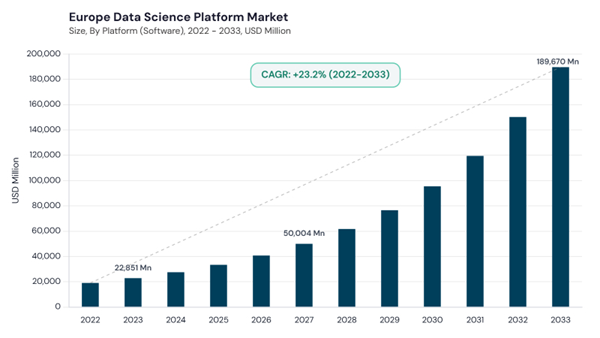
Based on Component, the market is segmented into Platform (Software), and Services. The Platform (Software) segment dominated the Europe Data Science Platform Market by Component in 2025 and is expected to continue to be a dominant market till 2033; thereby, achieving a market value of USD 150.26 billion by 2032.The segment is poised for high growth owing to increasing adoption of AI-powered analytics tools, machine learning platforms, and scalable cloud-native data science environments across enterprises. Organizations across Europe are increasingly investing in advanced analytics software to improve business intelligence, automate workflows, and strengthen digital transformation initiatives.
The Services segment is expected to witness strong growth due to increasing demand for consulting, deployment, training, support, and managed analytics services across enterprises modernizing their analytics infrastructure.
Application Outlook
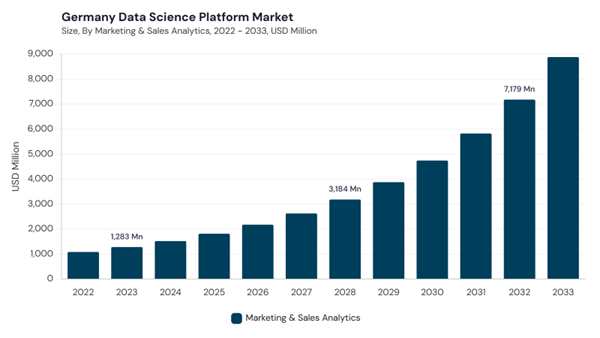
Based on Application, the market is segmented into Marketing & Sales Analytics, Financial Analytics (Risk & Fraud), Supply Chain & Operations Analytics, Customer Analytics & Support, Predictive Maintenance, and Other Applications. The Marketing & Sales Analytics segment dominated the Europe Data Science Platform Market by Application in 2025 and is expected to continue to be a dominant market till 2033; The segment attained a market size of USD 8.89 billion in 2025 owing to increasing enterprise demand for customer intelligence, campaign optimization, consumer behavior analytics, and AI-driven sales forecasting platforms.The Supply Chain & Operations Analytics segment is expected to witness significant growth during the forecast period due to rising adoption of predictive logistics management, operational intelligence, and AI-enabled supply chain optimization tools across manufacturing and retail industries.
Vertical Outlook
Based on Vertical, the market is segmented into BFSI, IT & Telecommunications, Healthcare, Retail & E-commerce, Manufacturing, Government & Public Sector, Energy & Utilities, Automotive, and Other Verticals. The BFSI segment dominated the Europe Data Science Platform Market by Vertical in 2025 and is expected to continue to be a dominant market till 2033; thereby, achieving a market value of USD 41.21 billion by 2032.The IT & Telecommunications segment is expected to witness strong growth owing to increasing investments in network analytics, AI-driven customer experience management, and cloud-native data processing infrastructure across telecom operators.
Country Outlook
The UK Data Science Platform Market represents one of the most advanced analytics ecosystems in Europe, supported by strong enterprise digitalization, financial technology innovation, and widespread AI adoption. Organizations across BFSI, retail, healthcare, and telecommunications sectors are increasingly utilizing data science platforms to automate workflows, optimize operations, and enhance customer experiences. Strong cloud adoption, mature digital infrastructure, and high investments in AI research are supporting continued market expansion.Germany is witnessing increasing deployment of industrial analytics, predictive maintenance systems, and AI-enabled manufacturing platforms due to strong adoption of Industry 4.0 technologies. France is also emerging as a high-growth market supported by increasing enterprise cloud adoption, digital transformation initiatives, and investments in AI-powered analytics solutions across healthcare, BFSI, and retail sectors.
List of Key Companies Profiled
- Microsoft Corporation
- IBM Corporation
- SAP SE
- Oracle Corporation
- SAS Institute Inc.
- Google LLC
- Amazon Web Services, Inc.
- Alteryx, Inc.
- Databricks, Inc.
- Teradata Corporation
Market Report Segmentation
By Component- Platform (Software)
- Services
- Marketing & Sales Analytics
- Financial Analytics (Risk & Fraud)
- Supply Chain & Operations Analytics
- Customer Analytics & Support
- Predictive Maintenance
- Other Applications
- BFSI
- IT & Telecommunications
- Healthcare
- Retail & E-commerce
- Manufacturing
- Government & Public Sector
- Energy & Utilities
- Automotive
- Other Verticals
- Germany
- UK
- France
- Russia
- Spain
- Italy
- Rest of Europe
Table of Contents
Chapter 1. Europe Market1.1 Market Overview
1.2 Key Factors Impacting Market
1.2.1 Market Drivers
1.2.2 Market Restraints
1.2.3 Market Opportunities
1.2.4 Market Challenges
1.2.5 Market Trends
1.2.6 State of Competition
1.2.7 Market Consolidation
1.2.8 Key Customer Criteria
1.3 Product Life Cycle
1.4 Segmentation By Component
1.4.1 Platform (Software)
1.4.2 Services
1.5 Segmentation By Application
1.5.1 Marketing & Sales Analytics
1.5.2 Financial Analytics (Risk & Fraud)
1.5.3 Supply Chain & Operations Analytics
1.5.4 Customer Analytics & Support
1.5.5 Predictive Maintenance
1.5.6 Other Application
1.6 Segmentation By Vertical
1.6.1 IT & Telecommunications
1.6.2 Healthcare
1.6.3 BFSI
1.6.4 Manufacturing
1.6.5 Retail & E-commerce
1.6.6 Energy & Utilities
1.6.7 Government & Public Sector
1.6.8 Automotive
1.6.9 Other Vertical
1.7 Segmentation By Country
1.7.1 Germany
1.7.1.1.1 Platform (Software)
1.7.1.1.2 Services
1.7.1.1.3 Marketing & Sales Analytics
1.7.1.1.4 Financial Analytics (Risk & Fraud)
1.7.1.1.5 Supply Chain & Operations Analytics
1.7.1.1.6 Customer Analytics & Support
1.7.1.1.7 Predictive Maintenance
1.7.1.1.8 Other Application
1.7.1.1.9 Segmentation By Vertical
1.7.1.1.10 BFSI
1.7.1.1.11 IT & Telecommunications
1.7.1.1.12 Healthcare
1.7.1.1.13 Retail & E-commerce
1.7.1.1.14 Manufacturing
1.7.1.1.15 Government & Public Sector
1.7.1.1.16 Energy & Utilities
1.7.1.1.17 Automotive
1.7.1.1.18 Other Vertical
1.7.2 United Kingdom
1.7.2.1.1 Platform (Software)
1.7.2.1.2 Services
1.7.2.1.3 Marketing & Sales Analytics
1.7.2.1.4 Financial Analytics (Risk & Fraud)
1.7.2.1.5 Supply Chain & Operations Analytics
1.7.2.1.6 Customer Analytics & Support
1.7.2.1.7 Predictive Maintenance
1.7.2.1.8 Other Application
1.7.2.1.9 Segmentation By Vertical
1.7.2.1.10 BFSI
1.7.2.1.11 IT & Telecommunications
1.7.2.1.12 Healthcare
1.7.2.1.13 Retail & E-commerce
1.7.2.1.14 Manufacturing
1.7.2.1.15 Government & Public Sector
1.7.2.1.16 Energy & Utilities
1.7.2.1.17 Automotive
1.7.2.1.18 Other Vertical
1.7.3 France
1.7.3.1.1 Platform (Software)
1.7.3.1.2 Services
1.7.3.1.3 Marketing & Sales Analytics
1.7.3.1.4 Financial Analytics (Risk & Fraud)
1.7.3.1.5 Supply Chain & Operations Analytics
1.7.3.1.6 Customer Analytics & Support
1.7.3.1.7 Predictive Maintenance
1.7.3.1.8 Other Application
1.7.3.1.9 Segmentation By Vertical
1.7.3.1.10 BFSI
1.7.3.1.11 IT & Telecommunications
1.7.3.1.12 Healthcare
1.7.3.1.13 Retail & E-commerce
1.7.3.1.14 Manufacturing
1.7.3.1.15 Government & Public Sector
1.7.3.1.16 Energy & Utilities
1.7.3.1.17 Automotive
1.7.3.1.18 Other Vertical
1.7.4 Russia
1.7.4.1.1 Platform (Software)
1.7.4.1.2 Services
1.7.4.1.3 Marketing & Sales Analytics
1.7.4.1.4 Financial Analytics (Risk & Fraud)
1.7.4.1.5 Supply Chain & Operations Analytics
1.7.4.1.6 Customer Analytics & Support
1.7.4.1.7 Predictive Maintenance
1.7.4.1.8 Other Application
1.7.4.1.9 Segmentation By Vertical
1.7.4.1.10 BFSI
1.7.4.1.11 IT & Telecommunications
1.7.4.1.12 Healthcare
1.7.4.1.13 Retail & E-commerce
1.7.4.1.14 Manufacturing
1.7.4.1.15 Government & Public Sector
1.7.4.1.16 Energy & Utilities
1.7.4.1.17 Automotive
1.7.4.1.18 Other Vertical
1.7.5 Spain
1.7.5.1.1 Platform (Software)
1.7.5.1.2 Services
1.7.5.1.3 Marketing & Sales Analytics
1.7.5.1.4 Financial Analytics (Risk & Fraud)
1.7.5.1.5 Supply Chain & Operations Analytics
1.7.5.1.6 Customer Analytics & Support
1.7.5.1.7 Predictive Maintenance
1.7.5.1.8 Other Application
1.7.5.1.9 Segmentation By Vertical
1.7.5.1.10 BFSI
1.7.5.1.11 IT & Telecommunications
1.7.5.1.12 Healthcare
1.7.5.1.13 Retail & E-commerce
1.7.5.1.14 Manufacturing
1.7.5.1.15 Government & Public Sector
1.7.5.1.16 Energy & Utilities
1.7.5.1.17 Automotive
1.7.5.1.18 Other Vertical
1.7.6 Italy
1.7.6.1.1 Platform (Software)
1.7.6.1.2 Services
1.7.6.1.3 Marketing & Sales Analytics
1.7.6.1.4 Financial Analytics (Risk & Fraud)
1.7.6.1.5 Supply Chain & Operations Analytics
1.7.6.1.6 Customer Analytics & Support
1.7.6.1.7 Predictive Maintenance
1.7.6.1.8 Other Application
1.7.6.1.9 Segmentation By Vertical
1.7.6.1.10 BFSI
1.7.6.1.11 IT & Telecommunications
1.7.6.1.12 Healthcare
1.7.6.1.13 Retail & E-commerce
1.7.6.1.14 Manufacturing
1.7.6.1.15 Government & Public Sector
1.7.6.1.16 Energy & Utilities
1.7.6.1.17 Automotive
1.7.6.1.18 Other Vertical
1.7.7 Rest of Europe
1.7.7.1.1 Platform (Software)
1.7.7.1.2 Services
1.7.7.1.3 Marketing & Sales Analytics
1.7.7.1.4 Financial Analytics (Risk & Fraud)
1.7.7.1.5 Supply Chain & Operations Analytics
1.7.7.1.6 Customer Analytics & Support
1.7.7.1.7 Predictive Maintenance
1.7.7.1.8 Other Application
1.7.7.1.9 Segmentation By Vertical
1.7.7.1.10 BFSI
1.7.7.1.11 IT & Telecommunications
1.7.7.1.12 Healthcare
1.7.7.1.13 Retail & E-commerce
1.7.7.1.14 Manufacturing
1.7.7.1.15 Government & Public Sector
1.7.7.1.16 Energy & Utilities
1.7.7.1.17 Automotive
1.7.7.1.18 Other Vertical
Chapter 2. Company Snapshot
2.1 Microsoft Corporation
2.1.1 Business Overview
2.1.2 Key Information
2.1.3 Company Focus
2.1.4 Strategic Insights
2.1.5 Strategy Deployed
2.1.6 Product & Service Portfolio
2.1.7 Capability Overview
2.1.8 Technology & Innovation Focus
2.1.9 Customers / End Users
2.1.10 Competitive Positioning
2.1.11 Key Differentiators
2.1.12 Portfolio Matrix
2.1.13 SWOT Analysis
2.1.14 Future Outlook
2.2 Amazon Web Services, Inc. (Amazon.com, Inc.)
2.2.1 Business Overview
2.2.2 Key Information
2.2.3 Company Focus
2.2.4 Strategic Insights
2.2.5 Strategy Deployed
2.2.6 Product & Service Portfolio
2.2.7 Capability Overview
2.2.8 Technology & Innovation Focus
2.2.9 Customers / End Users
2.2.10 Competitive Positioning
2.2.11 Key Differentiators
2.2.12 Portfolio Matrix
2.2.13 SWOT Analysis
2.2.14 Future Outlook
2.3 Google LLC (Alphabet Inc.)
2.3.1 Business Overview
2.3.2 Key Information
2.3.3 Company Focus
2.3.4 Strategic Insights
2.3.5 Strategy Deployed
2.3.6 Product & Service Portfolio
2.3.7 Capability Overview
2.3.8 Technology & Innovation Focus
2.3.9 Customers / End Users
2.3.10 Competitive Positioning
2.3.11 Key Differentiators
2.3.12 Portfolio Matrix
2.3.13 SWOT Analysis
2.3.14 Future Outlook
2.4 IBM Corporation
2.4.1 Business Overview
2.4.2 Key Information
2.4.3 Company Focus
2.4.4 Strategic Insights
2.4.5 Strategy Deployed
2.4.6 Product & Service Portfolio
2.4.7 Capability Overview
2.4.8 Technology & Innovation Focus
2.4.9 Customers / End Users
2.4.10 Competitive Positioning
2.4.11 Key Differentiators
2.4.12 Portfolio Matrix
2.4.13 SWOT Analysis
2.4.14 Future Outlook
2.5 SAS Institute Inc.
2.5.1 Business Overview
2.5.2 Key Information
2.5.3 Company Focus
2.5.4 Strategic Insights
2.5.5 Strategy Deployed
2.5.6 Product & Service Portfolio
2.5.7 Capability Overview
2.5.8 Technology & Innovation Focus
2.5.9 Customers / End Users
2.5.10 Competitive Positioning
2.5.11 Key Differentiators
2.5.12 Portfolio Matrix
2.5.13 SWOT Analysis
2.5.14 Future Outlook
2.6 Oracle Corporation
2.6.1 Business Overview
2.6.2 Key Information
2.6.3 Company Focus
2.6.4 Strategic Insights
2.6.5 Strategy Deployed
2.6.6 Product & Service Portfolio
2.6.7 Capability Overview
2.6.8 Technology & Innovation Focus
2.6.9 Customers / End Users
2.6.10 Competitive Positioning
2.6.11 Key Differentiators
2.6.12 Portfolio Matrix
2.6.13 SWOT Analysis
2.6.14 Future Outlook
2.7 Databricks, Inc.
2.7.1 Business Overview
2.7.2 Key Information
2.7.3 Company Focus
2.7.4 Strategic Insights
2.7.5 Strategy Deployed
2.7.6 Product & Service Portfolio
2.7.7 Capability Overview
2.7.8 Technology & Innovation Focus
2.7.9 Customers / End Users
2.7.10 Competitive Positioning
2.7.11 Key Differentiators
2.7.12 Portfolio Matrix
2.7.13 SWOT Analysis
2.7.14 Future Outlook
2.8 SAP SE
2.8.1 Business Overview
2.8.2 Key Information
2.8.3 Company Focus
2.8.4 Strategic Insights
2.8.5 Strategy Deployed
2.8.6 Product & Service Portfolio
2.8.7 Capability Overview
2.8.8 Technology & Innovation Focus
2.8.9 Customers / End Users
2.8.10 Competitive Positioning
2.8.11 Key Differentiators
2.8.12 Portfolio Matrix
2.8.13 SWOT Analysis
2.8.14 Future Outlook
2.9 Cloudera, Inc.
2.9.1 Business Overview
2.9.2 Key Information
2.9.3 Company Focus
2.9.4 Strategic Insights
2.9.5 Strategy Deployed
2.9.6 Product & Service Portfolio
2.9.7 Capability Overview
2.9.8 Technology & Innovation Focus
2.9.9 Customers / End Users
2.9.10 Competitive Positioning
2.9.11 Key Differentiators
2.9.12 Portfolio Matrix
2.9.13 SWOT Analysis
2.9.14 Future Outlook
2.10 QlikTech International A.B.
2.10.1 Business Overview
2.10.2 Key Information
2.10.3 Company Focus
2.10.4 Strategic Insights
2.10.5 Strategy Deployed
2.10.6 Product & Service Portfolio
2.10.7 Capability Overview
2.10.8 Technology & Innovation Focus
2.10.9 Customers / End Users
2.10.10 Competitive Positioning
2.10.11 Key Differentiators
2.10.12 Portfolio Matrix
2.10.13 SWOT Analysis
2.10.14 Future Outlook
Companies Mentioned
- Microsoft Corporation
- IBM Corporation
- SAP SE
- Oracle Corporation
- SAS Institute Inc.
- Google LLC
- Amazon Web Services, Inc.
- Alteryx, Inc.
- Databricks, Inc.
- Teradata Corporation


