



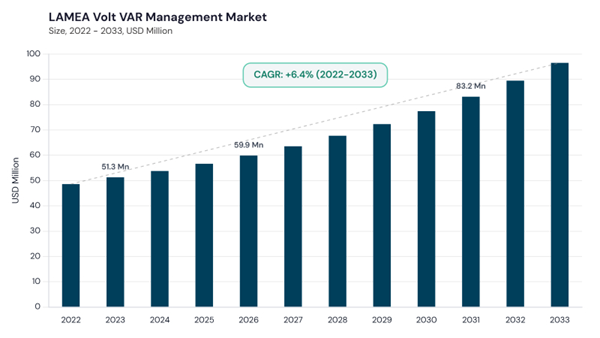
The LAMEA Volt VAR Management Market would reach USD 96.53 million by 2033, growing at a CAGR of 7.1% during the forecast period (2026-2033).
The Brazil market dominated the LAMEA Volt VAR Management Market by country in 2025, and is expected to continue to be a dominant market till 2033; thereby, achieving a market value of USD 19.60 million by 2033. The Argentina market is expected to witness a CAGR of 7.6% during 2026-2033. Additionally, the UAE market is expected to witness a CAGR of 5.7% during 2026-2033. The Brazil and UAE led the LAMEA Volt VAR Management Market by Country with a market share of 22.84% and 11.41% in 2025. The South Africa market is expected to witness a CAGR of 8% throughout the forecast period.
The LAMEA Volt VAR Management Market is witnessing strong growth due to increasing investments in power infrastructure modernization, grid reliability enhancement, renewable energy integration, and utility automation across Latin America, the Middle East, and Africa. Utilities throughout the region are increasingly deploying Volt VAR optimization technologies to improve voltage stability, reduce transmission and distribution losses, enhance energy efficiency, and strengthen power quality management across electrical networks. Rising urbanization, industrialization, and electricity demand are further accelerating the adoption of intelligent reactive power management and voltage optimization solutions throughout the region.
Governments and utility providers across LAMEA are increasingly focusing on grid modernization initiatives, smart metering infrastructure, renewable energy deployment, and digital substations to improve operational efficiency and reduce technical losses. The growing penetration of distributed energy resources (DERs), solar farms, wind energy projects, and electric vehicle infrastructure is increasing the need for advanced voltage control and reactive power compensation systems across both transmission and distribution networks. Utilities are also leveraging AI-enabled analytics, IoT-connected grid devices, advanced distribution management systems (ADMS), and cloud-based utility platforms to improve real-time monitoring, predictive maintenance, and automated grid optimization capabilities.
Furthermore, increasing focus on conservation voltage reduction (CVR), sustainability initiatives, and reliable electricity access is creating strong opportunities for deployment of advanced Volt VAR management solutions across emerging economies within the region. Rising investments in utility digitization and energy efficiency programs are expected to further strengthen market growth during the forecast period.
The Argentina Volt VAR Management Market attained a market size of USD 5.40 million in 2025 and is expected to reach USD 9.56 million by 2033, growing at a CAGR of 7.6% during the forecast period. Increasing electricity demand, modernization of transmission infrastructure, and growing renewable energy deployment are driving demand for advanced voltage optimization and reactive power management systems across Argentina. Utilities are increasingly focusing on improving operational efficiency and reducing technical power losses throughout the national grid.
The UAE Volt VAR Management Market attained a market size of USD 6.46 million in 2025 and is expected to reach USD 10.00 million by 2033, growing at a CAGR of 5.7% during the forecast period. The UAE is witnessing increasing investments in smart utility infrastructure, digital substations, and sustainable energy systems. Rising focus on energy efficiency, grid resiliency, and renewable energy integration is supporting adoption of advanced Volt VAR optimization technologies across the country’s utility sector.
The Brazil market dominated the LAMEA Volt VAR Management Market by country in 2025, and is expected to continue to be a dominant market till 2033; thereby, achieving a market value of USD 19.60 million by 2033. The Argentina market is expected to witness a CAGR of 7.6% during 2026-2033. Additionally, the UAE market is expected to witness a CAGR of 5.7% during 2026-2033. The Brazil and UAE led the LAMEA Volt VAR Management Market by Country with a market share of 22.84% and 11.41% in 2025. The South Africa market is expected to witness a CAGR of 8% throughout the forecast period.
The LAMEA Volt VAR Management Market is witnessing strong growth due to increasing investments in power infrastructure modernization, grid reliability enhancement, renewable energy integration, and utility automation across Latin America, the Middle East, and Africa. Utilities throughout the region are increasingly deploying Volt VAR optimization technologies to improve voltage stability, reduce transmission and distribution losses, enhance energy efficiency, and strengthen power quality management across electrical networks. Rising urbanization, industrialization, and electricity demand are further accelerating the adoption of intelligent reactive power management and voltage optimization solutions throughout the region.
Governments and utility providers across LAMEA are increasingly focusing on grid modernization initiatives, smart metering infrastructure, renewable energy deployment, and digital substations to improve operational efficiency and reduce technical losses. The growing penetration of distributed energy resources (DERs), solar farms, wind energy projects, and electric vehicle infrastructure is increasing the need for advanced voltage control and reactive power compensation systems across both transmission and distribution networks. Utilities are also leveraging AI-enabled analytics, IoT-connected grid devices, advanced distribution management systems (ADMS), and cloud-based utility platforms to improve real-time monitoring, predictive maintenance, and automated grid optimization capabilities.
Furthermore, increasing focus on conservation voltage reduction (CVR), sustainability initiatives, and reliable electricity access is creating strong opportunities for deployment of advanced Volt VAR management solutions across emerging economies within the region. Rising investments in utility digitization and energy efficiency programs are expected to further strengthen market growth during the forecast period.
Network Level Outlook
Based on Network Level, the market is segmented into Distribution Network and Transmission Network. The Distribution Network segment dominated the LAMEA Volt VAR Management Market by Network Level in 2025 with a market value of USD 39.26 million, and is expected to continue to be a dominant segment till 2033; thereby, achieving a market value of USD 65.25 million by 2033, growing at a CAGR of 6.7% during the forecast period. The Transmission Network segment attained a market value of USD 17.38 million in 2025 and is expected to witness a CAGR of 7.8% during 2026-2033.Component Outlook
Based on Component, the market is segmented into Hardware, Software, and Services. The Hardware segment dominated the LAMEA Volt VAR Management Market by Component in 2025 with a market value of USD 33.12 million, and is expected to continue to be a dominant segment till 2033; thereby, achieving a market value of USD 54.54 million by 2033, growing at a CAGR of 6.6% during the forecast period. The Software segment attained a market value of USD 14.85 million in 2025 and is expected to witness a CAGR of 7.5% during 2026-2033. Additionally, the Services segment attained a market value of USD 8.67 million in 2025 and is expected to witness the highest CAGR of 8.0% during the forecast period.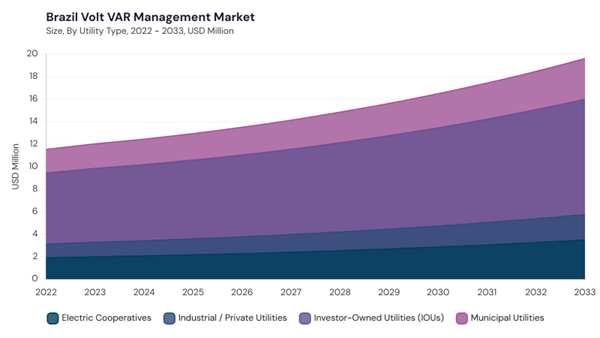
Utility Type Outlook
Based on Utility Type, the market is segmented into Investor-Owned Utilities (IOUs), Municipal Utilities, Electric Cooperatives, and Industrial / Private Utilities. The Investor-Owned Utilities (IOUs) segment dominated the LAMEA Volt VAR Management Market by Utility Type in 2025 with a market value of USD 30.86 million, and is expected to continue to be a dominant segment till 2033; thereby, achieving a market value of USD 50.70 million by 2033, growing at a CAGR of 6.6% during the forecast period. The Municipal Utilities segment attained a market value of USD 10.60 million in 2025 and is expected to witness a CAGR of 7.3% during 2026-2033. Additionally, the Electric Cooperatives segment attained a market value of USD 9.18 million in 2025 and is expected to witness a CAGR of 7.8% during the forecast period. The Industrial / Private Utilities segment attained a market value of USD 6.01 million in 2025 and is expected to witness a CAGR of 7.9% during the forecast period.Country Outlook
The Brazil Volt VAR Management Market attained a market size of USD 12.94 million in 2025 and is expected to reach USD 19.60 million by 2033, growing at a CAGR of 5.5% during the forecast period. Brazil dominates the regional market owing to rising investments in smart grid infrastructure, renewable energy integration, utility automation, and power distribution modernization. Utilities throughout the country are increasingly implementing advanced Volt VAR optimization technologies to improve power quality, minimize transmission losses, and strengthen voltage stability across electrical networks.The Argentina Volt VAR Management Market attained a market size of USD 5.40 million in 2025 and is expected to reach USD 9.56 million by 2033, growing at a CAGR of 7.6% during the forecast period. Increasing electricity demand, modernization of transmission infrastructure, and growing renewable energy deployment are driving demand for advanced voltage optimization and reactive power management systems across Argentina. Utilities are increasingly focusing on improving operational efficiency and reducing technical power losses throughout the national grid.
The UAE Volt VAR Management Market attained a market size of USD 6.46 million in 2025 and is expected to reach USD 10.00 million by 2033, growing at a CAGR of 5.7% during the forecast period. The UAE is witnessing increasing investments in smart utility infrastructure, digital substations, and sustainable energy systems. Rising focus on energy efficiency, grid resiliency, and renewable energy integration is supporting adoption of advanced Volt VAR optimization technologies across the country’s utility sector.
List of Key Companies Profiled
- Schneider Electric SE
- Siemens AG
- ABB Ltd.
- Eaton Corporation plc
- General Electric Company
- Mitsubishi Electric Corporation
- Landis+Gyr Group AG
- Open Systems International, Inc.
- S&C Electric Company
- Doble Engineering Company
Market Report Segmentation
By Network Level- Distribution Network
- Transmission Network
- Hardware
- Software
- Services
- Investor-Owned Utilities (IOUs)
- Municipal Utilities
- Electric Cooperatives
- Industrial / Private Utilities
- Brazil
- Argentina
- UAE
- Saudi Arabia
- South Africa
- Nigeria
- Rest of LAMEA
Table of Contents
Chapter 1. LAMEA Market1.1 Market Overview
1.2 Key Factors Impacting Market
1.2.1 Market Drivers
1.2.2 Market Restraints
1.2.3 Market Opportunities
1.2.4 Market Challenges
1.2.5 Market Trends
1.2.6 Market Consolidation
1.2.7 Key Customer Criteria
1.3 Product Life Cycle
1.4 Segmentation By Component
1.4.1 Hardware
1.4.2 Software
1.4.3 Services
1.5 Segmentation By Network Level
1.5.1 Distribution Network
1.5.2 Transmission Network
1.6 Segmentation By Utility Type
1.6.1 Investor-Owned Utilities (IOUs)
1.6.2 Municipal Utilities
1.6.3 Electric Cooperatives
1.6.4 Industrial / Private Utilities
1.7 Segmentation By Country
1.7.1 Brazil
1.7.1.1 Segmentation By Component
1.7.1.1.1 Hardware
1.7.1.1.2 Software
1.7.1.1.3 Services
1.7.1.2 Segmentation By Network Level
1.7.1.2.1 Distribution Network
1.7.1.2.2 Transmission Network
1.7.1.3 Segmentation By Utility Type
1.7.1.3.1 Investor-Owned Utilities (IOUs)
1.7.1.3.2 Municipal Utilities
1.7.1.3.3 Electric Cooperatives
1.7.1.3.4 Industrial / Private Utilities
1.7.2 Argentina
1.7.2.1 Segmentation By Component
1.7.2.1.1 Hardware
1.7.2.1.2 Software
1.7.2.1.3 Services
1.7.2.2 Segmentation By Network Level
1.7.2.2.1 Distribution Network
1.7.2.2.2 Transmission Network
1.7.2.3 Segmentation By Utility Type
1.7.2.3.1 Investor-Owned Utilities (IOUs)
1.7.2.3.2 Municipal Utilities
1.7.2.3.3 Electric Cooperatives
1.7.2.3.4 Industrial / Private Utilities
1.7.3 UAE
1.7.3.1 Segmentation By Component
1.7.3.1.1 Hardware
1.7.3.1.2 Software
1.7.3.1.3 Services
1.7.3.2 Segmentation By Network Level
1.7.3.2.1 Distribution Network
1.7.3.2.2 Transmission Network
1.7.3.3 Segmentation By Utility Type
1.7.3.3.1 Investor-Owned Utilities (IOUs)
1.7.3.3.2 Municipal Utilities
1.7.3.3.3 Electric Cooperatives
1.7.3.3.4 Industrial / Private Utilities
1.7.4 Saudi Arabia
1.7.4.1 Segmentation By Component
1.7.4.1.1 Hardware
1.7.4.1.2 Software
1.7.4.1.3 Services
1.7.4.2 Segmentation By Network Level
1.7.4.2.1 Distribution Network
1.7.4.2.2 Transmission Network
1.7.4.3 Segmentation By Utility Type
1.7.4.3.1 Investor-Owned Utilities (IOUs)
1.7.4.3.2 Municipal Utilities
1.7.4.3.3 Electric Cooperatives
1.7.4.3.4 Industrial / Private Utilities
1.7.5 South Africa
1.7.5.1 Segmentation By Component
1.7.5.1.1 Hardware
1.7.5.1.2 Software
1.7.5.1.3 Services
1.7.5.2 Segmentation By Network Level
1.7.5.2.1 Distribution Network
1.7.5.2.2 Transmission Network
1.7.5.3 Segmentation By Utility Type
1.7.5.3.1 Investor-Owned Utilities (IOUs)
1.7.5.3.2 Municipal Utilities
1.7.5.3.3 Electric Cooperatives
1.7.5.3.4 Industrial / Private Utilities
1.7.6 Nigeria
1.7.6.1 Segmentation By Component
1.7.6.1.1 Hardware
1.7.6.1.2 Software
1.7.6.1.3 Services
1.7.6.2 Segmentation By Network Level
1.7.6.2.1 Distribution Network
1.7.6.2.2 Transmission Network
1.7.6.3 Segmentation By Utility Type
1.7.6.3.1 Investor-Owned Utilities (IOUs)
1.7.6.3.2 Municipal Utilities
1.7.6.3.3 Electric Cooperatives
1.7.6.3.4 Industrial / Private Utilities
1.7.7 Rest of LAMEA
1.7.7.1 Segmentation By Component
1.7.7.1.1 Hardware
1.7.7.1.2 Software
1.7.7.1.3 Services
1.7.7.2 Segmentation By Network Level
1.7.7.2.1 Distribution Network
1.7.7.2.2 Transmission Network
1.7.7.3 Segmentation By Utility Type
1.7.7.3.1 Investor-Owned Utilities (IOUs)
1.7.7.3.2 Municipal Utilities
1.7.7.3.3 Electric Cooperatives
1.7.7.3.4 Industrial / Private Utilities
Chapter 2. Company Profiles
2.1 ABB Ltd.
2.1.1 Company Overview
2.1.2 Company Focus
2.1.3 Strategic Insights
2.1.2 Strategy Deployed
2.1.5 SWOT Analysis
2.1.6 Future Outlook
2.2 Schneider Electric SE
2.2.1 Company Overview
2.2.2 Financial Analysis
2.2.3 Segmental and Regional Analysis
2.2.2 Research & Development Expense
2.2.5 Recent Strategies and Developments
2.2.5.1 Product Launches and Product Expansions
2.2.6 Company Focus
2.2.7 Strategic Insights
2.2.8 Strategy Deployed
2.2.9 SWOT Analysis
2.2.10 Future Outlook
2.3 Siemens AG
2.3.1 Company Overview
2.3.2 Financial Analysis
2.3.3 Segmental and Regional Analysis
2.3.2 Research & Development Expense
2.3.5 Recent Strategies and Developments
2.3.5.1 Partnerships, Collaborations, and Agreements
2.3.5.2 Product Launches and Product Expansions
2.3.6 Company Focus
2.3.7 Strategic Insights
2.3.8 Strategy Deployed
2.3.9 SWOT Analysis
2.3.10 Future Outlook
2.2 Eaton Corporation PLC
2.2.1 Company Overview
2.2.2 Financial Analysis
2.2.3 Segmental and Regional Analysis
2.2.2 Research & Development Expense
2.2.5 Recent Strategies and Developments
2.2.5.1 Partnerships, Collaborations, and Agreements
2.2.6 Company Focus
2.2.7 Strategic Insights
2.2.8 Strategy Deployed
2.2.9 SWOT Analysis
2.2.10 Future Outlook
2.5 GE Vernova Group
2.5.1 Company Overview
2.5.2 Financial Analysis
2.5.3 Segmental and Regional Analysis
2.5.2 Research & Development Expenses
2.5.5 Recent Strategies and Developments
2.5.5.1 Product Launches and Product Expansions
2.5.6 Company Focus
2.5.7 Strategic Insights
2.5.8 Strategy Deployed
2.5.9 SWOT Analysis
2.5.10 Future Outlook
2.6 Landis+Gyr Group AG
2.6.1 Company Overview
2.6.2 Financial Analysis
2.6.3 Regional Analysis
2.6.2 Research and Development Expense
2.6.5 Recent Strategies and Developments
2.6.5.1 Partnerships, Collaborations, and Agreements
2.6.6 Company Focus
2.6.7 Strategic Insights
2.6.8 Strategy Deployed
2.6.9 SWOT Analysis
2.6.10 Future Outlook
2.7 Itron, Inc.
2.7.1 Company Overview
2.7.2 Financial Analysis
2.7.3 Segmental and Regional Analysis
2.7.2 Research & Development Expenses
2.7.5 Recent Strategies and Developments
2.7.5.1 Product Launches and Product Expansions
2.7.6 Company Focus
2.7.7 Strategic Insights
2.7.8 Strategy Deployed
2.7.9 SWOT Analysis
2.7.10 Future Outlook
2.8 S&C Electric Company
2.8.1 Company Overview
2.8.2 Company Focus
2.8.3 Strategic Insights
2.8.2 Strategy Deployed
2.8.5 SWOT Analysis
2.8.6 Future Outlook
2.9 Oracle Corporation
2.9.1 Company Overview
2.9.2 Financial Analysis
2.9.3 Segmental and Regional Analysis
2.9.2 Research & Development Expense
2.9.5 Recent Strategies and Developments
2.9.5.1 Product Launches and Product Expansions
2.9.6 Company Focus
2.9.7 Strategic Insights
2.9.8 Strategy Deployed
2.9.9 SWOT Analysis
2.9.10 Future Outlook
2.1 Hubbell Incorporated (Beckwith Electric)
2.10.1 Company Overview
2.10.2 Financial Analysis
2.10.3 Segmental and Regional Analysis
2.10.2 Research & Development Expenses
2.10.5 Recent Strategies and Developments
2.10.5.1 Product Launches and Product Expansions
2.10.6 Company Focus
2.10.7 Strategic Insights
2.10.8 Strategy Deployed
2.10.9 SWOT Analysis
2.10.10 Future Outlook
Companies Mentioned
- Schneider Electric SE
- Siemens AG
- ABB Ltd.
- Eaton Corporation plc
- General Electric Company
- Mitsubishi Electric Corporation
- Landis+Gyr Group AG
- Open Systems International, Inc.
- S&C Electric Company
- Doble Engineering Company


