



The Global Microbolometer Market size is expected to reach USD 843.73 million by 2033, rising at a market growth of 6.5% CAGR during the forecast period.
The market is witnessing strong momentum due to the increasing demand for uncooled infrared sensing technologies across defense, industrial monitoring, automotive safety, and security applications. Advancements in thermal imaging resolution, miniaturization, and AI-enabled analytics are further accelerating adoption across commercial and consumer-focused applications worldwide.
Today, microbolometer technologies are increasingly integrated with artificial intelligence, IoT platforms, drones, and autonomous systems to enhance real-time thermal monitoring and situational awareness. Rising investments in defense modernization, industrial automation, predictive maintenance, and smart surveillance infrastructure continue to strengthen market demand. Expanding adoption of thermal imaging in commercial and civilian applications is also encouraging manufacturers to focus on higher resolution sensors, improved sensitivity, and scalable manufacturing capabilities.
The major strategies followed by the market participants are Product Launches as the key developmental strategy to strengthen technology capabilities and expand thermal imaging applications. For instance, thermal imaging providers are focusing on advanced VOx sensor development, AI-enabled analytics integration, and compact thermal modules for autonomous systems and industrial monitoring applications. Companies are also strengthening strategic collaborations with defense agencies, automotive OEMs, and industrial automation providers to enhance product penetration and regional market presence.
However, the pandemic significantly increased the adoption of thermal imaging systems for contactless temperature screening and public safety monitoring. Demand for thermal cameras in healthcare facilities, transportation hubs, industrial workplaces, and public infrastructure accelerated market growth during the recovery phase. The increasing focus on remote monitoring, automation, and smart surveillance further supported long-term demand for microbolometer-based thermal imaging systems.
Teledyne Technologies held a leading position in the market with approximately 17.65% share, supported by its strong thermal imaging portfolio through FLIR Systems. Lynred and Leonardo DRS also maintained notable market positions due to their advanced infrared detector technologies and strong defense sector presence. RTX Corporation and L3Harris Technologies continue to strengthen their thermal imaging capabilities across aerospace and surveillance applications.
Mid-tier and regional participants including Zhejiang Dali Technology, Guide Sensmart, Hamamatsu Photonics, NEC, and InfraTec are focusing on cost-competitive thermal imaging solutions for industrial inspection, commercial surveillance, and consumer applications. Future market competition is expected to intensify due to increasing demand for compact thermal imaging systems, AI-driven analytics, and next-generation autonomous sensing platforms.
Europe continues to witness steady market expansion supported by automotive innovation, industrial automation, and growing demand for advanced surveillance systems. Meanwhile, Asia Pacific is projected to emerge as one of the fastest-growing regions due to increasing industrialization, expanding automotive production, rising defense investments, and growing adoption of thermal imaging technologies across commercial applications. LAMEA is also witnessing gradual adoption driven by infrastructure development, security modernization initiatives, and increasing industrial safety requirements.
Strategic partnerships, ecosystem collaborations, and regional expansion remain key competitive factors influencing market dynamics. Companies are also focusing on supply chain optimization, localized manufacturing capabilities, and scalable sensor fabrication processes to improve operational efficiency and address rising global demand. Additionally, integration of thermal imaging with drones, autonomous systems, industrial IoT, and smart surveillance infrastructure is expected to further intensify innovation-focused competition.
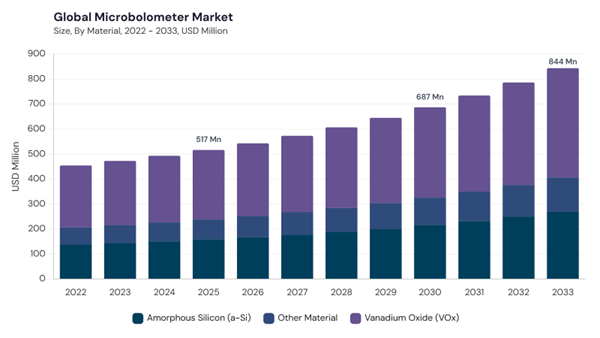
The market is witnessing strong momentum due to the increasing demand for uncooled infrared sensing technologies across defense, industrial monitoring, automotive safety, and security applications. Advancements in thermal imaging resolution, miniaturization, and AI-enabled analytics are further accelerating adoption across commercial and consumer-focused applications worldwide.
Key Market Trends & Insights:
- The North America Microbolometer market dominated the Global Market in 2025, accounting for the largest revenue share of 36.62%.
- The 640 × 480 segment dominated the global market in 2025 and is expected to reach USD 364.78 million by 2033.
- The Vanadium Oxide (VOx) segment accounted for the largest share in 2025 and is projected to reach USD 437.43 million by 2033.
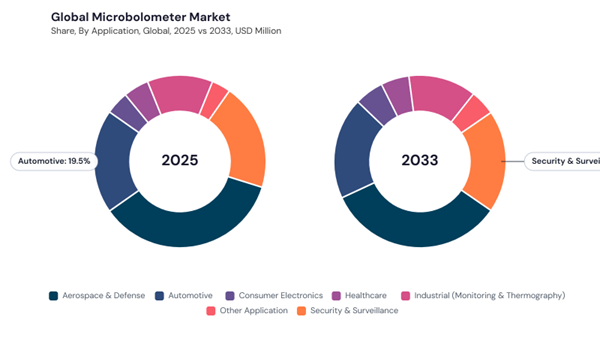
- Aerospace & Defense dominated the application segment in 2025 and is expected to reach USD 282.52 million by 2033.
- Asia Pacific is projected to witness strong growth across multiple segments, with the 1024 × 768 and Above segment expected to grow at a CAGR of 7.8% through 2032.
- Consumer Electronics is expected to witness one of the fastest growth rates, reaching USD 46.09 million by 2033.
Today, microbolometer technologies are increasingly integrated with artificial intelligence, IoT platforms, drones, and autonomous systems to enhance real-time thermal monitoring and situational awareness. Rising investments in defense modernization, industrial automation, predictive maintenance, and smart surveillance infrastructure continue to strengthen market demand. Expanding adoption of thermal imaging in commercial and civilian applications is also encouraging manufacturers to focus on higher resolution sensors, improved sensitivity, and scalable manufacturing capabilities.
The major strategies followed by the market participants are Product Launches as the key developmental strategy to strengthen technology capabilities and expand thermal imaging applications. For instance, thermal imaging providers are focusing on advanced VOx sensor development, AI-enabled analytics integration, and compact thermal modules for autonomous systems and industrial monitoring applications. Companies are also strengthening strategic collaborations with defense agencies, automotive OEMs, and industrial automation providers to enhance product penetration and regional market presence.
COVID-19 Impact Analysis
The COVID-19 pandemic had a mixed impact on the microbolometer market. During the initial phase of the pandemic, manufacturing disruptions, supply chain constraints, and reduced industrial activity negatively affected production and deployment across automotive, aerospace, and industrial sectors. Delays in semiconductor manufacturing and logistics also impacted thermal imaging device availability.However, the pandemic significantly increased the adoption of thermal imaging systems for contactless temperature screening and public safety monitoring. Demand for thermal cameras in healthcare facilities, transportation hubs, industrial workplaces, and public infrastructure accelerated market growth during the recovery phase. The increasing focus on remote monitoring, automation, and smart surveillance further supported long-term demand for microbolometer-based thermal imaging systems.
Driving and Restraining Factors
Drivers- Increasing Demand for Cost-Effective Uncooled Infrared Sensors
- Rising Adoption of Thermal Imaging in UAVs and Autonomous Systems
- Growing Importance of Thermal Imaging for Public Safety and Security
- Technological Advancements Improving Resolution and Sensor Performance
- High Manufacturing Cost and Complex Fabrication Processes
- Environmental Sensitivity and Accuracy Limitations
- Regulatory Compliance and Export Control Challenges
- Expansion of Thermal Imaging Across Industrial Monitoring Applications
- Integration of AI and Multi-Sensor Fusion Technologies
- Growing Adoption in Consumer Electronics and Automotive Safety Systems
- Limited Sensitivity in Certain Harsh Environmental Conditions
- Integration Complexity Across Advanced Imaging Systems
- High Cost of High-Resolution Thermal Imaging Solutions
Market Share Analysis
The market is characterized by the presence of several major thermal imaging and infrared sensing technology providers competing through technological innovation, advanced imaging performance, and strategic partnerships. Leading companies are investing heavily in sensor miniaturization, enhanced thermal sensitivity, and AI-enabled image processing to strengthen competitive positioning.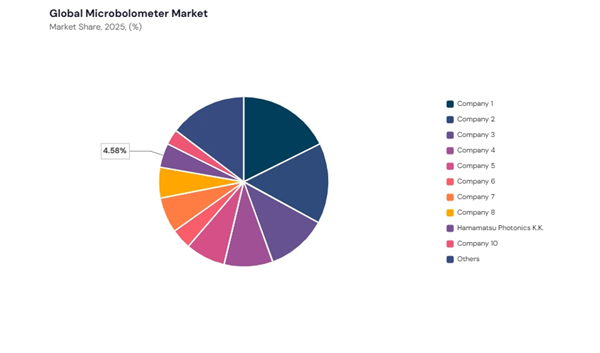
Teledyne Technologies held a leading position in the market with approximately 17.65% share, supported by its strong thermal imaging portfolio through FLIR Systems. Lynred and Leonardo DRS also maintained notable market positions due to their advanced infrared detector technologies and strong defense sector presence. RTX Corporation and L3Harris Technologies continue to strengthen their thermal imaging capabilities across aerospace and surveillance applications.
Mid-tier and regional participants including Zhejiang Dali Technology, Guide Sensmart, Hamamatsu Photonics, NEC, and InfraTec are focusing on cost-competitive thermal imaging solutions for industrial inspection, commercial surveillance, and consumer applications. Future market competition is expected to intensify due to increasing demand for compact thermal imaging systems, AI-driven analytics, and next-generation autonomous sensing platforms.
Resolution Outlook
On the basis of resolution, the microbolometer market is classified into 640 × 480, Below 320 × 240, and 1024 × 768 and Above. The 640 × 480 segment dominated the market in 2025 by accounting for the largest revenue share due to its balanced combination of imaging quality, affordability, and operational efficiency. These sensors are widely adopted across defense, surveillance, automotive, firefighting, and industrial thermography applications where reliable thermal detection and moderate-to-high image clarity are essential. Meanwhile, the 1024 × 768 and Above segment is projected to witness strong growth due to increasing demand for high-precision thermal imaging across aerospace, advanced surveillance, medical diagnostics, and scientific applications.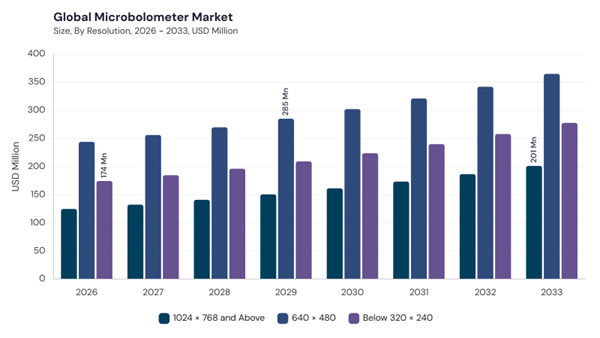
Material Outlook
Based on material, the microbolometer market is segmented into Vanadium Oxide (VOx), Amorphous Silicon (a-Si), and Other Material. The Vanadium Oxide (VOx) segment accounted for the largest revenue share in 2025 due to its superior thermal sensitivity, low noise characteristics, and strong performance across defense, industrial, and medical thermal imaging applications. VOx-based sensors continue to witness strong adoption in high-performance thermal cameras and surveillance systems. In addition, the Amorphous Silicon (a-Si) segment is witnessing increasing adoption due to its cost-effectiveness and scalability for commercial and consumer-grade thermal imaging devices.Application Outlook
By application, the microbolometer market is segmented into Aerospace & Defense, Security & Surveillance, Automotive, Industrial (Monitoring & Thermography), Healthcare, Consumer Electronics, and Other Application. The Aerospace & Defense segment dominated the market in 2025 owing to the extensive deployment of thermal imaging systems for surveillance, target acquisition, night vision, and border security operations. Growing investments in military modernization and advanced sensing technologies continue to support market expansion. Additionally, the Automotive and Industrial segments are witnessing strong growth due to increasing integration of thermal imaging into ADAS systems, predictive maintenance, industrial safety monitoring, and smart infrastructure applications.Regional Outlook
Region-wise, the microbolometer market is analyzed across North America, Europe, Asia Pacific, and LAMEA. North America dominated the market in 2025 due to strong defense spending, advanced thermal imaging infrastructure, and significant investments in surveillance and aerospace technologies. The presence of major thermal imaging manufacturers and government-funded defense programs further strengthens regional growth.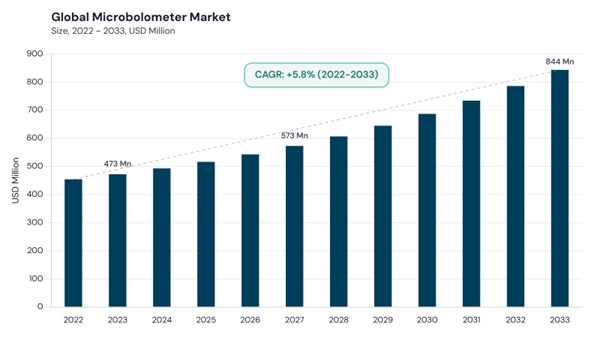
Europe continues to witness steady market expansion supported by automotive innovation, industrial automation, and growing demand for advanced surveillance systems. Meanwhile, Asia Pacific is projected to emerge as one of the fastest-growing regions due to increasing industrialization, expanding automotive production, rising defense investments, and growing adoption of thermal imaging technologies across commercial applications. LAMEA is also witnessing gradual adoption driven by infrastructure development, security modernization initiatives, and increasing industrial safety requirements.
Market Competition and Attributes
The microbolometer market is highly innovation-driven and characterized by strong competition among thermal imaging technology providers, defense contractors, and infrared sensor manufacturers. Companies compete primarily through thermal sensitivity enhancement, pixel miniaturization, image resolution improvement, and AI-based analytics integration. The market continues to witness increasing investments in next-generation uncooled infrared sensing technologies and low-power thermal imaging systems.Strategic partnerships, ecosystem collaborations, and regional expansion remain key competitive factors influencing market dynamics. Companies are also focusing on supply chain optimization, localized manufacturing capabilities, and scalable sensor fabrication processes to improve operational efficiency and address rising global demand. Additionally, integration of thermal imaging with drones, autonomous systems, industrial IoT, and smart surveillance infrastructure is expected to further intensify innovation-focused competition.
Recent Strategies Deployed in the Market
- Mar-2025: Teledyne FLIR introduced advanced compact thermal imaging modules designed for UAVs and industrial monitoring applications, enhancing portability and imaging accuracy.
- Nov-2024: Lynred expanded its infrared detector portfolio with enhanced VOx-based thermal imaging sensors focused on defense and industrial applications.
- Jul-2024: L3Harris Technologies strengthened its surveillance capabilities through integration of advanced thermal imaging systems for aerospace and border security operations.
- Feb-2024: Leonardo DRS enhanced its infrared sensing solutions portfolio to support next-generation defense surveillance and tactical imaging systems.
- Oct-2023: Guide Sensmart expanded its commercial thermal imaging product lineup targeting industrial inspection and predictive maintenance applications.
List of Key Companies Profiled
- Teledyne Technologies
- Lynred
- Leonardo DRS
- RTX Corporation
- L3Harris Technologies
- Zhejiang Dali Technology
- Guide Sensmart
- Hamamatsu Photonics
- NEC Corporation
- InfraTec GmbH
Market Report Segmentation
By Resolution- 640 × 480
- Below 320 × 240
- 1024 × 768 and Above
- Vanadium Oxide (VOx)
- Amorphous Silicon (a-Si)
- Other Material
- Aerospace & Defense
- Security & Surveillance
- Automotive
- Industrial (Monitoring & Thermography)
- Healthcare
- Consumer Electronics
- Other Application
- North America
- US
- Canada
- Mexico
- Rest of North America
- Europe
- Germany
- UK
- France
- Russia
- Spain
- Italy
- Rest of Europe
- Asia Pacific
- China
- Japan
- India
- South Korea
- Singapore
- Malaysia
- Rest of Asia Pacific
- LAMEA
- Brazil
- Argentina
- UAE
- Saudi Arabia
- South Africa
- Nigeria
- Rest of LAMEA
Table of Contents
Chapter 1. Market Overview
Chapter 2. Key Factors Impacting Market
Chapter 5. Competition Analysis - Global
Chapter 6. Segmentation By Resolution
Chapter 7. Segmentation By Material
Chapter 8. Segmentation By Application
Chapter 9. North America Market
Chapter 10. Europe Market
Chapter 11. Asia Pacific Market
Chapter 12. LAMEA Market
Chapter 13. Company Snapshot
Companies Mentioned
- Teledyne Technologies
- Lynred
- Leonardo DRS
- RTX Corporation
- L3Harris Technologies
- Zhejiang Dali Technology
- Guide Sensmart
- Hamamatsu Photonics
- NEC Corporation
- InfraTec GmbH


