



The Europe Microbolometer Market is expected to reach USD 179.82 million by 2031, growing at a CAGR of 6.1% during the forecast period.
The Germany market dominated the Europe Microbolometer Market by country in 2025 and is expected to continue to remain dominant till 2033; thereby, achieving a market value of USD 43.2 million by 2033, growing at a CAGR of 4.7% during the forecast period. The UK market is expected to witness a CAGR of 5.0% during 2026-2033. Additionally, the France market is expected to register strong growth momentum with a CAGR of 6.7% during the forecast period. Germany and the UK accounted for approximately 23.2% and 17.4% share of the regional market respectively in 2025. The Europe market is supported by rising adoption of thermal imaging technologies across defense modernization, industrial monitoring, and automotive safety applications.
The Europe microbolometer market evolved significantly alongside increasing deployment of uncooled infrared sensing technologies across aerospace, defense, automotive, industrial thermography, and public security applications. Initially driven by military surveillance and border security requirements, the market progressively expanded into industrial automation, predictive maintenance, healthcare diagnostics, and automotive night vision systems due to advancements in thermal detector sensitivity and compact sensor architectures. The growing emphasis on infrastructure safety, energy efficiency monitoring, and industrial automation accelerated adoption across manufacturing and utility sectors. Additionally, improvements in focal plane array technologies, semiconductor fabrication processes, and low-power thermal imaging systems enabled broader commercialization across civilian and enterprise applications throughout Europe.
The market is increasingly influenced by AI-enabled thermal analytics, smart surveillance systems, and the integration of thermal sensing technologies into autonomous platforms and connected infrastructure. Defense agencies across Europe continue investing in advanced infrared imaging systems for tactical reconnaissance, perimeter monitoring, and unmanned systems. Simultaneously, industrial sectors are integrating thermography solutions for predictive maintenance and operational efficiency enhancement. Automotive manufacturers are also adopting thermal imaging technologies within advanced driver assistance systems (ADAS) and autonomous vehicle platforms. Competitive dynamics in the market are centered around detector sensitivity, high-resolution imaging capabilities, miniaturization, and advanced sensor integration rather than pricing competition. Strategic collaborations among defense contractors, semiconductor firms, and thermal imaging technology providers continue accelerating innovation across the European ecosystem.
The 1024 × 768 and Above segment is anticipated to witness the highest CAGR of 6.6% during 2026-2033. Increasing demand for high-resolution thermal imaging systems across aerospace targeting, scientific research, and advanced industrial monitoring applications is supporting segment growth. Analysis & Future Outlook: Continuous advancements in thermal sensitivity, AI-driven analytics, and high-resolution infrared imaging are expected to strengthen demand for both mid-range and advanced-resolution microbolometer systems across Europe.
The Other Material segment is anticipated to witness the highest CAGR of 6.7% during 2026-2033. Continuous innovation in advanced detector materials, infrared absorption technologies, and semiconductor optimization is supporting growth across emerging material categories. Analysis & Future Outlook: Material innovation focused on improving detector performance, manufacturing scalability, and low-power imaging capabilities is expected to reshape the competitive landscape of the Europe microbolometer market.
The Other Application segment is expected to witness the highest CAGR of 9.9% during 2026-2033, followed by Consumer Electronics at 9.2%. Increasing integration of thermal sensing technologies into wearable systems, portable thermal cameras, smart devices, and IoT-enabled monitoring platforms is accelerating commercial adoption across multiple sectors. Analysis & Future Outlook: Expanding use cases across smart infrastructure, industrial automation, connected healthcare, and consumer electronics ecosystems are expected to create substantial long-term growth opportunities for microbolometer manufacturers across Europe.
Additionally, increasing integration of thermal imaging systems into autonomous mobility platforms, industrial robotics, and smart infrastructure projects is expanding commercialization opportunities across Germany. The country also benefits from ongoing collaborations between research institutions, defense contractors, semiconductor manufacturers, and imaging technology developers focused on improving thermal sensitivity, miniaturization, and AI-enabled thermal analytics. Future market expansion is expected to be supported by increasing investments in defense modernization, industrial automation, energy infrastructure monitoring, and next-generation thermal imaging technologies.
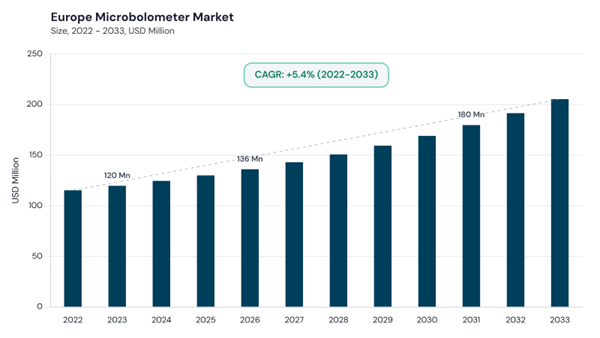
The Germany market dominated the Europe Microbolometer Market by country in 2025 and is expected to continue to remain dominant till 2033; thereby, achieving a market value of USD 43.2 million by 2033, growing at a CAGR of 4.7% during the forecast period. The UK market is expected to witness a CAGR of 5.0% during 2026-2033. Additionally, the France market is expected to register strong growth momentum with a CAGR of 6.7% during the forecast period. Germany and the UK accounted for approximately 23.2% and 17.4% share of the regional market respectively in 2025. The Europe market is supported by rising adoption of thermal imaging technologies across defense modernization, industrial monitoring, and automotive safety applications.
The Europe microbolometer market evolved significantly alongside increasing deployment of uncooled infrared sensing technologies across aerospace, defense, automotive, industrial thermography, and public security applications. Initially driven by military surveillance and border security requirements, the market progressively expanded into industrial automation, predictive maintenance, healthcare diagnostics, and automotive night vision systems due to advancements in thermal detector sensitivity and compact sensor architectures. The growing emphasis on infrastructure safety, energy efficiency monitoring, and industrial automation accelerated adoption across manufacturing and utility sectors. Additionally, improvements in focal plane array technologies, semiconductor fabrication processes, and low-power thermal imaging systems enabled broader commercialization across civilian and enterprise applications throughout Europe.
The market is increasingly influenced by AI-enabled thermal analytics, smart surveillance systems, and the integration of thermal sensing technologies into autonomous platforms and connected infrastructure. Defense agencies across Europe continue investing in advanced infrared imaging systems for tactical reconnaissance, perimeter monitoring, and unmanned systems. Simultaneously, industrial sectors are integrating thermography solutions for predictive maintenance and operational efficiency enhancement. Automotive manufacturers are also adopting thermal imaging technologies within advanced driver assistance systems (ADAS) and autonomous vehicle platforms. Competitive dynamics in the market are centered around detector sensitivity, high-resolution imaging capabilities, miniaturization, and advanced sensor integration rather than pricing competition. Strategic collaborations among defense contractors, semiconductor firms, and thermal imaging technology providers continue accelerating innovation across the European ecosystem.
Resolution Outlook
Based on Resolution, the market is segmented into 640 × 480, Below 320 × 240, and 1024 × 768 and Above. The 640 × 480 segment dominated the Europe Microbolometer Market by Resolution in 2025 and is expected to continue to remain dominant till 2033; thereby, achieving a market value of USD 88.9 million by 2033, growing at a CAGR of 5.5% during the forecast period. The segment continues to lead due to its balanced combination of image clarity, operational efficiency, and cost-effectiveness across surveillance, industrial inspection, and defense applications.The 1024 × 768 and Above segment is anticipated to witness the highest CAGR of 6.6% during 2026-2033. Increasing demand for high-resolution thermal imaging systems across aerospace targeting, scientific research, and advanced industrial monitoring applications is supporting segment growth. Analysis & Future Outlook: Continuous advancements in thermal sensitivity, AI-driven analytics, and high-resolution infrared imaging are expected to strengthen demand for both mid-range and advanced-resolution microbolometer systems across Europe.
Material Outlook
Based on Material, the market is segmented into Vanadium Oxide (VOx), Amorphous Silicon (a-Si), and Other Material. The Vanadium Oxide (VOx) segment dominated the Europe Microbolometer Market by Material in 2025 and is expected to continue to remain dominant till 2033; thereby, achieving a market value of USD 106.7 million by 2033, growing at a CAGR of 5.6% during the forecast period. The dominance of VOx-based detectors is supported by superior thermal sensitivity, low noise performance, and widespread deployment across defense-grade and industrial thermal imaging systems.The Other Material segment is anticipated to witness the highest CAGR of 6.7% during 2026-2033. Continuous innovation in advanced detector materials, infrared absorption technologies, and semiconductor optimization is supporting growth across emerging material categories. Analysis & Future Outlook: Material innovation focused on improving detector performance, manufacturing scalability, and low-power imaging capabilities is expected to reshape the competitive landscape of the Europe microbolometer market.
Application Outlook
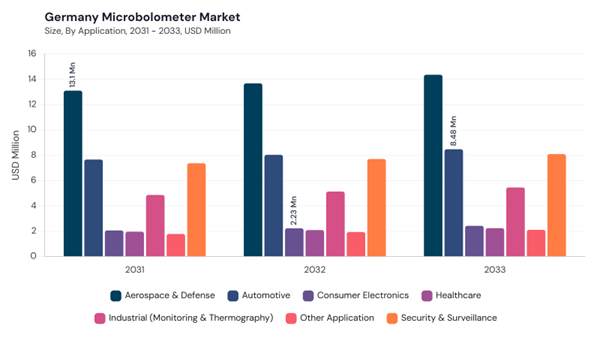
Based on Application, the market is segmented into Aerospace & Defense, Security & Surveillance, Automotive, Industrial (Monitoring & Thermography), Healthcare, Consumer Electronics, and Other Application. The Aerospace & Defense segment dominated the Europe Microbolometer Market by Application in 2025 and is expected to continue to remain dominant till 2033; thereby, achieving a market value of USD 68.9 million by 2033, growing at a CAGR of 5.3% during the forecast period. Rising defense modernization initiatives, border security investments, and increasing deployment of UAV-based thermal imaging systems continue to support segment dominance across Europe.The Other Application segment is expected to witness the highest CAGR of 9.9% during 2026-2033, followed by Consumer Electronics at 9.2%. Increasing integration of thermal sensing technologies into wearable systems, portable thermal cameras, smart devices, and IoT-enabled monitoring platforms is accelerating commercial adoption across multiple sectors. Analysis & Future Outlook: Expanding use cases across smart infrastructure, industrial automation, connected healthcare, and consumer electronics ecosystems are expected to create substantial long-term growth opportunities for microbolometer manufacturers across Europe.
Country Outlook
Germany represents the largest and most technologically mature microbolometer market across Europe, supported by strong industrial infrastructure, advanced automotive manufacturing capabilities, and significant defense technology investments. The country continues to witness substantial adoption of thermal imaging systems across aerospace, industrial automation, predictive maintenance, and automotive safety applications. Germany’s strong semiconductor ecosystem, engineering expertise, and focus on Industry 4.0 initiatives are further accelerating deployment of advanced infrared sensing technologies across manufacturing and industrial sectors.Additionally, increasing integration of thermal imaging systems into autonomous mobility platforms, industrial robotics, and smart infrastructure projects is expanding commercialization opportunities across Germany. The country also benefits from ongoing collaborations between research institutions, defense contractors, semiconductor manufacturers, and imaging technology developers focused on improving thermal sensitivity, miniaturization, and AI-enabled thermal analytics. Future market expansion is expected to be supported by increasing investments in defense modernization, industrial automation, energy infrastructure monitoring, and next-generation thermal imaging technologies.
List of Key Companies Profiled
- Teledyne Technologies Incorporated
- Lynred
- Leonardo DRS, Inc.
- RTX Corporation
- L3Harris Technologies, Inc.
- Zhejiang Dali Technology Co., Ltd.
- Guide Sensmart
- Hamamatsu Photonics K.K.
- NEC Corporation
- InfraTec GmbH
Market Report Segmentation
By Resolution- 640 × 480
- Below 320 × 240
- 1024 × 768 and Above
- Vanadium Oxide (VOx)
- Amorphous Silicon (a-Si)
- Other Material
- Aerospace & Defense
- Security & Surveillance
- Automotive
- Industrial (Monitoring & Thermography)
- Healthcare
- Consumer Electronics
- Other Application
- Germany
- UK
- France
- Russia
- Spain
- Italy
- Rest of Europe
Table of Contents
Chapter 1. Europe Market1.1 Market Overview
1.2 Key Factors Impacting Market
1.2.1 Market Drivers
1.2.2 Market Restraints
1.2.3 Market Opportunities
1.2.4 Market Challenges
1.2.5 Market Trends
1.2.6 State of Competition
1.2.7 Market Consolidation
1.2.8 Key Customer Criteria
1.3 Product Life Cycle
1.4 Segmentation By Resolution
1.4.1 Below 320 × 240
1.4.2 640 × 480
1.4.3 1024 × 768 and Above
1.5 Segmentation By Material
1.5.1 Vanadium Oxide (VOx)
1.5.2 Amorphous Silicon (a-Si)
1.5.3 Other Material
1.6 Segmentation By Application
1.6.1 Aerospace & Defense
1.6.2 Security & Surveillance
1.6.3 Automotive
1.6.4 Industrial (Monitoring & Thermography)
1.6.5 Healthcare
1.6.6 Consumer Electronics
1.6.7 Other Application
1.7 Segmentation By Country
1.7.1 Germany
1.7.2 United Kingdom
1.7.3 France
1.7.4 Russia
1.7.5 Spain
1.7.6 Italy
1.7.7 Rest of Europe
Chapter 2. Company Snapshot
2.1 Teledyne Technologies Incorporated
2.1.1 Business Overview
2.1.2 Key Information
2.1.3 Company Focus
2.1.4 Strategic Insights
2.1.5 Strategy Deployed
2.1.6 Product & Service Portfolio
2.1.7 Capability Overview
2.1.8 Technology & Innovation Focus
2.1.9 Customers / End Users
2.1.10 Competitive Positioning
2.1.11 Key Differentiators
2.1.12 Portfolio Matrix
2.1.13 SWOT Analysis
2.1.14 Future Outlook
2.2 Lynred
2.2.1 Business Overview
2.2.2 Key Information
2.2.3 Company Focus
2.2.4 Strategic Insights
2.2.5 Strategy Deployed
2.2.6 Product & Service Portfolio
2.2.7 Capability Overview
2.2.8 Technology & Innovation Focus
2.2.9 Customers / End Users
2.2.10 Competitive Positioning
2.2.11 Key Differentiators
2.2.12 Portfolio Matrix
2.2.13 SWOT Analysis
2.2.14 Future Outlook
2.3 Leonardo SpA (Leonardo DRS, Inc.)
2.3.1 Business Overview
2.3.2 Key Information
2.3.3 Company Focus
2.3.4 Strategic Insights
2.3.5 Strategy Deployed
2.3.6 Product & Service Portfolio
2.3.7 Capability Overview
2.3.8 Technology & Innovation Focus
2.3.9 Customers / End Users
2.3.10 Competitive Positioning
2.3.11 Key Differentiators
2.3.12 Portfolio Matrix
2.3.13 SWOT Analysis
2.3.14 Future Outlook
2.4 RTX Corporation
2.4.1 Business Overview
2.4.2 Key Information
2.4.3 Company Focus
2.4.4 Strategic Insights
2.4.5 Strategy Deployed
2.4.6 Product & Service Portfolio
2.4.7 Capability Overview
2.4.8 Technology & Innovation Focus
2.4.9 Customers / End Users
2.4.10 Competitive Positioning
2.4.11 Key Differentiators
2.4.12 Portfolio Matrix
2.4.13 SWOT Analysis
2.4.14 Future Outlook
2.5 L3Harris Technologies, Inc.
2.5.1 Business Overview
2.5.2 Key Information
2.5.3 Company Focus
2.5.4 Strategic Insights
2.5.5 Strategy Deployed
2.5.6 Product & Service Portfolio
2.5.7 Capability Overview
2.5.8 Technology & Innovation Focus
2.5.9 Customers / End Users
2.5.10 Competitive Positioning
2.5.11 Key Differentiators
2.5.12 Portfolio Matrix
2.5.13 SWOT Analysis
2.5.14 Future Outlook
2.6 NEC Corporation
2.6.1 Business Overview
2.6.2 Key Information
2.6.3 Company Focus
2.6.4 Strategic Insights
2.6.5 Strategy Deployed
2.6.6 Product & Service Portfolio
2.6.7 Capability Overview
2.6.8 Technology & Innovation Focus
2.6.9 Customers / End Users
2.6.10 Competitive Positioning
2.6.11 Key Differentiators
2.6.12 Portfolio Matrix
2.6.13 SWOT Analysis
2.6.14 Future Outlook
2.7 Zhejiang Dali Technology Co., Ltd.
2.7.1 Business Overview
2.7.2 Key Information
2.7.3 Company Focus
2.7.4 Strategic Insights
2.7.5 Strategy Deployed
2.7.6 Product & Service Portfolio
2.7.7 Capability Overview
2.7.8 Technology & Innovation Focus
2.7.9 Customers / End Users
2.7.10 Competitive Positioning
2.7.11 Key Differentiators
2.7.12 Portfolio Matrix
2.7.13 SWOT Analysis
2.7.14 Future Outlook
2.8 Guide Sensmart Tech Co., Ltd.
2.8.1 Business Overview
2.8.2 Key Information
2.8.3 Company Focus
2.8.4 Strategic Insights
2.8.5 Strategy Deployed
2.8.6 Product & Service Portfolio
2.8.7 Capability Overview
2.8.8 Technology & Innovation Focus
2.8.9 Customers / End Users
2.8.10 Competitive Positioning
2.8.11 Key Differentiators
2.8.12 Portfolio Matrix
2.8.13 SWOT Analysis
2.8.14 Future Outlook
2.9 Hamamatsu Photonics K.K.
2.9.1 Business Overview
2.9.2 Key Information
2.9.3 Company Focus
2.9.4 Strategic Insights
2.9.5 Strategy Deployed
2.9.6 Product & Service Portfolio
2.9.7 Capability Overview
2.9.8 Technology & Innovation Focus
2.9.9 Customers / End Users
2.9.10 Competitive Positioning
2.9.11 Key Differentiators
2.9.12 Portfolio Matrix
2.9.13 SWOT Analysis
2.9.14 Future Outlook
2.10 InfraTec GmbH
2.10.1 Business Overview
2.10.2 Key Information
2.10.3 Company Focus
2.10.4 Strategic Insights
2.10.5 Strategy Deployed
2.10.6 Product & Service Portfolio
2.10.7 Capability Overview
2.10.8 Technology & Innovation Focus
2.10.9 Customers / End Users
2.10.10 Competitive Positioning
2.10.11 Key Differentiators
2.10.12 Portfolio Matrix
2.10.13 SWOT Analysis
2.10.14 Future Outlook
Companies Mentioned
- Teledyne Technologies Incorporated
- Lynred
- Leonardo DRS, Inc.
- RTX Corporation
- L3Harris Technologies, Inc.
- Zhejiang Dali Technology Co., Ltd.
- Guide Sensmart
- Hamamatsu Photonics K.K.
- NEC Corporation
- InfraTec GmbH


