



The North America Trade Promotion Optimization (TPO) AI Market is projected to reach USD 1.94 billion by 2032, growing at a CAGR of 12.0% during the forecast period (2026-2033).
The US market dominated the North America Trade Promotion Optimization (TPO) AI Market by country in 2025, and is expected to continue to be a dominant market till 2033. The Canada market is expected to witness strong growth during 2026-2033. Additionally, the Mexico market is expected to witness robust expansion throughout the forecast period. The US continued to account for the majority share of the regional market in 2025, supported by strong enterprise AI adoption, advanced retail infrastructure, and increasing deployment of cloud-native trade promotion platforms across large retail and consumer packaged goods organizations.
The North America trade promotion optimization (TPO) AI market has evolved rapidly with the growing digitalization of retail operations, increasing complexity of omnichannel commerce, and rising adoption of AI-powered enterprise analytics. Initially, trade promotion management relied heavily on manual spreadsheets and historical sales estimations, resulting in inefficient promotional spending and limited visibility into campaign effectiveness. However, the emergence of machine learning, predictive analytics, and cloud-native enterprise platforms transformed the market into a highly data-driven ecosystem capable of real-time promotion optimization and demand forecasting. Large retailers and consumer packaged goods companies across the United States and Canada increasingly integrated AI-powered TPO systems to improve pricing strategies, promotion planning, and trade spend management. The expansion of e-commerce ecosystems and digital retail channels further accelerated demand for scalable AI-enabled optimization platforms. Additionally, advancements in cloud computing, automation technologies, and enterprise data integration capabilities continue to strengthen adoption across the region.
The market is witnessing strong momentum driven by growing investments in predictive analytics, generative AI, and autonomous decision-making systems across retail and consumer goods industries. Organizations are increasingly leveraging AI-driven demand forecasting, scenario simulation, and post-event promotional analytics to improve campaign ROI and reduce operational inefficiencies. Cloud-based TPO platforms are gaining substantial traction due to scalability advantages, lower infrastructure costs, and real-time cross-channel visibility capabilities. Competitive dynamics remain centered on AI sophistication, analytics integration, automation capabilities, and enterprise interoperability rather than pricing alone. Vendors are increasingly focusing on embedding machine learning algorithms, generative AI assistants, and intelligent recommendation engines into TPO ecosystems to strengthen market differentiation. Rising adoption among SMEs and mid-sized retailers is also broadening the long-term addressable market across North America.
The component landscape is expected to remain solution-centric as enterprises continue prioritizing AI-powered analytics platforms and automated trade optimization tools. However, services are expected to gain substantial traction due to rising demand for AI integration, platform customization, cloud migration, and ongoing optimization support.
Cloud-native deployment models are expected to remain the primary growth engine for the market due to increasing adoption of omnichannel retail ecosystems and AI-driven enterprise intelligence platforms. However, on-premise deployment will continue to maintain relevance among organizations prioritizing data governance, security, and customized infrastructure environments.
The democratization of AI-powered analytics platforms and increasing availability of cloud-based enterprise solutions are expected to significantly accelerate adoption among SMEs. Expanding awareness regarding promotion optimization and operational efficiency is also expected to support long-term market penetration across smaller retail organizations.
AI-powered demand forecasting and predictive promotion analytics are expected to become increasingly important as retailers seek higher operational agility and improved promotional efficiency. Advanced analytics integration and real-time optimization capabilities are also expected to drive continued innovation across application categories.
The industry vertical landscape is expected to diversify steadily as AI-enabled trade optimization expands beyond traditional retail and consumer goods environments into healthcare, electronics, and emerging commercial sectors requiring advanced promotional intelligence capabilities.
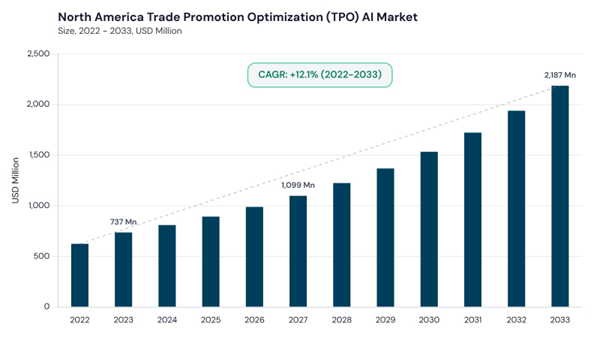
The US market dominated the North America Trade Promotion Optimization (TPO) AI Market by country in 2025, and is expected to continue to be a dominant market till 2033. The Canada market is expected to witness strong growth during 2026-2033. Additionally, the Mexico market is expected to witness robust expansion throughout the forecast period. The US continued to account for the majority share of the regional market in 2025, supported by strong enterprise AI adoption, advanced retail infrastructure, and increasing deployment of cloud-native trade promotion platforms across large retail and consumer packaged goods organizations.
The North America trade promotion optimization (TPO) AI market has evolved rapidly with the growing digitalization of retail operations, increasing complexity of omnichannel commerce, and rising adoption of AI-powered enterprise analytics. Initially, trade promotion management relied heavily on manual spreadsheets and historical sales estimations, resulting in inefficient promotional spending and limited visibility into campaign effectiveness. However, the emergence of machine learning, predictive analytics, and cloud-native enterprise platforms transformed the market into a highly data-driven ecosystem capable of real-time promotion optimization and demand forecasting. Large retailers and consumer packaged goods companies across the United States and Canada increasingly integrated AI-powered TPO systems to improve pricing strategies, promotion planning, and trade spend management. The expansion of e-commerce ecosystems and digital retail channels further accelerated demand for scalable AI-enabled optimization platforms. Additionally, advancements in cloud computing, automation technologies, and enterprise data integration capabilities continue to strengthen adoption across the region.
The market is witnessing strong momentum driven by growing investments in predictive analytics, generative AI, and autonomous decision-making systems across retail and consumer goods industries. Organizations are increasingly leveraging AI-driven demand forecasting, scenario simulation, and post-event promotional analytics to improve campaign ROI and reduce operational inefficiencies. Cloud-based TPO platforms are gaining substantial traction due to scalability advantages, lower infrastructure costs, and real-time cross-channel visibility capabilities. Competitive dynamics remain centered on AI sophistication, analytics integration, automation capabilities, and enterprise interoperability rather than pricing alone. Vendors are increasingly focusing on embedding machine learning algorithms, generative AI assistants, and intelligent recommendation engines into TPO ecosystems to strengthen market differentiation. Rising adoption among SMEs and mid-sized retailers is also broadening the long-term addressable market across North America.
Component Outlook
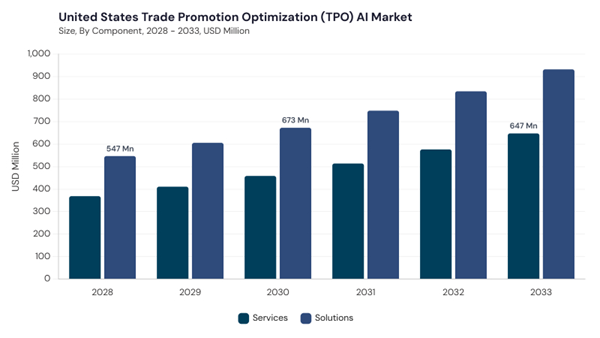
Based on Component, the market is segmented into Solutions, and Services. The Solutions segment dominated the North America Trade Promotion Optimization (TPO) AI Market by Component in 2025, and is expected to continue to be a dominant segment till 2033; thereby, achieving a market value of USD 1.29 billion by 2033 while growing at a CAGR of 11.7% during the forecast period. The Services segment is expected to witness a CAGR of 12.4% during 2026-2033. Increasing demand for AI deployment consulting, system integration, managed services, and enterprise optimization support continues to accelerate growth across the services segment.The component landscape is expected to remain solution-centric as enterprises continue prioritizing AI-powered analytics platforms and automated trade optimization tools. However, services are expected to gain substantial traction due to rising demand for AI integration, platform customization, cloud migration, and ongoing optimization support.
Deployment Mode Outlook
Based on Deployment Mode, the market is segmented into Cloud-based, and On-premise. The Cloud-based segment dominated the North America Trade Promotion Optimization (TPO) AI Market by Deployment Mode in 2025, and is expected to continue to be a dominant segment till 2033; thereby, achieving a market value of USD 1.40 billion by 2033, growing at a CAGR of 12.1% during the forecast period. The On-premise segment is expected to witness a CAGR of 11.8% during 2026-2033. Increasing enterprise preference for scalable SaaS infrastructure, lower deployment costs, and real-time retail analytics capabilities continues to support strong cloud adoption across the region.Cloud-native deployment models are expected to remain the primary growth engine for the market due to increasing adoption of omnichannel retail ecosystems and AI-driven enterprise intelligence platforms. However, on-premise deployment will continue to maintain relevance among organizations prioritizing data governance, security, and customized infrastructure environments.
Organization Size Outlook
Based on Organization Size, the market is segmented into Large Enterprises, and Small & Medium Enterprises (SMEs). The Large Enterprises segment dominated the North America Trade Promotion Optimization (TPO) AI Market by Organization Size in 2025, and is expected to continue to be a dominant segment till 2033; thereby, achieving a market value of USD 1.30 billion by 2033 while growing at a CAGR of 11.7% during the forecast period. The Small & Medium Enterprises (SMEs) segment is expected to witness a CAGR of 12.4% during 2026-2033. Growing accessibility of subscription-based AI platforms and increasing digital transformation initiatives among mid-sized retailers continue to strengthen SME adoption.The democratization of AI-powered analytics platforms and increasing availability of cloud-based enterprise solutions are expected to significantly accelerate adoption among SMEs. Expanding awareness regarding promotion optimization and operational efficiency is also expected to support long-term market penetration across smaller retail organizations.
Application Outlook
Based on Application, the market is segmented into Price & Promotion Optimization, Promotion Planning & Calendar Management, Demand Forecasting, Post-event Analysis, and Other Application. The Price & Promotion Optimization segment dominated the North America Trade Promotion Optimization (TPO) AI Market by Application in 2025, and is expected to continue to be a dominant segment till 2033; thereby, achieving a market value of USD 671.9 million by 2033 while growing at a CAGR of 11.1% during the forecast period. The Demand Forecasting segment is expected to witness the highest CAGR of 12.3% during 2026-2033. Additionally, the Post-event Analysis segment is expected to register strong growth throughout the forecast period due to increasing enterprise focus on campaign performance assessment and ROI optimization.AI-powered demand forecasting and predictive promotion analytics are expected to become increasingly important as retailers seek higher operational agility and improved promotional efficiency. Advanced analytics integration and real-time optimization capabilities are also expected to drive continued innovation across application categories.
Industry Vertical Outlook
Based on Industry Vertical, the market is segmented into Consumer Packaged Goods (CPG), Retail & E-commerce, Food & Beverage, Healthcare & Pharmaceuticals, Electronics & Appliances, and Other Industry Vertical. The Consumer Packaged Goods (CPG) segment dominated the North America Trade Promotion Optimization (TPO) AI Market by Industry Vertical in 2025, and is expected to continue to be a dominant segment till 2033; thereby, achieving a market value of USD 582.5 million by 2033 while growing at a CAGR of 10.3% during the forecast period. The Other Industry Vertical segment is expected to witness the highest CAGR of 16.6% during 2026-2033. Increasing adoption of AI-driven promotion optimization technologies across diversified industry sectors continues to support long-term market expansion.The industry vertical landscape is expected to diversify steadily as AI-enabled trade optimization expands beyond traditional retail and consumer goods environments into healthcare, electronics, and emerging commercial sectors requiring advanced promotional intelligence capabilities.
Country Outlook
The US trade promotion optimization (TPO) AI market represents the leading regional ecosystem within North America due to strong enterprise AI adoption, advanced retail infrastructure, and increasing investments in predictive analytics technologies. Large retailers and consumer packaged goods companies across the country are increasingly integrating AI-powered TPO platforms to improve pricing optimization, campaign planning, trade spend visibility, and demand forecasting capabilities. The expansion of omnichannel commerce and digital retail ecosystems has accelerated adoption of cloud-native trade optimization platforms capable of delivering real-time promotional intelligence across both physical and online retail channels. In addition, increasing investments in machine learning, generative AI, and autonomous analytics systems continue to strengthen enterprise adoption across the retail and consumer goods sectors. Growing emphasis on operational efficiency, customer engagement, and promotion effectiveness is expected to support sustained market growth across the United States throughout the forecast period.List of Key Companies Profiled
- SAP SE
- Oracle Corporation
- Blue Yonder Group, Inc.
- Salesforce, Inc.
- IBM Corporation
- Accenture PLC
- Wipro Limited
- Tredence Inc.
- o9 Solutions, Inc.
- RELEX Solutions
Market Report Segmentation
By Component- Solutions
- Services
- Cloud-based
- On-premise
- Large Enterprises
- Small & Medium Enterprises (SMEs)
- Price & Promotion Optimization
- Promotion Planning & Calendar Management
- Demand Forecasting
- Post-event Analysis
- Other Application
- Consumer Packaged Goods (CPG)
- Retail & E-commerce
- Food & Beverage
- Healthcare & Pharmaceuticals
- Electronics & Appliances
- Other Industry Vertical
- US
- Canada
- Mexico
- Rest of North America
Table of Contents
Chapter 1. North America Market1.1 Market Overview
1.2 Key Factors Impacting Market
1.2.1 Market Drivers
1.2.2 Market Restraints
1.2.3 Market Opportunities
1.2.4 Market Challenges
1.2.5 Market Trends
1.2.6 State of Competition
1.2.7 Market Consolidation
1.2.8 Key Customer Criteria
1.3 Product Life Cycle
1.4 Segmentation By Deployment Mode
1.4.1 Cloud-Based
1.4.2 On-Premise
1.5 Segmentation By Component
1.6 Solutions
1.7 Segmentation By Industry Vertical
1.7.1 Consumer Packaged Goods (CPG)
1.7.2 Retail & E-commerce
1.7.3 Food & Beverage
1.7.4 Healthcare & Pharmaceuticals
1.7.5 Electronics & Appliances
1.7.6 Other Industry Vertical
1.8 Segmentation By Application
1.8.1 Promotion Planning & Calendar Management
1.8.2 Demand Forecasting
1.8.3 Price & Promotion Optimization
1.8.4 Post-Event Analysis
1.8.5 Other Application
1.9 Segmentation By Organization Size
1.9.1 Large Enterprises
1.9.2 Small & Medium Enterprises (SMEs)
1.10 Segmentation By Country
1.10.1 United States
1.10.1.1 Segmentation By Component
1.10.1.1.1 Solutions
1.10.1.1.2 Services
1.10.1.2 Segmentation By Deployment Mode
1.10.1.2.1 Cloud-Based
1.10.1.2.2 On-Premise
1.10.1.3 Segmentation By Organization Size
1.10.1.3.1 Large Enterprises
1.10.1.3.2 Small & Medium Enterprises (SMEs)
1.10.1.4 Segmentation By Application
1.10.1.4.1 Price & Promotion Optimization
1.10.1.4.2 Promotion Planning & Calendar Management
1.10.1.4.3 Demand Forecasting
1.10.1.4.4 Post-Event Analysis
1.10.1.4.5 Other Application
1.10.1.5 Segmentation By Industry Vertical
1.10.1.5.1 Consumer Packaged Goods (CPG)
1.10.1.5.2 Retail & E-commerce
1.10.1.5.3 Food & Beverage
1.10.1.5.4 Healthcare & Pharmaceuticals
1.10.1.5.5 Electronics & Appliances
1.10.1.5.6 Other Industry Vertical
1.10.2 Canada
1.10.2.1 Segmentation By Component
1.10.2.1.1 Solutions
1.10.2.1.2 Services
1.10.2.2 Segmentation By Deployment Mode
1.10.2.2.1 Cloud-Based
1.10.2.2.2 On-Premise
1.10.2.3 Segmentation By Organization Size
1.10.2.3.1 Large Enterprises
1.10.2.3.2 Small & Medium Enterprises (SMEs)
1.10.2.4 Segmentation By Application
1.10.2.4.1 Price & Promotion Optimization
1.10.2.4.2 Promotion Planning & Calendar Management
1.10.2.4.3 Demand Forecasting
1.10.2.4.4 Post-Event Analysis
1.10.2.4.5 Other Application
1.10.2.5 Segmentation By Industry Vertical
1.10.2.5.1 Consumer Packaged Goods (CPG)
1.10.2.5.2 Retail & E-commerce
1.10.2.5.3 Food & Beverage
1.10.2.5.4 Healthcare & Pharmaceuticals
1.10.2.5.5 Electronics & Appliances
1.10.2.5.6 Other Industry Vertical
1.10.3 Mexico
1.10.3.1 Segmentation By Component
1.10.3.1.1 Solutions
1.10.3.1.2 Services
1.10.3.2 Segmentation By Deployment Mode
1.10.3.2.1 Cloud-Based
1.10.3.2.2 On-Premise
1.10.3.3 Segmentation By Organization Size
1.10.3.3.1 Large Enterprises
1.10.3.3.2 Small & Medium Enterprises (SMEs)
1.10.3.4 Segmentation By Application
1.10.3.4.1 Price & Promotion Optimization
1.10.3.4.2 Promotion Planning & Calendar Management
1.10.3.4.3 Demand Forecasting
1.10.3.4.4 Post-Event Analysis
1.10.3.4.5 Other Application
1.10.3.5 Segmentation By Industry Vertical
1.10.3.5.1 Consumer Packaged Goods (CPG)
1.10.3.5.2 Retail & E-commerce
1.10.3.5.3 Food & Beverage
1.10.3.5.4 Healthcare & Pharmaceuticals
1.10.3.5.5 Electronics & Appliances
1.10.3.5.6 Other Industry Vertical
1.10.4 Rest of North America
1.10.4.1 Segmentation By Component
1.10.4.1.1 Solutions
1.10.4.1.2 Services
1.10.4.2 Segmentation By Deployment Mode
1.10.4.2.1 Cloud-Based
1.10.4.2.2 On-Premise
1.10.4.3 Segmentation By Organization Size
1.10.4.3.1 Large Enterprises
1.10.4.3.2 Small & Medium Enterprises (SMEs)
1.10.4.4 Segmentation By Application
1.10.4.4.1 Price & Promotion Optimization
1.10.4.4.2 Promotion Planning & Calendar Management
1.10.4.4.3 Demand Forecasting
1.10.4.4.4 Post-Event Analysis
1.10.4.4.5 Other Application
1.10.4.5 Segmentation By Industry Vertical
1.10.4.5.1 Consumer Packaged Goods (CPG)
1.10.4.5.2 Retail & E-commerce
1.10.4.5.3 Food & Beverage
1.10.4.5.4 Healthcare & Pharmaceuticals
1.10.4.5.5 Electronics & Appliances
1.10.4.5.6 Other Industry Vertical
Chapter 2. Company Snapshot
2.1 o9 Solutions, Inc.
2.1.1 Business Overview
2.1.2 Key Information
2.1.3 Company Focus on Trade Promotion Optimization (TPO) AI Market
2.1.4 Strategic Insights on Trade Promotion Optimization (TPO) AI Market
2.1.5 Strategy Deployed for Trade Promotion Optimization (TPO) AI Market
2.1.6 Product & Service Portfolio
2.1.7 Key Products / Services (Representative)
2.1.8 Capability Overview
2.1.9 Technology & Innovation Focus
2.1.10 SWOT Analysis (Trade Promotion Optimization (TPO) AI Market)
2.1.11 Customers / End Users
2.1.12 Competitive Positioning
2.1.13 Key Differentiators
2.1.14 Portfolio Matrix
2.1.15 Analyst View
2.1.16 Future Outlook for Trade Promotion Optimization (TPO) AI Market
2.2 Oracle Corporation
2.2.1 Business Overview
2.2.2 Key Information
2.2.3 Company Focus on Trade Promotion Optimization (TPO) AI Market
2.2.4 Strategic Insights on Trade Promotion Optimization (TPO) AI Market
2.2.5 Strategy Deployed for Trade Promotion Optimization (TPO) AI Market
2.2.6 Product & Service Portfolio
2.2.7 Key Products / Services (Representative)
2.2.8 Capability Overview
2.2.9 SWOT Analysis (Trade Promotion Optimization (TPO) AI Market)
2.2.10 Customers / End Users
2.2.11 Competitive Positioning
2.2.12 Key Differentiators
2.2.13 Portfolio Matrix
2.2.14 Analyst View
2.2.15 Future Outlook for Trade Promotion Optimization (TPO) AI Market
2.3 SAP SE
2.3.1 Business Overview
2.3.2 Key Information
2.3.3 Company Focus on Trade Promotion Optimization (TPO) AI Market
2.3.4 Strategic Insights on Trade Promotion Optimization (TPO) AI Market
2.3.5 Strategy Deployed for Trade Promotion Optimization (TPO) AI Market
2.3.6 Product & Service Portfolio
2.3.7 Key Products / Services (Representative)
2.3.8 Capability Overview
2.3.9 Technology & Innovation Focus
2.3.10 SWOT Analysis (Trade Promotion Optimization (TPO) AI Market)
2.3.11 Customers / End Users
2.3.12 Competitive Positioning
2.3.13 Key Differentiators
2.3.14 Portfolio Matrix
2.3.15 Analyst View
2.3.16 Future Outlook for Trade Promotion Optimization (TPO) AI Market
2.4 Anaplan, Inc.
2.4.1 Business Overview
2.4.2 Key Information
2.4.3 Company Focus on Trade Promotion Optimization (TPO) AI Market
2.4.4 Strategic Insights on Trade Promotion Optimization (TPO) AI Market
2.4.5 Strategy Deployed for Trade Promotion Optimization (TPO) AI Market
2.4.6 Product & Service Portfolio
2.4.7 Capability Overview
2.4.8 Technology & Innovation Focus
2.4.9 SWOT Analysis (Trade Promotion Optimization (TPO) AI Market)
2.4.10 Customers / End Users
2.4.11 Competitive Positioning
2.4.12 Key Differentiators
2.4.13 Portfolio Matrix
2.4.14 Analyst View
2.4.15 Future Outlook for Trade Promotion Optimization (TPO) AI Market
2.5 Accenture Plc.
2.5.1 Business Overview
2.5.2 Key Information
2.5.3 Company Focus on Trade Promotion Optimization (TPO) AI Market
2.5.4 Strategic Insights on Trade Promotion Optimization (TPO) AI Market
2.5.5 Strategy Deployed for Trade Promotion Optimization (TPO) AI Market
2.5.6 Product & Service Portfolio
2.5.7 Technology & Innovation Focus
2.5.8 SWOT Analysis (Trade Promotion Optimization (TPO) AI Market)
2.5.9 Customers / End Users
2.5.10 Competitive Positioning
2.5.11 Key Differentiators
2.5.12 Portfolio Matrix
2.5.13 Analyst View
2.5.14 Future Outlook for Trade Promotion Optimization (TPO) AI Market
2.6 Wipro Ltd.
2.6.1 Business Overview
2.6.2 Key Information
2.6.3 Company Focus on Trade Promotion Optimization (TPO) AI Market
2.6.4 Strategic Insights on Trade Promotion Optimization (TPO) AI Market
2.6.5 Strategy Deployed for Trade Promotion Optimization (TPO) AI Market
2.6.6 Product & Service Portfolio
2.6.7 Technology & Innovation Focus
2.6.8 SWOT Analysis (Trade Promotion Optimization (TPO) AI Market)
2.6.9 Customers / End Users
2.6.10 Competitive Positioning
2.6.11 Key Differentiators
2.6.12 Portfolio Matrix
2.6.13 Analyst View
2.6.14 Future Outlook for Trade Promotion Optimization (TPO) AI Market
2.7 Nielsen Consumer LLC
2.7.1 Business Overview
2.7.2 Key Information
2.7.3 Company Focus on Trade Promotion Optimization (TPO) AI Market
2.7.4 Strategic Insights on Trade Promotion Optimization (TPO) AI Market
2.7.5 Strategy Deployed for Trade Promotion Optimization (TPO) AI Market
2.7.6 Product & Service Portfolio
2.7.7 SWOT Analysis (Trade Promotion Optimization (TPO) AI Market)
2.7.8 Customers / End Users
2.7.9 Competitive Positioning
2.7.10 Key Differentiators
2.7.11 Portfolio Matrix
2.7.12 Analyst View
2.7.13 Future Outlook for Trade Promotion Optimization (TPO) AI Market
2.8 The Kantar Group Limited
2.8.1 Business Overview
2.8.2 Key Information
2.8.3 Company Focus on Trade Promotion Optimization (TPO) AI Market
2.8.4 Strategic Insights on Trade Promotion Optimization (TPO) AI Market
2.8.5 Strategy Deployed for Trade Promotion Optimization (TPO) AI Market
2.8.6 Product & Service Portfolio
2.8.7 Technology & Innovation Focus
2.8.8 SWOT Analysis (Trade Promotion Optimization (TPO) AI Market)
2.8.9 Customers / End Users
2.8.10 Competitive Positioning
2.8.11 Key Differentiators
2.8.12 Portfolio Matrix
2.8.13 Analyst View
2.8.14 Future Outlook for Trade Promotion Optimization (TPO) AI Market
2.9 Aera Technology, Inc.
2.9.1 Business Overview
2.9.2 Key Information
2.9.3 Company Focus on Trade Promotion Optimization (TPO) AI Market
2.9.4 Strategic Insights on Trade Promotion Optimization (TPO) AI Market
2.9.5 Strategy Deployed for Trade Promotion Optimization (TPO) AI Market
2.9.6 Product & Service Portfolio
2.9.7 SWOT Analysis (Trade Promotion Optimization (TPO) AI Market)
2.9.8 Customers / End Users
2.9.9 Competitive Positioning
2.9.10 Key Differentiators
2.9.11 Portfolio Matrix
2.9.12 Analyst View
2.9.13 Future Outlook for Trade Promotion Optimization (TPO) AI Market
2.10 Innovative Routines International (IRI), Inc.
2.10.1 Business Overview
2.10.2 Key Information
2.10.3 Company Focus on Trade Promotion Optimization (TPO) AI Market
2.10.4 Strategic Insights on Trade Promotion Optimization (TPO) AI Market
2.10.5 Strategy Deployed for Trade Promotion Optimization (TPO) AI Market
2.10.6 Product & Service Portfolio
2.10.7 SWOT Analysis (Trade Promotion Optimization (TPO) AI Market)
2.10.8 Customers / End Users
2.10.9 Competitive Positioning
2.10.10 Key Differentiators
2.10.11 Portfolio Matrix
2.10.12 Analyst View
2.10.13 Future Outlook for Trade Promotion Optimization (TPO) AI Market
Companies Mentioned
- SAP SE
- Oracle Corporation
- Blue Yonder Group, Inc.
- Salesforce, Inc.
- IBM Corporation
- Accenture PLC
- Wipro Limited
- Tredence Inc.
- o9 Solutions, Inc.
- RELEX Solutions


