



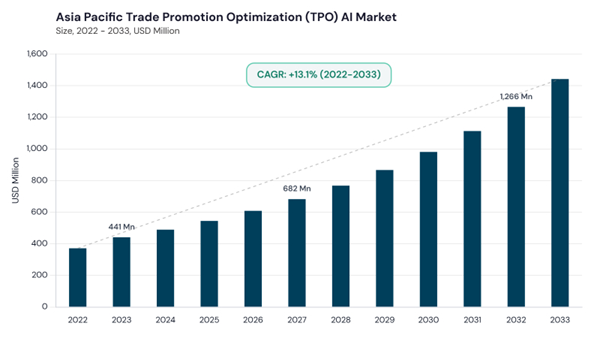
The Asia Pacific Trade Promotion Optimization (TPO) AI Market is expected to witness market growth of 13.1% CAGR during the forecast period (2026-2033) and would reach USD 1.26 billion by 2032.
The China market dominated the Asia Pacific Trade Promotion Optimization (TPO) AI Market by country in 2025, and is expected to continue to be a dominant market till 2033; thereby, achieving a market value of USD 374.3 million by 2033. The Japan market is expected to witness a CAGR of 12.3% during 2026-2033. Additionally, the India market is expected to witness a CAGR of 13.9% during 2026-2033. The China and Japan led the Asia Pacific Trade Promotion Optimization (TPO) AI Market by Country with a market share of 29.9% and 17.1% in 2025. The Singapore market is expected to witness a CAGR of 14.8% throughout the forecast period.
The Asia Pacific Trade Promotion Optimization (TPO) AI market has evolved rapidly in response to the region’s dynamic retail expansion, digital transformation, and growing consumer markets. Countries such as China, India, Japan, South Korea, and Australia have experienced significant growth in organized retail and e-commerce, creating a complex environment for trade promotions. Traditionally, trade promotions in Asia Pacific were managed through manual processes or basic Trade Promotion Management (TPM) systems that focused on tracking budgets and execution rather than optimization. These approaches often resulted in inefficiencies such as inconsistent promotional outcomes, lack of visibility into return on investment, and challenges in aligning promotions with supply chain operations. The integration of artificial intelligence and machine learning has significantly transformed the regional market by enabling enterprises to analyze large datasets, forecast demand, and optimize promotional campaigns in real time. Furthermore, increasing cloud adoption and government-backed digital transformation initiatives have accelerated enterprise-wide implementation of AI-driven trade optimization solutions.
The market is witnessing increasing adoption of AI-powered promotion planning platforms, predictive analytics, and automated pricing optimization tools across retail and FMCG industries. Enterprises are integrating generative AI, machine learning, and scenario simulation capabilities into commercial planning operations to improve promotional effectiveness and customer targeting. Demand for cloud-native TPO solutions is increasing as organizations seek scalable and cost-efficient deployment models. Strategic partnerships, data ecosystem collaborations, and integrated revenue growth management platforms are also reshaping competitive dynamics across the region. Moreover, the rapid expansion of omnichannel retail and e-commerce platforms is driving the need for real-time trade promotion analytics, demand forecasting, and post-event performance evaluation systems. As businesses increasingly focus on maximizing trade spend efficiency and improving promotional ROI, the adoption of AI-enabled TPO platforms is expected to accelerate significantly across Asia Pacific.
Additionally, the rapid expansion of omnichannel commerce and real-time consumer engagement strategies has increased demand for advanced AI-driven trade optimization systems. Chinese enterprises are also integrating generative AI and machine learning capabilities into revenue growth management platforms to enhance commercial planning and customer personalization. The presence of large-scale retail chains, technology providers, and digital payment ecosystems is expected to further strengthen China’s dominance in the regional market throughout the forecast period.
The China market dominated the Asia Pacific Trade Promotion Optimization (TPO) AI Market by country in 2025, and is expected to continue to be a dominant market till 2033; thereby, achieving a market value of USD 374.3 million by 2033. The Japan market is expected to witness a CAGR of 12.3% during 2026-2033. Additionally, the India market is expected to witness a CAGR of 13.9% during 2026-2033. The China and Japan led the Asia Pacific Trade Promotion Optimization (TPO) AI Market by Country with a market share of 29.9% and 17.1% in 2025. The Singapore market is expected to witness a CAGR of 14.8% throughout the forecast period.
The Asia Pacific Trade Promotion Optimization (TPO) AI market has evolved rapidly in response to the region’s dynamic retail expansion, digital transformation, and growing consumer markets. Countries such as China, India, Japan, South Korea, and Australia have experienced significant growth in organized retail and e-commerce, creating a complex environment for trade promotions. Traditionally, trade promotions in Asia Pacific were managed through manual processes or basic Trade Promotion Management (TPM) systems that focused on tracking budgets and execution rather than optimization. These approaches often resulted in inefficiencies such as inconsistent promotional outcomes, lack of visibility into return on investment, and challenges in aligning promotions with supply chain operations. The integration of artificial intelligence and machine learning has significantly transformed the regional market by enabling enterprises to analyze large datasets, forecast demand, and optimize promotional campaigns in real time. Furthermore, increasing cloud adoption and government-backed digital transformation initiatives have accelerated enterprise-wide implementation of AI-driven trade optimization solutions.
The market is witnessing increasing adoption of AI-powered promotion planning platforms, predictive analytics, and automated pricing optimization tools across retail and FMCG industries. Enterprises are integrating generative AI, machine learning, and scenario simulation capabilities into commercial planning operations to improve promotional effectiveness and customer targeting. Demand for cloud-native TPO solutions is increasing as organizations seek scalable and cost-efficient deployment models. Strategic partnerships, data ecosystem collaborations, and integrated revenue growth management platforms are also reshaping competitive dynamics across the region. Moreover, the rapid expansion of omnichannel retail and e-commerce platforms is driving the need for real-time trade promotion analytics, demand forecasting, and post-event performance evaluation systems. As businesses increasingly focus on maximizing trade spend efficiency and improving promotional ROI, the adoption of AI-enabled TPO platforms is expected to accelerate significantly across Asia Pacific.
Component Outlook
Based on Component, the market is segmented into Solutions, and Services. The Solutions market dominated the Asia Pacific Trade Promotion Optimization (TPO) AI Market by Component in 2025, and is expected to continue to be a dominant market till 2033; thereby, achieving a market value of USD 857.4 million by 2033. The Services market is expected to witness a CAGR of 13.5% during 2026-2033.Deployment Mode Outlook
Based on Deployment Mode, the market is segmented into Cloud-Based, and On-Premise. The Cloud-Based market dominated the Asia Pacific Trade Promotion Optimization (TPO) AI Market by Deployment Mode in 2025, and is expected to continue to be a dominant market till 2033; thereby, achieving a market value of USD 928.4 million by 2033. The On-Premise market is expected to witness a CAGR of 12.9% during 2026-2033.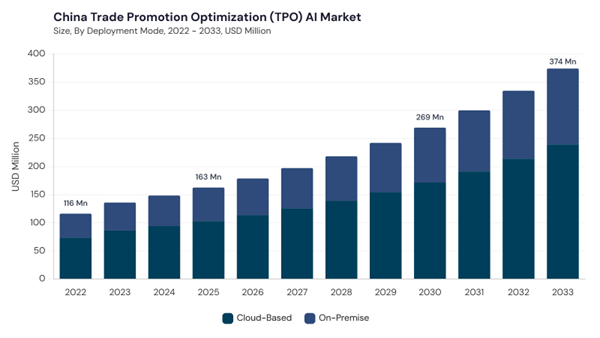
Organization Size Outlook
Based on Organization Size, the market is segmented into Large Enterprises, and Small & Medium Enterprises (SMEs). The Large Enterprises market dominated the Asia Pacific Trade Promotion Optimization (TPO) AI Market by Organization Size in 2025, and is expected to continue to be a dominant market till 2033; thereby, achieving a market value of USD 863.7 million by 2033. The Small & Medium Enterprises (SMEs) market is expected to witness a CAGR of 13.5% during 2026-2033.Application Outlook
Based on Application, the market is segmented into Price & Promotion Optimization, Promotion Planning & Calendar Management, Demand Forecasting, Post-Event Analysis, and Other Application. The Price & Promotion Optimization market garnered the highest revenue share in the Asia Pacific Trade Promotion Optimization (TPO) AI Market in 2025. The Demand Forecasting market is expected to witness notable growth during the forecast period owing to increasing adoption of predictive analytics and inventory optimization solutions across retail ecosystems. Additionally, the Post-Event Analysis segment is gaining traction due to rising enterprise focus on campaign performance measurement and ROI optimization.Country Outlook
China remains the leading market for Trade Promotion Optimization (TPO) AI solutions in Asia Pacific due to its strong retail ecosystem, large-scale e-commerce penetration, and extensive investments in artificial intelligence technologies. Enterprises across retail, FMCG, and consumer goods sectors are increasingly leveraging AI-powered pricing optimization, demand forecasting, and promotion analytics platforms to improve operational efficiency and promotional effectiveness. The country’s robust cloud infrastructure and government-backed AI development initiatives continue to accelerate digital transformation across enterprises.Additionally, the rapid expansion of omnichannel commerce and real-time consumer engagement strategies has increased demand for advanced AI-driven trade optimization systems. Chinese enterprises are also integrating generative AI and machine learning capabilities into revenue growth management platforms to enhance commercial planning and customer personalization. The presence of large-scale retail chains, technology providers, and digital payment ecosystems is expected to further strengthen China’s dominance in the regional market throughout the forecast period.
List of Key Companies Profiled
- SAP SE
- Oracle Corporation
- Salesforce, Inc.
- IBM Corporation
- Accenture PLC
- Blue Yonder Group, Inc.
- RELEX Solutions
- o9 Solutions, Inc.
- Wipro Limited
- Tredence Inc.
Market Report Segmentation
By Component- Solutions
- Services
- Cloud-Based
- On-Premise
- Large Enterprises
- Small & Medium Enterprises (SMEs)
- Price & Promotion Optimization
- Promotion Planning & Calendar Management
- Demand Forecasting
- Post-Event Analysis
- Other Application
- Consumer Packaged Goods (CPG)
- Retail & E-commerce
- Healthcare & Pharmaceuticals
- Electronics & Appliances
- Other Industry Vertical
- China
- Japan
- India
- South Korea
- Singapore
- Malaysia
- Rest of Asia Pacific
Table of Contents
Chapter 1. Asia Pacific Market1.1 Market Overview
1.2 Key Factors Impacting Market
1.2.1 Market Drivers
1.2.2 Market Restraints
1.2.3 Market Opportunities
1.2.4 Market Challenges
1.2.5 Market Trends
1.2.6 State of Competition
1.2.7 Market Consolidation
1.2.8 Key Customer Criteria
1.3 Product Life Cycle
1.4 Segmentation By Deployment Mode
1.4.1 Cloud-Based
1.4.2 On-Premise
1.5 Segmentation By Component
1.5.1 Solutions
1.5.2 Services
1.6 Segmentation By Industry Vertical
1.6.1 Consumer Packaged Goods (CPG)
1.6.2 Retail & E-commerce
1.6.3 Food & Beverage
1.6.4 Healthcare & Pharmaceuticals
1.6.5 Electronics & Appliances
1.6.6 Other Industry Vertical
1.7 Segmentation By Application
1.7.1 Promotion Planning & Calendar Management
1.7.2 Demand Forecasting
1.7.3 Price & Promotion Optimization
1.7.4 Post-Event Analysis
1.7.5 Other Application
1.8 Segmentation By Organization Size
1.8.1 Large Enterprises
1.8.2 Small & Medium Enterprises (SMEs)
1.9 Segmentation By Country
1.9.1 China
1.9.1.1 Segmentation By Component
1.9.1.1.1 Solutions
1.9.1.1.2 Services
1.9.1.2 Segmentation By Deployment Mode
1.9.1.2.1 Cloud-Based
1.9.1.2.2 On-Premise
1.9.1.3 Segmentation By Organization Size
1.9.1.3.1 Large Enterprises
1.9.1.3.2 Small & Medium Enterprises (SMEs)
1.9.1.4 Segmentation By Application
1.9.1.4.1 Price & Promotion Optimization
1.9.1.4.2 Promotion Planning & Calendar Management
1.9.1.4.3 Demand Forecasting
1.9.1.4.4 Post-Event Analysis
1.9.1.4.5 Other Application
1.9.1.5 Segmentation By Industry Vertical
1.9.1.5.1 Consumer Packaged Goods (CPG)
1.9.1.5.2 Retail & E-commerce
1.9.1.5.3 Food & Beverage
1.9.1.5.4 Healthcare & Pharmaceuticals
1.9.1.5.5 Electronics & Appliances
1.9.1.5.6 Other Industry Vertical
1.9.2 Japan
1.9.2.1 Segmentation By Component
1.9.2.1.1 Solutions
1.9.2.1.2 Services
1.9.2.2 Segmentation By Deployment Mode
1.9.2.2.1 Cloud-Based
1.9.2.2.2 On-Premise
1.9.2.3 Segmentation By Organization Size
1.9.2.3.1 Large Enterprises
1.9.2.3.2 Small & Medium Enterprises (SMEs)
1.9.2.4 Segmentation By Application
1.9.2.4.1 Price & Promotion Optimization
1.9.2.4.2 Promotion Planning & Calendar Management
1.9.2.4.3 Demand Forecasting
1.9.2.4.4 Post-Event Analysis
1.9.2.4.5 Other Application
1.9.2.5 Segmentation By Industry Vertical
1.9.2.5.1 Consumer Packaged Goods (CPG)
1.9.2.5.2 Retail & E-commerce
1.9.2.5.3 Food & Beverage
1.9.2.5.4 Healthcare & Pharmaceuticals
1.9.2.5.5 Electronics & Appliances
1.9.2.5.6 Other Industry Vertical
1.9.3 India
1.9.3.1 Segmentation By Component
1.9.3.1.1 Solutions
1.9.3.1.2 Services
1.9.3.2 Segmentation By Deployment Mode
1.9.3.2.1 Cloud-Based
1.9.3.2.2 On-Premise
1.9.3.3 Segmentation By Organization Size
1.9.3.3.1 Large Enterprises
1.9.3.3.2 Small & Medium Enterprises (SMEs)
1.9.3.4 Segmentation By Application
1.9.3.4.1 Price & Promotion Optimization
1.9.3.4.2 Promotion Planning & Calendar Management
1.9.3.4.3 Demand Forecasting
1.9.3.4.4 Post-Event Analysis
1.9.3.4.5 Other Application
1.9.3.5 Segmentation By Industry Vertical
1.9.3.5.1 Consumer Packaged Goods (CPG)
1.9.3.5.2 Retail & E-commerce
1.9.3.5.3 Food & Beverage
1.9.3.5.4 Healthcare & Pharmaceuticals
1.9.3.5.5 Electronics & Appliances
1.9.3.5.6 Other Industry Vertical
1.9.4 South Korea
1.9.4.1 Segmentation By Component
1.9.4.1.1 Solutions
1.9.4.1.2 Services
1.9.4.2 Segmentation By Deployment Mode
1.9.4.2.1 Cloud-Based
1.9.4.2.2 On-Premise
1.9.4.3 Segmentation By Organization Size
1.9.4.3.1 Large Enterprises
1.9.4.3.2 Small & Medium Enterprises (SMEs)
1.9.4.4 Segmentation By Application
1.9.4.4.1 Price & Promotion Optimization
1.9.4.4.2 Promotion Planning & Calendar Management
1.9.4.4.3 Demand Forecasting
1.9.4.4.4 Post-Event Analysis
1.9.4.4.5 Other Application
1.9.4.5 Segmentation By Industry Vertical
1.9.4.5.1 Consumer Packaged Goods (CPG)
1.9.4.5.2 Retail & E-commerce
1.9.4.5.3 Food & Beverage
1.9.4.5.4 Healthcare & Pharmaceuticals
1.9.4.5.5 Electronics & Appliances
1.9.4.5.6 Other Industry Vertical
1.9.5 Singapore
1.9.5.1 Segmentation By Component
1.9.5.1.1 Solutions
1.9.5.1.2 Services
1.9.5.2 Segmentation By Deployment Mode
1.9.5.2.1 Cloud-Based
1.9.5.2.2 On-Premise
1.9.5.3 Segmentation By Organization Size
1.9.5.3.1 Large Enterprises
1.9.5.3.2 Small & Medium Enterprises (SMEs)
1.9.5.4 Segmentation By Application
1.9.5.4.1 Price & Promotion Optimization
1.9.5.4.2 Promotion Planning & Calendar Management
1.9.5.4.3 Demand Forecasting
1.9.5.4.4 Post-Event Analysis
1.9.5.4.5 Other Application
1.9.5.5 Segmentation By Industry Vertical
1.9.5.5.1 Consumer Packaged Goods (CPG)
1.9.5.5.2 Retail & E-commerce
1.9.5.5.3 Food & Beverage
1.9.5.5.4 Healthcare & Pharmaceuticals
1.9.5.5.5 Electronics & Appliances
1.9.5.5.6 Other Industry Vertical
1.9.6 Malaysia
1.9.6.1 Segmentation By Component
1.9.6.1.1 Solutions
1.9.6.1.2 Services
1.9.6.2 Segmentation By Deployment Mode
1.9.6.2.1 Cloud-Based
1.9.6.2.2 On-Premise
1.9.6.3 Segmentation By Organization Size
1.9.6.3.1 Large Enterprises
1.9.6.3.2 Small & Medium Enterprises (SMEs)
1.9.6.4 Segmentation By Application
1.9.6.4.1 Price & Promotion Optimization
1.9.6.4.2 Promotion Planning & Calendar Management
1.9.6.4.3 Demand Forecasting
1.9.6.4.4 Post-Event Analysis
1.9.6.4.5 Other Application
1.9.6.5 Segmentation By Industry Vertical
1.9.6.5.1 Consumer Packaged Goods (CPG)
1.9.6.5.2 Retail & E-commerce
1.9.6.5.3 Food & Beverage
1.9.6.5.4 Healthcare & Pharmaceuticals
1.9.6.5.5 Electronics & Appliances
1.9.6.5.6 Other Industry Vertical
1.9.7 Rest of Asia Pacific
1.9.7.1 Segmentation By Component
1.9.7.1.1 Solutions
1.9.7.1.2 Services
1.9.7.2 Segmentation By Deployment Mode
1.9.7.2.1 Cloud-Based
1.9.7.2.2 On-Premise
1.9.7.3 Segmentation By Organization Size
1.9.7.3.1 Large Enterprises
1.9.7.3.2 Small & Medium Enterprises (SMEs)
1.9.7.4 Segmentation By Application
1.9.7.4.1 Price & Promotion Optimization
1.9.7.4.2 Promotion Planning & Calendar Management
1.9.7.4.3 Demand Forecasting
1.9.7.4.4 Post-Event Analysis
1.9.7.4.5 Other Application
1.9.7.5 Segmentation By Industry Vertical
1.9.7.5.1 Consumer Packaged Goods (CPG)
1.9.7.5.2 Retail & E-commerce
1.9.7.5.3 Food & Beverage
1.9.7.5.4 Healthcare & Pharmaceuticals
1.9.7.5.5 Electronics & Appliances
1.9.7.5.6 Other Industry Vertical
Chapter 2. Company Snapshot
2.1 o9 Solutions, Inc.
2.1.1 Business Overview
2.1.2 Key Information
2.1.3 Company Focus on Trade Promotion Optimization (TPO) AI Market
2.1.4 Strategic Insights on Trade Promotion Optimization (TPO) AI Market
2.1.5 Strategy Deployed for Trade Promotion Optimization (TPO) AI Market
2.1.6 Product & Service Portfolio
2.1.7 Key Products / Services (Representative)
2.1.8 Capability Overview
2.1.9 Technology & Innovation Focus
2.1.10 SWOT Analysis (Trade Promotion Optimization (TPO) AI Market)
2.1.11 Customers / End Users
2.1.12 Competitive Positioning
2.1.13 Key Differentiators
2.1.14 Portfolio Matrix
2.1.15 Analyst View
2.1.16 Future Outlook for Trade Promotion Optimization (TPO) AI Market
2.2 Oracle Corporation
2.2.1 Business Overview
2.2.2 Key Information
2.2.3 Company Focus on Trade Promotion Optimization (TPO) AI Market
2.2.4 Strategic Insights on Trade Promotion Optimization (TPO) AI Market
2.2.5 Strategy Deployed for Trade Promotion Optimization (TPO) AI Market
2.2.6 Product & Service Portfolio
2.2.7 Key Products / Services (Representative)
2.2.8 Capability Overview
2.2.9 SWOT Analysis (Trade Promotion Optimization (TPO) AI Market)
2.2.10 Customers / End Users
2.2.11 Competitive Positioning
2.2.12 Key Differentiators
2.2.13 Portfolio Matrix
2.2.14 Analyst View
2.2.15 Future Outlook for Trade Promotion Optimization (TPO) AI Market
2.3 SAP SE
2.3.1 Business Overview
2.3.2 Key Information
2.3.3 Company Focus on Trade Promotion Optimization (TPO) AI Market
2.3.4 Strategic Insights on Trade Promotion Optimization (TPO) AI Market
2.3.5 Strategy Deployed for Trade Promotion Optimization (TPO) AI Market
2.3.6 Product & Service Portfolio
2.3.7 Key Products / Services (Representative)
2.3.8 Capability Overview
2.3.9 Technology & Innovation Focus
2.3.10 SWOT Analysis (Trade Promotion Optimization (TPO) AI Market)
2.3.11 Customers / End Users
2.3.12 Competitive Positioning
2.3.13 Key Differentiators
2.3.14 Portfolio Matrix
2.3.15 Analyst View
2.3.16 Future Outlook for Trade Promotion Optimization (TPO) AI Market
2.4 Anaplan, Inc.
2.4.1 Business Overview
2.4.2 Key Information
2.4.3 Company Focus on Trade Promotion Optimization (TPO) AI Market
2.4.4 Strategic Insights on Trade Promotion Optimization (TPO) AI Market
2.4.5 Strategy Deployed for Trade Promotion Optimization (TPO) AI Market
2.4.6 Product & Service Portfolio
2.4.7 Capability Overview
2.4.8 Technology & Innovation Focus
2.4.9 SWOT Analysis (Trade Promotion Optimization (TPO) AI Market)
2.4.10 Customers / End Users
2.4.11 Competitive Positioning
2.4.12 Key Differentiators
2.4.13 Portfolio Matrix
2.4.14 Analyst View
2.4.15 Future Outlook for Trade Promotion Optimization (TPO) AI Market
2.5 Accenture Plc.
2.5.1 Business Overview
2.5.2 Key Information
2.5.3 Company Focus on Trade Promotion Optimization (TPO) AI Market
2.5.4 Strategic Insights on Trade Promotion Optimization (TPO) AI Market
2.5.5 Strategy Deployed for Trade Promotion Optimization (TPO) AI Market
2.5.6 Product & Service Portfolio
2.5.7 Technology & Innovation Focus
2.5.8 SWOT Analysis (Trade Promotion Optimization (TPO) AI Market)
2.5.9 Customers / End Users
2.5.10 Competitive Positioning
2.5.11 Key Differentiators
2.5.12 Portfolio Matrix
2.5.13 Analyst View
2.5.14 Future Outlook for Trade Promotion Optimization (TPO) AI Market
2.6 Wipro Ltd.
2.6.1 Business Overview
2.6.2 Key Information
2.6.3 Company Focus on Trade Promotion Optimization (TPO) AI Market
2.6.4 Strategic Insights on Trade Promotion Optimization (TPO) AI Market
2.6.5 Strategy Deployed for Trade Promotion Optimization (TPO) AI Market
2.6.6 Product & Service Portfolio
2.6.7 Technology & Innovation Focus
2.6.8 SWOT Analysis (Trade Promotion Optimization (TPO) AI Market)
2.6.9 Customers / End Users
2.6.10 Competitive Positioning
2.6.11 Key Differentiators
2.6.12 Portfolio Matrix
2.6.13 Analyst View
2.6.14 Future Outlook for Trade Promotion Optimization (TPO) AI Market
2.7 Nielsen Consumer LLC
2.7.1 Business Overview
2.7.2 Key Information
2.7.3 Company Focus on Trade Promotion Optimization (TPO) AI Market
2.7.4 Strategic Insights on Trade Promotion Optimization (TPO) AI Market
2.7.5 Strategy Deployed for Trade Promotion Optimization (TPO) AI Market
2.7.6 Product & Service Portfolio
2.7.7 SWOT Analysis (Trade Promotion Optimization (TPO) AI Market)
2.7.8 Customers / End Users
2.7.9 Competitive Positioning
2.7.10 Key Differentiators
2.7.11 Portfolio Matrix
2.7.12 Analyst View
2.7.13 Future Outlook for Trade Promotion Optimization (TPO) AI Market
2.8 The Kantar Group Limited
2.8.1 Business Overview
2.8.2 Key Information
2.8.3 Company Focus on Trade Promotion Optimization (TPO) AI Market
2.8.4 Strategic Insights on Trade Promotion Optimization (TPO) AI Market
2.8.5 Strategy Deployed for Trade Promotion Optimization (TPO) AI Market
2.8.6 Product & Service Portfolio
2.8.7 Technology & Innovation Focus
2.8.8 SWOT Analysis (Trade Promotion Optimization (TPO) AI Market)
2.8.9 Customers / End Users
2.8.10 Competitive Positioning
2.8.11 Key Differentiators
2.8.12 Portfolio Matrix
2.8.13 Analyst View
2.8.14 Future Outlook for Trade Promotion Optimization (TPO) AI Market
2.9 Aera Technology, Inc.
2.9.1 Business Overview
2.9.2 Key Information
2.9.3 Company Focus on Trade Promotion Optimization (TPO) AI Market
2.9.4 Strategic Insights on Trade Promotion Optimization (TPO) AI Market
2.9.5 Strategy Deployed for Trade Promotion Optimization (TPO) AI Market
2.9.6 Product & Service Portfolio
2.9.7 SWOT Analysis (Trade Promotion Optimization (TPO) AI Market)
2.9.8 Customers / End Users
2.9.9 Competitive Positioning
2.9.10 Key Differentiators
2.9.11 Portfolio Matrix
2.9.12 Analyst View
2.9.13 Future Outlook for Trade Promotion Optimization (TPO) AI Market
2.10 Innovative Routines International (IRI), Inc.
2.10.1 Business Overview
2.10.2 Key Information
2.10.3 Company Focus on Trade Promotion Optimization (TPO) AI Market
2.10.4 Strategic Insights on Trade Promotion Optimization (TPO) AI Market
2.10.5 Strategy Deployed for Trade Promotion Optimization (TPO) AI Market
2.10.6 Product & Service Portfolio
2.10.7 SWOT Analysis (Trade Promotion Optimization (TPO) AI Market)
2.10.8 Customers / End Users
2.10.9 Competitive Positioning
2.10.10 Key Differentiators
2.10.11 Portfolio Matrix
2.10.12 Analyst View
2.10.13 Future Outlook for Trade Promotion Optimization (TPO) AI Market
Companies Mentioned
- SAP SE
- Oracle Corporation
- Salesforce, Inc.
- IBM Corporation
- Accenture PLC
- Blue Yonder Group, Inc.
- RELEX Solutions
- o9 Solutions, Inc.
- Wipro Limited
- Tredence Inc.


